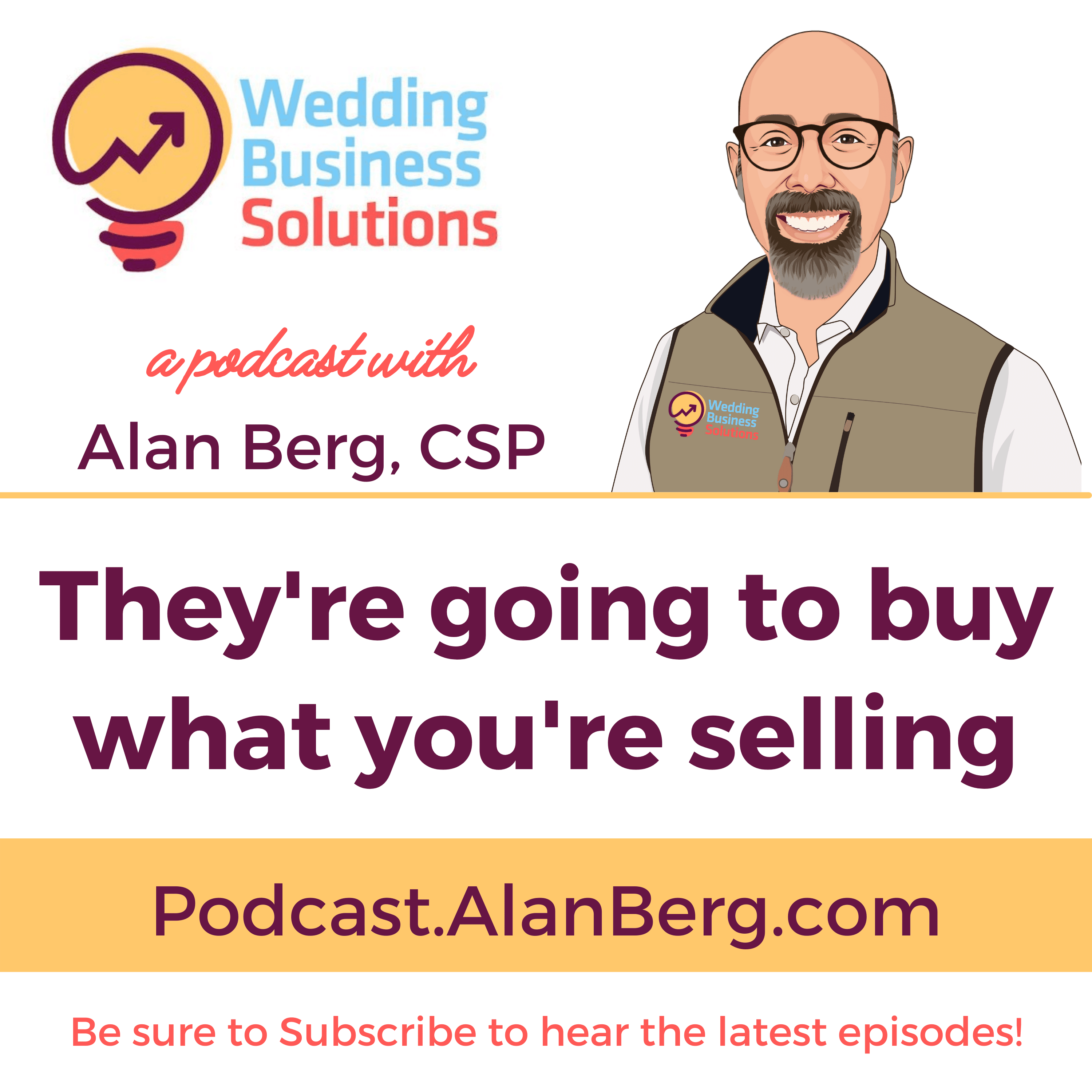
 They’re going to buy what you’re selling
Many companies have cut back on the number of products and services. Menus have gotten more limited. Supply-chain issues have reduced inventories. Can you cut back on the products and services you sell, and still profit more. Your customers seek you out for the results you provide, not the specific products and services.
Listen to this new 8-minute episode and find out how you may be able to profit more, with offering fewer products and services.
Listen to this and all episodes on Apple Podcast, YouTube or your favorite app/site:
- Apple Podcast:
- YouTube: www.WeddingBusinessSolutionsPodcast.tv
- Spotify: https://spoti.fi/3sGsuB8
- Stitcher:
- Google Podcast:
- iHeart Radio: https://ihr.fm/31C9Mic
- Pandora:
Below is a full transcript. If you have any questions about anything in this, or any of my podcasts, or have a suggestion for a topic or guest, please reach out directly to me at [email protected] or contact me via text, use the short form on this page, or call 732.422.6362
Please be sure to subscribe to this podcast and leave a review (thanks, it really does make a difference). If you want to get notifications of new episodes and upcoming workshops and webinars, you can sign up at www.ConnectWithAlanBerg.com
– They’re going to buy what you’re selling. Listen to this new episode. In your business and as a consumer, we run up against options, and there are some places that seem like they have limitless options like Amazon or places like that, and then we run into very limited options, so if you go to a Five Guys restaurant and they serve hamburgers, big ones and small ones, and hot dogs and fries and not much else because that’s what they do. So you, as the business are going to sell to your customers what you’re selling, which means they’re going to buy what you’re selling. And if you limit your menu, which a lot of people did physically, restaurants physically did during the past two years of the pandemic, they limited the number of things because it was easier to source them, easier to prepare them, easier to sell them, limited that menu.
A lot of my customers and a lot of people I’ve met in the industry have done the same thing, cut down on the options and actually becoming more profitable because in a business, having so many things, like retail store calls them the SKUs, you know, the SKUs, the unit numbers there or how many different products do you actually sell, how many different variations do you sell? And keeping all that stuff in inventory costs money. Well, similarly in your business, if you’re having trouble with staffing, I know a lot of you are laughing right now because yes, you’re having trouble with staffing. Limiting what you sell, reducing the number of things you sell, reducing the choices to the customer can actually make it easier for you to get your job done, maybe with the limited staff. A lot of my catering customers push back on me when I say, “Don’t make the customer “or have the customer choose everything on the menu,” and they’re like, “But that’s what they want to do”, and it’s like, “Well, that’s what you’ve been doing, “doesn’t mean that’s what they want to do.” I think it’s always funny that the two people least likely to eat at a wedding are the people that choose the menu. The 150 other people are going to eat and they have no idea what they’re going to eat when they show up, and the two people that choose the menu, they’re the people that are least likely to eat.
So what if you said, “We’re going to give you three appetizers “and they’ll be the most popular ones we have at the time?” “You’re going to have a salad course, “your main protein will be…,” and then let them choose that whether it’s meat or fish or vegetarian or chicken, or some combination of the above, and how it’s prepared, unless they specifically need it prepared a certain way, just tell ’em it’s going to be delicious because you wouldn’t do it any other way, of course it’s going to be delicious. Now imagine if you were doing events on Friday, Saturday, and Sunday, and they all had the same appetizer, and they all used the similar salad, and as far as main dish, some of them are going to be the same, some of them are not, but how much easier is your ordering and you’re preparing if you were doing that? When it comes to the packages and the things that you offer, the more variations there are, the harder it is for you to prepare for each event.
I have some clients that have one package, and this is what you get, and you just tell me if you want some of these things or not. I equate kind of like to Batman with the bat belt. He’s always wearing the bat belt, but he doesn’t use every tool every time, he uses the right tool at the right time, or another analogy I like to use is Mary Poppins shows up with that bag and it seems like whatever she needs is in the bag. She just reaches in and pulls out a canoe because you needed a canoe all of a sudden. So, could you do something like that and cut down on the number of options, cut down on the number of packages? Certainly in packages, because the more packages, the harder it is for someone to decide. I have a lot of my clients where we’ve cut out their bottom package altogether, just don’t offer it. Now, if somebody comes to you and asks for something very limited, and they’re getting married at maybe a small wedding, micro wedding, mini wedding, maybe a during the week or an off-season, yeah, maybe you’ll offer something that seems custom at that point, but it was just a package you took off the menu at that time.
You have a limited number of dates. I think that’s another thing that we’ve learned over the past couple of years. When you go from zero weddings to 150% of the normal amount of weddings, you realize, “You know what, that’s too many, “I don’t want to do that anymore.” When you limit the number of dates, you can also limit the choices, and let them buy because it’s you providing the results. Now, this doesn’t mean they don’t have choices. They can still have choices of colors or flavors or of things like that within the package. If you think about a price-fixed menu, a price-fixed menu means it’s one price, but we get to still choose what’s in there and then there are still upgrades. The price-fixed menu, very often, it’s an upcharge for certain items, like if you wanted a steak or things, it’s an upcharge on that. You could do the same and say, “Hey, here’s the price, you’re still going to have choices, “but those choices are going to be after you’ve bought, “not before.”
Make it easier to buy, it’s easier to sell. And sometimes limiting the choices makes it easier for them to make the decision that they want you to do it because that’s the key. They have to want you to do it. Otherwise, somebody else does something that looks similar to what you do. So, they’re going to buy what you’re selling. You don’t have to sell what other people are selling because you don’t even know if people are buying that, or if they’re only buying it because that’s what the other company was selling, and this becomes an endless merry-go-round where you all start selling things that look very much the same instead of something that looks different. So, the results that you’re going to provide are different. How you get to those results, if you know Simon Sinek, S-I-N-E-K, he has a book called Start With Why, and there’s a very famous YouTube TED Talk that he had called the Golden Circle. Also, Start With Why, The Golden Circle. What they need is already a given. They need to have fill in the blank, the kinda results. How you’re going to get there most people don’t care about, but they do care why, and they should care why they should choose you instead of someone else, and that means also paying more for you than someone else.
I said this on a recent episode that I was at a conference and I had heard in a a book by Jay Acunzo, Break the Wheel, he was quoting someone else who said, “On a scale of one to 10, “where one is terrible and 10 is amazing, “how many of you strive to be a five?” And nobody wants to be a five because five is just average. Well, are you charging average prices? Are you providing average results? Then it’s okay. If you’re providing better than average results, you should be getting paid better than average and you should be able to show your customers that they want the results you’re going to provide because they don’t look like anybody else’s. So people are going to buy what you’re selling. And if you’re selling the results that only you can provide, then they have to hire you, they have to pay your price, and you don’t have to be offering things other people have.
Bill Hermann, a good friend of mine on another episode and Bill is an amazing MC, right, DJ, MC, and he doesn’t have lights and photo booths and all the other things that a lot of other companies have to try to bulk up and get more profit from an event. He doesn’t have any of that. And if you don’t understand the difference for hiring him versus someone else, you’re never going to pay his price because it’s many times more than someone else. But if you do understand the results because you’ve either read about it or experienced it yourself, then you have to hire him because nobody else does what he does, and that’s why he’s able to get that price. And this is the same thing for all of you. If you want to get better than average prices, you have to show that you’re providing better than average results and you have to not sell things that look like what everybody else is doing. They’re going to buy what you’re selling. Sell something better, show them the results are better, and then they’re going to pay your price to get it. Thanks for listening.
I’m Alan Berg. Thanks for listening. If you have any questions about this or if you’d like to suggest other topics for “The Wedding Business Solutions Podcast” please let me know. My email is [email protected]. Look forward to seeing you on the next episode. Thanks.
Listen to this and all episodes on Apple Podcast, YouTube or your favorite app/site:
- Apple Podcast:
- YouTube: www.WeddingBusinessSolutionsPodcast.tv
- Spotify: https://spoti.fi/3sGsuB8
- Stitcher:
- Google Podcast:
- iHeart Radio: https://ihr.fm/31C9Mic
- Pandora:
©2022 Wedding Business Solutions LLC & AlanBerg.com