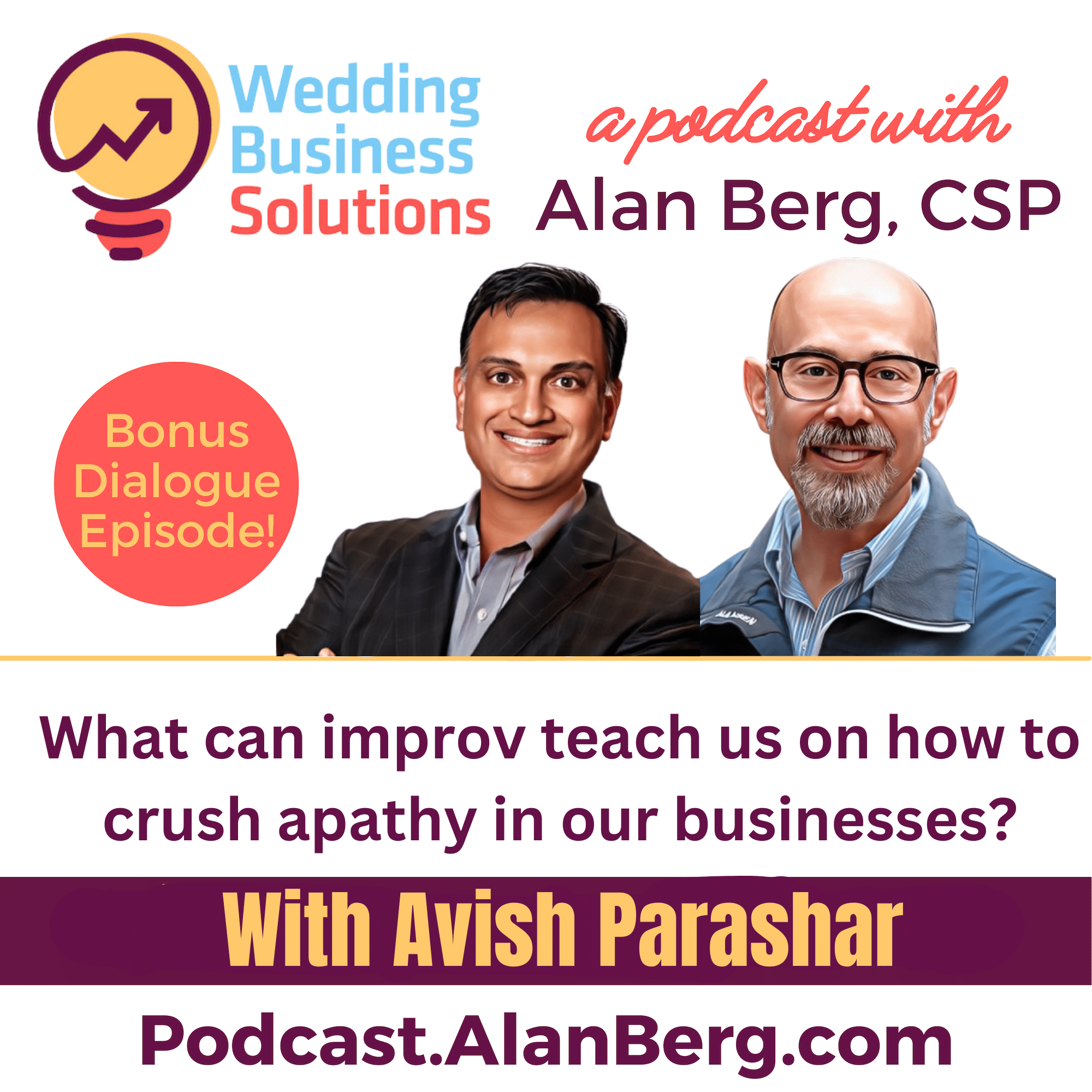
 Avish Parashar – What can improv teach us on how to crush apathy in our businesses?
Are you stuck in a cycle of “yes, but” thinking that keeps your business from growing? What if the real challenge to change isn’t resistance, but apathy? How can embracing improv’s “yes, and” mindset empower your team, crush burnout, and spark creativity? In this episode, I explore how recognizing and shifting your mindset can transform engagement in your business, with insights from improv and practical steps for moving from passive acceptance to genuine excitement—even in the face of overwhelm or uncertainty.
Listen to this new episode for practical ideas to spot hidden apathy, empower your people, and use “yes, and” to fuel meaningful change and creativity in your business.
About Avish:
Avish Parashar, originally from Poughkeepsie, New York and now based in Philadelphia, started in theater but quickly pivoted to improv in college, launching a career that led him to found Polywumpus Improv Comedy. Through that experience, he discovered that the principles of improv translate directly to navigating real-world change. Today, he’s a keynote speaker and author who helps leaders and teams embrace uncertainty, boost creativity, and shift from apathy to engagement using the “Yes, And” mindset. Blending humor, audience interaction, and practical tools, Avish empowers organizations to turn change into opportunity, with a core message that the real barrier isn’t resistance—it’s apathy—and that growth comes from saying “Yes, And” to what’s next.
Website: https://www.AvishParashar.com
Book URL: https://avishparashar.com/say-yes-and-to-change/
LinkedIn: https://www.linkedin.com/in/avishparashar/
If you have any questions about anything in this, or any of my podcasts, or have a suggestion for a topic or guest, please reach out directly to me at [email protected] or visit my website Podcast.AlanBerg.com
Please be sure to subscribe to this podcast and leave a review (thanks, it really does make a difference). If you want to get notifications of new episodes and upcoming workshops and webinars, you can sign up at www.ConnectWithAlanBerg.com
View the full transcript on Alan’s site: https://alanberg.com/blog/
What can improv teach us on how to crush apathy in our businesses? Listen to this episode and find out. Hey, it’s Alan Berg. Welcome back to another episode of the Wedding Business Solutions podcast. I am so happy to have my friend Avish Parashar on to talk about improv, apathy and your new book, yes and for Change. Havish.
Well, thank you, Alan. I’m super excited to be chatting with you about all those things and more.
Oh, it’s great because I loved your book and the whole idea of yes and for those of you that don’t know yes and is the core of improv and your background is many, many, many, many years.
Over 30 now.
Over 30. But this is not your first book on this, right? You had your first book was what?
So my first book was called Improvised to Success. Then I had another book called Just say Yes and okay, and now this one is more geared towards change. Say yes and to change.
Right. So say yes and to change. And you talk in the book about a few different things. Three different things in the book there, but one of them is about how apathy quietly undermines our businesses. What do you mean by that?
Well, when you know for the longest time as a speaker talking about change. I’ve talked about change for a long time. I thought my goal was to take people who are resisting change and get them to accept it. And then I realized that while there is that element is there, the real challenge to change is apathy. Because we look at the resistors and we want to sort of crush them. I guess you want them to shut up, you want them to get on board. It’s the squeaky wheel syndrome. But that’s usually just a handful of people or one person.
But in the middle, like that bell curve, your standard distribution you’ve got. Most people are just so these days, overwhelmed, overworked, burnt out, constantly changing. They’re just apathetic about it. And when they hear changes coming, they’re like, alright, here’s another one. And so it’s like, you know what? We don’t need to spend all of our time on that one loud person. If we can tap into just some of those apathetic people and get them not just accepting, but excited. It’s gonna not only improve results, but really transform culture, transform life, transform how we work every day.
So how do you, how do you recognize it? First, recognizing apathy?
Well, that’s the other problem is resistance is easy to recognize because people are vocal. So with apathy, you gotta dig a little deeper and you Know, in my parlance, talking about yes and versus yes. But one of the biggest signs of apathy is just yes. So if we think if our employees or our clients or whoever’s saying yes, then everything is great. We’re doing great. They said yes. They agreed.
Right.
What I found, though, is I’ve had jobs I liked and jobs I didn’t like, and of the jobs I didn’t like, I always said yes because I want to keep my job, and I’m proud of my work. The jobs I liked. If someone said, avish, can you do this? Can you? I was a computer programmer in my previous life. Like, oh, here’s. Here are the specs for this program. I would say, yeah, oh, and what if I also did this? Or, oh, and here’s another idea. I was more engaged because I was adding on to it, right? So it’s paying attention. Are they just nodding their heads? Are they just doing the bare minimum? Are they just saying yes and not adding anything new? Are they not coming to you with new ideas? Now, that’s not necessarily a sign of apathy.
It could just be a sign that, you know, they’re there for a paycheck, which not the. You know, that’s not the worst thing in the world.
Right.
But if you really want them to be excited, realize that the lack of response is the. Is the sign.
Could that be coming from the top, that people. People are not open to hearing what their people want to say?
Oh, yeah. Which is why the book is about yes. And it’s funny. I have my own podcast, and I interview leaders. And the common theme I find when we talk about leadership is leadership is actually quite simple. Shut up, ask questions, listen to the answers, and do something with the information. So, and this is one of the best ways to. To remove apathy is if.
If I want to get my employees involved and engaged and excited, it’s not about me telling them, here’s why this is gonna be great for you. Here’s what you should do. It’s me asking them a question, hey, what are you feeling? What’s going through your mind? What would you like to do? And then when they give a response, not immediately saying, yeah, but like, oh, yeah, but you don’t have to worry about that. Everything’s gonna be fine. Or, you don’t have to worry about, yeah, but you don’t have to worry about AI. We’re not gonna replace you, or, yeah, but everything’s gonna work out. Or, yeah, but here’s why you’re being silly. It’s Just listen and accept.
And if I could, you could also extend this a bit into, you know, small business and sales. It’s. I mean, it’s a sales principle, right? It’s. You don’t just launch into the pitch, right? If you’re, you know, trying to get someone to hire you for your, you know, photography service or DJ service, you don’t just launch into how great you are. You ask them questions, right? What’s your theme? What’s important to you? What are you looking for? And just shut up and listen.
Well, that’s why my most popular book is called Shut up and Sell More. There you go. And the subtitle is Ask Good Questions. Really Listen to the answers. That. That’s what that is.
So I’d forgotten that. I think I knew, but I literally said the exact same. So it’s because really, all. All persuasion, which would be sales, will be leadership, relationships, it’s all the same thing. And it’s. Right, listen, do something with the answers.
It’s also empowering, right? You want to empower people. And I, Because I’ve been in that position, and I always say, you don’t want to give someone responsibility without authority, right? Because if you give them responsibility and now they’re going to be held accountable, but they had no authority to. To do anything about it. That’s not fair. That’s not fair. And I remember when I was a sales director and one of my reps came to me and said, you know, I’m having a. Having a problem with a customer. I said, no, you’re not.
She said, I’m not. I said, no. I said, would you like to discuss your customer with me? Okay. And she told me what’s going on. I said, and what do you think we should do? She said, what? You want to know what I think? I said, yeah, it’s your customer. I want to know what you think. Right. Really? Yeah.
Yeah, I really do. And then she told me. I said, okay. Do you think that’ll make them happy? I think so. No, really? Do you think it’ll make them happy? If that. If that’ll make them happy, then go do it. I want. I wanted them to be part of the solution instead of.
Well, my boss said, no, no, I did this for you. I did this for you. Right. Plus, I couldn’t have everybody coming to me every time. Right? That’s what empowering your people is. I always said when I was VP of sales, if I did my job really well and hired really good people and trained them really well, and gave them that responsibility with authority. It should look like I’m doing nothing.
It’s so funny. A slightly different environment. I had a similar conversation. An association I was involved in, not the speaker association we’re both in, but another one. You know, one year I was president and then, you know, I was still involved. So afterwards I was talking with some people and I’m like, you know what? Like, for me, like, being present was like the easiest job in the world because you have all these like, VPs of meetings and marketing, and literally every other person, that room jumped on me like, oh, no, I did so much work as president. I’m like, all right, well, you were doing something wrong. You were micromanaging and trying to do everything yourself.
If you get good people, give them good, like, guidelines, instructions, parameters, and then just help them, but not do it for them.
Like, right. It’s pretty.
It can be pretty easy.
Yeah. I used to say that I would dealt with my reps the way I dealt with my children. I said, but don’t get offended because I want to empower my children. I want them to be able to fail and I want them to learn from that and all those same things. Managing and leading are two different things. We shouldn’t be managing our people, we should be leading our people. They manage their tasks, but we should be leading the people because that’s different. Because managing them is, like you said, ends up being micromanaging and me telling you what to do.
I don’t know if you ever read the book why Work Sucks.
I don’t think I have.
But it was people in the Best Buy corporate offices who were tasked with finding out why there was so much voluntary turnover. Not involuntary voluntary turnover. And they came up with this thing called the ROW Results Only work environment, which is, we don’t own your time, right? We hired you to give us results and these are the results we need. If you happen to get that done in less time, great. You’re still getting paid, right? And if you want to do it at night, if you want to do it on the weekend, whatever, it doesn’t matter. You have to get it done by a certain time, go ahead and do it. And people are happier because they talked about this one guy who used to leave every Friday at 4 o’. Clock.
Everybody else was there till 5, but he left at 4 because he went fishing and he liked to go fishing and he was happy when he got to go fishing and he did his job and got it done in less time so he could go fishing. Right? So everybody’s happy.
Yeah, it’s, it’s funny, the management leadership thing too. I had this like tagline slash title. I never quite put it together. Was basically like shifting from yes but management to yes and leadership. Because management is very much. Or the way people perceive management is very much about saying yes, but to people. Oh, yeah, but you can’t do that or yeah, but here’s the policy or leadership is about expanding the minds and kind of helping people step into their own. I love what you’re saying about, you know, give them autonomy, give them some authority and let them.
And one thing I find very helpful with that, beyond shifting, just paying attention to your language from yes but to yes and is this idea of small steps. You know, if you’re uncertain, like a lot of leaders who are new to this, don’t they feel like scared, Right. Giving up that control?
Right.
But you can do it one step at a time. You don’t have to give up the whole project all at once. Right. It could be like, all right, let your people give them one little thing to do, you know, see how they do. And I love what you said. It’s like you want them to fail. You want to give them that. So you want to get.
But you want to make sure the consequence of failure is not terrible.
Right? It’s not that I want them to fail, but I’m okay if they fail because fail meaning they took steps. Right. And that’s just life with us is failure means I tried something, it didn’t get the result that I wanted to, you know. But so many times in life, failure leads to a different result that turns out to be a good result. And we can go down the list of products that were not intended to be, you know, what they were like post it notes or silly putty or WD40, you know, water displacement formula number 40. Okay, 39 didn’t work. Okay, here, here we go over here. So let’s, let’s go to this.
You talk about yes, but being like a, like the brake in your car and yes, and being the accelerator in the car. So expand on that for us.
So yes, but is very much about staying with what you know. It’s staying in your comfort zone. It’s limiting. Usually the yes but response is an emotional fear type based response. It could be because you don’t want to get into uncertainty like we said, like, yes, but by definition it’s like, yeah, I, this is a new idea. But I’m going to keep doing what I’ve been doing because I’m comfortable with it. Right, right. Yes.
And it’s like, yeah, this is a new end. I’m gonna give it a try. So if we want to make progress and keep moving forward, we have to say yes. And. And I think too many people are kind of pushing that. Yes, but break. But just sort of hoping that things will get better. Like, yeah, you know, I want to grow my.
My. My wedding planning business. Oh, what are you doing differently? Well, I’m just, you know, I’m going to networking events. Yeah, but you’ve been doing that for 10 years. What are you trying? What’s a new thing you’re trying? Oh, I don’t know. I’m thinking about doing that. Well, why aren’t you doing that? I don’t know. But what if people don’t like me? You know what I mean? Like, we just.
Yes. But ourselves to stay in our comfort zone.
Right. And you talked about that in the book, about your website. You knew you needed a new website. Sorry, I’m bringing up the pain here. I’m sure there’s other people that have that same pain. So tell the story now.
It was just one of those things. I had a website, you know, vparsha.com. you have my name, and this is, you know, again, I have a background. It. So I made my website HTML, and I don’t know if people even know what HTML is anymore these days. You know, I hand coded it in like HTML myself, and it was fine. And then it needed an update, let’s just say. And it was outdated.
The pictures were old, the layout was old, Everything was old. It was still.
Yeah.
And I knew I needed to move to WordPress, but it was such a project. I was like, but it’s gonna. What if the site is down for a long time? Yeah, but what if it takes longer? I thought it would. Yeah. But what if I never had to pay someone to fix it? So I sort of. I went around, right. I thought I was innovating. What I did is I created a new website called Ding Happens, which was the title of my keynote for a long time.
The Ding is an improv game where you ring a bell, you change a story. It’s a whole metaphor. But Avish Parish, it was still up there. Which means if someone’s considering hiring me, they’re not going to do a Google search on Ding Happens, they’re going to do a Google search on Avish Parisher.
Right.
A, that’s my name. B, that site’s been around since 2000. Whatever. So people were still going to that site. And. And finally it was like, all right, now just. Just do it. And again, we’re starting with.
It started with little steps, right? I didn’t say. I didn’t take the website down. I started with, like, a new theme, and I actually started by building a separate site for something, a different project, just to learn the thing, because it lowered the stress, it lowered the stakes. It made it more playful. And so as I got through that, I’m like, oh, I figured it all out. Oh, now it’s not gonna take me very long. And so then I moved the news. It was like.
But just the yeah button is just easier not to change than it is to change.
Yeah. My current site, which I changed a while back, I uploaded a plugin for WordPress without asking somebody if I should have done so and screwed up the whole site. And it’s like, well, I guess I’m making a new site now.
Yeah. Well, it is amazing, the necessity of being the mother of.
And part of this reminds me of conversations I’ve had with people like. And myself. Like, what’s the worst that could happen? Like, if you try this, what’s the worst that could happen? I think about my son. I probably told this story. He was in a really good job, but hit a ceiling. And to get to that next level, he was looking to go to this startup company where he would get that title. But unknown, right? Startup company versus, you know, pretty solid where he was. And I said, okay, so what’s the worst that happens? Right? Let’s say the company goes out of business.
I said, are you on the street? No. You got a roof over your head? Yep. Food on the table? Yep. You got money in the bank? Yep. I said, okay, what’s the worst that could happen? Not much. Not much. Bad, right? So he takes the job, and he’s only there for maybe three, four months or whatever, and it’s not what he wanted. And they’re not listening to him.
He was the treasurer, and he landed where he is now. And where he is now, he wanted to be this. He. He wanted to be the cfo, but he had no experience with that title. So they hired him as the treasurer, and they were looking for a CFO for six more months, and he was doing the job. And then finally they said, well, I guess you’re doing the job and you’re doing it well, so it’s you.
Right?
But if he hadn’t taken that first leap, right? That. That, you know, what’s the worst that can happen? Leap and that’s what I do to myself. It’s like, okay, if the worst that happens is it cost me some money and time, I can get more money. I can’t get time back, but I can get more money. That’s not so bad. Right. But like you said, nothing’s going to change if I don’t try. Nothing’s going to change if I don’t say, all right, I’m going to do this and it might fail.
Right. And it might succeed. I’m not going to do this because. But it could fail.
Well, I’ll tell you what I think the real issue is, and I think that might be based on what I know of your audience. You got a lot of creative types, a lot of people who come from a creative artistic background. I think the real issue, and this is true for me, and it’s for a lot of people I’ve come across of the worst that can happen. It’s not tangible, it’s psychological. Is what’s stopping us. Yeah. Like, yeah, I’ve got the money saved up. I can land on my feet, I can get a new client.
It’s the sense of, I will feel like a failure if this doesn’t work and it will validate all of these deep seated insecurities I have about myself. Or what if my. What if I have to close up my business now? And then I have to admit to my parents who are now like 80 and I’m 50, that, oh, you know what? I couldn’t actually make it as an entrepreneur. I should have gone to med school, been a doctor. Like, all these things that matter even less than the stuff you were talking about, I think is what’s holding people back. And that’s why I think, I think in a chapter that wasn’t in the book originally in the yes and Framework, was the. The notice and nurture emotion. And I think it’s this element that I think is often overlooked.
We think we’re logical creatures. Right. And I think to your point, like the, well, I got money. That’s all logical. But the reason people aren’t making the decisions, because it’s deep emotion. And until you actually, like, learn how to sense it, process it and deal with it, like you’re just going to keep making. Yes. But decisions that hold you back.
Yeah. Because every decision we make involves emotion. Like, you know, what to. What to wear, what to eat. There were studies that if what people who had the part of their brain damaged that controls emotion can’t make the decision on what to wear, what to Eat. They can’t make basic decisions. And you think, well, there’s no. What’s the emotion in like what sandwich you’re going to eat right now there’s emotion in that.
It’s the driver, right?
It’s all the driver. So what about burnout, right? Like, you know that that’s gotta be. It’s a factor. I know, I’ve seen it myself. I’ve seen it with people in the industry. I’ve certainly seen it in the speaker community as well. Right. How does that affect here? And again, how did that fit in? Because I know you talked about that in the book.
How does that fit into the. Yes. And framework here?
So burnout is, I mean, I’m not the world’s leading burnout expert, so. Yeah, but in my opinion, and I read this was in my quote, but someone says you don’t get burnt out from doing too much, you get burnt out from doing too much of the things you don’t want to do.
Right.
And this to me comes very much to two things. One is taking the time to sort of figure out what’s at your core, like what is it you really want to do, what are your strengths? And I think so many of us, because we’re so overwhelmed, we never stop to even ask those questions like, what would make me happy? And these don’t need to be life altering questions where you’re like, well, now I gotta go quit my job and open a bakery. Because I. But just on a day to day basis, like, can you bring more of who you are? The more you’re expressing who you are, the more you’re gonna be doing activities that feed you instead of deplete you. Yeah. And the second thing is, I make this joke from stage often. Is the reason I’m still performing improv comedy 30 years after college instead of getting a real job, is that for me one of the best ways to feel engaged? And again, a flow state is creative expression. And for me that’s improv comedy.
But for someone, it could be painting, it could be drawing, it could be writing computer code, it could be photography, it could be, you know, making the best mix on your dj, like whatever it is. Yeah, but it could also just be journaling. Like there’s an exercise in the book I’d invent called Morning Pages by Julia Cameron. And it’s just, you just take a journal and write three, fill three blank pages of the writing. But the key is you don’t let the pen stop so you’re not thinking about what to write. You’re just flowing, and this gets you in touch with your creativity. So when you are regularly expressing your creativity in some ways and tapping deeper into kind of who you are and finding ways of doing that, because we all know people whose schedules are packed morning to night and they don’t get burnt out. So it’s not just how much you’re doing, it’s what are you doing, Right?
Yeah. I was a guest on a podcast and they asked me, why do you do what you do? You know, 30 years in? And it just came to me. I said, because it does two things. It brings you value and it brings me joy. And if it does both of those, I will cash the check, right? If it does both of those. But it has to do both of those, because if you’re not getting value, that’s not fair. And if I’m not getting joy, that’s not fair. And my.
My payback is not the check. My payback is the value, right? Because somebody else has gotten value. And I just saw two posts actually today from two different people, two different platforms, showing feedback from one of their customers about how they affected this customer, right? One of them was a speaker friend of ours, Mike Dhommish, and he spoke at a Speaks a lot of schools. And it was this student that wrote to him and very lovely letter and said, you know, you’ve changed my life, right? And that’s. You can’t put money on that. You can’t put money on that. I remember the first time somebody wrote that to me and I was very uncomfortable because I don’t believe I can change anybody’s life. I believe I can be a catalyst, get you unstuck, move you in a direction.
But you changed your life, like, because you still took the action. Because they could have said yes, but
yeah, yeah, there’s that balance. Like, you’re not taking responsibility, but you were the catalyst, like you said, right? It’s funny you mentioned that, because with this, this book launch story, there’s a whole process around it for this new book. And before people leave review, they enter a little form. It says, you know, why do you want to support Avish? And my launch coach I’m working with, like, you know, when you’re feeling down, when this process is feeling stressful, go read those. And there’s one on there. And it was one person I had messaged on LinkedIn, right? She saw me speak about nine years ago. Had no contact since then. We just were connected on LinkedIn but had no other contact.
And I saw her Name come up in the. In the feed. I’m like, oh, I remember. Let me. So I just dropped her line on LinkedIn, like, hey, are you interested in being the advanced reader for this book? You saw me speak a while ago. No contact for nine years. She says, I would love to. I still have your book.
Your talk changed my life. I use yes. And every day, like, you get. And you don’t know. And so those. And you think about it especially, I mean, literally, the stock answer to the happiest day of my life is the wedding, right? And just there are probably people who are. Who look back on the wedding, their wedding, and say, oh, my God. Like, the flower arrangements, just.
I still remember how beautiful they were. Oh, my God. Or, man, I remember having so much fun, you know, And June got up when the DJ played this song on, like, right? And we just forget that. We lose touch with that. I think that’s such a great reminder. Making is like, we start going through the motions, I think, in our businesses.
Yeah. I had a client of mine in Texas many years ago. She had owned her venue for 25 years at that point. And she said, when the day comes that a bride walks down my aisle and I don’t get a little teary, she said, then I know I’m done. And the way I express it to people is every business, yours, mine, everybody listening. Every time they say yes to us, they’ve said no to everybody else. That’s a privilege. That is a privilege because I also say I can’t say that my results are better because I’ll never know, because you chose me and not anybody else.
So we won’t have any comparison. But you feel my results will be better, or at least the results that you want, and that’s why you chose me. And that’s a privilege. Every time I’m on stage, every time I do a sales training, every time I’m a guest on a podcast. Right? You said yes to me. You didn’t say, but you said yes to me. It’s a privilege, Right? Because right now you’re giving me time that no one else can have. And if we look at it and say, again, am I getting joy? Yeah, I love talking to you.
Are you getting value? I hope so. Are the people listening getting value? I hope so. But we don’t know, right? We’re recording this ahead of time. We can’t see an audience like. Like we normally can. It’s the feedback. Someone comes to me at an event and goes, oh, I love your podcast. I’m like, oh, you know, I don’t know who’s listening.
We don’t get a list. Yeah, we don’t know who’s listening there. So what’s some simple things people can do to change their mindset? If they’re. If they’re in the yes, but mindset. And sometimes circumstances put us there. Right. Life can. Can push you into the yes, but because of things that are going on, what can can people do to first to recognize it and then maybe to take a step towards shifting? Yes, but to yes, that.
So for the recognizing it, I think. I think what you’re just talking about is a great way is ask yourself, when’s the last time I felt joy or happiness? And if all your answers are everything outside of the work you’re doing, you know, ask when’s the last time in work I felt, you know, engaged, joyful, happy? And if that is like a long time ago, then Right, That. That’s a pretty good sign. And then pay attention to your language. Are you using the yes, but. And again, it doesn’t have to be literal. You know, you could be saying, yeah, or you could even be saying, like, I do some improv exercises, and sometimes you’ll get a volunteer, and they will literally use the two words yes and but. They’re actually saying, yes, but.
So pay attention to the intention.
Right.
And even if you’re not in a real deep state, what I would say. Well, I’m going to say. I’m going to give you one answer. My favorite answer to this, which is not necessarily a small thing, but I think it ties into a lot of what we’ve talked about. And one of my favorite ideas from the book is set an impossible goal. Like, people want to set realistic goals, smart goals, that I can achieve this. I know I can do it. And.
And that’s great. They’re ubiquitous for a reason, because they work. What I found really helped my career and what I think helps engagement is set an impossible goal. Which is set a goal where your first thought when you said it is, yeah, but I have no idea how I’m gonna do that now. If that goal matters to you, it can’t just be a goal you think you should do. Like, if you’re like, well, I gotta lose 50 pounds and I don’t know how I’m gonna do it. But deep down you’re like, I don’t care. Not gonna work.
Right?
And then go about using your creativity, playing, experimenting, and figuring out how to do it. Because when you set an impossible goal, if it’s something when you’re like, yeah, but I don’t know how to do it, but if I did, it’d be amazing. Right now your creativity starts to play. Now you get motivated because you’re, like, going for something bigger. Now you have to learn and grow, which I think when we learn and grow, we get more engaged. So, for me, real quick, I play improv games on stage, and there is a subset of improv games, improv guessing games, where I have no idea how to play these in a keynote format. And so that’s my current impossible goal. Now, am I ever going to truly figure out? Maybe not.
But even if I don’t, the process will be engaging, and the cool stuff I’ll figure out, I’ll probably come up with new ideas that I never would have come with before. So I don’t know if that answers your question, but I just kind of really want to talk about that.
Yeah, no, that’s. No, it’s great. And, you know, a lot of what stuff comes down to is set that big goal, but then also understand that there’s a whole bunch of steps to get there. It’s not from here to there in one step.
Yeah.
And can it. Can I make progress? Right. That’s the thing, is, can I make progress?
Pardon me,
Adam Grant, you know, from your area down in Philly, Hidden Potential is one of his latest books, Hidden Potential. And again, he was talking about being okay with being uncomfortable. Right. And he talks about. The first thing in the book is talking about people who learn multiple languages as adults when they weren’t good at languages as children, which completely describes me.
Yeah.
And what I realized is my favorite days. Today was actually one of my favorite days on Duolingo French, because it was kicking my butt. And. And the reason it was both frustrating and. And exhilarating is because I was learning something that I didn’t know. The fact that I was not getting it. Right. Because it’s nice to get a perfect lesson.
Oh, perfect lesson. Good for you. And there you go. I didn’t learn anything. If I get a perfect lesson means I knew it. Right. But the fact that I didn’t. And I realized he was, like, writing this book about me when I’m reading this part, going, yeah, that’s my favorite day.
And today was day 19 19, that I’ve done at least one French lesson. And. And I always talk about that. Not. Not to brag about it, but to say, no matter what you wanted to do, if you did it 19, 19 days in a row. Right.
Yeah.
Wouldn’t you be better? I would hope.
Yeah. And that’s, you know, again, going back to the book and the, the framework. The S is because. Yes. And is an acronym. The S is start small and take small steps. Like, okay, again, I say set the impossible goal. But what’s the most new once? What’s the most doable next step I can take? What’s that one next step? And, you know, almost 1200 days of just like a little like, yeah, you’re going to.
And here’s the thing is, even if you don’t get to where you wanted to go originally, you’ll get somewhere which is different than where you are now.
I forget who wrote about that, but it was like, take time to look over your shoulder and look how far you’ve come.
Yeah, right.
Because you look ahead and say, look, I have so far to go. But when you look and see how far you’ve actually come already, like, wow. Okay, wait a minute. You know, like you said, you’re looking at the feedback, right? You want, you want the feedback to see that it’s, yeah, I’ve accomplished a lot. Give yourself credit for that. But also understood that took time, that took work, that took effort, that took money, that took, you know, whatever, but it took intention to do that. And I think that’s, you know, if you intentionally want to move forward, then it’s yes. And.
And if we don’t get exactly where we want to be, did we move forward? Right. And maybe we’ll zig and maybe we’ll zag, but we’re not worried.
What did you learn from it for your next step? So it’s like I call it act, analyze, adjust, take an action, but then see what happens. Make an adjustment, take the next step and keep, keep repeating.
Just keep taking steps. That that’s what it is. Well, Abish, thank you so much for talking about.
So the book again is say yes and to Change.
Say yes and to Change. Available on Amazon.
It’s on Amazon. If you want to find it anywhere, go to say yes and to change.com and that’ll. It’s going to starting out just coming out on Amazon and we’re going to expand distribution a little later on. Hopefully get an audiobook too later this year.
And I will put in the show notes. We’ll have the link over there for everything. And if they want to find out
more about you, it is avishparisher.com and
it’s the website that you redid.
It is. It’s the new version. It’s much better than the older.
Well, thanks so much for joining me. Definitely get the book. I really enjoyed it. I’m looking to hearing you read it to me on the audio book because that, that, that’ll come next. But thanks everybody for listening. Avish, thank you for joining me. And see you on the next episode.
Thank you. Alan.
I’m Alan Berg. Thanks for listening. If you have any questions about this or if you’d like to suggest other topics for “The Wedding Business Solutions Podcast” please let me know. My email is [email protected] or you can text, use the short form on this page, or call +1.732.422.6362, international 001 732 422 6362. I look forward to seeing you on the next episode. Thanks.
Listen to this and all episodes on Apple Podcast, YouTube or your favorite app/site:
- Apple Podcast: http://bit.ly/weddingbusinesssolutions
- YouTube: www.WeddingBusinessSolutionsPodcast.tv
- Spotify: https://spoti.fi/3sGsuB8
- Stitcher: http://bit.ly/wbsstitcher
- Google Podcast: http://bit.ly/wbsgoogle
- iHeart Radio: https://ihr.fm/31C9Mic
- Pandora: http://bit.ly/wbspandora
©2026 Wedding Business Solutions LLC & AlanBerg.com