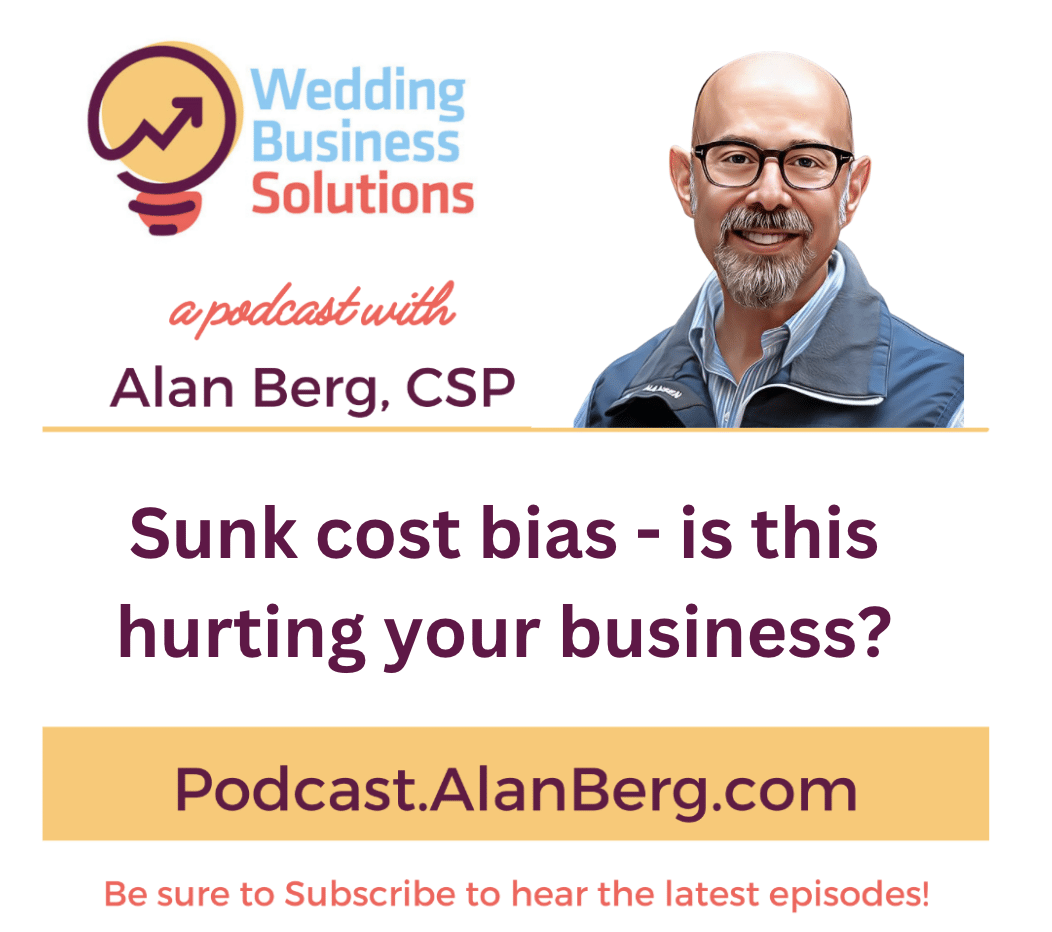
 Sunk cost bias – is this hurting your business?
Is sunk cost bias holding you back? Are you keeping an underperforming product, service, or employee just because you’ve already invested time or money? In this episode I challenge you to think about whether old investments are preventing you from making smarter decisions for your business—especially when starting fresh could actually move you forward.
Listen to this new 7-minute episode for eye-opening examples and practical ways to recognize (and move past) the sunk cost bias in your business decisions.
If you have any questions about anything in this, or any of my podcasts, or have a suggestion for a topic or guest, please reach out directly to me at [email protected] or visit my website Podcast.AlanBerg.com
Please be sure to subscribe to this podcast and leave a review (thanks, it really does make a difference). If you want to get notifications of new episodes and upcoming workshops and webinars, you can sign up at www.ConnectWithAlanBerg.com
View the full transcript on Alan’s site: https://alanberg.com/blog/
Some cost bias. Is this hurting your business? Now listen to this episode. See where I’m going. Hey, it’s Alan Berg. Welcome back to another episode of the Wedding Business Solutions podcast. I’m listening to a book now on decision making, and I love listening to books about that because it’s so many applications in personal life and business life and in my sales training and in my books and all. And this one, I’ll talk more about this particular book on another episode. But this chapter I was listening to the other day was talking about the sunk cost bias.
And what that is is that when we’ve spent money on something, we often don’t want to let it go because of the money that we spent. And there are many things throughout history that have talked about this and how it ends up hurting businesses. If you remember the first supersonic planes, you know the commercial passenger planes, the Concorde, Right. Those were from American and British Airlines. And the problem was is that they just cost too much money to run. They weren’t profitable. And the airlines just kept pumping money into them because they didn’t want to let it go because of this sunk cost. It’s like it was just too expensive, you know, to let go, even though they kept throwing more money into it, which made it more expensive.
So what do you, what, what is this in your business? I’ve seen this happen where someone has an employee that that is not performing well. I tend to deal with salespeople, but this could happen in any other position as well. And because you’ve invested in this person and because you know that it’s going to cost you to change this person, you just keep going with it, going with it, even though it’s not working for you. And in the long run, it ends up costing you more because you don’t get that other person in. Right. This could be a product or a service in your business. I had this happen to me last year. We came up with an idea that would be more efficient way to buy my books at a live show like Wedding mba.
You can come up and scan a QR code and buy it right on your phone, come up and show us the receipt. We hand you the books. And I think three people used it and one person’s credit card failed. And we spent thousands of dollars on development of this and the new banners and things like that. And, you know, do I keep using it? No, no. It was one of those ideas that look good on paper and it sounded good and we felt good and we ran it by other people and it Everybody thought it was a good idea. Exc the customers. So.
So we stopped doing that. Now, the sunk cost bias would have been use it at the next show. Use it at the next show. Now, if I thought there was a way to tweak it that I could have used it at the next show, I would have done that. But what we realized is that when people come to my booth, it’s usually because they want to see me and they usually want to talk to me because I am the author, I am the speaker, I am the sales trainer, I am the consultant. I am the real Alan. You know, there’s ask Alan in anything, but I am the real Alan and people want to talk to me. So that’s what we realize is the failure in this was not in the product.
The product was fine. The product was developed fine. The thing was, the demand wasn’t there. You know, we didn’t really ask the customers if this would make it easier for them. We just assumed that it would. So sunk cost biased would mean I would still have that banner at another trade show and another trade show and just try to get people to use it and tweak it. But we moved on. Now, what else could we move on from? What else could you move on from? Is your website outdated and, you know, spent so much money on it X number of years ago and you just don’t want to let it go wrong? It’s costing you more money today than a new one will cost you.
Right. If you converted a few more people because you had a new website, wouldn’t that pay for that site many times over? Right, Absolutely. When I print marketing pieces, I tend to print a smaller quantity than I think I might need in the long run. And a couple of reasons for that. One is, if it doesn’t work, Smaller quantity. There we go. Second reason is don’t you always come up with a better idea? Like as soon as you print something, you look at it and go, that’s good, but next time I will do that. So rather than just recycling, and I’ve done that, right, Rather than just recycling, you know, hundreds or thousands of pieces of something because you came up with a better idea, or worse, you keep handing them out, keep mailing them, keep using them at trade shows.
Right. When you know you have a better idea, that’s the sunk cost bias again. So I tend to do a smaller amount I’d rather reprint, even though it cost me more in the long run. Because if it’s a good idea and I reprint again, well, then I’ll print a larger quantity because I know it worked. It is a good idea. And if it’s not, I don’t feel so bad. Recycling, whatever. Or maybe I don’t have any left.
And right now is a, is a perfect example. I’m about to do a direct mailing and I was thinking, do I print 250 pieces, 500 pieces, 1,000 pieces? And I know that I have, you know, probably four figures of list that I could send this particular piece to, and Instead I printed 250 pieces. And the reason for that is if it works, I’ll print them again. I could just go online and say reprint. And if it doesn’t work, then no harm, no foul. I don’t have a lot of them sitting around them and I’m not going to be tempted to send them out even though they didn’t work. Well, that’s an example of sunk cost bias. And I’m getting past that because I’m not going to have that big pile of things here that nobody wants that nobody’s going to be using.
So what about your business? Is it a product? Is it something that’s sitting on your shelf in the warehouse and you just can’t seem to get rid of it? But couldn’t you use that room? Couldn’t you use that room in the warehouse? You probably could. And on your services list, right. You’ve invested money into doing different things. Have they paid for themselves already? Right. And yes, it’s nice that you don’t have development costs for something new, but if that something new can bring you in revenue you’re not getting now, then keeping doing the old thing, if that’s preventing you from doing the new thing, that’s sunk cost bias again. So what have you spent money on in the past that you’re just reluctant to let go of, even though there’s a little voice inside that tells you you really should be moving on. That’s the sunk cost bias. And if you can identify that, you can get past it.
And if you can’t, you’re probably not aware of it or don’t want to be aware of it because you know it’s going to cost you some money today. And as I always say, invest in your business today the way you want your customers to invest in your business today and in the future. Hope that’s something to think about. Thanks.
I’m Alan Berg. Thanks for listening. If you have any questions about this or if you’d like to suggest other topics for “The Wedding Business Solutions Podcast” please let me know. My email is [email protected] or you can text, use the short form on this page, or call +1.732.422.6362, international 001 732 422 6362. I look forward to seeing you on the next episode. Thanks.
Listen to this and all episodes on Apple Podcast, YouTube or your favorite app/site:
- Apple Podcast: http://bit.ly/weddingbusinesssolutions
- YouTube: www.WeddingBusinessSolutionsPodcast.tv
- Spotify: https://spoti.fi/3sGsuB8
- Stitcher: http://bit.ly/wbsstitcher
- Google Podcast: http://bit.ly/wbsgoogle
- iHeart Radio: https://ihr.fm/31C9Mic
- Pandora: http://bit.ly/wbspandora
©2026 Wedding Business Solutions LLC & AlanBerg.com