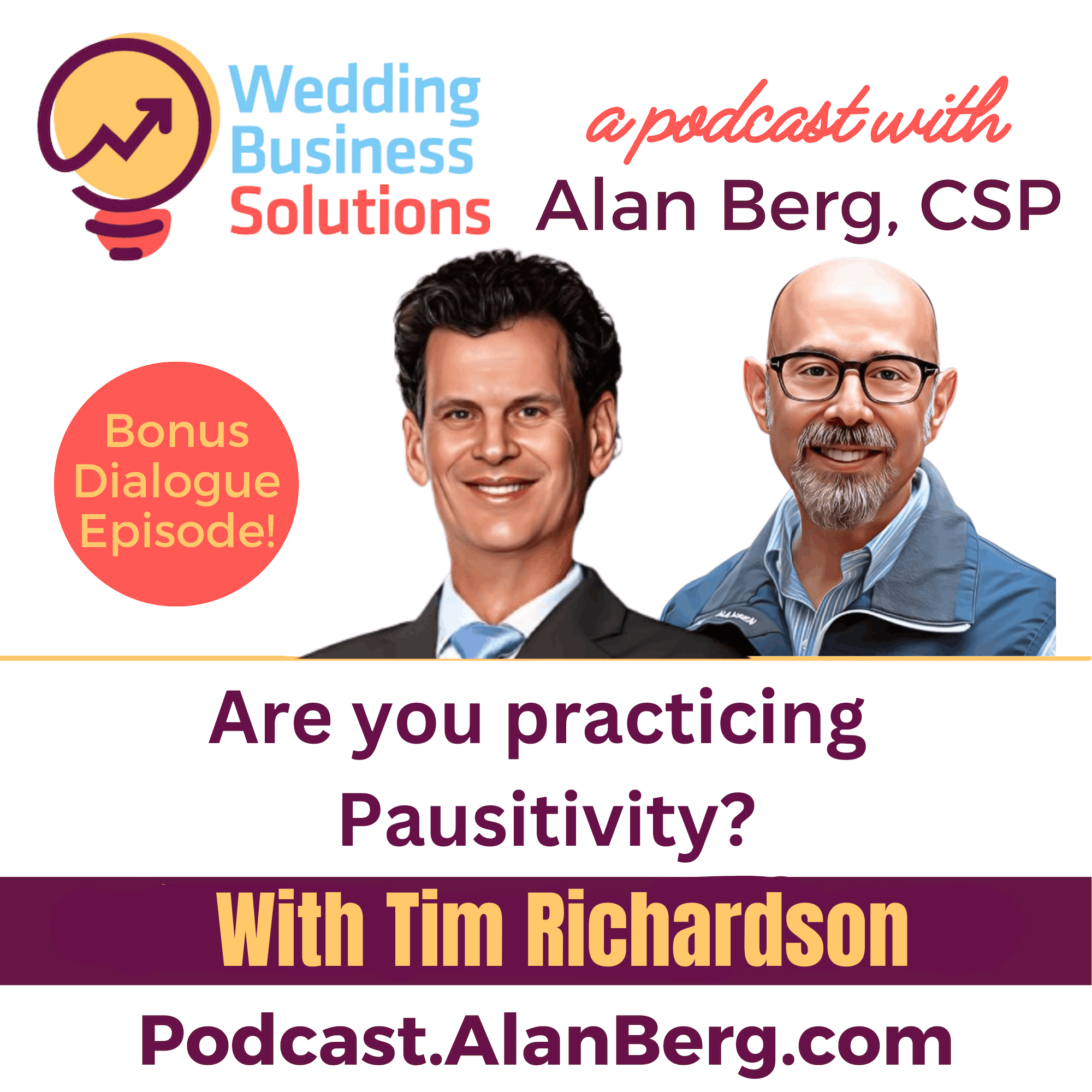
 Tim Richardson – Are you practicing Pausitivity?
What if you paused—really paused—just long enough to let the best ideas surface? What possibilities could emerge for your business if you built in moments of quiet, or even a technology sabbatical? In this episode, I talk about how hitting the pause button can fuel innovation, help reset your mindset, and encourage out-of-the-box thinking for both you and your team.
Listen to this new episode for inspiration on using intentional pauses to recharge your creativity and discover fresh solutions by simply stepping back.
About Tim:
Tim Richardson, CSP (Certified Speaking Professional), is a keynote speaker and customer experience expert who helps professionals create outstanding experiences by tapping into what he calls – Pausitivity.
With a background in luxury hospitality, including leading the effort to obtain AAA’s Five Diamond award at the Ponte Vedra Inn & Club, Tim shares practical, real-world strategies (and a few entertaining stories) to help clients handle customers, conversations, and chaos with confidence.
Subscribe to his newletter here – https://www.linkedin.com/newsletters/pausitivity-6885273916768686080/
If you have any questions about anything in this, or any of my podcasts, or have a suggestion for a topic or guest, please reach out directly to me at [email protected] or visit my website Podcast.AlanBerg.com
Please be sure to subscribe to this podcast and leave a review (thanks, it really does make a difference). If you want to get notifications of new episodes and upcoming workshops and webinars, you can sign up at www.ConnectWithAlanBerg.com
View the full transcript on Alan’s site: https://alanberg.com/blog/
Are you practicing positivity? Want to find out what I’m talking about? Listen to this episode. Hey, it’s Alan Berg. Welcome back to another episode of the Wedding Business Solutions podcast. I am so excited to have my friend Tim Richardson on to talk about positivity. Tim, welcome.
Thank you, Alan. I really appreciate the invite to be here today.
Well, you and I have known each other for a long time, and we share music and other things in common. But. But what sparked me to bring you on was one of your newsletter articles called what if, but let’s. Let’s just break the wall here. What is positivity?
So positivity is a combination of two words, pause and positivity. And so back pandemic time frame, when many of us were not doing much or doing nothing live, I came up with this idea of delivering a presentation on pausing because I was asking my. My clients and staying in contact with people via phone and Zoom and asking them what they were struggling with. And people were telling me they were working more than they’d ever worked before. They were at home. They would work until dinner and then have dinner with their family and then work another four or five or six hours and then repeat the next day. And, you know, as a recovering type A personality, I know that, that being driven to success of any kind without the appropriate kind of pauses is going to be very, very difficult for us, mentally, physically, spiritually, in every way possible. So I designed this speech I started delivering at a local toastmasters group just to get my reps in, and then people started hiring me to do it.
That’s great. I think about one of my books that came from. Somebody asked me to do a keynote and, and I like, it’s a little bit out of my normal lane. It was a keynote, not a workshop, and that turned into a book and all these things because you never know. So, yeah, taking time. Taking time for yourself. Taking time to pause. In your case, taking the time to play some jazz.
Maybe over to Distillery. That’s a side note over here. Okay, so let’s circle around to what if you wrote this newsletter. And I love reading your newsletters every week, but this one just kind of hit a nerve there. So what was the whole gist of that what if newsletter?
So what? One of my tenets and why pausing is important is leaders and their teams need to pause more for innovation and new thinking and, you know, new ideas don’t come if every moment is jam packed with to do items, with meetings with Zoom calls and so forth. So I was at an event in Atlanta earlier this year. And as I paused by, walking a lot, and that’s where I do a lot of my thinking. And so I’m walking outside the hotel and downtown area of Atlanta and Buckhead, actually, and I saw this automatic little guy on the. On the sidewalk delivering food to somebody. And then a moment later, I saw a wireless or a driverless car come by. And I only walked maybe a mile. And then on the way back, something else sparked my memory.
I think I saw another driverless car. And I just started thinking about who created that, who stopped long enough in their day to come up with these ideas. Because there’s no way either of those ideas would been developed if somebody was back to back to back to back with meetings and events and calls and to dos and emails and so forth. And so it struck me is, is why leaders need to stop, why business owners need to stop and pause and have time where they’re just looking out the window or taking a walk without an agenda, or going down to the lake or intently looking at a flower, whatever, just to have that moment of inspiration. It’s not going to come in a busy person’s day. So we’ve got to stop to say what if. So that’s where it came from.
Oh, that’s great. I mean, the best ideas come in the shower. I have a pad next to my bed I got many, many years ago. They stopped making it, unfortunately, called night notes, where it’s got a Fisher space pen that writes at any ang. You pull the pen out, it lights up, you write your notes, and I have these little pieces of paper all over the house. Drives my wife crazy because it’s all my little notes. Because I want to remember in the moment, oh, oh, I have to do this over here. But that was a.
You know, you made a great point. Every day we’re using stuff right now. Think about what we have here right now, okay? You and I are in different states on a video call. We gave no thought to how this happened, right? And somebody had to make this happen. Somebody had to think about this. I was talking to somebody about AI the other day, and they were. They were concerned about. They were asking about how something worked.
Like this AI agent called venuex. AI that responds to the inquiries that people make, has the conversation and books the tour for the venue. And they’re like, well, you know, but how does it work? It’s like, do you know how your cell phone works when you push the button in your car? Do you know how that works? Like every Time you start your car, you give no thought to the fact that what happens with this button and all that stuff’s happening under the hood and we give no thought to it unless it doesn’t work. And then all of a sudden then we open the hood and we still don’t know what we’re doing, but we have to open the hood anyway to see what’s going on there. But, but all those things are exactly what you said. Somebody said, well why do we need a key? What if you keep the key in your pocket and push the button, right? Somebody thought of that. You’re not going to lose your key, right? Not going to leave it in the car. So what are some ideas that maybe, I think you mentioned in the article that somebody had, that somebody else could have had but passed on?
Oh my goodness. Well, I don’t know about you, but over the years I have invented a number of things. I was speaking for a large telephone company in Colorado springs in the mid-90s and I found myself, I was there for a couple of days continuously fidgeting with my hotel card key and an idea clicked to me. I thought, what if this company and others like it could advertise on a, on a hotel card key? And, and so the card keys would be paid for by the advertiser, the Advertiser would have this multi use thing. And, and so I never did anything with it. And then six, nine, 12 months later, I’m checking into a hotel in Fort Worth, Texas, I get my key and there it is and I’m like oh my gosh. And I think what happens to me and a lot of people as well is we think of an idea and because we say, well nobody, nobody’s ever done that before and it stops, right? And Alan, that’s happened to me probably a half dozen times where I thought of something, thought it would be a great business idea, didn’t do anything and it’s like somebody jumped inside my brain, took my idea and went off. And not all of them are hugely successful, but that certainly that hotel card key has been a thing that I’ve seen over and over and over again and so have you.
And so I think we’ve got to stop when that voice comes on and say, well nobody’s ever done that before and turn that around and say that’s exactly why I need to investigate this or think this through more fully or get some people who are out of the box thinkers and say, hey, if I were to do this, what if I were to do this, what are Your thoughts? If I were to do this. What if I were to do? And so forth, and dig a little bit deeper. But again, I think most of us have been conditioned when we come up with an idea that’s never been done before, to think to ourselves, this is kind of crazy. How can I make this work? And we’ve got to flip that and be able to have those questions that direct us to a deeper investigation.
Yeah, I speak about that in terms of saying, well, why not? Instead of why. Instead of why should I? Well, why not? Right. If you’re having this problem. Right. If this would solve a problem for you. Which, by the way, I have something. Because those key cards that we sometimes forget to take back. Right.
Or have crate pictures on them or maybe ads, whatever. You can punch guitar picks out of key cards. Somebody put together hole punch and key card and turned it into. You can make guitar picks out of key cards. And I have one in the drawer here. Because there was the idea, so what
if a hotel in Nashville down near Music Row made that their branded hotel key card. What if, you know, the possibilities are endless with that kind of, kind of thinking.
Yeah.
So it would stand out. It would serve as an advertising piece for that. Somebody said, well, look what I got. What a cool hotel. The product obviously has to be there as well. But, you know, with, with the wedding planner professionals, you know, you’ve got to be looking in places other than the wedding industry to come up with those ideas and say, well, what if I were to. And I, I, I think that’s a really, really crucial reason why we need positivity or why we need regular pauses in our lives to have those ahas, to have those moments, to take an idea from another industry, to marry it with this other idea, bring them together and make it applicable in your business.
I think some of the best ideas just are what’s happening in your life. And you’re like, how can I apply this to what I do? How can I. How can this make my work better, my clients better, my family better, whatever it is, can I. This doesn’t have to be just this thing. And I think that’s what the big picture thinkers do is they don’t look at something for what it is they look for. What could it be, right? What could I use this thing for? And I’m sure our houses and our offices are filled with things like that that were just, you know, transferred in from something else. How could we use this over here? And then you have the famous stories of, you know, how Blockbuster could Have been doing online video and like. No, no, no, no.
Right. Or newspapers. When USA Today came out, they could handle the fact that this was a newspaper with short articles and, you know, color and whatever, but they never thought that nobody would want a newspaper. And then all of a sudden, you know, who wants a newspaper? Everybody’s getting their news online. Right. So it, we want news, but the format. Right. Changed.
Or Kodak, you know, could have had, they had a digital camera. They had one. They literally, they built a digital camera and they’re like, no. Because that would have killed their film business. Well, instead somebody else killed their film business.
As you’re aware, there’s story after story after, you know, industries. Yesterday my wife was, was talking to one of our daughters and we were talking, she was talking about where do you get a pattern to sew something anymore? Because last year, you know, the company that did all that 800 plus stores, the company went bankrupt because, you know, and they had all these followers. They had all these people. Yeah. Could they not think about, well, what’s next? You know, what if we, you know, with digital, what if we. And so forth.
Yeah.
And there’s story after story of businesses who just refuse to see what could be. And so because of that, their, their, their business is no longer.
I was in, where was it? Georgetown or somewhere just recently and I saw a Warby Parker eyeglass store. Now they, they built their business to be online purposely so you wouldn’t have to go to a store. And now they ended up opening stores because they realized people are telling them, I want to try these things on. I want to walk in the store and try these things on. So here’s a business that said we’re going to, we’re just going to be an online business and got pulled into retail. Just the opposite of what you think there. Right. It’s just really funny some of those things where you think it’s going to be one thing and you really have to listen to your customers.
You have to look for the need. I, I think about Apple. Steve Jobs was one of those rare people who could build something you didn’t know you needed and then you can’t live without. Most people see a need and then build something to fulfill that need. There aren’t many visionaries like Steve Jobs. I guess, you know, you can go back to Henry Ford, you know, if you ask people what they wanted. He didn’t ask them because he said they would have wanted a faster horse. There you go.
Well, and I think in both of those, those cases there’s something wedding professionals can learn from going back and understanding what happened there, particularly if your listeners have not, or subscribers of this podcast have not heard Steve Jobs speech introducing the iPhone. It’s a very powerful, powerful speech, first of all, but also just talking about it and the way he generated enthusiasm would be a great lesson for how we communicate our messages to the audiences that we serve.
Yeah, simplicity. And then his commencement at Stanford, what was that, 2004 or five somewhere. If you just look up Steve Jobs commencement at Stanford, and he talked about the connecting the dots. It’s called the connecting the dots speech, and how you can’t connect the dots going forward. You don’t know how what you’re doing right now is going to lead to something else. But when you look back, you’re like, actually, we were just talking about this. My wife and I grew up in Queens in New York City, but in different areas. You know, only a few miles away.
She was supposed to go to a different high school close to her. I was supposed to go to a high school further from me and ended up going to the one close to me. She ended up getting bused to that high school. And if it had not been that, we never would have met. Right. Just because of these, you know, the stars aligning, serendipity, you know, fate, whatever you want to call it, just things happening. But that speech he talked about, when you look back, you can see, oh, I was here because of that. I saw this because of that.
I did this because of that. But when you were in the moment, you can’t really connect the dots. And that’s. It’s. It’s good to look back sometimes and say, okay, maybe I should take that next chance. If I hadn’t taken that chance, maybe I won’t be here. Or as you said, what if. So let’s go back to positivity. What are some things that you tell people in your speeches and your coaching or whatever, in terms of not just for you yourself, if you’re the owner, but in terms of your team about giving them that opportunity to pause?
Well, the first thing I would say is the importance of a reset. Things don’t always go as we want them to, and so sometimes we have to have that moment to just stop. And you think about, if our technology that we’re using right now went haywire, or if our iPhone or if our computer, what would we do? Before we ever called technical support, we would turn it off and restart it. And there’s something about that that can solve a Lot of little problems in life and I think taking that pause to do a reset again for me it’s being outside, being in nature. Very fortunate that I live across the street from several acres of wooded trails. And multiple times per week, sometimes multiple times per day, I go out 5 minute walk to 20 minute walk to a 30 minute walk just to reset my brain so I can get recalibrated back to whatever might have thrown me off kilter. So I think it’s important that we have those periodically scheduled within our days, within our weeks to have that moment of reset. The second thing I would say is to reframe.
We hear a lot of negativity in our businesses. I would imagine people who plan letting weddings get a lot of grief sometimes from a bridezilla or from a mother in law or a mother who’s going to bat for their daughter or son and things aren’t working out and we’ve got to reset from having that really, really difficult conversation. And so, you know, just being able to, to take that moment and stop and, and not owning it, but having things in place to just say, you know what, I’m gonna, I’m gonna respond slowly and carefully and make sure that I don’t further exasperate the other person on the other line. So those are two big things that I talk about. The importance of a reset and the importance of reframing. And there are others as well. But those are two of my, my personal favorites.
Yeah. And it’s, it’s unplugging from what’s happening. Typically, you know, my wife will doom scroll on her phone. I’m like, could you just, just turn it off? Just, just turn it off. Right.
Just.
Let’s just be right. I have a family member that talks all the time. Can’t have silence. Talking all the time. And if we’re with that person, it’s nice. Sometimes my wife and I will leave and we’ll just be in the car. No radio, no nothing. Just quiet.
Let’s just be quiet right now because your brain just can’t be on all the time. You have to turn that off. I’m like you. I, I was hoping for this, the nicer weather because I love to walk outside too. We have in our neighborhood. I love to walk outside. I walk on the treadmill for, for exercise. But it’s not the same.
You know. Yes, I walk the same distance, but it’s not the same. You didn’t go anywhere.
All.
Well, all I did was French lessons on duolingo. But I love Just getting outside and, you know, just paying attention, paying attention to the birds. Sometimes I’ll take the trash out at night and it’ll be a clear night and you look up and I’ll just stop and look at the stars. Unfortunately, we don’t. We’re not in a dark sky area. But I’ll just, you know, put my hands by my eyes and say, let me just see that. Because, you know, they’d say that that light that we’re seeing is not current. That light we’re seeing, you know, started many, many, many years or, I don’t know, millennia.
I’m not sure how long ago that light is there.
A long time.
Long time, Long time ago there. So walking in the woods, what are some of the things you’ve heard from people that they like to do to, to reset?
So one of my favorites, just to go back to something you said a moment ago, is we’re, we’re always on, we’re always at arm length away from our technology. And so I have incorporated something over the last several years inspired by other entrepreneurs where it’s a Sunday sabbatical from technology. Unless I am traveling on a Sunday, I turn my phone off for a minimum of 12 hours, sometimes 24. Sometimes I turn off Saturday night, don’t turn on again until. Till Monday morning. Same thing goes for, for, for any kind of a screen. Because I, like everybody else, have that fear of missing out. I want to keep what, what’s, what’s, what’s going on, be in touch with people.
But what an interesting thing has happened now that I’ve been doing that. My family now knows that. And so I don’t get text messages. I don’t. So I don’t turn on my phone to a lot of, a lot of messages typically. And I think it’s important for anybody who’s an entrepreneur, whatever time you can carve out, just to have quiet, to not have your phone going off and to not feel like you have to be looking at your phone. And gosh, you and I see it all, all the time. And in stores, on planes, on, and, you know, Uber rides, if we’re sharing Uber, whatever people are like, just are.
It’s like their, their lifeline and it’s crazy. We can’t. Again to that comment I met earlier. We can’t come up with new ideas if we are always connected in some way, shape or form, and we don’t see the world around us either. We’re not listening, we’re not attentive, we’re not allowing Things to happen in our minds because we’re not connected to that electronic device. So I think having a sabbatical from technology is a great, great thing. And people say, oh, but, but I can’t. You can.
Yes.
You just have to be disciplined. And, you know, in the years that I’ve been doing this, Alan, I’ve missed one thing that I really wanted to do because I was offline for a period of time. And I thought, you know what the payoff is far, far exceeds the loss of that one single event. Now, there’ve been other smaller things, but this was a big thing that I had opportunity to do. I missed it because I wasn’t connected and I wouldn’t trade it for the world.
Yeah, I heard something recently about someone who said they have a second old fashioned old person cell phone, right? Maybe a flip phone or whatever. And that is they unplug their smart device, but they’re accessible for emergencies. And the only people that have that number are the family, right? The people that you would. You would need to. So if you have someone you need to be taken care of, if you are a caretaker or whatever, you’re still accessible because you have the old, I don’t know what is the one they ever has, the cricket or whatever it is, you know, the. Doesn’t do anything. It actually does the thing it was intended to do. It makes phone calls.
And that’s all it does. They have that to be accessible for the emergencies, but the other one is turned off, so that’s that. If you’re really freaking out, I need to be accessible. If there are emergencies in your life or could be, that’s certainly an option for you over there. But I remember times where the technology again went offline, failed or whatever. And you know, you find yourself like, oh, what, so what do I do now, right? And if I’m in the back of an Uber and I find myself on the phone and then I’m like, I just missed all that scenery. Like I’m in a new city and I just missed all that scenery. Or we’ll be driving and you know, you’re driving, so you got to pay attention.
And you know, my wife’s got her face on the phone. I’m like, look, look over here. And you know, she’s got her face like, no, look, look at that, look at that tree. Look at this, look at this house. Look at this building. Look at this. Whatever. We miss what’s around us.
And I think that awareness is really important. Just, you know, walking. I again walk in the neighborhood. And I’ll see. Okay. Oh, look that trees in bloom. Oh, look, this neighbor just did a. Whatever, you know, just did something over here.
Just being aware of what’s around us. I walk into a hotel room, I never turn the TV on, but I remember years ago, reflex. Walk in the room, turn the TV on, right? And now I walk in, sometimes the TV’s on because it’s got your name on it. You’ve probably had that one. Hi, Tim. You know, and I. Boom, turn it right off again. I don’t, I don’t need your ad for Marriott or whatever it is, but I’m not going to watch tv, right? If I watch TV at home in the evening with my wife, and if, if she wasn’t home, I probably wouldn’t watch tv.
Just, you know, I don’t need that. I do have other things, but I don’t need that. And you and I would probably be sitting playing music. But that’s a, that’s a whole nother story there. Well, actually, that’s an interesting story. So you didn’t play piano as a kid, is that right?
I did, I did play piano. My dad was a classically trained concert pianist and while that wasn’t his main profession, farmed over 40 plus years. So I was always around music. But I really got singular focused on Jazz 7, eight years ago and had a couple of different instructors. And I think that’s an important thing to think about as well. Having an outlet for something that you can do that can fuel you in ways that you might not expect. I was speaking a couple of weeks ago at my old college, actually, and there were several students in the audience, and somebody asked me one of the greatest questions I’ve been asked ever. And you’ll appreciate this as a musician, he said, what have you learned about jazz piano that’s applicable to the business world? I’ve never been asked that question before because I don’t really talk about that in my talks.
Yeah, but, but, but there was a lot to unpack there. So much so that I’m thinking someday of developing a whole presentation based upon the concept of improvisation in the workplace and why that’s important and how you, how you like a good jazz music musician does. How do you share that moment of, you know, of everybody having the spotlight, how do you know they’re done and so forth. And so all those things are things that are important to business owners. So being able to improvise when you know things aren’t quite as you anticipated, knowing when to give that look to Alan to say, you know what? I need you to take over now. So there’s a lot we can learn from having an outlet, whether it’s art or music or theater or whatever. I think there are great lessons in pausing to have those kind of experiences. And then sometimes these insights will just come to you just because.
So I’d encourage the people who watch this podcast. You find a hobby or interest outside of your work that really fuels you and speaks to your soul and watch your creativity soar.
Yeah. And if you can incorporate that into your work, great. And if you can’t, that’s okay. I don’t use music in my work. But then during COVID I started posting videos of me playing piano. And people tell me all the time, oh, I love your videos. Love your videos. So I still post them every once in a while.
But yeah, that’s a really great question about jazz. Because of being present, right? Being present when you’re, when you’re with people, that’s. It’s very hard with all the distractions we have. But when you’re playing jazz, you’re paying attention to what’s going on around you. You’re complimenting the other people. You’re not taking over. I have a hard time when I play with a band because I’m used to playing solo. So my left hand is playing the bass line and my right hand is playing the chord and the melody.
So I’m playing what the singer would sing, I’m playing what the bass player would sing. And. And I have to back off way big time. It’s like, this is my piece. My lane is right over here and complimenting those other things. But that, yeah, that’s. Yeah, there’s something there. There’s a presentation there, Tim.
Just so much of that back and forth, right. Having a conversation with someone in jazz, right. Trading fours or trading eights or whatever, where you solo a little bit. They sold a little bit. You sold a little bit, that same thing. And again, you’re not trying to one up them, you’re trying to complement what’s going on. And oh, oh, that’s so good. See, this is happening right in real time, folks.
This is happening in real time.
And to think about this for your audience as well. So as you know, if you are playing with a bass player, you’re going to draw to drop that left hand bass note that you’re typically playing. If you’re playing with a singer, you’re not going to want to play that melody. Like you’re going to be Comping. And so my, my instructor right now is showing four different ways to play the same song. And so how that might relate to people listening to this is, you know, not every one of your weddings obviously is going to be exactly the same. Sometimes you have to drop that bass part, if you will, or you’re going to, you’re going to be copying in the background, you know, and it’s so, so important to learn how to do that. And we do that by listening, by paying attention.
And back to my favorite callback. Getting off some of this technology for periods of time. You establish that backup system like you talked about. Give people an alternative way to get in touch with you. But it’s really, really critical for, for our mental health, for every type of health to have built in pauses that allow nothingness to happen, if you will. But the benefit of that, sometimes something really, really cool happens inside of our, our brains.
Yeah. Years ago we went to an all day jazz festival and it was a Duke ellington tribute. So 45 minutes. Each band had a 45 minutes set, but they had to play Take the A Train, but they played it any way they wanted. And this is, this is the what if? Like, what if we play it this way? What if we play it this way and literally heard five or six bands play the same song differently? And then there was a dinner break and then the headliner came on Cyrus Chestnut and he played Take the Atrium with his big band, but played it in 3, 4 time. It’s written in 4, 4 time. Played it in 3, 4 time. And for the first few seconds, your mind.
My mind was like, whoa, that’s not right. Wait a minute. Was it written in 3, 4? That sounds really good. Because he said, what if it. What if I played it in 3, 4 instead of 4, 4? And that inspired me to go home and sit down at my electric keyboard, play a song with a beat that was intended and then change the beat to something completely off from that and play the same song. So play it as a bossa nova, then play it as a rock song, then play it as a ballad, then play it as a waltz and whatever, just to challenge yourself. What if. What if I did it this way? Right? I mean, it’s ephemeral.
It’s there and gone, not recorded. But that’s the fun part of this is you don’t have to use every idea you come up with. But if you don’t try a new idea, you’re just playing the same old song the same old way every time. And that’s what that is. So, Tim, this is fun. Always fun chatting with you. Thanks for coming on. Thanks everybody for listening to two old friends just chat and hear about stuff.
But I hope you picked up something about are you going to take some time for yourself? Right? You can just take some time for yourself and let the ideas come because you’re clearing your mind from what’s going on in the day to day. So, Tim, if people want to find out more about you, where can they go?
TimRichardson.com I’m also on LinkedIn, have a Facebook page as well. I’m based in Knoxville, Tennessee area, so you can find me on LinkedIn. Tim Richardson, Knoxville and happy to be of service any way I can.
Great. And we’ll put all that in the show notes. Thanks everybody for listening. Tune into the next episode.
I’m Alan Berg. Thanks for listening. If you have any questions about this or if you’d like to suggest other topics for “The Wedding Business Solutions Podcast” please let me know. My email is [email protected] or you can text, use the short form on this page, or call +1.732.422.6362, international 001 732 422 6362. I look forward to seeing you on the next episode. Thanks.
Listen to this and all episodes on Apple Podcast, YouTube or your favorite app/site:
- Apple Podcast: http://bit.ly/weddingbusinesssolutions
- YouTube: www.WeddingBusinessSolutionsPodcast.tv
- Spotify: https://spoti.fi/3sGsuB8
- Stitcher: http://bit.ly/wbsstitcher
- Google Podcast: http://bit.ly/wbsgoogle
- iHeart Radio: https://ihr.fm/31C9Mic
- Pandora: http://bit.ly/wbspandora
©2026 Wedding Business Solutions LLC & AlanBerg.com