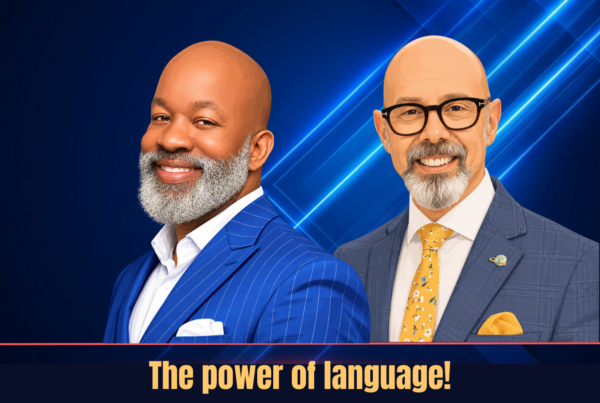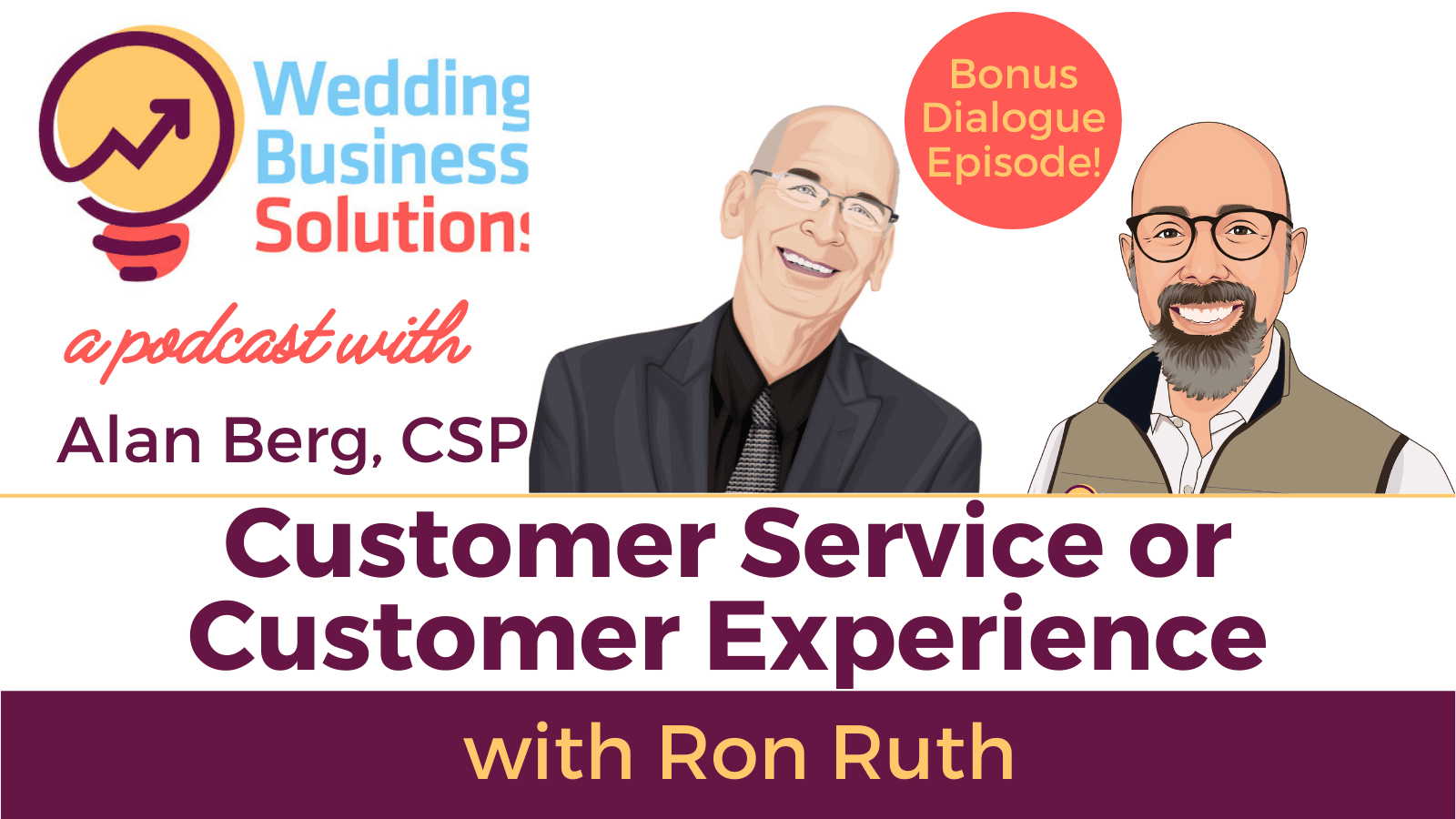
 Ron Ruth – Customer Service or Customer Experience? – Bonus Dialogue Episode
For this bonus episode I invited my good friend Ron Ruth to join me to talk about the customer experience. Through Ron’s speaking and training, and his lifelong addiction to all things Disney, Ron has some great perspective on how you can create a better experience for your couples and customers, right from the start. Join us for this discussion that was so compelling, there’s going to be a part II later!
With over 15 years experience in corporate management and 30 years as a small business owner in the wedding industry, Ron Ruth is celebrated as a fun and inventive Customer Experience Design speaker and business coach. Ron teaches entrepreneurs How to Speak Fluent “WOW!,” the language of the high-spending, loyal,raving customers they want most…a language that translates into never competing on price, again.
Ron Ruth, Keynote Speaker | Customer Experience Design
Workshop & Brainstorming Facilitator
RonRuth.com
Join Ron On These Social Channels:
- https://www.facebook.com/ronruthkc/
- https://www.linkedin.com/in/ronruth/
- https://twitter.com/ronruthkc
- https://www.instagram.com/ronruthkc/
Listen to this and all episodes on Apple Podcast, YouTube or your favorite app/site:
- Apple Podcast:
- YouTube: www.WeddingBusinessSolutionsPodcast.tv
- Spotify: https://spoti.fi/3sGsuB8
- Stitcher:
- Google Podcast:
- iHeart Radio: https://ihr.fm/31C9Mic
- Pandora:
Below is a full transcript. If you have any questions about anything in this, or any of my podcasts, or have a suggestion for a topic or guest, please reach out directly to me at [email protected] or contact me via text, use the short form on this page, or call 732.422.6362
Please be sure to subscribe to this podcast and leave a review (thanks, it really does make a difference). If you want to get notifications of new episodes and upcoming workshops and webinars, you can sign up at www.ConnectWithAlanBerg.com
– Customer service versus customer experience. They sound the same, but they’re really not. I have a very special guest. And we’re going to talk about that right now. When I think about customer service and I think about customer experience, there were very few people that come to mind that I love to talk about this more than just about anything, and my next guest is a very good friend who talks about the customer experience so much, Ron Ruth. Ron, how are you doing today?
– I’m awesome, Alan. Thank you so much for having me on your podcast. I’ve been looking forward to this opportunity for a very long time.
– Well, I’ve been looking forward to having a podcast for a long time, and that allowed me to have you on here. So you and I talked for hours sometimes just chatting. And very often we steer towards these experiences that you and I have had as customers. And there’s the phrase of customer service and there’s the phrase of customer experience. And I know you talk about the experience all the time, creating a wow experience. And I know you’re a huge Disney aficionado and few places do experience as well as Disney does. But just in your mind, what’s the difference between customer service and customer experience.
– Customer service to me is doing the basics, doing what’s necessary. It’s answering the phone. It’s responding to an email in a timely manner. It’s being available to answer a question. It’s all of that, just the basic stuff that can help keep a business afloat.
– Okay.
– Customer experience on the other hand is going that extra mile, doing the extra special things. The unanticipated that makes customer say, not only say wow, but also makes them, makes them spend more for it. There’ll be more loyal to it. And they’ll tell more of their friends about it as well.
– And the thing is that it’s an intangible, right? It’s not necessarily at the end, like you saved money is not customer experience, right?
– No, no. Nothing to do with whether you say, and actually customers, statistically, that’s a hard word to say this morning, statistically customers will spend more for a product or service from a business that provides a better experience. So it’s not really a matter of, well, you know, we want to do business with you because you can save money with us. No, the reason that you want to do business with us is because we’re going to take good care of you. We’re going to make you feel valued, special, important. We’re going to wrap you on our own little warm, fuzzy blanket of care and just make you feel as though you’re part of our family.
– So I had, actually had an experience last night. We did our, I think once a week, we’ve been doing Chipotle during the lockdown here, eating in our car because the restaurant was closed. You couldn’t eat there. We were in New Jersey, you’re in Kansas City. And same restaurant. We always go to order on the app. I’ve learned to order a little bit early because it’s almost never ready on time. Okay, that’s fine. I can live with that. It’s funny, ’cause you’ll go there and for a while they were still taking orders in person and then they weren’t taking orders in person. Then they were taking orders in person. Then they weren’t taking orders. So we just order on the app and that’s it. And I’ve had some great experiences there and I’ve had not great experiences there. And it’s the same restaurant. And it’s the same order. I just click reorder every time, right. And the thing that makes it different isn’t the food. It’s not the price. It’s not the location, the distance from my house, right. It’s not any of that.
So here’s what happened last night. So, I order, I show up right about the time when the food’s supposed to be ready, which was 20 minutes after I ordered. Okay, that’s enough time. I go in and there’s, I don’t know if you go to Chipotle, but there’s like a baker’s rack where they’ll put the finished orders on. You go up and you grab your order. Well, there’s two orders on there. I go take a peek because there’s a bunch of people waiting. Not my order, fine. Behind the baker’s rack is the preparation area. There’s another bag there. I’m thinking, it looks like it’s done. Why isn’t that on the rack? And then there’s another one. Why isn’t that on the rack? So they’ve prepared the food, they’ve packed the food, they haven’t put it out and the customers are probably waiting there, right? So I’m watching, I’m watching, I’m watching. I peek around a little bit. I don’t see my order ’cause you know how they pack a burrito is different than how they pack other stuff. So long story, not so short. I finally see them packing my order. And my order is now the fifth or sixth order that is prepared, but not in a bag.
So the person making the orders is not putting them into bags. Nobody’s putting them into bags. There’s five or six orders now getting cold ’cause nobody’s bagging them. Well, who’s supposed to bag them. It turns out at the cashier. The cashier is busy cashing people out who are placing orders in person. So then she goes over, packs two orders. And I said, hey, are those done? And she goes and looks, and then she puts them on the baker’s rack. That’s about 10 minutes later, right? I see a manager now talking to the prep person for the online orders, not helping. Goes and then talks to somebody else, goes and then talks to them, not helping. So where’s the experience there, right?
– Well obviously if you, especially, if you’ve got cold food, it’s not such a great experience. And it’s going to make you think twice as to whether or not you want to order from that restaurant again. I had a similar experience at a, it’s called the Main Event. It’s a bowling center here in Kansas City that’s got arcades and rock climbing. And I mean, it’s everything beyond, but they also have a little restaurant. One night we went in there as a family and the waitress told us it was her first night and she was just getting used to everything. And they gave her a very busy section, and with absolutely help on her first night. And of course we waited and waited and waited for our food. And eventually I went to the manager and I said, you know, I don’t blame her, I blame you, because you should be keeping, this is a new employee. Why are you not paying attention to what’s going on here? And no sooner than I say, especially since blamed him, all of a sudden every manager in that place, I’d imagined even pulled the pin setter at that point, they brought everybody up and all of a sudden this girl is getting all sorts of help from everywhere.
– Right, but again, watching the manager not do anything, right?
– Yeah, I mean, it’s like, what are you thinking? But you know, that’s a whole thing about customer experience. I’ve spoken to groups before, I’ve been invited, as you probably have, been invited to come in and say, give that rah-rah speech about, you know, this is what customer experience is all about. This is how you can increase your income. This is how you can make customers happy. This is how you can keep them coming back for more. But if the manager, if the higher ups, the leader, the business leader, whoever it may be is not on board and willing to follow through on all of that information, then it’s nothing more than a pep rally.
– Right, right. And you know, it has to go from the top down because it’s like parenting, right? You can’t be there with a cigarette in your mouth telling your kids not to smoke.
– Right, setting an sample, that’s basically what you’re doing.
– Right, so this manager was setting an example that she doesn’t jump in when things are backed up, as opposed to, you know, other places where I’ve seen managers jump in and do things like that. Now the followup is I got a survey, you know, rate your experience from Chipotle. And I gave them a one because it was a one. I got my food 20 minutes late. It was cold ’cause it had been sitting there, right? I got an email maybe less than an hour later back from Chipotle apologizing. We’re going to reach out to the manager over there. We’ve put a buy one, get one into your thing. And the thing is in the rating, I only had 200 characters. So I couldn’t even tell them the whole story. So when I replied back, I said, thank you, but let me tell you, you know, everything else that went on here so you know. And that’s it, you have to know to be able to do it. When the mask mandates in New Jersey were in full force, I was in, I think it was in a Walmart and all the people are walking around with masks under their noses, okay. And I was going to say something to a manager. So I saw somebody in a yellow vest and I went to go say something. And he turned around as I was getting closer and his mask was on his chin. I was like, well, clearly he’s not going to do anything about this, right. So customer experience is not about money. Customer experience is how you make people feel. Is that a good way to say it?
– Yeah, it’s the emotional connection you make with customers. I mean, it’s like Maya Angelou used to say that customers, people will remember, will not remember what you said or did, but they will remember how you made them feel.
– Right, people remember what you said, people will remember what you did, but people will never, people will forget what you said, will forget what you did, but never forget how you made them feel.
– But I want to address, you are the customer that can help a business because you’re the one that will say I had a bad experience. Do you realize how many customers will say nothing and they just don’t come back.
– Right.
– But so many people, so many businesses are afraid of those bad reviews. They don’t look at those reviews as an opportunity to make the improvements they need to make in order to increase revenue and to keep those customers coming back for more. You’re more likely now to do business with Chipotle than most customers have if they had not responded. A lot of people would go, I don’t really wanna, I don’t really wanna take the time.
– Right, you you know what? For me, I’ve posted a lot of reviews in my life because of my traveling. You know, not in 2020, okay. But prior to that, I’m a Yelp elite, which means I have over a hundred reviews I’ve personally posted on Yelp. I think about 140, 150. TripAdvisor, because I used to travel so much. I have personally posted over 600 reviews on TripAdvisor. Now that’s hotels, restaurants, attractions, whatever. And the thing is, I won’t post a review if I pretty much got what I expected.
– Right.
– I will post the review if the needle went one way or the other pretty far. And the thing is, it’s not about money, right? If I’m at a Hampton Inn and I have just, I felt was a really great experience, I want to tell them because, you know, I expect a good experience, but I don’t expect that, whatever that is, right. Air quotes, whatever that is. And then bad, of course, you want to tell them. And you know, bad is in the eyes of the beholder, right? That’s really, you know, you’re a Disney aficionado, you certainly know what great experience is, you know what what the Disney experience is, but you don’t expect that when you go to every place that you go, it might be a benchmark for you, but you don’t expect it. Right, you don’t expect that every place, right? So what do you, having that Disney experience as you know, this is my benchmark for what it could be, What’s an experience that you’ve had someplace that you just didn’t expect, but they blew you away?
– You know, that doesn’t happen often enough. Seriously, I mean, and it’s funny because you go, when you stop and think about it, for me, I always remember the bad experiences. That’s the sad thing, you don’t remember all the good ones. I think probably where I, here in Kansas City, Comcast. Believe, you know, as much as people complain about their cable company, I’ve developed a relationship with a guy at the store here so that when I need something or want something, I can just reach out to him and he takes care of it for me. I don’t have to worry about. So many people, like I said, so many people talk about Comcast and that you’re on hold with customer service for like forever in order to get something repaired. That doesn’t happen for me. I just send an email.
– But see, that’s not the company.
– Takes care of it.
– But that’s not a company, that’s a person.
– Well, exactly. I mean, that again, comes back to being a part of our family. I’m not asking you, customer experience is not asking you to be a part of our business. It’s asking you to be a part of our family. There’s a huge difference.
– Right, but again, it’s always about people ’cause there are people that could go to that same Comcast store and hate Comcast because the other person wasn’t doing the same thing, right?
– It’s funny because we went, we had spoken with Derek. Derek is my guy at Comcast, by the way. So if you ever have a problem with your Comcast, call Derek. But we went in one day and Derek was busy so we asked somebody else to wait on us. And what happened, we allowed someone else to wait on us. And what happened was the individual we were talking to, it wasn’t that they were rude or anything. They just weren’t knowledgeable. They didn’t know for sure and rather than saying, you know what, I’m not really sure about that, but let me go find out or, you know, maybe taking an extra few moments to research whatever the question was that we were asking. And it made me extremely uncomfortable. And I chose not to change services on that day. I waited until I could get back to the guy I originally talked to. Again, it’s the people, and it’s the way the people are trained.
– Right, but see, there’s something there. It’s okay not to know if you work to go get the answer. It’s not okay to not know, pretend you know, that’s worse, or to not know and then that’s it. You just leave it as, I don’t know.
– Boy and you talk about my Disney relationship with, my relationship with Disney. At Disney, they’re not allowed to say, I don’t know. What they will say is, is I’m not really sure, but let me go find out for you. I’ll find somebody that can help you, or I will. They don’t say, I don’t know.
– Trader Joe’s, you have Trader Joe’s by you, right? You go into a Trader Joe’s, you ask someone for where something is, they’re cutting open boxes, stocking a shelf. They get up and walk you to where it is, right. They never point. And if you say just show me, now if it’s just down the aisle, they might say, it’s just here on the left. But I had people to say no, no, just tell me. They say no, I’ll show you, right? And they do it with a smile. You know what they never do. They never do this, they never do. They never preface it with that sigh of, I have to help somebody here, right? Body language. I just had Tracy Brown, I did an interview with her for the podcast about body language in the age of Zoom. But that, you know, their body language is, I want to help you. It’s not, oh, I have to help you, right? The tone, the body language, all those things, that’s the customer experience even if they’re doing, like you said, and I liked the way you put that, they’re doing the mechanics of customer service. So they’re showing you where it is, but they’re doing it with disdain, right? That’s customer service, good, maybe or adequate, but bad customer experience at the same time. So where does the customer experience start for wedding and event pros that are listening here? Where does that experience start?
– For me I believe it starts with the very first conversation you have with a couple. See in the wedding and, the wedding and event industry to me, it’s a rare, beautiful bird because unlike most businesses, in the wedding and event industry, you’re being invited to be a part of someone’s special day. In a sense you’re being, yes, they’re paying you to be there, but in a way, they’re inviting you to be a guest of sorts. You’re helping them create something that’s going to be unique to them, and it’s also going to be something that is going to be appealing to their family as well. So it starts with that first conversation. And for me, it was always, you know, not a matter of here’s what I do. Instead it would start out with, tell me about yourself.
Tell me, you know, I want to know everything, and I didn’t say it out loud, but I was in my mind I’m thinking, I want to know everything I can about this couple for a couple of reasons. One as we start getting into the sales process and actually talking about their event, then I have some information I can work with to give them ideas along the line. But more importantly, I think just by asking the very simple question of, tell me about yourself, that’s the beginning of a relationship. That’s what people, Alan, when you and I first met, I don’t remember the exact words we said, but I’m certain that it came down to what made you want to do this? What made you want to talk about sales? What made you want to get into the wedding industry? I know our relationship goes all the way back to when you were with the Knot, so we’ve had lots of those conversations where it’s not just about business. It’s about each other.
– Right, for me, I think it actually starts before that. I think the experience of where you advertise and how you advertise. Your social media voice. Your website, is it easy to navigate, not easy to navigate?
– Well, it’s true.
– Is it about people and all that? ‘Cause I think they won’t even reach out to you if they don’t like what they, that experience before that. The personal experience absolutely starts with when you get that inquiry and how you respond, you know, digitally, on the phone, whatever all that kind of stuff is there. But it carries through to everything that you do, every interaction that you do. There’s a woman who is a venue in Austin, Texas. She’s got a venue outside of Austin, Texas. And I remember when I was there doing sales training, she’s had the venue at the time for about 25 years. And she goes, you know, Alan, when the day comes that I don’t get just a little teary when I send a bride down the aisle, then I’m done. Right, because it matters, like you said, it matters so much to her that they chose her venue. You think about that. Choosing her venue means not choosing every other venue. You should feel special about that, whether you’re the venue, the photographer, the DJ, the band, the invitation company, whatever, right. It means they didn’t choose anybody else except you.
– Yeah, it’s not just about what you do. It’s about, again it comes back to how it makes, the emotional impact that makes on the event. You know, your attitude plays a big part into how successful the event is going to be. Yes, you can make people get up and dance, but dancing isn’t all that there, for a DJ, I should say ’cause I come from the DJ background. You can make flowers, you can do all these different things, you can make a cake, but it’s not all about the stuff. You know, the stuff is secondary to the experience that you deliver.
– Well, it comes down to the why, you know, why does it matter to them? How important is this to them? So what are some of the things that wedding and event pros can do to make the experience memorable, to make it about the experience differently than things that you’ve seen that where people were doing? ‘Cause you work one-on-one with people as well, you speak to groups. So what are some of the things that, what are some of the easy things people can do that some people might be doing if they’re listening, some people might not be.
– Well one of the things I always ask the groups that I talk to is that how much time, how much time is there between the time a couple contracts you and the time that you actually sit down to really dive into their event, whether it’s a planning meeting or you know, to talk about the way the flowers are going to be designed. You know, in most cases it’s going to be anywhere from 18 months to six months in advance. My question is how much of that time between the time they contract you and the time that you actually sit down with them, how many times do you communicate with them during that time or is that nothing but dead air? You know, there is absolutely nothing wrong with reaching out to your customers, to your couples on occasion, just to say, how are you doing? How can I be of help to you? Here’s an idea, I found this article of information. I thought you might appreciate, something that appeals to whatever–
– Value, add value to the relationship is the way I express that.
– Because if you’re communicating with them along the way, in my opinion, what happens is you’re proving to your customer automatically that you care just as much about their wedding as they do. And because so many couples, they don’t really appreciate how much I care, how much you may care about their event, but you can show them just simply by engaging with them in conversation. And I’m not talking about upselling and all of those things. Another great way, this is an itty-bitty way, Alan, but to me is extremely important. And it comes back to this idea of communication, is that all too often we end emails with things like, let me know if I can be of service to you, let me know if I can do this, let me know if I can do. every time that you end an email that way, you put the onus of coming to you on the customer. And basically what you’re saying is don’t come to me unless you have a problem. I realize that’s not what it says, but that’s really what you’re saying. It’s just saying, don’t bother me unless you have a problem. So again, in continuing that relationship, instead of ending an email with something like that, say, how else can I be of service to you today? What else can I do? What other things can I do? Because again, it just continues the conversation.
– Do you need help with any other parts of your wedding? Do you need any other referrals? Something like, again, adding value. I put it all into the–
– Did I answer all your questions.
– And again, I think it just, but above all, I think a lot of it has to do with yes, every business has policy and procedure, but a lot of times policy and procedure can get in the way of allowing that experience to naturally take place. We’re concerned about, I want to go back to a business, we were talking about businesses that blow you away and do things that take from the experience. I had an experience with Lowe’s not long ago where I had a problem with a, I’ll just make it real short. I had a problem with an extended warranty on a lawnmower. And when I went to them to get help with it, I was told by the person that answered the phone that we have a procedure for complaints. It starts, you have to talk to the assistant manager, then you have to talk to the manager. They literally said this all to me out loud. Then you have to talk to this person. And then we escalate it. And it’s like, I said, I understand that you have policies and procedures, but you know, I don’t care.
– I just want my lawnmower fixed.
– Exactly, and the same thing is true in this industry, is that don’t make it difficult. Again, you’re being invited to be a part of one of the most important days of someone’s life. Unless they’re asking you to do something that is just totally going to blow, you know, put you in bankruptcy, or so you play an extra 20 or 30 minutes at the end of the night as a wedding DJ. So you maybe you give an extra Carnation or something for a boutonniere, you know, these are all little things that matter, these are the little extras that can add up.
– Well, let me give you, I showing you before we started recording about these pins that I had made that said I’m vaccinated because I don’t know what the protocol is. Right, are you supposed to ask people, not ask people? And I’m going to conferences starting soon. And I just, you know, I want to know who I can hug. I mean, that’s what it is. I want to know who I could hug. Well, when I got these ordered, I ordered them from a lady on Etsy. I’m saying a lady, only I found that out afterwards because of the way she signed off. And I got what I ordered. And then there was this little tool bag with like four or five others in there, right? Just like little free samples, little thank you gift or whatever, right? Makes a difference. I had, what did I get?
I got a bottle, I forget probably a bottle of bourbon for knowing me, but again, the little note in there, right? Just little things like that, that make that difference. That go that little bit extra mile. Again, now is she sending me samples ’cause I might go, oh, I might want to order those also? Sure, that could be, but I also got some little extra there. It’s again, how did you feel about that experience? You’ve probably heard me tell this story. I went to wedding MBA. I’m sorry, I was at Cater Source in Vegas, going to the convention center. I’ll try to make the story short. I drive through a McDonald’s with three other people in the car and nobody else wanted a drink. I go to the ordering. And again, let’s talk about the Disney experience versus McDonald’s, I don’t expect the Disney experience at McDonald’s.
– No, no, no, not at McDonald’s.
– And a very pleasant young woman’s voice comes across. Welcome to McDonald’s, can I take your order? And I said, yeah, I’d like a large diet Coke please. And she said, will that be all? I said, yeah. She goes, that’s a $1.06, pull around, love.
– Love.
– And you know, there’s no rewind button. And I said to the people in the car, did she say pull around love? And they said, we think so, right. And it was a $1.06, $1.08, whatever it is. I was like, okay. So I drive around, I get up there, and there she is big smile on her face. She goes, Diet Coke? I said, yes, she goes, that’s a dollar, whatever, $1.06. And she goes, how’s your day going? As I’m handing her the money or the credit card or whatever it was. And I said, my day’s going good. How’s your day going? She goes, my day is going good too. Thank you so much for asking, right. And she takes my money, gives me my receipt, give me my change or whatever, and she goes, you have a great rest of your day. And I said, well, with that smile on your face, I will. You do too. And she said, thank you very much.
– See, and that’s the difference between the transaction and an experience. That’s the difference, you know.
– Wait, wait, wait, wait, it gets better. So I pull up and get my Diet Coke, and they gave me the receipt and I said, what was her name? And they said, Brianna. And what’s on the bottom of almost every receipt these days? A phone number, right? A phone number to call, right, if you have. So we call that number right from the, on the Bluetooth in the car, we call that number and person answered the phone. Thank you for calling McDonald’s, how can I help you? And I said, we were just in the McDonald’s on Paradise Road in Las Vegas and had the most wonderful experience with a young lady named Brianna. And I just thought you should know. And there was silence on the other end of the phone ’cause she didn’t know what to do with me, right. So she goes, she’s stumbling now, right? ‘Cause she doesn’t have a script for this. Oh, thank you, thank you for telling us. You know, as you can imagine, we don’t get that many calls like that. I said, well, if you had more people like Brianna working for you, you would, right. Wait, so the next day I go back hoping to get Brianna again, pull up to the speaker and a man’s voice comes across. I was like, oh, he was pleasant. He was not Brianna. He was not Brianna.
– I’m surprised you didn’t go, is Brianna home.
– Exactly. But again, $1.06, $1.08, whatever it is, I’m still telling this story three, four years later because she did the customer service. She processed the, like you said, the transaction.
– Right.
– But she didn’t make it transactional. And I have another podcast I talk about that, transaction versus transactional, right? It’s that same thing there. So I know we’re running a little longer than I normally go. What else do you have to share? What are some of the other things people should think about.
– Walking in your customer’s shoes. As silly as it sounds, we were talking earlier, where does the experience begin? I believe that the personal experience, I agree begins in a conversation, but the real experience, as you said, begins with the website. I think more in terms of just being in front of people.
– Right, sure.
– But as a business owner, if you haven’t taken the time recently just to kind of walk through your business, you put on your customer’s glasses, I know it’s hard. You’ve gotta be objective or maybe get somebody else to do it and say, go through my site. Let’s talk about how easy is it to navigate my site. How easy is it for you to contact me? How pleasant is the person that’s answering the phone? Especially if you have other people that are doing it besides yourself. What are some of the flashpoints? That’s a Disney term. What are some of the flash points that you can get rid of that are going to make life easier? I go back to what I was talking about earlier, that lack of communication. That could become a flashpoint if you’re not careful, because all of a sudden if a customer doesn’t hear from you, they think you don’t care about them. You know, I’ll tell you a Ron story, a bad Ron story. Years ago when I was multi-op, I had a mother called me about her daughter’s wedding. And I don’t remember exactly what her question was. All I remember, and I remember this, I said something to her about, we are so busy, I just can’t keep all the brides straight. And I said something about how many important weddings we had or something. She goes, but none of them are as important as my daughter’s wedding.
– To her, she’s right. She’s absolutely right.
– Yeah, and that was an eye opener. And that stayed with me from that point forward. It’s like, man, she’s absolutely right. Again, that goes back, I was young, but anyway, I was multi-op in those days. But yeah, everybody’s event, you may think, it’s kind of like Disney. Disney has the three o’clock parade. They, you know, the the most asked question that Disney is what time does the three o’clock parade start? So you know, the cast members, that can get really old, and be like, they could say, well, it starts at three o’clock, duh. Or they could say, you know what, it’ll be in this area at about 3:10. And actually the best viewing spot is over there. Same thing’s true with weddings. I get it, you’re hearing the same questions. I call them the, when our we’s? You’re hearing the same when are we questions. When are we gonna talk about this? When are we going to talk about that? I get it, you hear these everyday, but they don’t. So you have to treat that moment as this is unique to them, personal to them, maybe unique isn’t the right word, personal to them. So you have to treat each of those situations, realizing that, hey, you do this for living. They’re only going to get one, hopefully one shot at this. And they don’t know the questions to ask. They don’t know what the answer is going to be. You have to be patient enough and understanding enough to be able to provide all of that to them. I want to tell you one, it’s not always the stuff that you notice that makes the experience either. Boy, my wife and I just came back from Disney, thank you very much. And one of the things that, of course we were there during COVID, so everybody had to wear a mask. You were at six feet and all that.
The one thing that you notice when you go to Disney during a regular time, before COVID, and my wife and I go a lot, especially during times when it’s busy, it that cast members, every time you’re in a line, I don’t care what line you’re in for an attraction, cast members scream at the top of their voice, keep your party together and fill in all the empty spaces. I understand what they’re trying to do. Unfortunately, efficiency falls down there at the fourth step of their four-step process, but they’re trying to keep things efficient, I get it. It fails on courtesy, but anyhow. So they scream at you, and I hate being on vacation and have somebody scream at me. When we were there during COVID, didn’t hear that once because they want you to be six feet apart. And when I got my survey from Disney, I said, I hope this is a tradition that stays with you. I get, you know, having everybody squeeze together is not going to make anything move faster than if it’s not squeezed together. And you discover that, even though there was no fast passes and there were long lines, lines kept moving. You know, there was no big deal if you moved up six feet, you stopped, you moved up six feet. So sometimes you again, going back to flashpoints, when you walk through your business, what are some of the things that you say or do that could cause a situation like that to arise, where you go, ah, maybe I shouldn’t do that.
– I think it’s also what you said, walking in their shoes is some of the same things that customers get upset at, you would get upset at if you were the customer somewhere else and so many times I’ll have this negative experience somewhere and I’ll go, gosh, if you were the customer, would you accept that? Would you think that this was acceptable? If that manager last night at Chipotle was standing outside, seeing another manager not jumping in and helping bag stuff that was already prepared, it was already in packages. It just had to go into bags, put the label on, put it on the shelf. She could have moved that out there. The message that it sends, right, is listen, I care about efficiency back here, like you said, right? What I don’t care about is what this is, what my body language is saying. What this message is there.
The opposite would have been, wow, look at that manager jumping in. That’s great, I appreciate them doing that. I remember in the early days, when I would be at the Knot, we’d go to a trade show, you know? And I would go to help set up the booth or maybe it was when I was consulting with WeddingWire after I left the Knot. And somebody said to me, Alan, you don’t have to do this. And I said, yeah, I know, right? And then I continue to help set up the booth, right? If you’re only doing what you have to do, that’s customer service, right? That the mechanics of it. I’m doing what I don’t have to do. Now, they are my customer, because I remember one time saying to the CEO of the Knot, you know, you’re my customer, and I’m yours. When I get off the elevator, the receptionist is my customer and I’m hers, right? We’re internally and externally, right? We do business with people internally and externally.
– Every wedding professional is each other’s customer.
– Right, at a wedding, at a wedding show, anywhere. Costco famously has, you know, has longevity of their staff because they take care of their people first. Union Square Cafe, oh gosh, Danny Meyer, Danny Meyer. He’s got a great book also. Shake Shack is another one of his businesses there. Famously, take care of the people first. You take care of your people, they’ll take care of the customers.
– Right.
– You don’t take care of your people, if anybody listening here has high turnover, right, you want to have lower turnover, take care of your people better. They will stick around longer because the money doesn’t overcome the not being treated well by management.
– I wish I could remember who to attribute the quote to. So forgive me if I don’t know, but I love this quote, feed your employees so they don’t eat your customers.
– Wow, I like that, I like that.
– I love that. And again, going back to this negative experience of what you saw, one of the things I tell businesses is say, think about the businesses you enjoy doing business with, that wrap you in that warm, fuzzy blanket of care. What is that they do in their business that you could translate into your own business? There is no copyright, trademark if you will, on exceeding expectations. You can do it any way you choose, regardless of where the idea or the inspiration came from. So, you know, it’s okay. That’s why Disney for me, I love Disney and I try really hard to incorporate as much as I can of what they do into my own business.
– But that’s about paying attention, right? When you have a good experience, what was it that made it good? I kind of do the same thing when people say to me, oh, I want to be a speaker, I want to be a speaker. I say, okay, start paying attention to speakers. I said, matter of fact, watch some speaker videos with the sound off.
– Right.
– Right, watch the body language. How do they interact with the audience? I’m a member of the National Speakers Association, as are you, one of the things as the CSP, certified speaking professional, I volunteer every year to judge other potential CSPs that are candidates that are applying. And I have to watch an unedited video of them. And they don’t know, we never tell who we are, you know, who’s we did or whatever. And this year I had two people, and one I gave very high marks to, and one I gave middling marks to. I thought they were good, I didn’t think they were quite there. And part of it was the way they interacted with the audience, right. It’s not only how much you know, it’s how you get that knowledge across, how you interact with the audience.
One of my favorite things somebody ever said to me was about a webinar. And they said, was I the only one on? They thought, they said, I felt, I thought you were just talking just to me. I said, thank you. I was, I was. And I was talking to the other 1,500, but each one of you, I was talking to you as one, that’s a great compliment there. So I watch a speaker, what did she do that was so good? What did he do that was so good? When I have a good experience, wow, what was so good about that? And also we, as the customer can elicit a better experience because you know, you go in there with, you know, a chip on your shoulder, you’re going to get some of that back. You’re dealing with people, right?
– Yeah, I mean, well, that’s true. There are, unfortunately, there are going to be people in your life, but again, I think a lot of that comes down to a whole different conversation is that when you’re booking your customer, you know, are you paying close attention before you actually contract that individual? Is this going to be someone that is going to appreciate working with you just as much as you are working with them? Or is this somebody that’s going to suck the life out of you? And I think we’ve all had at least one, I know I have, I’ve had at least one or two of those that you go, God, why did I do that?
– I actually had that conversation the other day. I was doing sales training for one of my clients. And we were talking about the experience, right, and attitude. And I asked that question. I said, who do you, two questions? Who do you know that just being around them makes you feel great?
– Right.
– Right, they just make you feel great. And people were thinking, okay, ’cause we’re on Zoom so I have 28 windows open here on Zoom, right. And then I say, now who do you know that just being around them sucks the life out of you? And you see what you’re doing, they all start laughing and everybody’s hand goes up there. And I said, okay, I don’t need you to name names here, right. But what is it about, and I said, what is it about the first person? What is it about the second person, right? And it could be like your, what was it, Derek? Who’s your Comcast guy?
– Right, my Comcast guy, Derek, yeah.
– Right, right, Derek versus the person standing next to Derek, right? It’s what did Derek bring in today? Or what does Derek bring everyday, clearly, versus what did the other person bring? Last thought go, no, go.
– Come on, come on man.
– I know, I know, I know. Give a last thought, give a last thought. We’ll come and do this again.
– I just want to add on to what you were saying because in the wedding industry, I think this is a big deal, especially when it comes to the people that you’re working with. Two things, one, if you’re that individual says, I’ll book anybody with a checkbook, stop it. I’m just going to, I’ll leave it with that. But then the other part of that is, is that in one of the things that changed my life was Michael Port’s book. It’s called Book Yourself Solid. And there’s a line in his book where he’s talks about, you are in charge. You’d think of your business as being that bouncer outside of a swanky nightclub with the red velvet rope. You get to decide who’s going past that red velvet rope. Not everyone is entitled to the opportunity to go into your swanky nightclub, just not. They may not be dressed right. They may not have the right attitude. They may not whatever. But the point is, is that not everyone has that, is eligible to get past that rope. You have the ability to determine who does and who doesn’t. So if you’re unhappy with the people you’re working with, if you feel that what you’re doing is a job versus an opportunity to change someone’s life, to make a difference in their life, then you need to be a whole lot more selective in the people that you’re choosing to work with.
– Choosing, yeah. Just real quick on that. I was in Mexico one time at this event and we’re out by this beautiful pool. And somebody said, you know, if you don’t want to do the wedding, just give them a really high price.
– Oh God.
– And I said, no, if you don’t want to do the wedding, don’t do the wedding. Because the money doesn’t make the people nicer, the money doesn’t make the event more convenient for you, whatever it is that you didn’t want to do it in the first place. If you don’t want to do it, you don’t do it, period. That’s it, right. Now we will forgive the people brand new in business because they’ll have to learn the hard way. They’re going to learn the hard way just like you did with that customer when you told the mother, you know, too busy or whatever. So Ron, we could keep talking for hours. We will come back and do this again. We’ll put it into the show notes as well, but if somebody wanted to reach out to you, find out about you know, helping them with their customer experience, how would they do that?
– It’s easy-peasy, RonRuth.com.
– RonRuth.com, we’ll put this in the show notes as well. Thank you so much for joining me, my friend. And we’ll do this again.
– Thank you so much, Alan.
I’m Alan Berg. Thanks for listening. If you have any questions about this or if you’d like to suggest other topics for “The Wedding Business Solutions Podcast” please let me know. My email is [email protected]. Look forward to seeing you on the next episode. Thanks.
Listen to this and all episodes on Apple Podcast, YouTube or your favorite app/site:
- Apple Podcast:
- YouTube: www.WeddingBusinessSolutionsPodcast.tv
- Spotify: https://spoti.fi/3sGsuB8
- Stitcher:
- Google Podcast:
- iHeart Radio: https://ihr.fm/31C9Mic
- Pandora:
©2021 Wedding Business Solutions LLC & AlanBerg.com