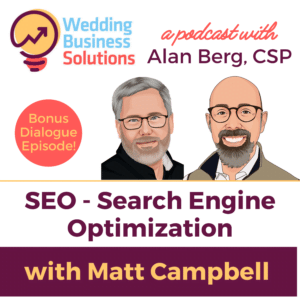
 Matt Campbell – Search Engine Optimization (SEO)
Search Engine Optimization is on the minds of many wedding and event pros. Matt Campbell became knowledgeable about it for his business, MyWeddingSongs.com and he and I are had a follow up conversation to our one about his niche. In this new episode we talk about SEO and how you can learn to improve it for your website.
Matthew (Matt) Campbell is the owner of My Wedding Songs. He has written for Rolling Stone, Mobile Beat Magazine, and DJ Times. Matt hosts the Wedding Songs Podcast and is the author of the Wedding Music Playlist. His work has been referenced in Forbes, The Knot, and Style Me Pretty.
Books Matt Mentioned on the podcast:
- Play Bigger – https://amzn.to/3lui0DZ
- Blue Ocean Strategy – https://amzn.to/3in3CeJ
SEO Tools Matt mentioned on the podcast
- Ubersuggest – https://neilpatel.com/ubersuggest/
- Google Keyword Planner (part of Google Ads) – https://ads.google.com/home/tools/keyword-planner/
- MozBar for Chrome – https://chrome.google.com/webstore/detail/mozbar/eakacpaijcpapndcfffdgphdiccmpknp?hl=en
- Yoast SEO – https://wordpress.org/plugins/wordpress-seo/
- Google Analytics – https://analytics.google.com
- Bonus tool! Screaming Frog – https://www.screamingfrog.co.uk/seo-spider/
Listen to this and all episodes on Apple Podcast, YouTube or your favorite app/site:
- Apple Podcast:
- YouTube: www.WeddingBusinessSolutionsPodcast.tv
- Spotify: https://spoti.fi/3sGsuB8
- Stitcher:
- Google Podcast:
- iHeart Radio: https://ihr.fm/31C9Mic
- Pandora:
Below is a full transcript. If you have any questions about anything in this, or any of my podcasts, or have a suggestion for a topic or guest, please reach out directly to me at [email protected] or contact me via text, use the short form on this page, or call 732.422.6362
Please be sure to subscribe to this podcast and leave a review (thanks, it really does make a difference). If you want to get notifications of new episodes and upcoming workshops and webinars, you can sign up at www.ConnectWithAlanBerg.com
– I had my next guest on to talk about how he niched his business, but he’s also an SEO expert, so I asked him to come back and talk about SEO, search engine optimization. And if you have a website, you’re going to want to hear this. Welcome back to another episode of the Wedding Business Solutions Podcast. I have a repeat guest, Matt Campbell, from myweddingsongs.com Matt, how you doing again?
– I’m great, Alan, how are you?
– I am, well, thank you. We were talking about niching your business, as you have, and we kept getting sidetracked because a big part of your business is SEO, search engine optimization, and you have become an expert in that, you helped me with my website, and we kept getting sidetracked. I’m like, you know what? We need to come and talk about SEO, just SEO, search engine optimization, and get people to understand what they maybe do need to know and what they don’t need to know, what they need to not worry about. So give us the quick thing, what is SEO?
– SEO is the process of getting more visibility in search results.
– So… So the whole idea, and I said this on the last episode, if you’re looking to get traffic from search engines, Google, Bing… Are there any other ones they should care about besides Google and Bing?
– It really depends… So Bing has an older generation that uses the platform, but 90% of our traffic’s from Google. So I would narrow down to Google.
– Right, so it’s Google. If you’re looking to get traffic to your website from Google, search engine optimization can help you come up higher in the results, that’s what it is.
– Yes.
– If you’re filling your calendar with traffic that’s already coming from other sources, The Knot, WeddingWire, we have people listening from around the world. So EasyWeddings in Australia, weddingsonline in Ireland or Dubai or India or Guides For Brides in the UK, if you’re getting traffic from any source like that and you’re filling your calendar, then you don’t really have to worry about SEO, right?
– No, but I would at least do the basics. So a caveat would be, if people are researching you before they hire you, I would still create that Google My Business, which is a side note to Google, but you would at least want to create your profile have everything filled out, so that way, if somebody Googles your business, that information is there.
– Right, and our mutual friend, Brian Lawrence is great with Google My Business. I actually got an email from them yesterday and it said, “Hey, you have no reviews.” And I don’t get Business… When people go to Google, they’re looking for Alan Berg, they’re not looking for somebody like me, which is what I’m looking for. But I wanted to have that presence, so I have a Google My Business, my photos are there, my book covers there, and they said, “Hey, you don’t have any reviews.” So I actually sent an email out to a small group, not my whole list, and said, “Hey, could you do me a favor? Google said, I should have at least five reviews, could you be one of my five?” Last time I looked, I had 14, all of a sudden. Now, they all came in at once, which I heard may not be great, but I guess it’s better than zero, right?
– Yes.
– And I did reply to every one of them, which is also… Now, does that make a difference to Google?
– Yes, so I even tell people, you want to respond within 24 to 48 hours, but let’s say you’re in the wedding industry, and I don’t know your space very well , but let’s say you’re in the wedding industry, a venue, or a DJ or, or whatnot, you want to respond with keywords that potential customers would be using, so you would want to reply with what the venue is, what the city is, maybe the state, you would put in there, maybe, the area. Put in those keywords inside of that answer, and then you want to really make it unique. So you would say something like, “Hey, Theresa and Mike, thanks for having me a part of your wedding that was at Emerald Gardens in Las Vegas, Nevada.” You know, you’re getting those keywords in there and then also personalizing it to that couple.
– Right, you don’t want to just copy paste the same review and the same response. I personally post on Yelp and TripAdvisor when I travel, which wasn’t so much in the last 18 months, but will become again, I’ve started to post again. And I post a very specific review, one that I would want to read. And I love when people respond, and I hate when it’s this canned, copy-pasted response, which I know they gave to everybody. I mean, you know that’s the one. Now, I appreciate that they responded, but I actually almost wish they wouldn’t, Because they didn’t even read what I wrote. And if you’re on WeddingWire or The Knot, sites that have reviews like that, where you’re allowed to reply, reply to them, don’t wait for a bad one to reply, reply to the good ones. So search engine optimization is, somebody going to a search engine, they’re typing in a word or the typing in a phrase, they’re looking for someone that does something like what you do. Now, if they’re looking for you, you have to write your name on your website, you have to write your business name on your website because I get people that tell me, “I Google myself and The Knot comes up, or WeddingWire comes up, and then I go to their website and their name is in a logo, which is a picture. And it’s hardly written anywhere else on their website.” I was like, well, you didn’t even write your name in text. So what are some other things that are these low-hanging fruit, obvious things, like you said, the must haves there, what do people need to do?
– So the first thing is always the titles and meta descriptions, because that’s when somebody Googles whatever they’re searching for, that’s what shows up in the search results. So you want to make sure that… I always say three things that need to be included in each. And number one is the keyword phrase you’re trying to get that page to rank for, a benefit to the reader, and if you have enough room in the title, you should have enough room in the description, is a call to action. And the call to action could be a single word, so call, text, visit, just something to give them something to do.
– And the meta-description, people who are, maybe, not so technical, where does that go, where do you enter that?
– So on the backend, hopefully, depending on your platform, no matter if you’re on Wix or on Squarespace or WordPress, there should be someplace to enter the page title and the page description, inside of the backend of the website.
– And the page title shows up where? Besides that Google search, where else would it be seen?
– So each individual page should have a section for the title and the description.
– And the title is… Is that the address of the page or is that something else?
– Oh, I see what you’re saying. So the address would be considered the slug. We’re getting a little technical –
– So “alanberg.com/speaking” that’s the slug.
– Correct.
– And then the title?
– Then the title could be something like, “Speaking, Wedding Business Speaking Expert, Call Alan Berg,” we’re just doing this on the fly.
– That’s all right. Actually, while you’re thinking about that, I’m going to pull up my page, and I’m going to actually look and see. So if I hover here, if I hover over that little tab in the browser, “Top Speaker and Industry Expert Alan Berg’s Key Wedding…” and then it goes dot, dot, dot, because it’s longer than that?
– Correct, you only get 60 characters.
– So that was the title that, I think, you probably came up with Brian, when you guys went through my site. So the page is alanberg.com/speaking, but that whole description comes there. So if you Google Alan Berg Speaker, that’s what’s going to show up in the Google results?
– Correct?
– Yep, okay, all right.
– And I would start with that as well, start with the Google to see what other people are, the terms that they’re using, what they’re saying, because you don’t want to say the exact same thing, you want to stand out from everybody else. So I would start with the Google. And we’re also saying, Okay, we’re going to create all of this search engine optimization, we’re going to do all of this work, we also have to set expectations. So if you Google, let’s say, “New York City wedding venues” and the top position is Yelp, then you have WeddingWire, then you have The Knot, then you have Brides or whoever else, you have to put it all into perspective that the chances of you overthrowing them are pretty slim. So let’s put your expectations correct, that you’re not going to be number one, I’m sorry.
– And somebody else is trying to knock you off, even if you were number one or number five, or whatever, it’s a moving target all the time. But we touched on this on the last episode, but you could own your local area of a particular name. So I live in Central New Jersey, I live outside of Princeton. So if you have a wedding venue in Princeton, you could come up really high under “Princeton wedding venue” because it’s really hard for sites like The Knot and WeddingWire to get that micro. And I’ve often said this with like local… There’s a guy here in New Jersey, Eric Kent, njwedding.com, I’ve known Eric for a long time. Eric can own a lot of things that The Knot and WeddingWire can’t because he can be hyper-local. And it’s that hyper-specificity where somebody could win, this is called the long tail, again, of search, which we mentioned on the last one, these very specific terms. So if in that title, should they be putting things like location words, like cities and towns and things like that?
– Yes, that would be part of your targeted keywords, your location, it’s going to be extremely important to use. But that goes back to the keyword research. You know, as an example, the area in Las Vegas can be Summerlin, but maybe nobody’s searching for Summerlin wedding venues. Why optimize for something that nobody’s really searching for? But in that same token, maybe, 25 people search for that a month, and, potentially, you could get all of 25 people looking for a wedding venue in Summerlin. So let’s put that into perspective as well.
– And that’s what the long tail is, is saying, You know what? Let the big boys fight it out over the big words, but let me own these, so that those very specific people looking for this, whatever those phrases are, which doesn’t have to be towns it can be something else, what you do. So if you do South Asian weddings, you can, maybe, own something like that, or specific words in there, talking about the Mandap and the Baraat and whatever, “Best Wedding Baraat DJ,” that’s a very specific term and other people aren’t beating the doors down to try to get that. So you could get those searches if somebody’s that specific. But let’s talk about keyword research. How does someone go about deciding, what are the words and phrases that I might do? I know Google has a tool for that, the Keyword Tool, and then there’s also other ways to do it. So where would you say people should start? Because we all get these emails every day. I can put you page one on Google. Yeah, on a phrase that nobody ever uses, you can put me page one on Google. So where should people go and what do they do?
– So the first place to start is, like you mentioned, inside of Google Ads, there’s the Google Keyword Planner. And they will give you stats on the number of searches that people are using per month. The caveat to that is you have to be a paid advertiser within Google Ads to get the exact numbers. So maybe you just spend a small amount of money, and then you can have access to that. Another tool that I really like is Ubersuggest, that’s owned by Neil Patel. And now that’s becoming part of a paid feature as well, but those are two tools that I’ll use to do keyword research, just to find out what people are actually searching for. And to go off of that as well, when you’re optimizing a page, just keep the same theme per page. So if you are targeting “Princeton Wedding Venue,” that is what that page is about, don’t bring in other cities within that, have other cities be their own individual pages as well.
– So if you work in a larger geographic area, but you focus on certain ones, or want to focus on certain ones, you could have separate pages. It sounds redundant, but if you have… So again, here, Princeton is near me, but then I’m in Kendall Park. So if I did a Kendall Park page and a Princeton page, even though the content is very, very similar, these are the pages that if somebody Googles, “I’m looking for a venue in Kendall Park,” or, “Photographer in Kendall Park,” or whatever, that page could rank higher because it’s so specific to that as opposed to being diluted with all these other ones? The old days, the 15, 20 years ago, where you would list every city at the bottom of the page and texts that was just slightly different color than the page. That’s actually bad now, right, keyword stuffing?
– Yeah, it’s very bad.
– Very bad!
– You know what? Last year or the year before, there was over 3,600 Google algorithm updates within a year. So yes, they are very smart at what they do and they are getting better. And so you say, “Slightly different.” I would challenge you to be as different as possible. So Princeton versus Kendall Park, maybe you are saying things to do in the area, things to see in the area, where to stay, what’s the weather in all four seasons, maybe it’s different between the two, figure out what makes each one unique. And this is where the local’s perspective that somebody that’s in a different area will never know. You know, where’s the best place for DJs to set up. Make each one unique, because that’s what’s going to get you to rank.
– So let’s say you are a florist or a photographer, and you did a page for Princeton, you could talk about all the different venues that you work at in Princeton and what you love about them, right?
– Right, and each one could be a post in itself.
– Each one could be… Okay, that they were getting even more hyper-local there, but, I’m thinking about a florist that I know, Georgianne, if you’re listening in Princeton. So there’s venues around there. And Matt says, “Hi,” if you’re not watching on video. She could say, “We love working at the Hyatt Regency in Princeton, it’s got beautiful areas, their ceremony area, this, or whatever.” Now, should she link to the Hyatt in Princeton, and have it open up a new site, a new page, or does that not matter?
– Yes, it does matter, and I absolutely would do that.
– Now, why does that matter?
– Because you’re giving relevancy and you’re, not quoting the source, but you’re linking this to the source, so that way Google knows, oh… Okay, Especially the Hyatt Regency, the number of Hyatts that there are out there, you’re going to link to the exact one. And now you’re saying, “At this place, this is where I would set up the flowers, this is how I’d set up the aisles, and the type of flowers per season that I would use, that would bring your costs down.” Just really relate what you’re talking about to that specific venue.
– So that link, are you getting any halo effect, where if their page ranks higher than yours, does it help you to be linking to this busy page?
– I would just link to the homepage, I wouldn’t link to their wedding page, because now you can-
– No, I meant, but the idea of my site gets a certain ranking from Google based upon how many searches and what the content is and all that kinda stuff, but now I’m linking to the Hyatt. Is that pulling me up a little bit?
– Yes.
– Okay, now, do I ask the Hyatt to link back to me?
– You can always ask, but corporate, I highly doubt that’s going to happen.
– Of course it might not happen, but you have a local wedding venue, and let’s say you’re on the preferred list of that wedding venue, you definitely want them to link to you.
– Yes.
– So if they link to you, does it matter if you link to them?
– It’s less valuable, but you’re topic specific, it’s not like that links coming from your homepage. I’m trying to think of a good example. So let’s say you’re speaking at the MGM Grand, and the MGM Grand… It would be more valuable if the MGM Grand did not link to your homepage, that they would link to your speaking page, if page was talking about speaking at the MGM, because you’re talking about relevance.
– So I have events on my website, and every one of those events has a page, I’d want them to link to that page. And then I should be linking from that page to the homepage of the MGM. So we have it going both ways there. Okay, so what would you say for someone who wants to increase the amount of traffic that they’re getting from search engines? What would be your top three things to focus on? Assuming that they’ve done their title tags and their meta, because we spoke about that already. So assuming they already have that done, what comes next after that?
– Number one, in any part of SEO is content content, content, content, what is on your site. The more content that you have, the more authority that Google is going to give to you. And then number two… I’m not even going to give a number three. Number two is links to your site.
– Links TO your site?
– To your site. So, as an example… And we’re talking about authority and relevance, because that’s really two different things. Any business works with specific vendors. So if you’re a florist, maybe you’re working with the venue, you’re working with other DJs, other professionals in the wedding industry to get links from them, you’re already working with them. Just ask them, hey, especially if they have a page on their site, if you’re a florist that talks about flowers, or maybe a specific wedding, if they link back to you, that would be gold, especially if it was, “What do weddings symbolize?” I don’t know why the DJ would be writing about that, but let’s say they did, and then they linked from that page to you, then, the relevancy is gold. You know, let’s say you work with a plumber, you know, that’s not really relevant. I probably would skip the plumber.
– Some people ask about blogging. And if they blog, let’s say you or somebody else blogs about a wedding, and then you talk about the other professionals that were involved, and link to those professionals, there’s a relevance there, but that link, if it’s just a list on the page, here’s everybody else here, that’s not as strong as if you wrote something about, “I love working with…” Again, I’ll use Georgianne here. “I love working with Georgianne at Monday Morning Flowers. She always brings such beautiful flowers, as you can see in these photos,” that link is stronger than a bullet point list of vendors, right?
– Exactly.
– Okay. But you don’t need seven paragraphs about why you love working with them, you just want to have a more descriptive thing, because Google is smart enough to know that wasn’t the bullet-point list that you actually took the time to write something.
– And the text that you’re using to link to that site, I mean, we’re getting a little bit technical, but let’s say they’re a Princeton Florist, then you could say, “Here’s so and so,” and then the actual text link is “Princeton wedding florist” that links to your site. Oh yeah, that’s cool too.
– So if the sentence there was like, “Georgianne from…” and then the link is “Monday Morning Flowers, a wedding florist in Princeton,” even though that’s a bigger link, that’s a stronger link for her, because she’s getting that in the relevance there again. So title tags… Go ahead.
– Just because the bare minimum, at least I would link the business name to the website.
– And that is the bare minimum, but if you can add a little bit more, you can add a little bit more juice, and now you can tell your friends. So what about people that are on a site like WeddingWire or The Knot, or again, EasyWeddings, WeddingsOnline, or whatever, the link from there, so the link from The Knot to their site, The Knot has to rank a whole lot higher, it’s a much bigger site and all that kinda stuff, is that benefiting that individual business?
– Yeah, so there’s a tool that I’d like to use called the Moz Toolbar, and what it does is it ranks all sites in authority from zero to 100. So the 100 is going to be Facebook, Google, high-90’s are going to be CNN, Fox, those types of sites. And then it works its way down from there. So The Knot, WeddingWire’s probably around, I think last time I looked it was 82 to 88. So it’s a very high authority. So those links to your site are very important. So let’s say, we’ve been talking about florists, let’s say 1-800-FLOWERS writes an article, or you can guest-post a blog on 1-800-FLOWERS. That link from that blog to you, yeah, it would be awesome.
– So, in other words, what I’m trying to get at is, a side benefit of advertising on a site like WeddingWire or The Knot, is that link. So whether or not anybody clicks on it, the fact that the link is there is giving you that authority by association, if you will.
– Correct.
– So that’s… When people talk about advertising, it’s all about direct response. No, no, it’s also about seeing your name over and over again. You know, we say you have to see someone seven to 12 times until they become more familiar and they trust you more. But there’s also this behind-the-scenes trust over there. So title tags, meta-tags. So I go to people’s sites and at the top of the page, on the tab, I’ll see the WordPress logo, because they haven’t even put it in their own favicon, and then it’s just the name of the page with nothing else going on there. That’s the easy stuff, that’s low hanging fruit. What I also tell people is, if you go to Google Analytics, which you should have Google Analytics, or if you have Analytics at all, it tells you what your most popular pages are. So start with the pages that are most popular, and work your way down. If you have 50 pages on your site, start with the top 10, and then work your way down. It’s the same as we spoke about responding to reviews, if you’ve never responded, start with the top five, and then as the new ones come in, if you have more time, go back and respond to others, but the ones from two years ago, you don’t have to go back respond.
– Actually, my tip for that is, respond on their anniversary, say, “Hey, happy third anniversary, it was such a pleasure being part of your wedding.”
– Nice.
– Just don’t do it seven months, “Okay, great.” It just makes you look bad.
– Well, you know what? Some of the sites don’t notify the customer that you have replied, Google does. I don’t believe WeddingWire and The Knot do. Yelp, I think does. But I’m pretty sure WeddingWire and The Knot, they don’t get notified. So if you go back and respond to the first five or eight or whatever, it’s not like they’re like, oh, like you just came out of the woodwork here. That’s why on the 14 reviews I got on Google yesterday, because I asked for five and I got 14, thank you very much all who did that, you’re going to see I replied. You said within 24 hours, I replied within minutes. As soon as I saw it came in, I replied personal to each one. I always reply to every review I get where I can. I can’t reply on Amazon, they don’t let me reply. I would, but I can’t. Nobody posts reviews for me pretty much anywhere else. So it’s my site, Amazon, or now, Google. So title tags, meta-tags, the keywords. And again, Matt, I’ll ask you to give me this for the show notes, but the Google Keyword Planner, Ubersuggest, Moz Toolbar, you’ll give me those links so I can give to people to look there. And then the low-tech way is if you go and do a search on Google, it’s going to show you what other people are searching. So you know how it just starts to fill in for you when you start to type stuff, it’s doing that based upon what other people have searched, right?
– Correct, and since we’re talking about Google, let’s say we’re talking about low-tech, you could search with the parameter “site:” and then your domain – “site:yourdomain” So it’d be “site:alanberg.com” And it’ll give you a list of the pages on your site that Google is indexing. And you can see right from there, what your titles are, what your descriptions are.
– So if somebody does that and nothing comes up, that means Google is not reading your page, it’s not indexing?
– It’s not indexing your site, yes. And I have worked with sites that, there was blocking Google from seeing the site, and that’s not something that-
– No, no I’ve been to sites where you couldn’t copy text, like you couldn’t copy text to paste it. If you can’t copy the text, is that being blocked, or is that something else-
– There’s JavaScript in there that’s blocking you from copying and pasting. If that’s a bad thing-
– So you’re just still reading, yeah.
– Yes, I’m not sure if that’s a… I would assume that that’s good, just because that’s been on very-high authoritative sites where you couldn’t copy that.
– Yeah, I guess, but you could specifically block pages. For instance, if you have a hidden page with your pricing on it, that you only send people a link to, you could tell Google, “Don’t read this page, don’t index this page.” And that’s, again, a technical thing in the back. In things like WordPress, is that a check box, like “Don’t index,” or is there someplace else you’d have to go to say, “Hey, don’t read this page.”
– In WordPress I use a tool called “Yoast SEO”, it’s plugin that you would add to your website. And within that tool, within the page, you can say, “No index this page.” And you would actually want to use that feature on pages like your thank-you page because you don’t want people searching Google and then going to your thank-you page, that’s a terrible user experience.
– But theoretically, that page doesn’t have a whole lot of content on it, and it shouldn’t come up high in it. If your thank you page is coming up high in a search, your other pages are really bad.
– Yes.
– I would think your other pages are really bad. So, again, what are the pages that you want to come up? But if I’m thinking more of the hidden-page stuff where people will get an inquiry and then send someone to pages where they don’t want prospects seeing it, those are called “hidden pages”, you have to have the link to get there. But if somebody Googled “Alan Berg pricing,” if I had a page like that, if I don’t tell it not to index that page, that hidden page is no longer hidden, and people are going to find that.
– And just keep in mind, one of the top things every couple’s searching for is pricing and packages.
– So I was going to end here, but I’m not going to end now because this is a great point, you have to use the words they’re looking for, they’re not looking for your “investment”, they’re looking for “pricing’. And even if you don’t want to put pricing, if you have a pricing page and you said on there, we know that couples like you are looking for pricing for your weddings, for your officiating, or whatever it is, and we would love to give you pricing information, blah, blah, blah, or have packages without pricing, but still say “pricing” and say, “We’d love to give you a price for your wedding, call, email, contact, whatever.” So whether you put the prices, we’re not saying pricing is going to get people to a page. And I see all the time, investment, investment. Save the word “investment” on the page, that “hiring the right wedding photographer, is an investment in the future of your photos”, but don’t call it “investment” because they’re not looking for it, right?
– Yep, correct.
– But they are looking for pricing, they are looking for packages, and whether or not you want to put it there, you have to talk about that. All right, I’m going to end us there because Matt, we can keep talking about this forever. And I’ve already had you on twice now, so we’ll have to come back for a third and talk more. But thank you so much in the show notes. Again, myweddingsongs.com is Matt, but Matt, I’m going to ask you to just tell them about Ubersuggest, the Google Keyword Planner or Moz Toolbar, Yoast SEO, just those things. We’ll put the links in, if you you want to find out more about those things. And myweddingsongs.com, if you want to find out more, and connect with Matt, he is a super-nice guy, and he talks to anybody that asks. And when you get out to Vegas, Wedding MBA, or whatever, look him up. You’ll you’ll be at Wedding MBA, right?
– Yes, we have a booth.
– All right, So come and see him at the booth, come and see me at my booth. Matt, thank you so much again for joining me.
– Thanks Alan, for having me, I really appreciate it.
I’m Alan Berg. Thanks for listening. If you have any questions about this or if you’d like to suggest other topics for “The Wedding Business Solutions Podcast” please let me know. My email is [email protected]. Look forward to seeing you on the next episode. Thanks.
Listen to this and all episodes on Apple Podcast, YouTube or your favorite app/site:
- Apple Podcast:
- YouTube: www.WeddingBusinessSolutionsPodcast.tv
- Spotify: https://spoti.fi/3sGsuB8
- Stitcher:
- Google Podcast:
- iHeart Radio: https://ihr.fm/31C9Mic
- Pandora:
©2022 Wedding Business Solutions LLC & AlanBerg.com