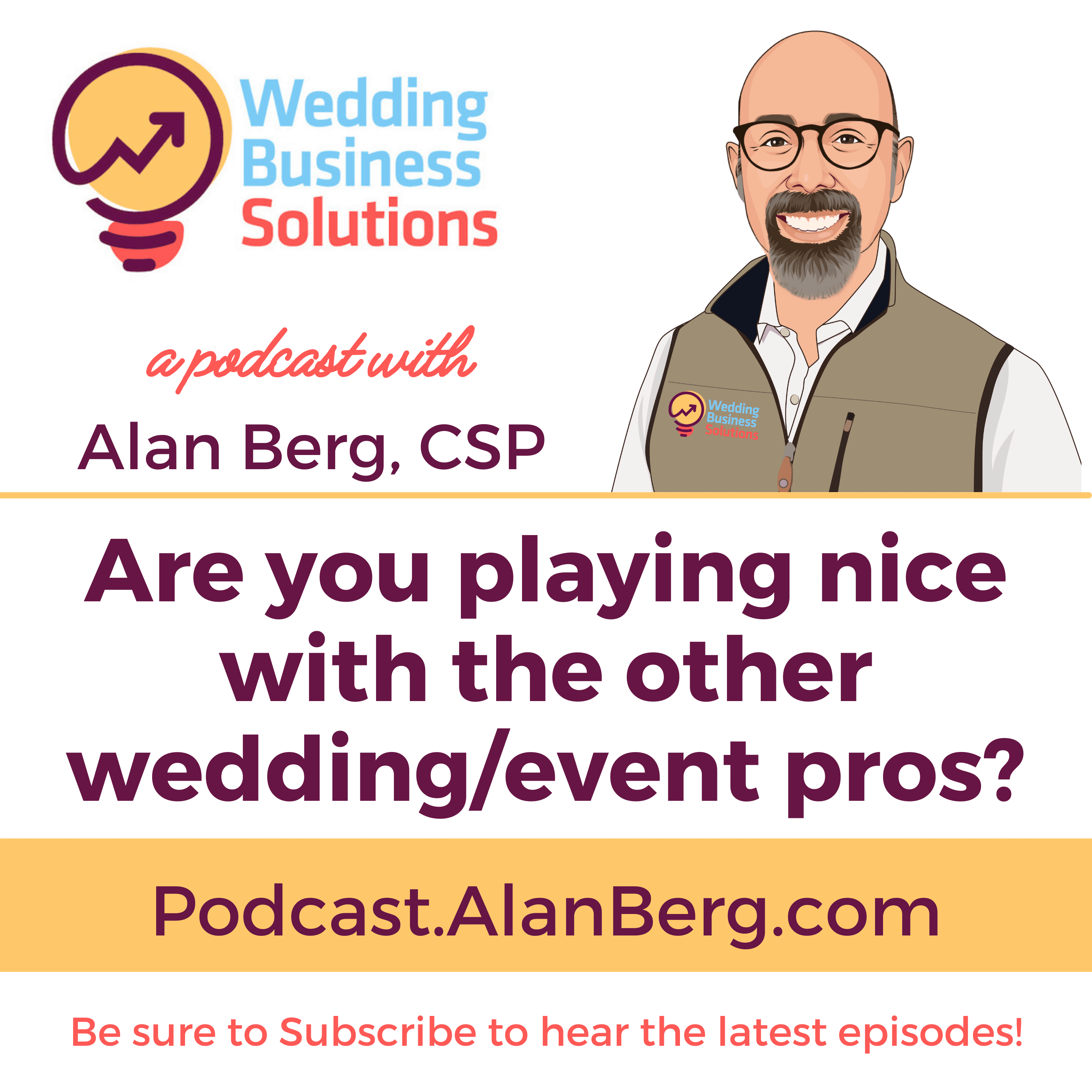
 Are you playing nice with the other wedding/event pros?
A Facebook post inspired this conversation about how wedding and event pros do, or don’t work well with others on the same wedding or event. I’ve heard some great stories and some horror stories about this, and in this episode I weigh in with my thoughts.
Listen to this new, 8-minute episode to hear my perspective on how wedding and event pros can and should work together.
Listen to this and all episodes on Apple Podcast, YouTube or your favorite app/site:
- Apple Podcast:
- YouTube: www.WeddingBusinessSolutionsPodcast.tv
- Spotify: https://spoti.fi/3sGsuB8
- Stitcher:
- Google Podcast:
- iHeart Radio: https://ihr.fm/31C9Mic
- Pandora:
Below is a full transcript. If you have any questions about anything in this, or any of my podcasts, or have a suggestion for a topic or guest, please reach out directly to me at [email protected] or contact me via text, use the short form on this page, or call 732.422.6362
Please be sure to subscribe to this podcast and leave a review (thanks, it really does make a difference). If you want to get notifications of new episodes and upcoming workshops and webinars, you can sign up at www.ConnectWithAlanBerg.com
– Are you playing nice with the other wedding and event pros? Listen to this episode and find out what I’m talking about. Hi, it’s Alan Berg, and welcome back to another episode of the Wedding Business Solutions podcast. I saw a post on Facebook the other day from a venue who was complaining about a particular wedding planner. They didn’t say who it was. Actually, they were complaining about planners in general, who come in, have not been to their venue before and then take over like it’s just their wedding, and they’re the general, and they’re the one in charge. Now, wedding planners listening hang on a second, I’m not beating you up. Here’s the thing. The average wedding has 12 to 14 different services. If you think about how many people are at the wedding or at the venue, okay? So I’m leaving out let’s say the invitation people, because you’re not physically at the venue. You’re doing business with the customer directly over there. The dress shop, you are not necessarily there unless they pay you to come and take care of them during the day, right?
So there are some of you that are not at the venue. But those of you that interact with other wedding and event professionals, you need to play nice. You need to understand that if you want to know who’s in charge, and if you want to be in charge, if that’s it, you need to have better communication. And that’s not coming in like, you know, someone who’s never been to a venue. Just use this example, whether you’re a planner, or a photographer, or a band, or a DJ, or a florist or something coming in there, and then acting like you’re the one in charge in somebody else’s house.
Now, venues, I’m not letting you off the hook here either. It’s also incumbent upon you to play nice with the other people there. We could talk about vendor meals, and things like that, but that’s not what this is about. What I’m talking about is this. If you are a planner, let’s say, and you’ve never been to a venue before, and your customer hires you to do their wedding at that venue, you need to do a site visit. You need to go there when that venue is not busy, and make a relationship with them, so you can all understand here’s the timeline, here’s what’s going to happen. And if there’s any friction in that timeline, between you and that venue in this particular case you need to work that out beforehand, not on the day of the wedding. Same for the photographer. If there’s a planner involved you need to be talking with that planner. You need to be go to that venue. You need to know where to load in. You need to understand about meals. You need to understand all these things before.
Now, if you already have a relationship, this is why so many of you get referred by other vendors. Because you have a relationship, and you guys know how to play nice together. Well, people refer people they know, like and trust. And if you want to be referred by people at a wedding where you’ve never worked with them before, you need to get to know them beforehand. You need to not show up and be like, “Hey, you know, oh look who’s here, sorry. don’t know you. I’m not going to play nice with you.” I’ve heard these stories over, and over, and over again, and I don’t understand them. I don’t understand why you wouldn’t play nice with these other people, because you could get referred by them. As far as the timeline. I know there’s a lot of controversy about this. Who owns the timeline? Well, the truth is anybody who’s on the timeline is invested in that timeline and needs to be, there needs to be communication.
You can’t just change the timeline, and not tell the other people on there, because you felt you want to change it. Yes, I’m talking to you, the caterer. I’m talking to you, the venue, and the planner, and the band, and the DJ, and the photographer, and the videographer, and everybody else who’s there. You can’t change the timeline without communicating with other people, because it might make it better for you. It might make it worse for somebody else. And the question is why? And do we want to make it worse for someone else, which then makes it worse for the customers? But you guys need to play nice together. It’s funny, I had this conversation many, many, many years ago. I did a podcast, not actually, it was a webinar, when I was back at The Knot, I was VP of sales at The Knot. And I had people on the panel like Mark Kingsdorf, who’s not in the industry anymore, is amazing wedding planner, good friend. And we had the same conversation.
Planners like to look at the other vendors as, “Hey, you know I’m running the timeline,” And the other vendors are like, “Yeah, but I have to do my job. I have to do my job, so this timeline doesn’t work for me. Let me tell you why.” Instead of somebody saying, “Yeah, you’re going to do it this way, regardless.” You don’t want that friction at the event. How many times do we see pictures where the photographer and the videographer never worked together before, and all of a sudden we’re seeing the other one in the photos or in the video? That doesn’t look good for the customer. It doesn’t look good for you. It doesn’t look good for the customer. Just things like that where having a conversation ahead of time, understanding, yes, you each have a job to do, but that all of this dovetails together with everybody else who is here. I think that really would solve a lot of these problems. People are either reluctant to, don’t think about, or afraid to have that conversation ahead of time. Because… I don’t know why. I just don’t know why.
I have these conversations with my clients before I come out. And yes, we get surprises when we get there. When at all possible, I try to go with the flow. If there’s a good reason, why not, for instance, somebody has me come and speak at a luncheon event, and I’m going to speak after lunch. And I say, “Great, I’m going to speak after everyone’s done eating.” I tell them that right up front. And then I get there and they say, “Okay, we’re going to serve the salad, and then you’re going to present.” And it’s like, “No, no, no.” It’s not fair to the people who have their backs to me. It’s not fair to have the clinking of the forks and knives on the plates, and the noise that’s happening, and people trying to talk to each other. It’s not fair to them. So I will either shorten my presentation, or I’ll just start after, and I’ll give the full presentation if it’s okay to go longer. But here’s the reason why I don’t speak during lunch. It’s not that I’m a diva, I’m not going to speak during lunch. I’ve been there sitting with my back to the stage while somebody’s trying to talk, and I can’t listen to them, I can’t pay attention to them, and I can’t eat. Neither one of those is happening well. There’s a good reason for that, and I’ll have that conversation. But I will also be flexible and say, “I’ll cut my presentation shorter then. Start me afterwards, but I’ll cut my presentation shorter.” Is it shortchanging the audience? Eh, a little bit, but they’ll never know. They’ll never know what I didn’t say, right?
But that’s going with the flow and working with whatever the constraints are. I did have that conversation ahead of time, but obviously that didn’t get translated to whoever, or transmitted to whoever else was there who was thinking, okay, you’re going to do it this way. So that’s an example in my world. Your world is very similar to that. Things are happening. You know, ceremonies are happening. Introductions are happening. Cake cuttings are happening. First dances are happening, right? All these things are happening, and a lot of people need to coordinate. You can’t just tell the caterer, “No we’re not going to serve now for another half an hour,” because they’re just going to overheat the food. And then people are going to say, “Oh, the food was overheated,” but the caterer was ready on time per the timeline. So you know that would’ve had to be transmitted to them that morning, not at the event, when you say, “Give me another half an hour here.” It’s just, you know, food doesn’t understand that it’s supposed to stop cooking, right?
So once again, this is a little bit of a soapbox, but really this thing on Facebook really kind of hit home that this has not gone away. In all the years that I’ve been in the industry, this idea of people not playing nice together, and not understanding that everybody’s job is important at this wedding or event, everybody. And that everybody needs to work together. And a little bit of communication, a little bit of investing a little bit more time ahead of time to have those conversations, so you don’t have them there, especially, if you haven’t worked with those people before. I think it’s just really important. It makes for good relationships in the industry, and good relationships in the industry lead to more referrals. So are you playing nice with the others? Think about times people didn’t play nice with you. You don’t want that to happen. Be a little bit more self-aware that maybe you’re not playing nice with somebody but you didn’t realize it. And what can we do about that? That’s all I want you to do is just think about it a little more, thanks.
I’m Alan Berg. Thanks for listening. If you have any questions about this or if you’d like to suggest other topics for “The Wedding Business Solutions Podcast” please let me know. My email is [email protected]. Look forward to seeing you on the next episode. Thanks.
Listen to this and all episodes on Apple Podcast, YouTube or your favorite app/site:
- Apple Podcast:
- YouTube: www.WeddingBusinessSolutionsPodcast.tv
- Spotify: https://spoti.fi/3sGsuB8
- Stitcher:
- Google Podcast:
- iHeart Radio: https://ihr.fm/31C9Mic
- Pandora:
©2022 Wedding Business Solutions LLC & AlanBerg.com