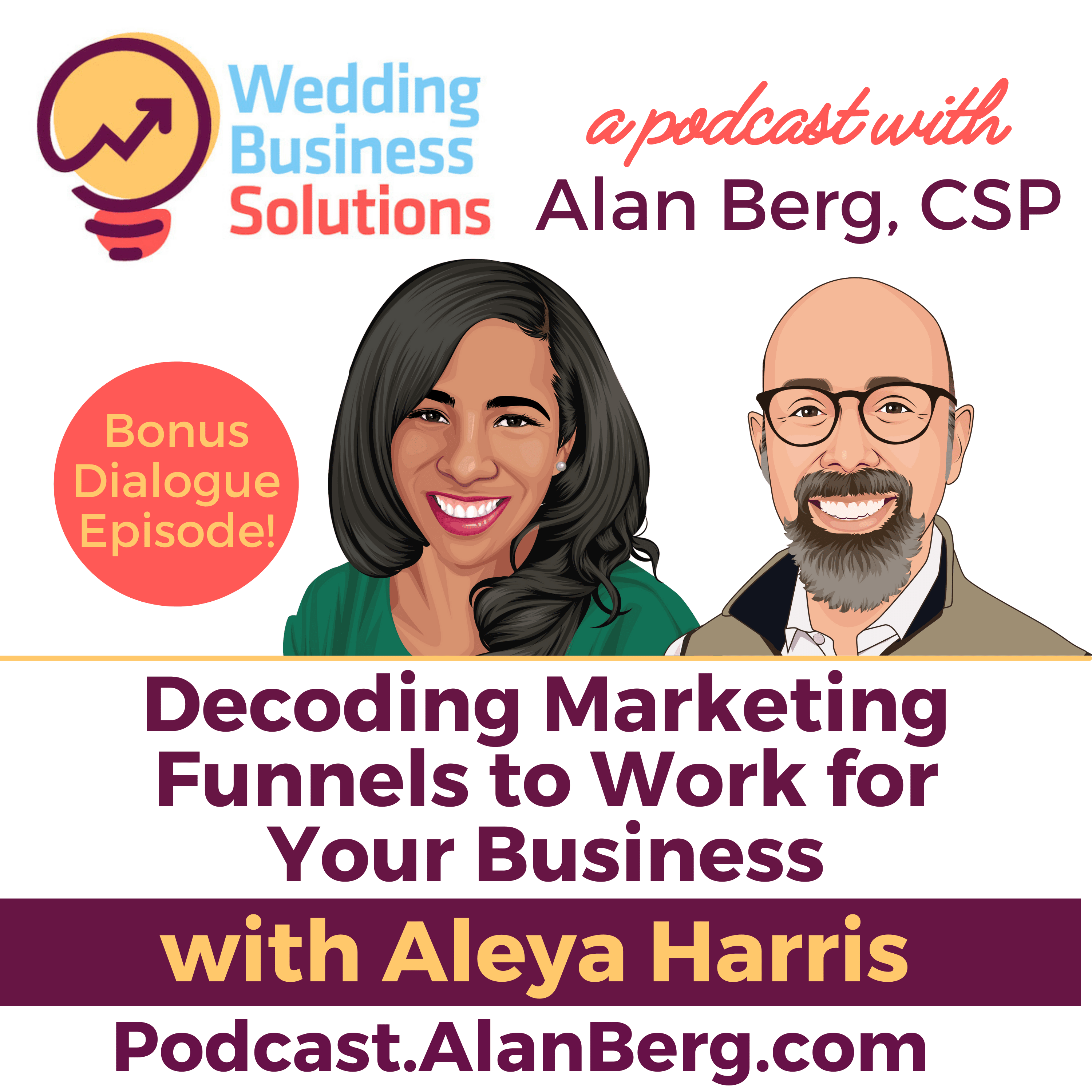
 Aleya Harris – Decoding Marketing Funnels to Work for Your Business
If you’ve been paying attention to marketing for your business, you’ve probably heard about “marketing funnels.” What are they? How do you use them? Do you need to use them? If you’re confused about what they are or how you can use them for your business, listen to this new episode where Aleya Harris breaks them down for you.
Aleya Harris, CPCE is an award-winning marketer and former chef and catering company owner. She is the Owner of Flourish Marketing, an agency that provides marketing education, strategy, and tools to help wedding and creative professionals get and keep a consistent stream of clients. Aleya is a StoryBrand Certified Guide. She uses that narrative-based framework to develop clear, engaging, and highly converting marketing assets, like email sales funnels and social media solutions, for her clients. A WeddingPro Educator for 2021, Aleya also currently serves as the marketing committee chair for NACE National and is the proud founder and head of the NACE Black Caucus. More recently, Aleya was honored as the 2020 NACE Emerging Member of the Year, celebrating her commitment and dedication to the organization. She has received the Certified Professional in Catering and Events (CPCE) designation to add to her list of accolades, which also includes being a StoryBrand Certified Guide.
Topic: Decoding Marketing Funnels to Work for Your Business
Name Pronunciation: https://www.dropbox.com/s/sn6cho8vf5j1sv8/Name%20Pronunciation%20-%20Aleya%20Harris.mp4?dl=0
Website: https://www.flourishmarketing.co/
Facebook: https://www.facebook.com/flourishmarketing.co/
Instagram: https://www.instagram.com/flourishmarketing.co/
Speaker Kit Link:https://weddingindustryspeakers.com/speaker/aleya-harris/
Listen to this and all episodes on Apple Podcast, YouTube or your favorite app/site:
- Apple Podcast:
- YouTube: www.WeddingBusinessSolutionsPodcast.tv
- Spotify: https://spoti.fi/3sGsuB8
- Stitcher:
- Google Podcast:
- iHeart Radio: https://ihr.fm/31C9Mic
- Pandora:
Below is a full transcript. If you have any questions about anything in this, or any of my podcasts, or have a suggestion for a topic or guest, please reach out directly to me at [email protected] or contact me via text, use the short form on this page, or call 732.422.6362
Please be sure to subscribe to this podcast and leave a review (thanks, it really does make a difference). If you want to get notifications of new episodes and upcoming workshops and webinars, you can sign up at www.ConnectWithAlanBerg.com
– You’ve probably heard talk of Marketing Funnels. And some of you were thinking, what the heck is that? You’re going to want to hear this episode to find out. Welcome to another episode of the Wedding Business Solutions podcast. I am so proud to have on my friend Aleya Harris from Flourish Marketing to tell us all about Marketing Funnels, Aleya welcome.
– Thank you so much for having me, Alan. It’s an honor to be on your show.
– Well, it was so good to see you in person briefly at the Catersource and Special Event Show Conference, walking in, it’s always the two ships passing in the night, but at least it was a person passing in the night.
– Exactly.
– There’s always talk online. I get emails every day about it. I see people posting online and talking about Marketing Funnels, talking about Marketing Funnels. And I know that there are so many people out there that are thinking, what the heck is that? Or they kind of have an idea cause they’ve seen that graph or something or some info graphic on Marketing Funnels. And they’re like, I still don’t get it. I don’t know how that would affect me. So the wedding and event industry, give everybody just the really quick background to show them how you know the industry and how you got to here.
– Oh, sure absolutely. So I started off actually in the Cosmetic and Fashion Industry and that was not for me. So, and luckily the universe realized it wasn’t for me cause I got laid off. Then while I was at home, I couldn’t figure out what to do because I was applying for everything. And I ended up just scrapbooking and cooking all day. And one of my friends is over eating at my house. She said, you should go to culinary school. Now I am hoping she gave me that suggestion because the food was good and could have been better. Not because the food was super bad. So I did, I applied and I ended up going to the Le Cordon Bleu for two years. And while I was there, I became the owner of a catering company. And I also started a private chef branch of that company, my very first kind of four raise and two catering. I’ve done weddings and events, and I’ve also traveled all over the world as a chef to different celebrities and movies and music in the screen. So that’s how I started. But then when I was traveling all over the place, you’re kind of at their beck and call. So it would be like a Monday and they’d be like, we need to go to London on Thursday. So you couldn’t really plan your life, your own life. And I realized that I wanted to have an empire and I couldn’t do that while being a part of someone else’s, right? So I was like, well I need some time, something as a transition. So I ended up working at Google as a vendor partner on their food team. And we had those higher level conversations I had was a Regional Marketing Manager with my region being the United States. And then I was like just a small, just a small channel. And we dove into like sustainability and behavioral sciences and behavioral economics and the future of food. And I love that as well. And I became then the head of marketing for North America for my parent company, which was the one of the largest corporate food service and facilities management companies in the world. And then I got there and I was like, this is great. Paycheck is great. Not going to lie. However, I’m super far removed from the food and the people in the events and the passion and the love and all of that stuff, which is what I love to begin with. And I’m not really building my empire. I’m still building somebody else’s. So that’s how I got, I started Flourish Marketing while I was still the head of marketing for North America for the other company in my corporate gig. And then I got laid off from my corporate gig and I had a choice. I said, okay, well I thought this works clearly I was not listening or doing something because when I was in corporate, this is what my prayer to the universe on it. Something like this, hey universe, I started this other company, you know about it, right? Okay, cool, I don’t want you to have me lose my job until I have like all my credit card paid off. All my student loans paid off six months of saving. I’m making double or triple what I’m making here. Like cool, and we’re going to do that in like three months, okay? Thanks so much.
– Yeah.
– It didn’t quite work out that right.
– Really surprising, shocking, I’m very shocked.
– I was shocked. I am genuinely shocked, but I had a choice and I said, well, I could go and get another gig or I can do Flourish Marketing full-time and that’s the decision that I made and I haven’t looked back. It was, we made six figures in our first five months and we’ve been just rolling on from there. And I did that with a Marketing Funnel. So that’s why I’m super passionate about talking about Marketing Funnels to folks in the wedding, catering and events industry, especially because this is usually clients come to me and they say, oh, I need more clients. I don’t have any clients, if you’re in the wedding boom. And they were like, put me on Instagram, that’s it. That’s all I need. That’s all I need to be successful. That’s where I’m going to find all of the clients that I’m going to go ride off into the sunset. And I’m like, that’s not going to work. You need a way to attract, convert and close those clients. And once they get that aha moment, that marketing is a continual process where you should be always audience building and growing. Then they start to kind of relax a little bit. It’s not this feast and famine mentality because they have a strong Marketing Funnel.
– Right, and that’s what many people do see then pass because as you know very well in the wedding and event industry, most people don’t come in with the business skills. They come in with the craft skills. So as a chef, you come in with chef skills and as a photographer or videographer, band, DJ, florist, etc, you come in with those skills. And so many people bootstrap it. And now I need Instagram is a very, very common thing because it’s the flavor of the day and that they’re going to need fill in the blank. They’re going to need Tik Tok. Are they going to need Facebook or whatever it is. It’s interesting because on the podcast I do something, a series called The Pivot with people that have pivoted into the industry out of the industry, whatever. And this could easily be one of those episodes, but I want it to be, I didn’t want it to be because although I can relate very well because I got downsized as well, except with me, I didn’t have my other gig going. So I was thinking about what I might want to do some other day and then getting the push.
– Yeah, that day was, the day all of a sudden, right?
– Yes, it was the, you don’t work here anymore. Give us your keys, give us your credit card. And there you go. But what I did is I said to my wife, if I can’t look in the mirror and tell that guy how to start and run a successful business, then no one should have me help them with theirs.
– Absolutely.
– That’s what it is. And we practice what we preach. And that’s one of the things I love about you is you’re doing it. You’re not just telling people what to do. It isn’t, those who can do and those who can’t teach.
– Those who can’t teach, yeah, true.
– Not that kind of thing there. So the concept of always marketing, yeah. We are in kind of a wedding boom. And I’m not sure exactly when this is going to drop, but weddings are recession resistant with the exception of the COVID recession, because that was completely different.
– Exactly, right.
– Being told you can’t do your job is different than the economy, the stock market went down.
– Exactly.
– Housing prices went down. It’s completely different. I’ve been in the industry over 25 years. And it’s the first time that that’s happened. We’ve survived everything. And you know what, we’re surviving this.
– Absolutely.
– Some people are more bruised than others.
– Yes, it’s true.
– I was with a client yesterday, a rental company. And they had a phenomenal year last year because people needed tents. And just to be outside other clients who are venues are expanding because unfortunately some venues are closing down and real estate in some places is up and in commercial it’s down, which gives opportunities for people. So there’s always opportunities.
– There’s always a silver lining.
– Right, but the idea of, I don’t ever want to slow down is because I’m always marketing. That’s what it is. We don’t, I’ve spoken about creating your own personal recession and that’s the not realizing why you’re as busy as you are and taking for granted. And then you can’t play catch up in the wedding industry.
– No, you can not.
– If you don’t have next whatever books, it’s really hard to do that. So let’s talk about the concept of Marketing Funnels. You talked about, you’re always marketing, you talked about audiences and stuff like that. Give the, and we don’t dumb down to our audience here, but we talk straight to them in a way without the jargon, because we’re not dealing with, if you’re talking to ad people, we can talk jargon all day long, but let’s talk to wedding people. What is Marketing Funnel?
– The Marketing Funnel is the tool you use to attract, convert and close deals with your clients. It’s a tool that allows you to take control over your revenue, as opposed to just rolling with the punches of what whatever’s happening. So if you’re in a wedding boom, that’s an external force that is now artificially heightening the amount of clients that are there, but a boom is called a boom for a reason. What happens when the boom is it has boomed. What happens when the boom is gone, you should be able to have that consistent audience building. So I’m breaking into a very simple funnel, some funnels they say there’s seven sections. There’s five. I see three sections, attract, convert and close as large chunks. and the top, you’re attracting your ideal client. And you’re doing that by getting out into the world, you use techniques like public relations, guest podcasting. I don’t know. Just for example, you can run ads, the things that will have you, where your audience is hanging out. Because often people say, I put up this beautiful website, why don’t I have business? Well it’s because your audience is not hanging out on your website. They’re hanging out in Facebook groups and networking opportunities, at conferences on other people’s blogs and websites that are more established and have a larger authority on the internet than yours does.
So if I were you, I would pick one main way to start attraction, in the middle you have conversion. This is where yes, you can use your Instagram and your socials. Should you choose to do so? Your relationship building, your goal is okay. Now I have your attention. Now my goal is in the old marketing adage. I’m trying to get you to know, like and trust me, this is who I am. This is the problem I solve. This is how I solve it more uniquely than someone else. And this is how you buy from me. That’s what is happening in the middle that happens on your own blog, on your own website. It happens on your social media. My favorite place for this to happen is in your email list. A strong lucrative email list is a huge aspect of creating a strong funnel and an audience. Recently I’ve been dealing with some drama Alan. My Instagram, my @Aleya Harris Instagram was deleted by Instagram. We’re talking thousands of followers, years of posting daily quality content and reels. Poof, gone, no warning, no real rationale. They just send you to their general terms and conditions. I don’t use bots. I don’t do any crazy weirdness, just gone. And while I am trying to get it back. And I’m a little bit angry about it. I’m not going to lie. I am still a little like hashtag unbothered because I have my real audience inside of my email list that I can control. I’m not borrowing their perspective. I’m borrowing their viewership from Mark Zuckerberg. I have that asset.
So if you’re trying to attract them, you can use like a lead magnet that you’re putting out in an ad, and then you’re converting them into your email list. And then you’re emailing them with regularity. Closing them, involves all of the closing elements that you might think of, whether it’s getting them on a discovery call and having a clear discovery call intro call quote, process that you walk people through to vet and find a match. Whether it’s having a clean and clear proposal, not just like, yeah, I’ll shoot you an email and I’ll have some random pricing in it. And a photo of flowers. Like I’ve seen those subordinates, like girl, what are you doing? That’s not going to close anybody. It could even be closing them using your email list and having emails, sales letters go out periodically to support promotions, engagement, season, wedding, season and referrals. So again, attracting, converting and closing your audience is a consistent way of marketing. So you should always be working on public relations, always be going out there and attracting, always be emailing and posting on social, on a consistent basis and always refining your buyer’s journey and buyer’s experience. So by the time they get to close, it’s like, okay, just tell me how much it is. I got, I’m clearly already going to book with you. And I kind of know, just like where’s the contract. And that’s what happens with me often when I get people on discovery calls. It’s so funny. Cause they usually come from my email list and I emailed with regularity and they get on and they just start talking about their day. Like we’ve known each other for years. I’ve never talked to this person before, right? And there’s so cool.
– you actually have.
– It was been a one way conversation, right?
– You you’ve been the only one talking, but you do get, if you’ve done it well, I heard your voice and they understand you. So the reason that it’s called a funnel is what Aleya just described is in a V-shape because the largest audience is the one that you’re trying to get yourself in front of. I call it the sales circuit, I add these little cards over there. So it’s getting their attention, getting the inquiry, having a conversation and making the sale. It’s the same thing. It’s just the round shape instead of a funnel shape. But you have to be in front of your target audience where they are, meet them where they are. And then you have to get them to want to find out more, to make the inquiry, to get the conversation and so forth. It’s the same thing. The idea of a Marketing Funnel. If you’re familiar with a real funnel, like you would use a funnel is a V, right? There’s more people at the top. There’s less people in the middle and there’s less at the bottom. And the truth is we don’t want them all.
– No, we don’t
– We don’t want them all. Whenever I’m working with somebody and they’re talking about whether they want to get into speaking or they want it, they’re doing more weddings or more events. And I was like, well, who’s your target audience? Let’s get the avatar, right? Let’s get our geographics, demographics and psychographics. And I was like, well, anybody who was getting married, I’m like, hey.
– No.
– You’re really don’t want everybody who getting married. I can’t think of anybody who wants that. Like, target doesn’t even want that, right?
– No, no.
– Target doesn’t want the Walmart customer, right? Target wants to target customer.
– Right at David’s bridal. I mean, they’ve bought some high-end lines, right? And they have the low lines and stuff, but they’re still people they’re missing on both hands, right? Certain people and they’re missing on both ends. So the idea is, I think the biggest challenge in what you described is that email list in the wedding industry, because where do you create that? I’m actually speaking at a Wedding Show. Now I normally speak to Wedding Show vendors because that shows, but I’m actually speaking at a Wedding Show for the first time.
– To couples.
– To couples.
– Oh, wow.
– Well, all right. I’ve written articles for wedding magazines in the past. I’ve published two wedding magazines, but I’ve never spoken to couples. So it’s going to be interesting for me. Cause there’s nothing for me to sell them, right?
– Right.
– But he said, I could have some famous celebrity planner come and talk about their multi-million dollar weddings or I could have somebody give them practical advice that used to be vice president at the Knot, right?
– Right, right, right, right.
– So the idea here of, at a Wedding Show, the least 10%, at the most 10% of those vendors will use that list. Would you and I, you want to pull your hair out and you’ll start looking like me. It’s so frustrating.
– I know, and I have a lot of hairs that would take me a while.
– Yeah, if you’re listening, which most people are listening, they’re not watching. If you just go on YouTube or you just look at the graphic that I have up there, she’s got a lot of hair. It’s beautiful hair. It’s a lot of hair.
– You’re right, someone who doesn’t use an email list, I would be completely bald skin baldheaded.
– Because that audience, and this is what Aleya said, right? The attracting is that audience has chosen of their own volition to come on that day or days to that place. Cause they need stuff. Now they may not need your service, but you don’t know that they, but they came, they are buyers maybe today, maybe not, but there are buyers. And to me to not use the list is to take money and just throw it out of the window.
– Yeah, pretty much.
– Throw it out the window. It’s just learning how to do it well, right? What to do, like if you send them to your website, did you send them to your homepage, no. You send them to a landing page for that Show and stuff like that. So you do have this combination of, yeah. If I put up a website, that means nothing. Because if nobody knows it exists, that means nothing. So in the wedding industry, give me some examples, some of your clients, what are they doing either to generate the list or what are they doing to move people through the funnel, from whatever they’re doing, whether it’s wedding wire, the Knot, Facebook, Instagram, whatever, Google, SEO, whatever, what are they doing there? And how were some of them using a list? Because we know again, creating that generating your own list.
– Right, you need to generate your own list, absolutely.
– Aleya talk about that.
– So when you are generating a list, actually, regardless of industry, you need to know exactly what the pain points are of your ideal client. Going exactly back to what you were saying. And then you create something that is so juicy. So irresistible, that’s free that you give away that gives your ideal client a quick win. That thing is called a lead magnet. I think it’s quite appropriately named. It could be a quiz. It could be a PDF. It could be a video series. It could be a master class. There’s lots of things that it could be, the top 10 things to do when you first say yes, right? To make sure your wedding goes off without a hitch or something like that, or a quiz. What is your bridle style or what is your wedding style, a quiz? What are the perfect colors of, your perfect wedding colors to match your Zodiac sign? You can, if you’re into the woo couple, that is like going to have crystals and Sage in their wedding. And it’s going to be like out in the great outdoors. Like that could be a perfect option for you. But the whole point is that you’re going to give them information that allows them to have a clear understanding of one of their pain points and brings them closer to working with you.
– Well, let me hang you right there. You’ve said something very important. I want to make sure people heard this. If you’re looking for that woo client that’s into crystals and stuff like that, you have to know your target audience. You can’t put out the top 10 wedding songs or something that’s very generic. I mean, if you’re a DJ, that’s fine. If you’re a band, that’s fine, but you don’t want, your lead magnet has to be the right magnet for the right audience. It’s like fishing. If you’re looking for sea bass, it’s a certain bait. If you’re looking for brook trout, it’s a different bait. So that thing that top 10 and by the way, how tos, right? How to whatever, you go onto YouTube people search that way. People go to Google and search that way. How to whatever, top tens people love top tens. And please don’t make it the top 50. Cause they don’t want to read everything. They don’t want to read your 50. Okay so your pain point, knowing what problem you solve, what pain there, because people act faster to eliminate pain and negatives than to get positives. The lead magnet speaks directly to that language of your target audience, whatever that is. And this can be evergreen stuff, right? This doesn’t have to be last week’s top 10.
– No, and it shouldn’t be actually the amount of effort that you’re going to put to create it.
– Right.
– Have it last for a long time.
– Right, and that’s what evergreen means is you can use it next week. Next month, next year, it’s still relevant to your audience. It’s not getting stale. You’re not taking day old bread. We’re doing that, okay. So now we understand the pain point. We understand who our target audience is. We have this lead magnet, where do we put the lead magnet? Where does the magnet go?
– Everywhere, so literally everywhere. So you’re going to put it in your email signature. You’re going to put it in the bio, on your Instagram page. You’re going to create social media posts around it. And you’re going to also see if depending on the publication, when you’re doing a guest blog post, if you could include it there as well, that’s the more or add on your website, obviously do a pop-up for it on your website. Those are the organic free ways of doing it. If you’re trying to grow an audience quickly, you’re going to spend a little bit of cash-ola and you run ads directly to your lead magnet. And you create a landing page like Alan was talking about earlier, a landing page should also match. So there’s something called Ad Scent. And when I do ads I work with Christiane Oz, one from mountain side media, and she’s the science, I’m the art. So we do, I do the copywriting and then she does all of the brainiac stuff that she talks. And I blink a lot and smile and hope that she knows that I don’t know how to do any of that stuff, but she gets conversions for her clients. So that’s all that matters. And she will talk about Ad Scent.
So when someone is running an ad, the image and the words need to smell and look and feel the same as the landing page. So the landing page should use the same image that your ad used. The headline should be exactly the same so that when they’re moving over your dome, they don’t get confused, confusion as a profit killer, your landing page, after you’ve run these ads should also be simple. We’re not talking about a page and pages and long, and you’re scrolling forever, again what is the thing? What problem will it solve? How will it make my life better? What kind of transformation might I find from it? Also on your landing page, you’re not asking for their entire life story and social security number here. You’re going to ask for two things, their first name and their email address. The more fields you put for them to fill out the less likely it is that they will download your lead magnet. And the less likely it is that you’re going to end up with them on your email list, right?
– And by the way, that applies to any contact form you do anywhere every field you add, less people will fill it out. Every field you take away, more people will fill it out. And it’s not what you need to know ever. It’s what you need to know to get them to the next step.
– Exactly, what do you need to know right now. And I need to know your first name so that when I use the personalization code in my email service provider, I can call you by your name. People like being called by their names, and I need your email address. I can send you an email, that’s it. That’s all I need to know.
– And so they can get the thing.
– Yeah, so the answer they can get the thing, right? So I’m glad that you brought that up because that’s the very first thing. As soon as they enter in their first name and their email address and click submit or download or whatever your action oriented button text says, they should get an email right away. And that email needs to include the thing. Even if after they clicked download, there’s a redirect to that PDF or that resource, you should also send it in their email. Then you should have an automated sequence of about five to six emails that goes out that does things like hold on pain points, address objections. Your goal in that initial email sequence is to get them to the point where they are ready to work with you, what paradigm or mentality shifts they do, they need to have. So for example, say that you’re a planner and they need to know that doing it by themselves is not the way to go and they’re going to be stressed and they might even actually spend more money and they’re not going to enjoy their day. You need to paint that picture in the email sequence. So that by the time you send that last email, which is a sales letter that articulate the overarching problem that you have, it has testimonials. It goes through transformation and benefits. And has that schedule a call button by the time they get there, they’re like, oh, well, it’s a no brainer. I don’t want all that other stuff that they just finished emailing me about. So I’m going to work with this person.
– Right.
– Email is incredibly powerful, one, because you get to control the message, two, because you get to control when it’s sent and when it’s received and three, because you’re having much more in-depth data and analytics. So you can understand and craft and refine your messaging over time to have a really good messaging platform that converts with more regularity. It also as a bonus, I guess, allows you to better plan your sales. When you can understand what your conversion rates are. So once you build your email list, you got a couple thousand folks on there. You can say, okay, every time I send an email out, I do a promo every month. I’m saying something every month, every time this happens, I get a 5% conversion rate. And if I’m selling something at a thousand bucks, well, now I can pretty much understand by using email how much money I’m going to make for my email list every single month. I love it.
– Let me just pause right there. I don’t want to scare anybody. You don’t need thousands of people to like your email address.
– You do not need thousands, no. Sorry, sorry, sorry.
– Well again, your business and my business are about this small percentages.
– Yes.
– There are tens of thousands. If not hundreds of thousands of people that could be called a wedding professional in my world.
– Yes.
– I know again, we’re not talking full-time part-time whatever, just in total, somebody that does something for a wedding that gets paid for that. And I need a tiny, tiny point zero fraction of that to fill my calendar for the year.
– Absolutely.
– We were talking about how the Catersource Show this year because of COVID, it was a much lower attendance, but I had some really, really good conversations. So a small list of the right people with the right messaging can give you the conversion rate you need, because when you’re dealing with thousands, a half of percent is a lot of people. But if you’re dealing with dozens and you get one out of the dozens each time, one out of the dozens is one sale at an average of fill in the blank of whatever you did.
– Exactly, and that’s huge. That means you’re doing it right. You have dozens of people on your email list. And if you’re making those sales, it’s not only as the email efforts paid off, already paid for itself, but that also gets you motivated to keep growing it, right?
– Right.
– Cause if I’m like, wait a minute, I got 50 people on this list and I make a sale a month what would happen if I got 75?
– Right, and I can say, email lists are like sponges. I just, was doing the audio book for “Why are they ghosting me?” And I was talking about that, when you have a lead, you squeeze this list and you get water out the sponge, you get water out. And when you squeeze the sponge another time you get more water and you squeeze it again, you get more water, you might get less, but you get more. And if you stop squeezing, you stop getting, if you keep squeezing, you keep getting. And this is the persistence, that person who has filled out that here’s my name and my email has shown an interest that the other 99% didn’t.
– Exactly.
– They didn’t, now the other thing with email, subject lines, and they’re reading it on mobile.
– Yes.
– Right, so I always tell people, send it to yourself and look at it on your phone. Do you have to scroll to read it? can you click the button? Is the link, so the print so small, I had somebody send me an email the other day and it was in kind of a script, the font in a light blue. I’m like.
– I’m not reading that.
– I can’t read it. And this is ridiculous. The font was, the color. Why would you say light blue print?
– Right, cause people are trying to be cute. It’s my brand. It’s like, no one cares. If they can’t read it, it doesn’t matter.
– Right, conversion is what matters. So subject lines really important. I actually thought of you saying wedding planners and my marketing brain was going, I was thinking of five reasons. You don’t want to use a wedding planner.
– Yeah, that’s awesome.
– And inside is, number one, I want to be stressed out on my wedding day. Number two, I want to do a whole lot of work about things that I don’t know. Number three, right? That’s the pain.
– Exactly.
– Is creating the pain. That’s my marketing brain. If you’re talking and I’m already creating emails.
– It’s like and I already have the lead magnet here done, we’re going to just pump that up for this client.
– There we go. There we go. So is it, you need to move the people through. And then you said also something important was you need to pay. And I tell people they need to pay because you’re trying to get in front of an audience that’s not yours.
– Yeah.
– You don’t own that audience. And when you buy an ad, you’re buying access to an audience. You’re not buying an ad. The ad is a means to an end, right? You’re buying access to that audience. You said, go where they are. Well, you know what? Facebook is there, sandbox it’s their toys. Instagram it’s their sandbox. Look what they did to you.
– Exactly, look at what they did to me Alan.
– Look what they did to you. How dare they do that to you. But I’ve said this for years. If you put all your eggs into a basket that you have no control over and no recourse by the way, because it was free.
– It was free, what am I going to do? Say, give me my money back. What am I going to do today?
– Yeah, you were getting a hundred percent of your money back. A hundred percent of your money back. There you go. So we want to move them the idea again of the funnel, but you have to keep putting in the top of the funnel. So that’s the metaphor of the funnel. You said that continuously feeding the beast.
– Yeah, feeding the beast.
– Continuously, feeding the beast and then landing page. Again, some people may not be clear on that. A landing page is not your homepage.
– No.
– Right, it’s another page on your website. Usually a hidden page, which just means the only way to get there is through that ad only way to get there through that link. It’s not something super secret that you need the NSA for. It’s just the page. If I go to your homepage.
– No passwords involved.
– Yeah, we don’t need Snowden or somebody there to go find that. But that’s all it is. It’s just a page that the only way to get there is through that source, through that funnel, through that email, through that link, whatever we’re working through. And then you don’t know that people are interested until you get that message that says, hey, somebody filled out this lead magnet. And that’s when your work starts. The drip campaign is again, another way to talk about it. When you send these emails to go out and intervals, they drip, drip, drip. That’s just another phrase. That’s an industry phrase for stuff like that. And then that tell us about that sales letter because sales letter sounds like old school.
– It is actually, and you know why it’s old school, because it works. You don’t have to reinvent everything people, sometimes stuff just works and we’ve cracked that code. Let’s move on, right?
– Right.
– So a sales letter, okay, let me explain. It is not a hand letter. It’s still an email is what we’re still talking. We’re still talking about an email.
– Right.
– It starts off by talking about the problem. It talks then about, what is your unique solution like? And by the way, we’ve solved this also, And it gives a testimonial, talks about your package options, has a very direct call to action. That’s listed at least a couple of times, at least twice inside of the body of that email. So you’re not being passive aggressive. It’s not like I told you all of these wonderful things. I mean, and then you go work for with me if you want to, it’s like, no, let’s get this connect, click here to book a call. If you don’t ask the answer’s always no, that is absolutely right Alan for those that are just listening, just held up the sign. And that is absolutely right. You need to ask for the sale, you need to have clearest calls to action. And then truthfully, my favorite part of the email is the P.S. That is where I get almost all of the link clicks. I’m like, but I’ve written like War and Peace up there. Like this is good stuff. And no, they won’t read it. They’ll read those skim, but they’ll get down to that P.S., in that P.S.section, you recapitulate the main idea of your email. Hey, we’re running this promo right now, click here to buy, promo ends. You want to make sure you get to this level of success. You get this thing am I let’s reduce the stress on your wedding so you can love your engagement and not be worried, right? Click here to book a call today, right? You recapitulate them the whole email right there with some sense of urgency reiterated. Because otherwise what happens is that they’re like, that’s nice. That seemed like a nice planner or florist or caterer. I’ll just file this.
– Right.
– They’ll never come back to it. They’re never going to buy. So that’s.
– Sorry, hang on. So we have to be and I love P.S. I actually just wrote in the book because people, I say one of the biggest reasons you’re getting ghosted is you asked for the phone call right away.
– Right.
– You haven’t earned that yet. You haven’t earned that. And that’s why they ghost you. But if you put in the P.S., hey, would you like to have a call or a Zoom meeting? Put it in the P.S. It’s the soft, Hey, I’m not asking for it. But if it’s easier for you and they will read it because it is a P.S. because they scan that. So I’m picturing this letter, right? I’m actually a eight and a half by 11 on letterhead, right? This is an email letter and it’s long.
– Yes, or doesn’t have to be too long.
– It’s longer than the other ones. The other one should fit on one screen pretty much, right?
– Yeah.
– This one can be longer. But do you find that more people will get down to that P.S. because you already have this kind of little relationship going?
– Absolutely, well, P.S.is gold regardless. So people will like, literally did not read any of that. And it doesn’t matter how long or short it is and get down to P.S. But yes, I do find still long email, short emails that P.S.is strong, but you also have to be careful that you don’t use it in every single email.
– Right.
– Right, so like you use it when it really counts or you tend to use it in the first email, in the sequence and like the last email on the sequence.
– Right.
– So because the first email of P.S. that is usually, follow me on Instagram. Let’s connect. Let’s make sure that we’re, so increasing the amount of visibility that you have with them cross platforms. And then the last email it’s like, no, really buy, another thing that you can.
– Wait, wait, wait, Sorry to interrupt here. So not really buy, works for some businesses, not others is no really buy here mean now tell me that you want to talk to me about your wedding.
– Yes, so it’s like, buy now, like book the call, schedule a quote.
– But not buy that. I just want people that are to like, it’s not like click here and buy your photography, click here and buy,
– No, no, no, no. That’s not the button text. It’s you usually schedule a call, get a quote.
– Okay, I just want everybody to be clear. I know what you’re talking about with that.
– Thank you for slowing me down.
– But there are people, if you’re doing an e-commerce, are you doing something more like that where they can actually buy you, would be asking for the sale there.
– Yeah, the button would say “buy now.”
– Right, like for me, the new book comes out. I will have a P.S. I’m sure that P.S. if you haven’t seen my new book is out, click here to buy it. That makes sense. You’re going to go to a shop, to buy here means, right now you actually haven’t been speaking to them. You’ve been sending them messages that they’ve been reading. Otherwise they wouldn’t see it, right? They wouldn’t seeing it. And now the letter is, this is the next step.
– Yeah, absolutely, this is the next step that you want to take in order to achieve success and avoid failure. That’s the meaning.
– Whatever that means..
– Whatever that means for your business and for your ideal client.
– Right, and it’s being clear as to what the outcome that they want is if you’re a florist, if you want to have beautiful flowers that look and smell as good as whatever match your theme, or you want to have a dress that has all your friends being jealous, whatever it is, it’s that click here to make an appointment, may have a call, do whatever that is.
– Exactly, and I’m glad that we’re talking about this button language in more depth, because a lot of the times I see like “contact us” and it’s like,to do what? like, what am I doing? That’s again, being a little too passive aggressive. You want to be direct.
– Okay, so there’s my next side it’s ambiguous.
– Ambiguous next steps bring ambiguous results is what Alan’s newest sign says. And that is so true. It’s your job to help them navigate the relationship with you and as cool as you are and friendly as you are. And yes, we’re talking about love and all of that good stuff. You were building a lucrative relationship and it was a transactional based relationship. And you are in charge of helping them navigate through that relationship with your understanding of what the buyer’s journey is and what your process is. If you kind of leave it up to them, then they don’t know what they’re doing. And you’re actually being a little mean, but that’s what you’re doing because you’re assuming that they know like, yes, I book the wedding planners every day. I book a caterer a weekend. I know exactly what to do next. They have no idea. So now they’re confused and they’re frustrated and confused and frustrated people do not give invoice payments. That’s not how that works.
– They don’t take action. They don’t know what to do. You don’t want to create friction. I often refer to a book called “The Convenience Revolution” by my friend Shed Hyken. And anytime you add friction, they’ll go someplace else. Anytime you add in ambiguity, they don’t know what to do. So now they’re just floating in the ocean over there. So, all right, we’re going to run out of time, but I want to talk about this. How many of these lead magnet, of these emails, these drips until the sales letter.
– I do about five. Your emails zero, your first email, that’s delivering the thing. And then I do four to five emails with the last one, always ending in the sales letter.
– Okay.
– What I will say is, not everybody’s schedules a call on the sales letter. So don’t stop emailing them. You don’t know where they are in their process. I have other people on my email list that have got on there like two years ago. And now they’re just, now. Oh, I want to schedule a call. And I’m like, whoa. And I go in their history. They’ve been reading the emails. They’ve been clicking on links. They’ve been exploring, but they just weren’t ready yet. So you aren’t sure exactly when you’ve captured them. So then after that initial sequence, you should be emailing your list out every single week with a blog post, a quick tip, a little video, right? And then every month or two months you’re sending out another quick sales letter to a nudge toward the sale, because you want to balance relationship building with moneymaking.
– Now we talked about not adding any more fields, but theoretically in the wedding business, if they told us when the wedding date was, we might know when to be targeting or when to stop. Would it be terrible if we asked you for your first name, your wedding date, and obviously if you’re venue, they don’t have a date, they don’t have a date until they have you. But if you are a florist, let’s say asking for the wedding date, we know that adding one more field might get less people to fill it out. How do you feel about that?
– It’s not terrible. Another way to do that is through a different sequence in your tagging and timing. So you can set up inside your email service provider, like MailChimp and constant contact. Those are not my favorite. I prefer ConvertKit and or Flodesk, but pick your poison. Inside there you can tell that service using tagging to say, if after someone’s been on my list for six months or more, and they haven’t been tagged as a customer or a client, send them this additional sequence that asks them things like, have you gotten married yet? If so, click here. If not click here. And then, if so they’ve already gotten married and didn’t book you. Well, that means that maybe there’s a baby shower. Maybe there’s an anniversary party. Maybe there is a birthday party, maybe. So then you’re still marketing to them, but you want to always make sure you’re sending relevant information. So there are times when you need to, again, take charge of your audience and shift what they’re hearing based of how they interact with your content.
– Right, so again, if we can get to the point where they’re going to tell us, and we always want them to tell us yes or no, because no answer is the worst answer, because we don’t know if they need it or not. That’s the whole point of my book. Why are they ghosting me? You’re getting answers from some people. You’re not getting answers from a lot of people and those people might still need you.
– Exactly.
– So don’t stop asking.
– Don’t stop asking and don’t stop emailing. If they don’t say anything, you’re just going to keep emailing them just like before.
– And if your email sequences aren’t working the way you want change the subject line, change the content. Don’t say this doesn’t work. This does work. That’s why Aleya is here. This does work. It does work for anybody in the wedding and event industry. However, you have to be able to get in front of the audience. You might have to make an investment, you will have to make an investment, certainly in time.
– Yes, certainly in time.
– Probably in money.
– Probably.
– Depending upon your need. But it’s all about return on investment. When I do a mailing, a physical mailing, whatever, I need one sale to make it work. How do you not try something? When one is your winner, one is your conversion, right? And for most people in the wedding and event industry, you can make those numbers work for you. Where one is the wind. You don’t need 10 people to book. You might want them, but you don’t need them.
– You don’t need, right. And the average ROI that I most recently saw for 2021 was that for every dollar you spend, you make on average $42 with email marketing.
– That’s better odds than the lottery these days, right?
– Exactly, so again, why would you not?
– Right, exactly, all right. So let’s recap here because I know that you have to go and I have to go and everybody listening here could,. If they’re like me, they want to keep listening, but we’d like to keep these short, which we didn’t do already, but the funnel picture the V picture of the funnel. You need to keep feeding the top of the funnel so that you get to the people in the middle, who are showing interests. So you can have the conversations to turn into the one you want, which is the phone call, the in-person meeting, the Zoom call, whatever that is, because if they’ve made it through that far, they do feel like they know you and they are way better qualified than somebody that just started at the top where, yeah, I want your free thing. You’re going to get people want your free thing that are never going to book you.
– Yeah.
– But you got to kiss a few frogs, right?
– Absolutely. All right,
– So Aleya, if people want to know more about you, we’re going to put it into the Show notes, but they want to know more about you. Where’s the easiest place to go?
– You can head over to our website, flourishmarketing.co.
– Flourishmarketing.co.
– And when you’re there, there’s a resources section with a bunch of freebies in there. And spoiler alert a bunch of lead magnets.
– Practice, what you preach, girl.
– I practice what I preach that. I mean, we have quizzes and guides and videos and all kinds of cool stuff there. You can also find me on LinkedIn. My company is on Instagram, but as we’ve covered, I am no longer on Instagram, but you can follow @flourishmarketing.co on Instagram.
– Excellent, we’ll put it into the Show notes. Any other stuff you want to have over there? Thank you so much for joining me. And this is the longest conversation I think we’ve ever had.
– Oh, yeah, I think you’re right.
– We’re always passing in the hallway or something We’re always doing over there. Thank you so much for joining me and just dropping all this knowledge on my listeners here. And we have to do this again.
– Absolutely, this has been a blast. Thanks so much for having me.
I’m Alan Berg. Thanks for listening. If you have any questions about this or if you’d like to suggest other topics for “The Wedding Business Solutions Podcast” please let me know. My email is [email protected]. Look forward to seeing you on the next episode. Thanks.
Listen to this and all episodes on Apple Podcast, YouTube or your favorite app/site:
- Apple Podcast:
- YouTube: www.WeddingBusinessSolutionsPodcast.tv
- Spotify: https://spoti.fi/3sGsuB8
- Stitcher:
- Google Podcast:
- iHeart Radio: https://ihr.fm/31C9Mic
- Pandora:
©2022 Wedding Business Solutions LLC & AlanBerg.com