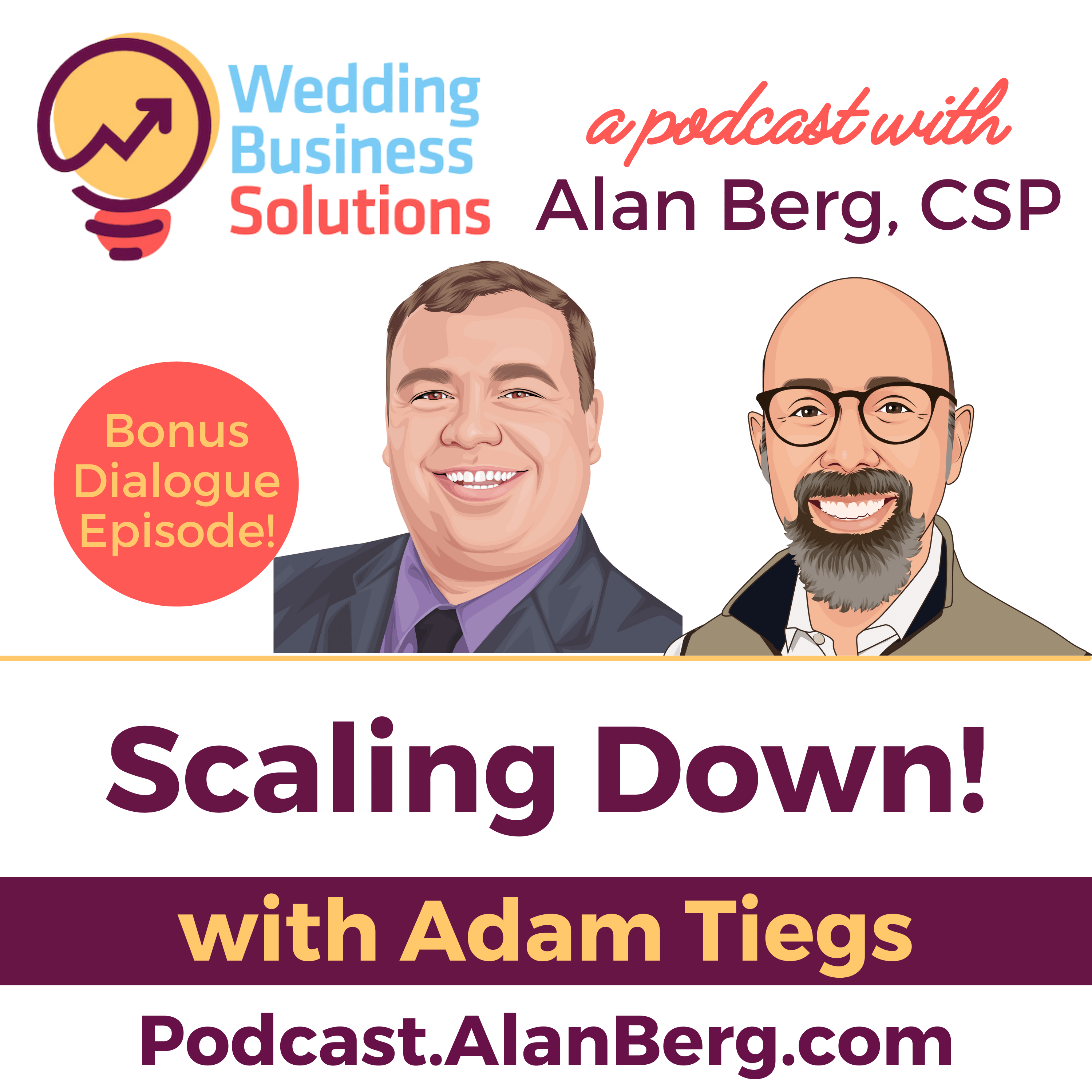
 Adam Tiegs – Scaling Down
Many of the businesses I come across are looking to grow, whether they’ve been in business months or years. Every so often I come across someone who’s in a different stage. My friend and client, Adam Tiegs grew his business and then decided it was time to scale back. I’m sure many of you can relate to feeling that it’s time to scale back.
Listen to this episode and see whether scaling down is in your future.
Adam Tiegs is a Professional DJ and Audio/Video/Lighting Swiss Army Knife. He runs two small businesses, Adam’s DJ Service and NW Event Lighting, and currently resides in Milton, WA. Since 2003, he has had well over 2000 opportunities to display his passion for mixing music and helping clients plan successful social and corporate events.
http://www.nweventlighting.com
Listen to this and all episodes on Apple Podcast, YouTube or your favorite app/site:
- Apple Podcast:
- YouTube: www.WeddingBusinessSolutionsPodcast.tv
- Spotify: https://spoti.fi/3sGsuB8
- Stitcher:
- Google Podcast:
- iHeart Radio: https://ihr.fm/31C9Mic
- Pandora:
Below is a full transcript. If you have any questions about anything in this, or any of my podcasts, or have a suggestion for a topic or guest, please reach out directly to me at [email protected] or contact me via text, use the short form on this page, or call 732.422.6362
Please be sure to subscribe to this podcast and leave a review (thanks, it really does make a difference). If you want to get notifications of new episodes and upcoming workshops and webinars, you can sign up at www.ConnectWithAlanBerg.com
– Okay. When I talk about scaling on my series for scaling businesses, most people think of scaling up, but my next guest has also scaled his business down on purpose, and it’s something that you might want to do to rightsize your business. Listen in. For my series on scaling, I wanted to not just have businesses that have scaled up, but also businesses that have rightsized themselves. And my next guest is a friend who has taken his business up and then back down on purpose, Adam Tiegs. Adam, how are you today?
– Hi, Alan, how are you?
– I’m doing great. Thanks. And when I started this series on scaling, I immediately thought of you because years ago, I can’t remember how many years ago, you and I had the conversation when I was out there on the West Coast, and you were talking about taking your business, that you have built up a DJ business from just you to what was called a multi-op. And then you said, “You know what, I’m going back to just me.” And we talked about what you needed to do with that time. And we were talking about your website and everything from the way you dressed to your business cards and all that stuff. So give us the history here. When did you start your own entertainment company?
– Instead of we, it was I, right? Right, when was that? How long ago was it I to begin with?
– Well, 2004 was the official first year of the business. Adam’s DJ Service was born really out of attending other weddings and being a closet or a bedroom DJ is what I like to call it. But just seeing other people and their lack of skillset compared to what I had and even got into shadowing other people at that point in time, and it really steered me into, hey, I need to do this. This isn’t just a hobby. This is something I can not only make money doing, but something I have a passion for and would like to do better than all the other people out there.
– Were you DJing someplace before that? because you said you had skills. So was this like a-
– Like I say, but college was at, ’95 was the year I kind of started learning what a crossfader was and how to hook up equipment. I’ve always been a gear junkie. I tell clients that I’ve been collecting music since the ’80s, DJing since the ’90s, and doing it professionally since the early 2000s. The other thing I tell them now, and this is kind of something I use to go into what we’re talking about today. Like Justin Timberlake went solo and left NSYNC, I decided to do the same thing. And about 2010, 2011-ish was when we went back from a multi-op to just me being a solo artist, so to speak.
– All right, but let’s get this journey here.
– Yeah, coming back. Coming back.
– 2004, it was just you.
– Yeah, just me.
– And then how long until it wasn’t just you.
– Three years later, 2007, it got to a point to where I’m booking events, creating demand for myself and having multiple people want me on the same day. So when it got to a point to where I’m turning away a lot of business, so to speak, because I can’t take it, it was a natural progression to just say, “Let’s hire more people. I know a lot of other DJs that are looking for work, some that don’t even want their own company, they just kind of want extra work on the weekends.” And so at the peak of Adam’s DJ Service between 2007 and 2010, ’11ish, we had seven or eight guys working for us at one time. So we would do seven or eight weddings a day.
– Right, and this is what pretty much has been the theme with the people that I’ve had on scaling. It was the demand was there, and you built into the demand that was already there, as opposed to some people that have come to me and say, “I want to get to X,” but they don’t have a plan to get to X. I’m like, “Are you getting more leads than you can handle?” And they go, “Well, no.” I’ll say, “Okay, well let’s back this off here, right?” You had the demand. You’re like, “I can’t be in seven places at once, but I know six other guys, so let’s do this.”
– Exactly. All right, so now at what point were you like, “I don’t know that I want to do this anymore with all these other guys,” and why?
– Yeah. Several reasons. One, imagine you’re at a wedding on any given Saturday and two of your DJs get in car accidents. So now you’re being pulled away from your clients, and when you thrive on providing good customer service, you’re not doing that at this point because now you’re focusing your energy elsewhere on tow trucks and your wife and your other car are going to one of the DJs so they get to their event. Oh yeah, I’ve got a grand entrance I gotta go do now. Or one of those kinds of things so that the added stress of those kinds of things. The other driving factor was, again, the service factor. I’ve got guys are great people. As you know, human beings make mistakes, we’re not perfect. Nine times out of 10, they’ll do a great job. There’s that one day they bring their personal life to the event or they’re late and now that reflects badly on you and your company, not them. So I just got sick of dealing with the three or four people that were in that boat. And then the fact that as we built this thing up, if we could have kept going, we could have built this thing up to 14 DJs and doing more wedding shows. My thing was, there’s all of these, as you know, wedding shows, booths that you can buy, publications you can buy ads in and this and that and the other thing. I felt like I was spending all the money that was coming in to keep the business going, right? So when you’re doing a quarter million of business, but you’re only keeping 40,000 for your family, but you’re working 100 hour weeks, and most of that work is me at the wedding show at the booth trying to fill not my calendar, but the other guys’ calendars because mine’s already full. It just got to a point where, why am I working so hard for so little?
– That that’s actually a theme also that I’ve heard, not just in the wedding industry, but others, even in the speaking industry. There’s a group of speakers called the Million Dollar Round Table, and I know a lot of the people in there. I’m not in there, but I know a lot of people in there, and they said, “You know what? When my company was grossing half as much, or even less, they said I was netting more. And now I’m grossing more, but I’m netting less.” And that’s what you’re talking about is when I talk to people about scaling businesses, and if you’re listening here, it doesn’t matter if you’re a venue, a photographer, an invitation person, they sell dresses, you do officiating. It doesn’t matter what you do. My phrase is this, Adam, and this is exactly what you’re describing. I want to feed your family, not your ego. The idea is to profit more. Be happy doing what you’re doing and profit more. And that’s what rightsizing your business is. If your ego, and you know people and I know people in the industry that are like, “I want to do X number of events, right?” Okay, and then you end up not making any more money and you’re working 100 hours a week, and you’re like, what did I accomplish? I actually was consulting recently with a entertainment company. They did, in 2019, 4,000 events. Right, I saw your eyes go there. If you’re listening, you’re not watching this on YouTube, Adam’s eyes just opened up like huge, like.
– 1,000 in one year.
– In one year, right?
– Yeah, that’s nuts. Just try to imagine the scaling from where you were with seven people, right, to even think about getting to 1,000. Forget about 4,000, right, to get to 1,000, they’re doing 4,000 events a year. And we were talking about, “Hey, what is 2022 going to look like, what is 2023 going to look like? And what’s the right number?” Is 4,000 too many for them? Is 3,000 too many for them? Is 500 the right number, right? That’s a possibility as well, because if you can profit more, doing a smaller number of events, be happy doing it, and not spend the 100 hours. Or you know what, if you’re spending the 100 hours, but you’re profiting, and you’re like, “Okay, at least I’m making something here, right? I’m doing something.” So you got to that point, and I know a lot of people in the industry that are doing as many or more events than you’re doing, but they have their systems in place, their backend, and they’re charging for it. That’s the key is you have to be able to charge for it, and maybe not every market can be there. So when you decided to go, what year was this? You said-
– it was right about 2011. About 2011ish. I say ish because the thoughts were there in ’10, ’11 we were still there. But so here’s the ultimate push, and when the government gets involved with an audit and they find that your subcontracted DJ’s in their opinion, are employees, you have to pay back taxes and penalties. So I paid some pretty heavy monetary fines for having employees when one, they had their own gear, two, they set their own schedule. I never told them how to operate or, “Hey, you need to be here at this time.” I gave them options like, “Hey, if you want to promote yourself, I’ll be at the show this weekend, come work the booth with me if you want.” It wasn’t a, “Hey, you need to be here 8:00 AM to 8:00 PM.”
– And you’re not in California. What state are you in?
– Washington State.
– Right, so you’re not in California, but again, the rules have been getting tighter all over the place with that on employees versus-
– Contractors.
– And along those lines, a little side note, before we started recording, you were talking about how with the pandemic and weddings stopped in a lot of places, and you went and like a lot of people in the industry, you went and got a job outside the industry, and you were an employee and being treated not so well. No, not at all.
– You’re treating your contractors better than you were treated as an employee.
– And I still do. I still do. There are a couple of, I say people, that I really trust for certain types of events and certain projects. I have a guy who can do not only the audio, video, lighting thing, but he’s kind of a carpenter, he’s worked a lot of set designs and stuff like, so he always brings spare wood, screws, and his drills. And he’s prepared to level some speakers in a yard that might not be level for me and things like that. I’ve found a lot of talented people I like to work with and share the wealth, give them a chunk of the pie that I’m getting. And that’s why I don’t charge the most, but I don’t charge the least either. I’m trying to price myself appropriately.
– So let let’s talk about the conversation we had. And I think it was when you brought me to an industry event and then drove me to the train station because I was going to Portland, and then my train was canceled. And you’re like, “Hey, come to lunch with me at this event,” and we met some great people there, which is what I love about the industry, right? You and I, you’ve been my client, but you’re also my friend. I had an event and I said, “Oh,” I needed a projector and screen and we were at an event that I was doing. And you’re like, “Here, just take this for tomorrow.” This is what the industry does, and that’s again, why I think why I connected with you so well. So we had a conversation when you said, “Listen, I’m going from multi-op, again, multi-operative where you have all these seven DJs down to just me. And I had said to you a couple of things. I said, “You know what? You are now, you, the brand, not you, these seven people, the brand. Website has to change, business cards needed to change.”
– The wording, yeah. I versus we.
– All that kind of stuff. And you were also going up on price. You were going up on price and I said, “When you go up on price, people are looking at the way you dress, people are looking at everything that you do there, and that all made a difference.” So what was that transition like? Because it wasn’t just, hey, I’m not going to promote all these other people anymore, It’s just going to be me. But now you’re asking more, right? What was the reaction that you got from the industry as well as from clients?
– I think I dealt with rejection a little bit more because I did some experimentation with pricing during that time. And I was very surprised when someone would take that $5,000 package I actually had for a while. And it was what I now charge three for. It’s just amazing. I’ve done more of a focus on just audio instead of lighting and audio or even video, and it’s really pinpointed. 80% of what I do, that’s where the focus is. It’s what the clients care about most. I’m actually ditching the lighting company now. I’m not ditching it 100%, but there’s a lot of other companies that have sprung up in the last few years and I’ve met a lot more people and I trust them to do just that. They specialize in it. So why do I try to do two things? I used to kind of go off on the DJs that would offer photo booths. It’s like, dude, focus on what you’re doing. Let the other guys handle that, and now I kind of get it, but at the same time, I’m learning to kind of relinquish things that I necessarily can’t do while I’m doing my job to those other companies and involve them. And then that helps spread the money around a little bit more, too, amongst the industry.
– Do you have packages that include the lighting and the photo booth? You’re just sending them out?
– Depends on the client. Every client’s different, as you know. So when it gets to that point in the conversation, for example, the other day, I told them, “Hey, I’ll bring all the lighting you want for your event with that price, because I’ve already kind of included it, but as far as the photo booth, I can include one that’s X amount of dollars that does this and has this extra person, or spend a little bit more, I’ll just send you directly to them because I don’t want to make money off it, I just want you to see you got a good deal and work with a good solution.” I’ve got a buddy that’s got a VW bus that’s a photo booth and it’s perfect for their event. And they’re like, “That is awesome.” So it just depends on the situation as far as what we’re doing. As you know, I’m not a hard seller. I don’t push, push, push. I kind of just go, “Here’s the info, ball’s in your court. If you want it, it’s yours. otherwise this other guy wants it.” Matter of fact, I did an online meeting the other day, Alan, I had a signed contract and money in my account by that the end of the night, and again, didn’t even expect it. It was that morning I got the lead. So again, if you don’t jump on those leads right away too, you’re going to miss out on opportunities.
– But it’s also, you didn’t have to meet them in person, they were interested, they were ready to buy, and you asked for the sale. Too many people look at that and then like, “Hey, let me know when you guys are interested.” And the couples are like, “Okay.” And then they go to somebody else and they buy from them. So according to a WeddingWire survey, after the wedding, couples said that about half the time they choose the first one who responds, so timing certainly matters. But this other part about subbing out to other people, I did two webinars earlier this year about when a venue or a caterer, let’s say, refers vendors. Like if you get referred business, there are some venues and caterers around the country, not every area and at every one, that want a referral fee commission, whatever, right? And then the same thing within the industry. I know people that will sub out to that video, that photo booth, and they will give you back something for that referral. What it comes down very simply is we get business, because we put ourselves in front of audiences, we get business by advertising ourselves, marketing ourselves, networking. Like when you brought me to that networking lunch, there was a cost to come to that lunch, there was a cost of time to come to that lunch, there’s a cost to get yourself in front of an audience. It’s okay. Artists, right? You play music all the time from different artists. They have agents, they pay their agents a commission. Managers get commissions. It’s not unusual to do that. Some people always call it a kickback. If somebody sends me business and they say, and I’ve had this happen, I spoke in Mexico one time, and they said, “Okay.” I told them my price. They said, “Could you add X on top of that for us?” I said, “Sure, you’re referring me the business, I told you what I want. If you tell the client, it’s more than that and that’s your piece, I’m okay because I got my piece.” I’m all right with that. I didn’t go, “Oh, I could have had that money.” No, they referred me business that I wouldn’t have had. And in that case they were bringing me to Mexico to a five star resort. Okay, yeah, let’s go. Let’s go.
– Work-cation right?
– Yeah. Not so bad. So this rightsizing the business, you’re pretty much you, but you’re not you, right? Like you said, you have people that you could still refer if you’re either not available or you’re not the right fit, which is a very important thing that people have to remember. Sometimes you’re not the right fit and the best thing for the customer is to give them somebody else, right? I do that all the time. Like, “I’m not the expert on that. Let me get you the expert on that.”
– Whether it’s a particular style of music or yeah.
– Right. Or language, right? Somebody says, “Do you have somebody that can do Tagalog and Spanish at the wedding?” because it’s a Philippine, Mexican, whatever.
– Need a bilingual DJ. That comes up every once in a while.
– Right, and you know what, if that’s important to the customer, you happen to know one, refer it and it’s up to you and that other person, whether or not there’s any referral fee or whatever. That’s not what we’re here to talk about today. But the idea of rightsizing. So you’re forgetting COVID, right? Just in general. Because things are coming back for you now, you’re happier or not happier as just Adam?
– Very much, matter of fact, hindsight’s 2020, as we know Alan, and I still to this day look back to that decision to go solo. Like Justin Timberlake left NSYNC, it’s one of the best decisions I could’ve made for, not necessarily financially, but yes, financially and for my sanity and my stress level. I was able to spend more time with my wife and my kids. 2012 was the year my son was born. He’s nine now, so it’s been a ride, as they say. the train was chugging along cruising when the COVID pandemic hit, and it was a slap to a lot of our faces in the industry, whether we were self-employed or just freelance workers, audio, video lighting, et cetera. And I feel really bad for people that were shut down because we were shut down to 0%. A lot of people are like, “Oh, restaurants and bars,” well, they were still able to operate at 50% capacity.
– Not here in New Jersey.
– Really? Were they shut down 100%?
– They were shut down 100% and we didn’t open indoor dining ’til September of 2020 and then it was like 25% capacity.
– Every state handled it differently.
– I have clients in Texas and they’re like, “Oh yeah, COVID, right? That was the thing, right?”
– They really did.
– because they shut down for like 10 minutes and same thing in Florida. I just came back from an event in Florida and they’re like, “Yeah, yeah, we shut down that day.” And the rest of the world, it is really different all over. The good news is you’re getting lots of leads in now, right?
– Totally.
– Yeah. And that’s what I’m hearing all over.
– The inquiries are flying not only for last minute stuff this year, there’s a little bit of corporate trickling in for holiday parties at the end of the year, which is, I know a lot of people up here, we’re very seasonal in the northwest. but going into next year, even, it’s a little scary, but my calendar’s filling up for next summer already. So that’s a good thing.
– Yeah, and that’s what I’m hearing all over is if you continue, and I know it was tough for a lot of people, if you continue to market, if you continue to keep yourself out there, we were expecting this kind of ramp up, right? It was going to ramp up and it kind of went from zero to 100. It was like nothing, nothing, nothing.
– Frenzied.
– And then like boom, boom, frenzied, and now it’s those 2021s, right? Like you said, the last minutes plus the postponements and all that other kind of stuff. Plus 2022, I don’t think until we get to 2023, we’re going to be back to kind of normal number of weddings.
– I agree.
– This is going to be the biggest number of weddings in our lifetime. Everybody listening here, I don’t care how young you are, how old you are. There will be more weddings in 2021 than any other time in your lifetime because of what didn’t happen last year.
– What didn’t happen in 2020. Yeah.
– Normally we’re about 2.1, 2.2 million weddings a year. We’re thinking there’s going to be about 3 million this year. We’re not really sure. We’ll see when the year ends up. And then next year we’re thinking it’ll be a little bit higher again because you still had some people that kicked the can down the road. So 2023 is looking like that’s going to be more, but the great news is weddings, right? Weddings still come back. Weddings are there, holiday parties. With the Delta variant, you’re going to have some holiday parties that are going to be like, “We’re not sure.”
– Yeah, of course.
– But people are getting married.
– Yeah, exactly. The social is back for sure. I have noticed kind of a small trend, but again, maybe this is just me in my bubble. Events are smaller, less people are attending events. I’ve only had a couple of opportunities where we’ve done hybrid events. I.E.,for example, even just the ceremony, we stream the ceremony from an iPad, and people can tune into that Facebook group at least and watch the ceremony that weren’t able to come to the wedding. But it is what it is we’re moving forward and I’m excited to be back at it. I have a really challenging event this weekend. We’re running off of batteries and there’s no power, and we’re out in the middle of nowhere essentially. There might be some generators involved, but I’m trying to come up with solutions to run sound off of batteries without having a generator or burning gas. And so battery solutions are kind of where I’m moving for the future.
– Solar?
– Yeah, solar. I have a solar panel for a hundred watts. It won’t keep the 400 watt draw of my speakers going during dancing, but at the same time. And that’s just the basic amp too, that’s not the big sound system.
– Right, exactly.
– But it’s still challenging to learn about amps and watts and power and apply that to making sure people have music at their event where there’s no power.
– I have solar panels on my house and I have a backup generator. And when I got the backup generator, we had to figure not just how much power things use, but like the air conditioning when it starts up.
– Yeah, the start up power. The initial surge.
– The start of the draw is more.
– Right, and we have upstairs, downstairs, so both of them couldn’t start up at the same time. They have to go at different times. And then the solar panels, well, it’s cloudy today, right? So cloudy today, I’m making power, but not as much as I’m using, right?
– Same with refrigerators. So when those pumps turn on, that’s a surge and I would say hairdryers too, but that doesn’t apply to you.
– No, it definitely doesn’t apply to me. Hairdryers, irons, again, and you think, again, hairdryers, I don’t need a hairdryer, but people are getting ready at the wedding and if they need hairdryers there. So again, trying to be environmentally friendly, try to have a lower carbon footprint when you can, important. But the idea of scaling here, you did your rise and your fall, but your fall was on purpose. Your fall wasn’t a push.
– Yeah, it was, let’s bring in less money, but let’s keep more of it. Let’s be a little bit more stress-free in our work environment.
– Right, so 2019 you would say that you profited more, even though the gross was less than what you’d been doing before?
– Yeah, I would say the transition kind of took place between 2011 and 2014 and ’15, right? In ’14, ’15. ’15, I had this thing nailed down. ’15, ’16, ’17, ’18, it kind of just solidified. By 2019, again, I felt like I was in cruise control to retirement.
– Yeah, and you’re a young man.
– Yeah, and that’s another thing as we get older, we gotta start thinking about that. because in my twenties, I really didn’t put anything away. Thirties, I started putting it away. Once I hit 40, I went, “Oh my gosh, I’m not putting enough away.” So I started putting more away. And of course you hit the wall, we hit the COVID wall.
– So this is a side discussion, but if anybody listening here in your twenties, time is the biggest thing on your side. Both of my sons, when they’ve got their first on the books job at 16, we opened Roth IRAs for them.
– Nice.
– The guy at the bank who was in his thirties. He told them, he said, “Listen, if you put away a little bit every year and I put away the max that I could do starting now,” he said, “I can never catch up to you because time is the one thing that you can’t make up.” And that’s the important thing. So yeah, we do want to look at that, and listen, we know guys in the industry, in your industry that are in their fifties and sixties and they’re killing it out there doing it because they love doing it. You can see my COVID beard, so I’m closer to retirement than you, but I love doing what I’m doing also. And I’ve been doing, gosh, I keep saying this, 10 years since I left The Knot. I do consult for them now, but 10 years since I left The Knot. I was there for 11 and been in the industry over 25 years, I got my push, right? Me and a whole bunch of people got our push and said, “You should go find something else to do,” and I found what I love. But one thing, if I don’t know if everybody heard this, you scale back on the services you provide, just like I did. And I noticed in COVID a lot of people and a lot of businesses scaled back. Like restaurants scaled their menus down and said, “We’re not going to offer as many things.” Your menu, if you will, air quotes, if you’re listening, you said, “Listen, lighting, I have a guy and photo booth, I have a guy. And if you need that, I have somebody who can do that. This is what I do. This is what I love to do. This is what I’m really good at, and this is what I’m going to do for you.” And if you’re listening, if you can profit yourself that way, you don’t have to spread yourself thin doing all these other things, just to bring in more gross when you’re not necessarily going to bring in more net, or in your case, bringing more agita, bring in more headaches with these other things there. So last thoughts for people here that are thinking about rightsizing their business. The scaling up, scaling down, what is the I wish I knew then what I knew now?
– I think sitting down and analyzing truly what you do, what your value is, and what your time is worth, and then what your costs are. Do some math, sit down and do some math and figuring and leave yourself a little wiggle room so that you can give a dog a bone when you need to, so to speak. I.E., I offer a military discount because when you run into somebody that was in the military, has served our country, or for example, I’ve got a military function next weekend for 400 troops on one of our local bases here, make it worthwhile to go out and have fun and do what you do, you know what I mean?
– Right, the whole idea of discounting and negotiating, it’s one of my most popular podcast episodes so far. There’s a reason for offering it. You don’t have to just because somebody asks. A military discount is a wonderful thing to do, to say thanks to the troops. You don’t have to do that because your time is still your time, and that’s a personal choice of you. And if somebody says, “Do you offer it?” They’re asking a question. And if the answer is, yes, it’s yes. My dad’s 91 and he’s a veteran, right? And he goes someplace, he carries his discharge card in his wallet at 91. And whether it’s the ice cream place or whatever it is, he’s pulling his thing out there. And sometimes the answer is yes. Sometimes the answer is no. That’s just what it is. So Adam, I will put it into the show notes, but if anybody wanted to find out more about you, where would be the best place to go?
– The best place to get a plethora of information about me is adamsdjservice.com. It is my mobile DJ website, again when it pertains to the wedding industry and what I do, that’s where I direct people to go. I’ve tried to put information on it and I even utilize it in my presentation now. I used to utilize just a separate presentation, but now I use the website so that when clients have questions, they can go back and they know where to find the answers.
– That’s great. That’s great, wonderful. So, Adam, thank you so much for joining me and for sharing your story-
– Thank you, Alan.
– Here of scaling, scaling up, scaling down, and even pivoting within, within the industry. We were talking before. I look forward to getting out to the Pacific Northwest at some point soon.
– Missed you, for sure.
– It’s been a while since I’ve been out there, or anywhere, actually, but we’ll get there. So thank you, my friend, and I will see you again soon.
– Thank you, Alan. Have a good one.I’m Alan Berg. Thanks for listening. If you have any questions about this or if you’d like to suggest other topics for “The Wedding Business Solutions Podcast” please let me know. My email is [email protected]. Look forward to seeing you on the next episode. Thanks.
Listen to this and all episodes on Apple Podcast, YouTube or your favorite app/site:
- Apple Podcast:
- YouTube: www.WeddingBusinessSolutionsPodcast.tv
- Spotify: https://spoti.fi/3sGsuB8
- Stitcher:
- Google Podcast:
- iHeart Radio: https://ihr.fm/31C9Mic
- Pandora:
©2022 Wedding Business Solutions LLC & AlanBerg.com