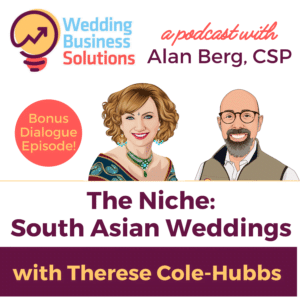
 Therese Cole-Hubbs – The Niche: Electric Karma – South Asian Weddings
Sometimes you meet someone with a unique niche and wonder “How did you end up in that business?” When I first met Therese, she was dressed in a beautiful sari, a garment traditionally worn by women from South Asia. What struck me is that Therese is not from India or Pakistan, she’s Polish, and she’s been the go-to wedding planner for South Asian weddings for over 25 years.
Want to hear how that happened and how you can learn to find your niche? Listen to this new episode
About Therese Cole-Hubbs
As the President and Creative Director of Houston-based Electric Karma International, Therese Cole-Hubbs is considered one of the nation’s leading event planning and coordinating experts for multi-cultural weddings.
A 30-year plus veteran of the events industry Ms. Cole-Hubbs formed Electric Karma, in 2010 in response to the demand for wedding planners who could merge cultural traditions with contemporary wedding elements.
Instagram: @electrickarma
Facebook: Electric Karma International
If you have any questions about anything in this, or any of my podcasts, or have a suggestion for a topic or guest, please reach out directly to me at [email protected] or visit my website www.AlanBerg.com
Please be sure to subscribe to this podcast and leave a review (thanks, it really does make a difference). If you want to get notifications of new episodes and upcoming workshops and webinars, you can sign up at www.ConnectWithAlanBerg.com
Listen to this and all episodes on Apple Podcast:
Watch this and all episodes on YouTube: www.WeddingBusinessSolutionsPodcast.tv
Below is a full transcript. If you have any questions about anything in this, or any of my podcasts, or have a suggestion for a topic or guest, please reach out directly to me at [email protected] or contact me via text, use the short form on this page, or call 732.422.6362
Please be sure to subscribe to this podcast and leave a review (thanks, it really does make a difference). If you want to get notifications of new episodes and upcoming workshops and webinars, you can sign up at www.ConnectWithAlanBerg.com
– Okay. When I think about niching a business, there is one person that comes to mind and this is a really unique niche and you’re going to want to hear how she got into this. Welcome to another special dialogue series about niching. And when I think about niching, I think about Therese Cole-Hubbs. Therese, thank you so much for joining me.
– Thank you, Alan. My pleasure.
– Your niche is South Asian weddings. You are the go-to for our high-end South Asian weddings as a planner. And just going to be perfectly frank, so most of your listening on audio, you’re not listening on video. You are not south Asian, correct?
– Correct. I’m 100% Polish.
– Okay. Those of you watching on video will look and say, she’s not South Asian. There you go. And I remember when I first met you, I’m not sure if you were wearing a saree that day or not. You do have some beautiful sarees, by the way, I will say that. I have one kurta. That’s what I can claim as my one beautiful orange silk kurta. But so this is a really unique niche. You’ve been doing south Asian weddings, planning Southeast weddings for how long?
– Over 30 years. And 839 as of last weekend.
– But who’s counting?
– Who cares.
– But who’s counting? No, no, I didn’t say who cares. I said who’s counting? So 839. So 30 Years ago, over 30 years ago, you start, now, this is a long time ago in the wedding industry. Now, South Asian weddings and weddings of mixed culture is a big deal over here. I remember my friend’s brother got married. He’s Greek. His wife is South Asian. And that was a big deal 40 years ago. That was a big deal. So how did you get into doing South Asian weddings in Texas of all places?
– Exactly. And it’s not cowboys and Indians, wrong kinda Indian. But I did want to say that back then, you’re right. The industry wasn’t even developed. Really, there weren’t even that many wedding planners back then, I am kind of like the grandmother of the Indian wedding world. Back then, it was the aunts and uncles and cousins that plan the wedding. Just as they did back in India. Just as a Polish wedding did and as many cultural weddings were happening. But one came to me and said, would I do it? And I am so happy I took that leap of faith and said, yes, if you tell me everything I need to know. The one thing about the Indian culture more than any other culture that I know, they love to share about their culture. They love to tell you every aspect of it, what it means and so on. Now, today’s weddings are a little bit more diluted and here I’m the one that’s the expert telling them how to do it. It’s hilarious how it’s turned around.
– Right. So back then, it was a Mandap, Mehndi, Baraat? I mean, like they have no idea.
– I’m so impressed that you know those words. Very good.
– And my kurta and there you go. So, people didn’t know that you didn’t know that you learned that from them and you bring that forward. So you were a wedding planner back then though, correct?
– I was.
– So you did this one Indian wedding and that could have been the only one you ever did, right?
– Exactly, but.
– But, what happened?
– Let me tell you that they realize that oh, we don’t have to work that hard. We don’t have to have our family work that hard and we don’t have to have the aunts all crazy. And that time also was a pivoting point for brides because now they were going to school here, even though the parents had not been here very long, but they were able to come in and oh, the bell doorbell’s going to ring. Hold on just a sec.
– That is real life we’re listening to right there.
– It is real life. I apologize for that. What took place is that they came to me and said would I do and I said, yes. And then what they realized is that they didn’t have to work as hard as they used to have to work. And they could enjoy the wedding instead of being the worker bees at the wedding. And then, like I said, the bride started getting a little bit more in college here and now they are meeting other people, they’re attending American weddings, they’re attending other cultural weddings. And they’re saying, oh, they’re planning their own wedding. I don’t need mom to plan my wedding as much. So then there was an age of like maybe 10 years, a segment of time where then the brides were like, this is my wedding mom, not your wedding. That whole nine yards. And then, like I said, then it started turning again the next 10 years where there were the David Tutera’s and My Big Fat Wedding and all those things that came out and then it started really exploding. And they didn’t have that experience level then to be able to plan it. So that’s where the wedding planners really came much more into play because we did have that experience of wealth and being able to negotiate contracts to what they needed. And I think the big pivoting point was really where the venues learned how to get into this business. Because up to then, they were trying to put this square into the round peg and it wasn’t working. And so they started learning how to accept outside catering into their kitchen, how to price it. I do workshop as well for venues still today to get them to know how to sell to the new Indian bride. Because they are changing daily. And now, they’re mixed cultures much more than what we ever had. Before, it used to be if you were a Gujarati, you married a Gujarati If you were a Punjabi, you married a Punjabi. And that’s just the way it was.
– And now, if you’re a Punjabi, you could marry someone who’s Jewish.
– And I’ve been marrying several now that are Hindu or Indian and marrying Pakistani, which is such a big switch over. And I’m happy to see it. Just as long as the couples are happy.
– And for those of you that don’t know, there’s a very, very big rivalry between India and Pakistan. When you think about North Korea with nuclear warheads, it’s India and Pakistan with nuclear warheads and they are neighbors. And that’s not a good thing if that happens over there. So what you described as why it was important to people to then have you do it instead of mom and aunts is really the reason why wedding planners were important to begin with.
– Exactly.
– But there, it was a cultural thing. We are the family, we plan the wedding. This is the way it’s done. Well, now you’re over here and guess what? Would you like to enjoy the wedding? I have actually, I’ve written articles for wedding magazine for couples. I normally write for in the industry. And when they asked me to write, I was like, what do you want me to write about? I write to the industry, I don’t write to couples. And they said, well, you’ve been happily married for a long time. You’ve been around the industry. You publish wedding magazines. So the first article was why you need video. And it’s called let’s watch our first dance. Oh, that’s right, we can’t. And then the second article I wrote was why you need a wedding planner and it was do you want to enjoy your wedding or work it? Or enjoy your wedding day, they work it. But that whole idea of, we don’t have to do all of this. And we don’t know what we don’t know is why people need a planner. And I heard a stat that said the two things people regret most after a wedding are not having a planner and not having video.
– Exactly.
– Those are the two things. But again, you’re doing other weddings at this time. So you’re still doing other weddings. At what point did this transition to your, now you only do South Asian weddings now?
– I do only do South Asian weddings only. And Pakistani is part of that South Asian as well. And I do all the different types of them. Telugu, Tamil, Punjabi, Gujarati, all of the styles and the different states and what the beauty is of that is that because now they are intermixing and marrying, it’s trying to find that happy balance. And I want to go back real quick to the family members. You still have to be very sensitive to this issue of the family members being involved because the family members can get their feelings hurt. I can remember and this is only about 10 years ago. Not that long ago in the realm of things, but we lost two years so not that long ago. But I remember the mother really having a problem with me. And I’ve never had this problem before. But the reason was is that she kept on thinking of why do you need a wedding planner? I can plan your wedding. And her feelings actually were hurt until she realized I was the worker and she was the planner. I had to change that feeling for her so that she would accept it and tolerate it more. And then after that, I did two other daughter’s wedding. So she was delighted. The family members can get offended too.
– That’s because people buy the results of what you do. They’re not buying the services. I tell planners this all the time. I said, please, you’re not selling wedding planning. You’re selling the results. If the same couple could choose between five different planners. If they were able to have five different weddings with five different planners, they get five different things. You’re going to take their ideas with your experience and your knowledge, you bring it together. So where, because this is about the niche. At what point did you not do any more non-South Asian weddings?
– Just about 10 years into it. And it was because that word of mouth had to grow. The parents accepting it. And it was my age also. Being too young made a difference too. Not that I was so young, but under 30, they didn’t really respect and I couldn’t tell them what to do or how to do it.
– So there is a benefit to age to certain people and culturally the fact that, well, like me, COVID has put, my son calls it more frost than the beard. I get a little more respect from the, not too much. But a little more respect with that. Oh, you’re muted.
– It looks good by the way. You wanted me to unmute just so you could hear that again. I’m sure. I’m just checking you out, that’s all.
– But so again, there is a benefit to that that it’s unfortunate. I’ve heard this a lot in the industry. ‘Cause I did a presentation at one point called how to be the experience wedding pro without sounding old. And I did a survey and I had like 900 different, literally 900 responses. And some of the people were young and they said, hey, you know what? I can’t get respect because I’ve been doing this since I’m 15. I’m 27. I’ve been doing this for 12 years. I have a lot of experience. But I’m not getting the respect because I’m too young or some people that have the baby face. They just look too young even if they’re not young there. There’s definitely a credibility thing. Me getting on stage and talking about some of the new tech, I could probably get away with it. But somebody who is younger gets up there, it’s like, well, you must know it better because you’re Gen Z or whatever.
– Right, exactly.
– So now, the did not doing other weddings is that just because you became so busy with the South Asian weddings?
– Exactly. It just took over immediately. Because in the South Asian wedding, you’ll have anywhere from three to six, sometimes seven different events. So, it’s not just one afternoon or one evening. It is five days long, seven days long. And just as we’re starting our wedding this afternoon for this weekend already, and we’ll have two events every day till Sunday.
– And today’s Tuesday, by the way.
– Exactly, so you can see that it’s a busy hectic time. But the one thing that we have learned how to do is embrace the fact that earning your client is very important and I say this in any of our industries that we service, but learning what is it that is important to them. So if the family members are very important to them, then I assign them jobs. No problem. But I give them jobs that I don’t rely on them for. Because how many times, I’ll have a list of like 20 people that have these jobs. Or responsibilities, helpers. And they feel good because they’re contributing, but on the day of, oh, their nails need to be done or their hair needs to be done, they’re nowhere to be found. So if I have any say in it, I give them very easy tasks that I normally would do myself so that I can pick up the pieces either way, but it does make them feel very responsible to the family and helping. And that that’s important. And the other fact is is that there’s a lot of, oh, there’s a lot of pressure in our weddings. Especially when it comes to invitations. And being respectful in that sense too and helping them guide them through that process is important. And I think with age, the one thing that really has made my niche very comfortable for me and why I am in pretty big demand is because I command the wedding. Indian people are used to not having a sense of time. We call it Indian standard time and we operate on Theresa standard time. I’m very firm about. But I am able to create a timeline that I don’t look like I’m pushy or ugly to them. I know how to command the crowd. And I think that that’s something very important because hospitality is the most important thing. I think that we forget about hospitality as a culture in the general culture, but I do think that the Indians practice it so very, very well in every way. From feeding them, from the time they step into the room, to the time they leave, to gifts, to just simple things of the way we lay out the ballroom. Or just another way of just smiling and saying, wasn’t this a great time at the end of the event. So those are the things that I’ve learned in this niche that I’m in. It’s about being kind, sharing the information. That’s why I do speak at conferences. I think it came from the person that taught me. I feel like I was supposed to pass it on and pay forward.
– Right, paying forward, really important. And while I think being in the niche, the narrow niche lets you go deep. I think when people think about India. I think at 70% of Americans will never have a passport. Which means that a very small percentage of those people who are not of South Asian descent will ever go to India, go to Pakistan. I’ve had the privilege of being there three or four times already. And I remember I was speaking at a conference in Bangalore for wedding photographers and we’re talking about pricing and stuff and it’s like, well, they price, how many days is it going to be? Is it going to be two days or three days or four days or five days? Which here is how many hours is this going to be?
– Exactly. Exactly, and if the parents have come directly from India or they recently just moved here or anything of that nature or they have a lot of family they don’t understand the concept of time again because time is money. And so, I think that’s important that you set those parameters at the beginning with the client. Letting them know that you will. And most of the time, they appreciate that because they do realize how much it’s going to cost. It can cost from 1,500 to $2,000 for an hour of photo and video. So depending on how many artists you have there. So I think that those are our responsibility. And then I think the other responsibility and these are the things that I’ve learned in the niche again, is to listen to the client because none of our weddings have ever looked alike and they never should look alike. Listening to what they want, what they need, what they prioritize is very important and then taking it to the next level.
– So what would you say to someone who’s a planner or a photographer or whatever it is in the wedding industry you been in a long time, who is doing multiple things and then thinking about niching? What would the advice you give to them and say, okay, if you want to go into this lane or these two lanes or whatever, what have you learned? Again, what are some of the mistakes? What’s some of the advice you would give people listening?
– I think the biggest thing is, is to make the commitment. Either one road or the other, you can’t serve too many masters. And I think that once you decide to do that, then you need to follow that and get to become an expert in it. Become the top in your field. Be able to give back to the community that you service. Give back to our community of professionals as well. Because there’s always somebody else trying to do the same thing. So helping them out, giving a leg up, how many times I’ve given opportunities to people that don’t have any experience in our Indian world, but they’re interested in it. If they’re interested, passionate, excited, I definitely will take them on board as a vendor and or another professional and have them work side-by-side with me to be able to elevate their craft, to build their portfolios so that if this is something they’re interested in, keep ongoing, give of your time, work many events as you can or whatever particular area it’s at.
– And don’t fake it.
– Do not fake it. You can see it a mile away.
– Like you said, you’re impressed that I knew about Baraats and Mandaps and Mehndi and things like that. In my industry, the wedding industry, there are the average wedding uses, 13 or 14 different services, the average. Some use more, some use less. In the speaking world, I’m an anomaly. I’m like you. You were an anomaly. People see you and say, how does this Polish woman become the South Asian weddings expert? I go to a speaker conference and when you meet new people and they say, well, what do you speak about? They expect me to say leadership or whatever it is. And I say, well, I speak about the business of weddings and events. And there’s silence. ‘Cause they do the Scooby-Doo, like what?
– Yeah, exactly, exactly.
– And somebody said to me something I think applies to you, it was my one of the last live speaker conferences I went to. They said, “Alan, your niche is an inch wide and it’s a mile deep.” And what you said about the knowledge and being able to go deeper into the knowledge, you were talking about the different states in India, again, people in the United States, they don’t know that there were states in India. Most of them don’t. They’ve heard of Delhi. They might’ve heard of Mumbai, maybe Bombay, before it was Mumbai. But they don’t understand the different areas and that there’s different cultures. And they’ve heard about maybe the caste system, but maybe they don’t understand what that is. And that knowledge that you have, which is when you’re talking to people and you’re like, okay, she’s Punjabi and. You understand. They didn’t maybe normally want to talk to one another, For those of you listening. It’s like the Israelis and the Palestinians.
– You’re right. And each one of those states has their own culture and their own way of doing a wedding. From south India to north India, south Indian wedding can actually last three to four hours long. And Pakistani Nikah can last 15 minutes. So you have such a range of culture and tradition in there that you really need to understand it. And that’s why I do that workshop for venues, especially to teach them a vocabulary, I give them a vocabulary, a list of 100 words because it makes it easier for them to sell instead of saying Mun-dub or Mun-dap instead of calling it a Mandap. Or I was with somebody yesterday and it was a catering director and I fortunately am going to be doing a training over there, but she had said, “Oh, what does your wedding dress look like to the bride?” And it’s like the wedding dress? Oh my God, do you need more help than what I thought?
– Unless it was my friend’s wedding where his wife was not south Asian. So the first, well, the second of the four days, ’cause the first day was friends and family, the second day was the Indian ceremony. And she did wear a beautiful saree. The third day was American wedding. So she wore a traditional wedding dress. And then the fourth day was at a winery watching polo matches and drinking Rose at noon. So why not, ’cause you do.
– You have to understand even the clothing. Because I dress in the attire. So I have to know if it’s Gujarati, I’m wearing my Saree this way with pleats in the front. If it’s Gujarati, it’s the Garba, I’m going to wear lehenga. And you have to know these things and you have to know how to dress it, talk it, speak it, love it, enjoy it. Every single day of my life, I have something Indian on. Whether it be an earring, whether it be shoes, whether it be a top, whether it be a formal outfit. I am in love with what I do.
– And you have a beautiful, beautiful book. Tell us about your book.
– Thank you. Yes, I do. I have SHAADI: A Journey Into Desi Weddings. And now it’s a few years old, but it still is a great inspiration for brides to pick out colors, styles, things that they may not have seen before, or like, so that’s how I use it. And obviously, promoting all the vendors in it is a great opportunity for them as well. But you know, I think let’s just talk just for a second about Pinterest and all of this other opportunities for brides. And now even Pinterest has so many Mandaps on it and it’s great for all cultures. And so in Instagram as well. And I think that, I always tell my brides, pick the pictures you like but put them into a PowerPoint because I encourage them to tell me what they like about the photo. Not just the photo. Because it could be just the candles on the table, but it’s all filled with flowers. And that gives the wrong impression when you’re looking at it to work with a decorator or a florist, they’re going to think, oh my gosh, this person has a huge budget. And that might be that they want something very simple, but they like those candles. So I always ask them do a PowerPoint, identifying what it is they like. And they also need to identify the feel that it needs to have. The emotion behind it. The emotion is more important than the physical eye-catching look to me. That people feel the sense of, I like to hit every sense in a room, the smell. Sometimes, I put those air fresheners in the room, just so that I get that jasmine smell at a ceremony. We can fake it well.
– You and the, wait, the Venetian hotel in Las Vegas that pumps in the Jasmine scent as well?
– Exactly.
– It’s a little overpowering and I was in Dubai and I’m in one of the malls and same thing. I walked in and it hit me. When you’re standing behind someone that put on too much perfume, it hit me like that. I was like, oh, where did this come from? But you have to understand the culture. And I think this is the thing about niching. Your expertise and when I said your niche, like mine, is an inch wide and a mile deep. It’s that depth of knowledge that makes it. So when I can come here and talk about a Baraat and things like that. But then I can turn and I can talk to the videographers about three chips CCDHD cameras. And then I go to the bridal shop and it’s about the decolletage and the bodice and things like that. It’s that knowledge. ‘Cause I don’t speak about weddings. I speak about business to people who do them. But being able to use that language and understand those things, that helps me be the expert. Why did they fly me to Bangalore, India to speak to wedding photographers? Not to teach them how to be a photographer, I can’t do that, but I can do this. So how many weddings a year in a normal year, let’s not talk about these years here. In a normal year, how many weddings do you do?
– So I personally do about 32, generally speaking. Right now I have, 53 on the books. And that does take me through next year but only 13 of those are next year. Just so many carried over. And I’m fortunate to have a great team behind me now. And even though I plan every single one of them, because they have to have the Electric Karma, Theresa Cole-Hubbs state.
– Electric Karma is your brand.
– Yes, it is. And so then, but I do have staff that can finish off an event, work an event, maybe some of the smaller events so that I can give the most that I can give to my clients.
– And now, you’re only doing one wedding at a time though.
– One at a time, for myself. Now I might have three in a weekend, but myself there present. When I’m present, I am present 100%.
– We did say, we’re talking about multiple days here. So you’re choosing obviously which ones you want to do, right?
– I’m here for all of them. You know I am. I will tell you about our clients a little different in our business. And this is part of that niche also is that we really become part of the family. We are not outsiders. When I go to their house, I’m taking off my shoes, obviously out of respect, but I’m having tea with them. If it’s an out of town, I spend the weekend with them, the night with them, I don’t require a hotel. Anything of that nature. ‘Cause we are family. And when your family you’re in that family forever. And that’s great business, I will tell you that I’ve done 15 in one family, 15 cousins and sisters and brothers and everybody else. Two more this year coming up. So you do become part of the family. You learn what the expectation is. So that’s really an important part. I do want to mention too about Zoom calls. Just because it has changed our world a lot and I’m happy that we’re able to do Zoom calls, but it has freed up my time a lot. Because I do get caught in meetings at decorators for four or five hours. Or I’ll get caught at somebody’s house for three hours ’cause I am having that tea with them. So I do intersperse it. So I’m using zoom and not doing zoom totally because I feel that that becomes almost like a crutch. And doesn’t give this kinda service, the personal touch service that we really pride ourselves in. So I try to go every other one in person. Because I think that gives them still that connection. And when anybody gets married, they’re the first ones to say, oh, you have to use Therese. Oh, you have to use, and that’s the impression I want to leave them with. That’s my calling card.
– And actually one of my podcast episodes is will we still be using zoom after COVID? And I said, I hope so. Because it does free up your time. There are meetings you definitely want to do in person if you can. And I understand exactly what you’re saying. It is very different sitting at the table with someone with your shoes off, having a cup of tea and just talking to people and getting to know them ’cause they do want to know you. They’re going to trust you. There’s an awful lot of trust that people are putting in here. I live in New Jersey. I live in central New Jersey, just outside of Princeton. Not far from Edison, New Jersey, I’m sure you know is one of the largest Indian communities outside of India. So a lot of my neighbors is big temples over here and all. So I’m very familiar with it from the industry, but then also not from the industry. I could point to my neighbors across the street over here. It is, people want to know you. I have this with some of my clients I’ve been dealing with for years, not just the Indian, South Asian clients. I have clients in Ireland, the same thing. I don’t go over there without having gone to their house and without sitting and having dinner there. And you know people on a different level. These are the people that brought me to India the first time. My Irish client expanded to Dubai and India. And he had me speaking in Dubai and he said, we want to go to India. And I didn’t want to go because my image was the movies and all this kind of stuff. And he finally twisted my arm. “Alan, it’s only a three and a half hour flight from Dubai to Mumbai. C’mon, we’ll do it.” Therese, when I tell you, the most animated, wonderful audience I have had, I can put it in my top 10, was in Mumbai the first time I spoke. I didn’t know what to expect.
– I’ve been to Dubai myself and you’re right. They are so interested in what we’re doing as well. I had the opportunity as a professional development, I check the catering director from Hilton Americas, which is one of our larger hotels here in Houston. And she was able, and I sold it to the Hilton Professional Development. And she had the opportunity to go with me to help me with a wedding. I sit on a board of Save A Mother. So we got to go into the villages. So she saw such a difference from the very poor to the very elite 5,000-person wedding over there that we did. And it’s just crazy. And that experience today, she has a beautiful picture of the two of us in her office in front of the Taj Mahal. Which coordinator do you think she recommends all the time?
– Exactly, exactly. But that’s also that giving back. The thing that you do so well, which is how we met. And then I do is we want to be in the hallway at the conference talking to people. We want to be helping people out.
– You know how I am in the bar.
– Well, we be in the bar too, in the bar too.
– In the bar enjoying the company, of course.
– Yes, yes, but if there happens to be a neat bourbon, yeah, just saying, if there happens to be or an Indian whiskey, they’re making whiskey over in India now.
– You know I’m going to be sitting right there. She’s a magnet.
– Yes, absolutely. And Pauline is typically, always in the bar.
– What can I tell you? We like good wine.
– Listen, if you’re going to go someplace and attract people, you might as well be able to have a nice drink there as well.
– I think that it is about the conferences and I love the conferences and I promote them all the time. And especially the newcomers. I really encourage them to join associations as well as going to the conferences. Joining an association is very important. But joining isn’t the important part, it’s participating. And if they don’t participate, then they did not get their money’s worth. If they don’t try to go after a leadership role, they have not done themselves any good whatsoever. A lot of times you hear them, oh, how much work it is, how much work it is, but it is so rewarding to know that you can make a difference. I sat on the original board of WIPA, Wedding Industry Professionals Association. And to this day, I’m so happy that we created a wonderful organization. I was a part of it right from the very beginning.
– Yup. And I’ve spoken for WIPA as well. It’s a great organization. I tell people if you move to a new area or if you’re getting into the industry or getting into the association, volunteer and that what I want you to do is I want you to be the person that sits at the desk and checks everybody in. Because you’re going to meet everybody.
– You know, it’s so funny because always, at these associations, I always say, hey, can I help check in? ‘Cause I love saying hi to everybody. And giving everybody heads and seeing everybody.
– People refer people they know, like and trust. So two quick things before we go, ’cause we could be talking forever ’cause we do.
– I miss you.
– I miss you too. You mentioned Desi weddings. I know with your book title, a lot of people don’t know what that is. What is the phrase Desi?
– That’s a slang for Indian, South Asian. That’s all, slang word. Actually at times, it could become a little offensive too so you have to be careful with it.
– Right. Because I have heard it both ways, but I’ve seen it. I’ve seen people talking about Desi weddings, Desi weddings, Desi weddings. I remember the first time I heard, I’m thinking Desi Arnaz, like Lucy and Desi. What’s the Desi weddings over here?
– It’s an American thing.
– It is an American thing. Again, we have our blinders on of what we know, we’re bringing this to here.
– And it’s really the aunt. And you would think it’s grandmother and the mother, yeah.
– Yeah, yeah. So the reason I invited you on is ’cause I think about niching, I think about you. So it took 10 years for you to get pulled in where your business was coming from here. You could have turned away from it, but you didn’t. You clearly enjoy it. You clearly know it better than anybody that I know, including most of the South Asian people that I know you do. And I love the little gifts and stuff. I have some little things you’ve given me for my wife and stuff like that. So a last piece of advice for people, whatever it is that you do, whether you’re a caterer, whether you’re a venue, whether you’re a photographer, a florist, invitations, whatever. And you’re thinking about narrowing your niche, what one last piece of advice we want to leave them with?
– You must be committed to it. And it will take time and just dive in. That’s what I’m going to tell you. Just dive in. Just as I suggest, you need to say yes also.
– There you go. In 2013, I went to a speaker conference ’cause I left the Knot in 2011. And I said, I’m coming to this conference with one thought in mind. Do I want to leave here as the wedding and event industries business guy, or do I want to be somebody that speaks about what I speak about, but to other industries? And I went to different sessions ’cause I go to speaker conferences like people go to wedding professional conferences. And I walked away from there and I said, I am doing exactly what you said. I am saying no to the other business. Now I do take other business now, but it comes to me. I don’t look for it. I’m going to take business if it comes to me, maybe, I’ve turned away. Actually, the highest paying speaking gig I ever would have had, I turned away because I wasn’t the right fit. I know there are people that know it better than me and you don’t want me. And I recommended other people. I said, there you go. And committing to that niche has, I’ve had many people along the way. And I have to put my cover my ears and say, and they’re like, Alan, you should speak to them. You’ll make more money, you’ll do all this. I love this industry. And I love.
– And stay in your lane. I say that a lot, to stay in your lane. Because there are a lot of DJs that now do this and that and decorators that do this and that and wedding planners that do catering and this and that. Stay in your lane. You’re going to prosper more if you stay in your lane and get all those people working for you.
– And like you said, when people think about the expert, just like I thought to invite you, if they’re going to think of someone who comes to mind first, I can’t tell you how many times people will come to me and say, we’re having this conference and we said, if we could only get Alan to come and speak, that’s how I want people to think is if I’m your go-to and let’s make it happen now, financially, let’s work it out. But if I’m your go-to, then I have niched myself the right way. So Therese, I’m going to put it into the show notes. You’ll give me all the links for everybody. But if some people wanted to find out more about you, where should they go?
– Electric Karma International is the name of the company. And it’s electric-karma.com.
– K-A-R-M-A
– Correct.
– Electrickarma.com, I’ll put it into the show notes. If anybody wants to reach out to you, find out about your training, your consulting, get your book, anything like that. Therese, thank you so much for joining me.
– Thank you so much. I really enjoyed it and I wish everybody that’s listening the most prosperous next three years. Let’s not make it all in one year. All right. Thank you, Alan.
– Thank you, namaste.
– To you too.
I’m Alan Berg. Thanks for listening. If you have any questions about this or if you’d like to suggest other topics for “The Wedding Business Solutions Podcast” please let me know. My email is [email protected]. Look forward to seeing you on the next episode. Thanks.
Listen to this and all episodes on Apple Podcast, YouTube or your favorite app/site:
- Apple Podcast:
- YouTube: www.WeddingBusinessSolutionsPodcast.tv
- Spotify: https://spoti.fi/3sGsuB8
- Stitcher:
- Google Podcast:
- iHeart Radio: https://ihr.fm/31C9Mic
- Pandora:
©2021 Wedding Business Solutions LLC & AlanBerg.com