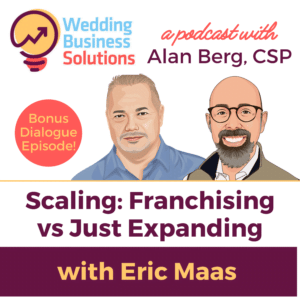
 Eric Maas – scaling – franchising vs just expanding
When it comes to growing your business there are many different paths. In this episode from my “Scaling” series I chat with a good friend, Eric Maas, whose family has taken Complete Weddings from a single DJ location to nationwide and beyond through franchising. Listen to this episode and hear another way that you might want to consider for growing your business.
Complete Weddings + Events is the leading franchise provider of event and wedding photography, videography, lighting, DJ services and photo booth rental in North America.
There are franchise territories still available contact Brittny with COMPLETE at 402-339-0001 for more information or go to our website www.completewedo.com/franchising/.
Complete has been starting parties, telling unique wedding stories and bringing people together since 1973. In fact, we’ve helped plan and execute more than 300,000 events, including more than 13,000 weddings a year.
Whatever you need to set the stage for a phenomenal special event, we have you covered. When you party with Complete Weddings + Events, it’s completely about you!
Listen to this and all episodes on Apple Podcast, YouTube or your favorite app/site:
- Apple Podcast:
- YouTube: www.WeddingBusinessSolutionsPodcast.tv
- Spotify: https://spoti.fi/3sGsuB8
- Stitcher:
- Google Podcast:
- iHeart Radio: https://ihr.fm/31C9Mic
- Pandora:
Below is a full transcript. If you have any questions about anything in this, or any of my podcasts, or have a suggestion for a topic or guest, please reach out directly to me at [email protected] or contact me via text, use the short form on this page, or call 732.422.6362
Please be sure to subscribe to this podcast and leave a review (thanks, it really does make a difference). If you want to get notifications of new episodes and upcoming workshops and webinars, you can sign up at www.ConnectWithAlanBerg.com
– Scaling your business. A lot of people ask me about how do you scale your business? Well, my next guest has scaled the business in a way that a lot of people would like to hear more about, and I’m sure you will as well. Stay tuned for this episode. Welcome back to another edition of the Wedding Business Solutions podcast. I have a very special dialogue guest here for you today on my scaling series. And it is Eric Maas from Complete Weddings. Eric, how you doing?
– Good, how are you, Alan?
– I am great. I can’t wait to get back out to Omaha and be there with you and the Complete team. We miss that last year as we miss so many other things. So as I had told you, I’m doing this series on scaling businesses. Now scaling a business could be scaling up, could be scaling down. And for a lot of people, it’s just adding more people is scaling their business. For some people, it’s adding another location, could be adding another line, another service to your business. And you’ve done all of that and franchised your business on top of that. So, this is something very unique in the wedding and event industry. It’s not unique in the world because that’s what people do, is expand businesses through franchising. So, give us a little bit of a background on the beginnings of Complete, where it went through, when did you start expanding, how did you start expanding, and when did you decide to go into franchising?
– Sure. Complete actually started, I’m a second generation owner. So my father actually started the business in 1974. He came back from Vietnam and where he bought equipment, which was less expensive to buy in Vietnam than it was here. So he came back and at the time, most people had either a cake and punch reception in the basement of a church or they would have a band, right? So for those that didn’t have the funds or the means to have a big reception, it was just a basement. So, my father’s sister was getting married and she asked him to come and play some music with the new equipment he brought back. So when he came back, he did the wedding reception and get this, it was on a reel to reel player. There was no digital music. There was no equipment made for DJs in 1974. So it was on a reel to reel player. So there was no requests. You got what you got. So he-
– Wait, wait, wait. So how did he get the music onto the reel to reel?
– Recorded it at the time he just, I think it was from album.
– From albums. So he took the songs off of album tracks, put them onto the reel to reel and that was it front to back there was no jumping around.
– There was no jumping around. Luckily the expectations at the time were very, there were large expectations. They just were like play music and people dance. And my father has a fun personality, he’s very outgoing. So he had a microphone, he got on there and did fun things. And so he did that. Some people were there that were getting married, wanted to have him at more events. And so he was working his way through college on the GI Bill and he was making extra money deejaying on the weekends. So that’s how it started. And then there-
– Wait here a second. So he brought this equipment back from Vietnam. What made them bring the equipment back if he wasn’t doing stuff like this? Or was he doing stuff like this before?
– Oh, just for his own personal use. He was in a band. He actually was in a band before he went to Vietnam. So he loved music, played guitar. He could play his guitar behind his head, still can. that’s pretty cool. Beatles stuff, and that’s kind of stuff we played. So, he had an interest in music that’s why he bought the audio .
– Okay, all right. So, very familiar story in the beginning, you did one wedding for free relative, friend, whatever somebody else saw it. “Hey, could you do that for me? “How much does it cost?” And you’re like, “I can get paid for this, right?” Putting yourself through college, you’re doing it. It’s people listening in here. You could be a photographer, it’s the same story. A videographer, it’s the same story. Florist, oh, you love doing flowers, could you make me centerpieces? Right, it’s the same story there. Okay, so now he’s deejaying, doing this in college. And when did it become more of a real business?
– So he had some friends in college and he started booking enough where like you said, other DJ companies and multi-system ops out there what they do is they had a bunch of dates that they already booked on. So he had some of his friends come in and started doing multiple events. And then some of them were interested in doing it. And we started one. So he had a manager in Lincoln, he had a manager in Kansas city and a guy that went down to Dallas and they all manage businesses. And that kind of was happening between ’74 and ’80. And then in 1983 in the 80s, franchising was a big deal. So these people wanted that feel as they own their own business, but obviously wanted to use the same model that they came from. So they decided to use franchising to expand their business.
– Okay, so initially they were working for your dad or… They were managers.
– They were managers. Right, so and it was called Complete at the time?
– Complete Music.
– Complete Music. So you’re in Omaha, dad started in Omaha, then you had Lincoln, you had Dallas, he had, so these people were working as managers for him. Now they wanted to continue doing that. But they’re like, you know what? We like this model, we like what we’re doing here. How do we continue doing that because it’s not our name it’s your name, right? Your dad’s business names. And franchising again 80s, it was a big thing there. So, did they come to him? Is that how the idea is, like how can we do this? Or did he say to them, well, how about you become a franchise?
– Well, so when they went, they were basically all them are in college. So as they started to graduate, they were looking for opportunities. And one of them wanted to move to Dallas was the farthest one that was I think the second managed or second area that was actually started. Lincoln’s very close to Omaha and that was easy, right? So, actually Ron Sexton, his name, he still the franchise owner down there. He started in 1983 and it’s still there.
– Wow!
– In Dallas. And so they wanted their independence. They wanted to be able to do what they wanted to do. And obviously that liability of having to worry about an event, someone’s event down in Dallas, without the person running it have skin in the game that’s not their company. that was very uncomfortable for my dad. So at that point, franchising made sense because then it’s their business, it’s their opportunity, they’re doing what they’re doing. We’re just providing the rails to run on like I said, and then manuals and kind of what to do. So the standard operating procedures.
– All right, so let’s stop there because that’s exactly what I want to talk about. The difference between a franchise and Ron going down to Dallas and just starting his own business, Ron the DJ, right? Ron the Dallas DJ. The difference between that is what you provide as a franchisor. And I’ve been a franchisee and I’ve worked for a franchiser in Omaha, by the way as you know. So I know both sides of that as well. So what is the advantage to the franchisee that you provide that they wouldn’t have on their own?
– Sure, I mean that’s a very valid question. And usually we have a process when someone calls and inquires about buying a franchise, we go through that process, because that’s the first thing people always ask, why in the world would I pay there’s a percentage and a franchise fee that you pay to be part of your system? where I didn’t give up any of my money to do what you’re doing? And it’s interesting because a lot of times people might take it that a franchise or things that they have all the wisdom in the world and that support office or that corporate office is the one just making ideas and pushing it out to everybody. But the reality is it’s all the fails that we’ve had, all of the times that we did something wrong, or we tried an idea or tried something that failed that we learned mostly from those opportunities. And obviously then finding out, especially where we’re at today, we’re in over 210 cities and so we’re able to see in those cities, the things that are working today, and then we can take that information in and send it out to the franchisees and the other markets and say, “Here’s what we’re seeing in Baton Rouge, “here’s what we’re seeing in Orlando. “This is what’s working in Spokane.” So that’s basically when you come in and the franchisees too they have a community. Certainly there’s communities, there’s photography communities, there’s DJ communities and those are great. In our system it’s nice because it’s under the same brand. It’s completely sharing the same and they do things the same way.
We’re using the same CRM when we’re doing things with clients and things. And then we do an annual meeting and it really is for us, we’ve tried to commit, I think with a franchise it’s important they have really good culture, and everybody throws around the word family, right? But I think really for us in the wedding industry especially although we’re a franchise business, I think the feeling that there’s a brother or sister in the industry that I can call and talk to that’s with the same name, that’s one of the things that we provide, but the standard operating procedures, the owner’s manual, this is what you do on Monday, this is what you do on Tuesday, Wednesday, Thursday, Friday. There’s a book called “The E-Myth” I’m sure you’re familiar with it. It talks about franchising and why you want to look at that as an opportunity. And it’s not for everybody. If you’re a major entrepreneur and you like trying new things every weekend, franchise probably not for you. If you look at the fast track of business, franchising might be the right way to go.
– Right, and that’s what the E-Myth talks about, which is the systems, you’re buying the systems. And I love the way you put that you’re buying the mistakes. I’ve been at your annual meeting more than once, and it is a community, it is a family. And I think part of the thing with what you have, you do have exclusivity and territory. So it’s competitive in the brother, brother, brother, sister, sister, sister way. It’s not competitive because we’re in the same city and we’re competing for the same couples here. But you have that competition where, “Yeah, oh, so-and-so just got a sale “over here in Kansas city “I’m going to get a sale in Orlando, right?” And you bring each other up with that. But having been a franchisee, it is those systems. It’s that turnkey where, yeah they could learn everything that you do. They could learn CRM systems and advertising ideas and marketing ideas and upsell ideas and what products are selling better and what are not, they could learn that, but it would take them time, right? So do you want to jumpstart and get to a different place that’s forward? Or do you want to find your way there? And yeah, it isn’t for everybody, for sure. There are some people that don’t like that rigidity, and then there are other people that just need it. They need that guidelines there. So obviously we have Ron 1983, so we’re going on what? 40 years almost there, yeah, right? We’re getting almost 40 years there. That’s a long time. You have many other people that are, again, I don’t see a lot of turnover with what you do, right?
– Right, yeah there’s . We’ve had most of our franchise owners that started back in the day are still with us and they’ve stuck around for a long time. We don’t have many people turn over their owners. The franchise owners don’t turnover very often all.
– Right, obviously people within them, if you’re a multi op multi-system thing. So again, if you are a photographer and you’re going to have multi photographers you’re going to lose some, people is the one thing we can never control. Systems is the thing we can control. We can control, even competition to a certain level, right? You know what your competition is doing, you know what you could do better, you know what they do better. But people, people get sick, people move, people get married, people have kids, people just get tired of doing whatever it is, stuff happens and you can’t control that. That is always that variable in any business. That’s not a franchise thing , that’s anywhere. So what are, you talked about the mistakes. What are some of the mistakes that you see people making? Could be within your family, every franchise family, or just in general in the industry since you know the industry so well. What are some of the biggest mistakes you see people making when they want to scale their business up?
– Scaling up. So yeah, I think doing everything yourself, not allowing yourself to pour into others, making sure that you can’t be doing they say when you start up. Dave Ramsey talks about when you start a business, you’re the CEO, the chief operations officer of everything. So you’re doing, I remember in Colorado Springs is where I started my franchise. And I remember being at an event and I had a DJ contact me right as I was doing the toasts, because the amplifier was at the time when you didn’t have self powered speakers back in the day, and he was having a hard time. Everything else was turning on the amplifier. So, I’m getting through the toast and then I’m on the phone, here’s what you need to do. So I think really it’s hard, it’s not an easy transition as a scale, but it’s all about you. I think finding pride, one of the best things that I can say for people when they grow the businesses is, I said this to a franchise owner just recently. And he was somebody that had their own business, their own DJ business and it was a multi-system op. And he came on board with Complete and he’s part of our deal now. And he’s doing a great job and he’s sharing information with us. And just he’s amazing. But he was deejaying himself. It was a DJ service. He was deejaying himself and he came in and it’s the same thing when you sit down and they want to go into have multiple services, you like, you really should stop deejaying it’s the same thing. Like, you don’t know who I am. I am amazing. I am the DJ industry in Kansas city or whatever city and name it here, right? This business can operate unless I’m out in front of the people. And like, well, don’t scale. That’s okay just don’t scale unless you just want headache.
– But you know what? I think it comes down to, I was just talking to somebody he’s a DJ and he’s gotten into speaking so he’s a member of the National Speakers Association chapter I had just spoken for this chapter in central Florida. And I said to him, the first thing is, “So why do you want to do this, right?” “Why do you want it?” And I’ve said this to DJs, “Why do you want to scale your business?” I remember saying this, I had a client. I was just two of them. It was so it was multi-system, but it was really just two of them, right? So there wasn’t 10, 12, 15, whatever. And he said, “You know what? “I want to do 250 weddings a year.” And I said, “Okay, why?” And he said, “Well, I’ll be seen as a bigger player “in my market by the planners and stuff like that.” I said, “Okay, why is that important?” And he started to repeat the same thing again. And I said, “Okay, so how do you plan on getting there? “Because you can’t do that just the two of you, right? “Two of you can’t do 250 weddings a year “and have a life and live.” All right? So he said, “Well, I turn away a lot of leads “that are at a much lower price point than I charged now, “so I’m going to bring somebody on “at the lower price point and all this.” And I said, “Okay, so after you advertise more, “because you need to get enough leads to fill 250. “And we know it’s not one for one, you don’t need 250 leads. “You need four digits worth of leads, right? “So you’re going to spend more on advertising and marketing. “You are going to maybe buy that system, “you’re going to have to have insurance, “you’re going to have payroll. “What else do you need, “overhead wise do you need somebody to take leads now “and field leads because now you’re getting four digits “for the leads, right?” All this stuff. I say, “Is there anything left over for you “or are you just moving the money from the clients “to everybody else and there’s nothing left for you?” And here’s what I said to him. “I want to feed your family, not your ego.” And so many people you’ve seen it Eric, I’ve seen it where it is, it’s about me, it’s about the ego, it’s about blowing the ego up. And it’s a house of cards because there’s no substance underneath that. When you move, I’ll give you a story. When I was at the Knot, I had sales reps who I might want to move to a manager. And I said, “Will your ego allow you “to have your reps make more money than you? “because their commission structure is such that “they can keep going, you’re on a salary plus incentive, “can you handle that?” Somebody who works technically under you on the ladder, is making more money than you. And not everybody can handle that. And as a business owner, everybody else gets paid.
– Yes.
– Right? Right, you should read “Profit First.” If you haven’t read “Profit First”, definitely read “Profit First” by Mike Michalowicz so you do get paid, but there. All right, so the stepping back that person needed to learn that if they want to own a business, they have to run a business. Now, truth is they could have said, “I’m going to do five weddings a year,” or “I’m going to do 10 weddings a year,” “pick the 10 that you want to do, “but you can’t do 50 and run the business” if it’s going to grow, there’s basically what you’re saying there?
– Yes. Yeah, you have to go out and check on those people and see what’s going on. And you have to want, like you said it right on Alan and you have to want to run a business. And the E-Myth they talk about the dog groomer that was good at grooming dogs and went and started their own business and kept doing it and doing it. And they were okay with it the first couple of years, not making any money, but eventually when they had that bring somebody on, they weren’t training them through a process, they’re just like haphazardly giving them the information of what they do hoping that they’ll get somewhat close to what they’re doing. So yeah, I think the approach is that you’re going to, you’re starting a business and not just a DJ company, that’s going to be the biggest and best and because of your ego thing, I totally agree with it’s been a profitability piece there and you have to love what you do for sure. But you’re taking off a technician hat and you’re putting on an owner hat and it’s a totally different job.
– All right, Sam Walton, most people don’t know he started Walmart he was actually in his 40s, but he famously said, I’m paraphrasing. I knew when I started a business, I’d be wearing a lot of hats. I just didn’t realize they’d be wearing them all at the same time. Right? We can all relate to that. And that’s the thing as you change. Listen, if you love being a DJ or if you love being a florist, if you love doing that and that’s what you love doing, that’s okay. But if you want to grow a business, especially a business that you might be able to sell, right? It can’t be about you personally performing that service because when you’re not there, what’s the value that’s left, right? Okay, so there’s that kind of scaling. When did Complete go horizontal and say, okay, we’re not just going to be DJ, we’re also going to be, and not just the ancillaries, like lighting and stuff like that, but we’re going to be photography, we’re going to be video photo booth, stuff like that. When did that happen?
– So we had played with video for quite a few years. Matter of fact, we started I want to say in the 80s, even doing a video and at the time, it was VHS tapes. So the cameras were like this big, right? And you have cassette they actually went in the camera and then the wires and the microphones and the battery packs were huge. So anyway-
– And the lights? You have all the big lights? No LEDs?
– No LEDs. And they all had to be plugged in. But at the time then we went through VHS, to Beta, to laser disc- Super 8
– Yes, all the different formats. So we kinda got out and then we kinda got back into it a little bit. So we kinda were familiar and our video product always sold really well because video at the time kind of came after DJ. So that made sense for us. We had another company that’s out there that’s nationwide that provides photo, video and DJ and had for a long time. And they had actually encouraged us for years to do it. And we were a little concerned to do it just because we didn’t to step on any of our vendor friends on their toes. So, we held back doing that. Well in 2008, Complete has had increases every year since ’74, till 2008. That recession in 2008 was we felt and I know venues and other wedding people out there felt it too, because usually weddings are recession-proof. And that’s what we always say in the wedding business, right? And people get married no matter what. Well, in 2008 Dad didn’t have the money the stock market went away. It was really turbulent and people were losing a lot of money. We were sending people off, away out of our country for military reasons. And there was a lot of reasons that we ended up losing our market share that was the first time ever we went down. And I’d love to say that, we were like super strategic and we had planned it all out and then this is what we’re going to do. But they say out of desperation comes innovation and kinda like through the pandemic, the same thing, we had to pivot. So at the time we said, we’re going to, I think this is the time to start adding these services and becoming a wedding company rather than just a DJ service. And so that’s kinda what led to that change was really out of that desperation. So it was funny, because it was three years, 2008 to 2010, we were complete music, we’re complete music in video, we’re complete music video and photo, we’re complete music video, photo, in photo booth. I mean, and then we had all these logos, we were a branding mass. So we went to a marketing company and said, “Help us please.” So then we came up with the mark. So actually our mark is Complete Weddings and Events and we have a play button. And then this is the actual, like a bow tie from the original DJ from original blog so…
– Nice, like tying in the old and the new. Bringing in the old and the little a little now to the past there. Yeah, so many businesses are started in recessions, out of necessity with that. And I always said that the wedding business is recession resistant. I never said recession proof, but recession resistant. And 2008 was definitely one of those trying times. 2020 is just, hopefully never again, certainly not in our lifetimes, but hopefully never again ever. When you’re told you can’t do a wedding, that’s very different from, “Hey, the stock market went down, we don’t have money.” Or in the case of me, my son started college and his 529 plan went down the toilet with it. I think it was at 2019, I finished paying off his student loans. I won’t tell you what year he graduated in, yeah, amazing. I have more money now, because I finished paying those loans. But the idea of scaling a business is, it is a business. I think that’s really the main thing here. There were so many people out there that have scaled in different ways. I have a client that has over 40 wedding venues around the country. And they use the same packages in every one of them. They could easily use different things in different parts of the country. And they’ve made a decision. Listen, this is what we do and we do it really well. And when we go to another location, we use these same.
You’ll hear this on another episode, it’s Wedgewood Weddings is the one that you’ll, we use the same packages because this is what we can do. We can execute this really well. There’s always a tweak to the menu that somebody is going to have a little something different, just like the songs, it’s never about the music, right? And it really wasn’t about the VHS camera that became the Beta camera that became the this camera, whatever. And now my gosh, it’s like here you go, let me take my, this camera. It’s always about the operator, it’s not about that. It’s 100,000, every DJ has access to the same songs. Your dad had access to what was on the reels , right? And then it was albums and then CDs. And how many albums could you bring with you? How many CDs could you bring with you, right? There was a limitation. Now the limitation is how has your bandwidth, right? I mean, that’s really what your limitation is. So, as someone grows the business, when you added those other services on there, what are some of the pain points? Maybe we’ll just end on this. So we have the growing pains, the vertical growing pains, right? And then we have the horizontal pains. As you added on these services, it’s now not hiring another DJ, now you need videographers, now you need photographers, now you need photo booth operators. What were some of the challenges there?
– Well, I think those of you that are watching will appreciate this. So for us, I look at ourselves as a franchisor in a franchise company that our product is in the wedding field and it’s video, photo and DJ. And so when we started hiring, we knew how to hire DJs and train DJs, which by the way, surprise surprise, those aren’t just normal people. Now I say that because I was a DJ, right? This is not-
– Takes one to know one.
– I am one of you DJ. As I say, I did it for 10 years. And it is not your average typical type of individual, somebody that has a little bit of ego, like to talk, likes to get in front of people, be the life of the party. And so we’re used to hiring those kinds of people. So we would have, Alan, we would have in each franchise, a given franchise usually has anywhere from 10 to 25 to 30 DJs. So they do these quarterly meetings. So then we have I add on these photographers and the photographers come in and we kind of joke about it because then you’re mixing the photographers that come in and I’m over indulging, but they’ll have the scarf and they’re very artistic, and then hello, and dressed a little bit nicer than the DJ, right? So they they’re coming in and then the videographers come in and they don’t talk to anybody. They’re kind of looking around. So when we would hire photographers and videographers, we’re looking for the same personality trait, as a DJs. And that’s when we videographers were the hardest for, because like you’re not talking what, you can’t go to a wedding and not, and they speak, you know what I’m saying. But they’re just not as outgoing as the others. So for us, we were having these quarterly meetings and we get up there and we’re like, “Yeah, just like the DJ conferences, right?” Like somebody gets something to like, “What’s going on, everyone’s like,” it’s like some kind of concert. And the photographers they’re like, “Where are we? “What’s going on?” And so I think for us, the hardest part was really because we love on our staff and we love on our teams. But what we found is, photographers and videographers and DJs have different love languages. So we started, the videography photographers want to learn more about their trait, so the DJs obviously, but they want to have fun together too they kind of let off some steam. Photographers are like they want training and they want to look at the art of what they’re doing, and video too. So I was-
– They’re working on the craft. The videographer is a very, very technical. The videographers are very technical. The photographers want to work on the craft. The DJs want to have a party while learning, while learning they want to have a party. And if I’ve spoken to photography groups, I mean, as far away as in India, I remember having 300, 400 photographers at an event in India. And same thing, they’re all into their equipment, they’re all into that stuff and how did you shoot that and all this kind of stuff. And yeah, they want to have a good time, but the videographers, especially they’re very reflective, right? They’re watching what’s going on. They’re not talking about it. They’re just, that’s what makes them so good, right? It’s like they’re seeing stuff in a way that we don’t see it, right? DJs, and I’m going to say this because so many have told me a lot of DJs, self admitted or have ADD, right? They have ADD, so getting you to focus it’s like, we need to have a party over here so you’re going to focus, butterflies, squirrels come on over here, right? And the videographers will capture all of that. They will capture all of that. They just won’t be part of it .
– All right.
– Right? So this comes back to people again. Understanding what motivates those people, what kind of training do they need? Don’t put everybody into the same bucket. And I think a really important thing is the way you learn is not the way other people learn, right? And you trying to teach somebody the way that you learn and they’re not getting it and you’re getting frustrated when it’s just really they’re a different person. They just learn differently than you. So it circles always back to people again. So people thinking about expanding their business franchise versus not, if you’re going to franchise your own business, what you’re selling is those systems and that’s what you’re selling. And if you haven’t gotten your house in order where you can’t articulate and don’t have that stuff down, there’s nothing to sell, right?
– Correct, yeah. You said it best. I mean, starting in being organized in writing down all the standard operating procedures, putting together an owner’s manual, you can’t even legally start a franchise until you have an owner’s manual. And the worst thing you can do, I think you know this Alan is that, one thing you said that’s so true is, if you don’t have your house in order, if you’re not profitable, if that business isn’t profitable, that you’re trying to franchise, and it’s not working like a well-oiled machine, then the expanding that just makes your life a lot harder because you’ve just expanded something that either doesn’t make money or doesn’t run efficiently.
– Right, and the franchisors and the franchise organizations that fail are the ones that are just out there collecting franchise fees from people, but they’re not giving back. They’re not supporting them. The more I support you, right? The more I water your flowers over there, the more that grows, the more it’s better for me. And you kind of touched on this a little earlier which is, taking the pride in the success of the franchisees, taking pride in the success of your employees. And when I went from being a salesperson to a publisher, to a regional sales director, to a vice president of sales, all of a sudden it was from me, I managed myself. And then all of a sudden I had 50, 60 people down underneath me. The more you sold, the prouder I was, right? I was like a parent. I don’t want to minimize it, but it’s the same with your kids. If you can watch your kid score a goal in soccer and be like, “Oh wow, so good for you.” And if you can watch the other kids score goals and be proud for them , that’s also good over there. So Eric, thank you so much for joining and for sharing your wisdom over here. I do miss being out there with all the Complete franchisees and the team, because it is such a wonderful experience to be there. I do have some logo clothing. I was wearing my Complete hat the other day, so thank you very much. I’ve worn it in many countries. You’ve seen, I’ve Instagrammed you in many countries wearing my Complete hat there, so thank you. Anybody has any questions for you, I will put into the show notes, but if somebody wanted to find out more about Complete, do you have any openings for franchise markets?
– Oh sure, we’re probably in half of the major markets and we have quite a few markets that are open in. And a lot of the franchises that we have they’re always looking. Our franchise system has three full-time people in every office. So you have your owner, then you have a sales manager and an operations manager. So we’re always looking for full-time people or franchisees. So we would love to talk to anybody that would be interested in that.
– And what would be a website that they would go to to find out more?
– Completewedo, W-E-D-O. Completewedo.com.
– Completewedo.com, I will put that into the show notes. Thank you so much for joining me today. Anybody has any questions reach out to Eric and I look forward to seeing you at the next meeting where I can be there.
– Yes, thank you, Alan so much.
– Thanks.
I’m Alan Berg. Thanks for listening. If you have any questions about this or if you’d like to suggest other topics for “The Wedding Business Solutions Podcast” please let me know. My email is [email protected]. Look forward to seeing you on the next episode. Thanks.
Listen to this and all episodes on Apple Podcast, YouTube or your favorite app/site:
- Apple Podcast:
- YouTube: www.WeddingBusinessSolutionsPodcast.tv
- Spotify: https://spoti.fi/3sGsuB8
- Stitcher:
- Google Podcast:
- iHeart Radio: https://ihr.fm/31C9Mic
- Pandora:
©2022 Wedding Business Solutions LLC & AlanBerg.com