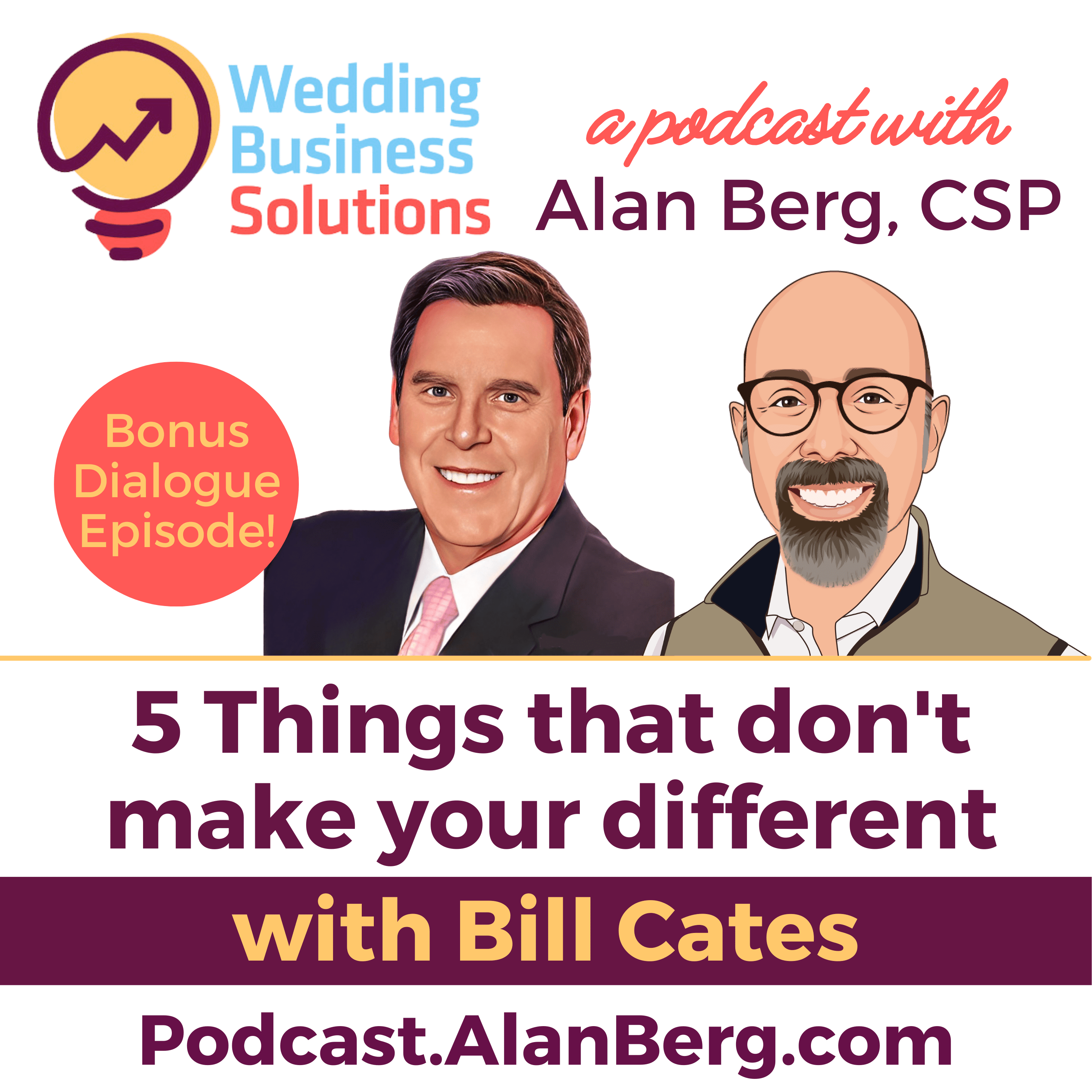
 Bill Cates – 5 Things that don’t make you different
I saw an article on LinkedIn by my friend Bill Cates titled: “5 things that don’t make you different”, and the title intrigued me. In reading through them, I was struck by how many of these companies in the wedding and events industry are using, thinking it shows how they’re different, when they don’t. So, I asked Bill to come on and talk through these with me so we can give you some ideas on how to tweak what you say, to really show what makes you different.
About Bill
Bill Cates is an internationally recognized client-acquisition expert, author, and speaker who motivates others to take action with proven strategies. A successful entrepreneur, Bill started and sold two book publishing companies. Turning his attention to help other businesses grow, Bill has written four best-selling books: Get More Referrals Now, Don’t Keep Me a Secret, Beyond Referrals and Radical Relevance. To get Bill’s books, which I highly recommend, visit: https://referralcoach.com/online-store/
Bill is one of the founding members of the Million Dollar Speakers Group and was inducted into the Professional Speakers Hall of Fame in 2010 (182 living members worldwide). Bill is also somewhat of an adventurer. He has trekked through the Himalayas of Nepal and the Andes of Peru. He has lived on a houseboat in Kashmir, India, climbed Machu Pichu, reached the summit of Mt. Kilimanjaro, camped in Arctic Circle… and Bill has toured the country as the drummer in a rock and roll band.
To find out more about Bill visit: https://referralcoach.com/
Listen to this and all episodes on Apple Podcast, YouTube or your favorite app/site:
- Apple Podcast:
- YouTube: www.WeddingBusinessSolutionsPodcast.tv
- Spotify: https://spoti.fi/3sGsuB8
- Stitcher:
- Google Podcast:
- iHeart Radio: https://ihr.fm/31C9Mic
- Pandora:
Below is a full transcript. If you have any questions about anything in this, or any of my podcasts, or have a suggestion for a topic or guest, please reach out directly to me at [email protected] or contact me via text, use the short form on this page, or call 732.422.6362
Please be sure to subscribe to this podcast and leave a review (thanks, it really does make a difference). If you want to get notifications of new episodes and upcoming workshops and webinars, you can sign up at www.ConnectWithAlanBerg.com
– There are five things that don’t make you different. Want to hear what they are? Listen to this episode. Hi, it’s Alan Berg, welcome back to another episode of the Wedding Business Solutions Podcast. I am so excited to have my friend Bill Cates on with me today. Bill, thank you for joining me.
– Hey Alan, thank you. And you say jump, I just say how high.
– I appreciate it. So Bill and I have met through the National Speakers Association, actually through music. He’s an amazing drummer. He says he’s average, I think he’s better than that. And we’ve also bonded over bourbon. So to music and bourbon, so there you go. But the reason I’m bringing him on, ’cause his industry is not specifically the wedding and event industry. He has actually known as the referral coach and he’s got some amazing books, those of you watching on video, “Radical Relevance” and “Beyond Referrals”, we’ll put links to these in the show notes there. I actually have these books signed by Bill that I can give out to some of my clients when it’s appropriate, because whenever I read one of my friends’ books and I think you guys would enjoy them, I will do that. So Bill, you wrote an article that I found on LinkedIn that says, Five Things that Don’t Make You Different. And that was like… I was like, Brian Walter says like, what… The Scooby-Doo, like, what! What is that? So where did the thought for that come from? And then we’ll get into what those things are.
– Sure. Working with many people, many types of businesses, my clients coaching, consulting, one of the things I help is with their messaging. And whether it’s for a website, LinkedIn profile, whatever it might be. And there’s a lot of people out there say, “You got to know what makes you different. “You got to know what makes you different.” Well, yeah, sort of. The truth is not everybody cares what makes you different. What they really cares, are you right for me right? Now sometimes your differentiation could be the deal maker. Like if someone’s looking for a… They’re having their wedding out on a floating dock in the ocean and you’re a DJ and you’ve spun records on a floating dock in the ocean. All right, well maybe that’ll seal the deal, right?
– Specific. Yeah, there you go.
– Underwater photographer for an underwater weddings. Clearly that differentiator. So what I realize is most people, when they talk about what makes them different, they’re platitudes, it’s what everybody says. And so I just want to… And I’m not saying we don’t say these things and now we’ll get into ’em, but yeah, we talk about these things, but don’t use them as a differentiation. As a differentiator, sorry.
– Right, I just finished listening to David Avrin’s book “Visibility Marketing” and he was saying the same thing, saying that we do quality work is the entry point. Like, yes, you have to do quality work, that’s not a differentiator that we do quality work. So it’s part of these things.
– And it doesn’t mean you don’t say it.
– No, but it doesn’t make you different because you should be doing quality work and so should everybody else. So let’s get into these five things. There five things that don’t make you different according to Bill Cate’s. Number one, we care about our clients.
– I hope you do. Not everybody listening to this would necessarily say that, depends a little bit on the business you’re in and whatnot. But they say we really care about our clients. We really want our clients to be statically happy, yada yada. We love ’em, they love us, yada yada. Yeah, I hope so. I mean, yeah… Again, it’s not that you don’t say this, it just, just be aware it’s not a differentiator. If you want to have a place on your website or LinkedIn profile or flyer, whatever, that says, here’s what makes us different, then have some things that make you different. And if I could add to that, and we’re going to get into this, I know, make sure you know what the benefit of that differentiation is. Meaning, a lot of people will talk about what they think makes them different, it may or may not, but they don’t draw it to a benefit. They assume that the receiver of this message is going to know what makes… So for instance, I was working with the bank. different world than your folks here, but nonetheless they said, we’ve been in business 128 years, that was one of their differentiators. I said, well, okay, so what does that mean? ‘Cause someone younger might think, stodgy, don’t have the current apps. I got to go to the big brick bank on the corner. Or someone older, maybe like myself, might think, okay, solid, they’re not going anywhere. We don’t know. In the absence of information, people make things up. So we always want to tie whatever does make us different to a benefit. Never assume that the receiver will know what that benefit to them is.
– Right. Make sure they know why they should care about that as opposed to, it’s just a thing.
– Yeah.
– Okay, number two. We get to know our clients’ goals and dreams. And in our industry, wedding event industry, what do they want their wedding to be like? Again, it’s kind of… All of these are kind of like, well, I mean, how are you going to provide the results for them if you don’t?
– Yeah, so now here’s where you could turn it into a differentiator. For instance, if you have a particular way you go about learning about this, if you have a comprehensive assessment perhaps, you got to make it not sound too daunting. But nonetheless, if you have a way you get to know people and a way you get to learn what these are for them and you have a set of questions that pull out some important things that other people don’t know to ask. Now that could be a differentiator. So in and of itself, it’s not a bad thing or a good thing. It’s just, make it a differentiator by your process behind it and explain it, show it, demonstrate it and then perhaps it is a differentiator.
– Okay. Number three, we offer advice tailored to our clients. So again, we offer customized solutions or it’s all the same thing there. I’ve often said, no matter what you do, whether he is selling by packages or out a cart, whatever it is, everything you do is custom because it’s a different client. It has to be custom. Unless you’re selling a product, which most of the people listening here are not, they might use product in what they deliver, but they’re not selling the product, they’re selling the results. So we offer advice tailored to our clients. Otherwise you’re not really selling, your order taking a static thing that doesn’t change, and that would be wrong.
– Exactly. And here’s where you got to be a little careful ’cause you know this, that sometimes we have to be careful about saying it’s totally fully customized no matter what ’cause then we end up giving them too many choices or if they don’t have… Sometimes we have to help them get clear on what they want and that’s through choices that we offer. Packages, photographer might have different packages. And we know that too many choices are not good. And it doesn’t mean they can’t adjust from there. So yeah, we’re going to make sure you get what you really want. And one of the best ways, by the way, to turn any of these that are not necessarily differentiators or kind of platitudes into differentiators are examples, anecdotes, case studies. Case studies are great. Not everybody cares, but a lot of people are really shopping and they’re shopping hard and they’re trying to look. I got these three different planning companies. I got these three different photographers. They’re trying to figure out, who is right for me? That’s the decision they want to make, Sometimes the case study makes a big difference ’cause you can… And the anatomy of the case study, really quick. It’s client or prospective client comes to you, here’s their challenge, here’s their concern, here’s their worry, the emotionality a little bit behind it. Maybe the logistics were a little bit special different. Here’s a solution we put in place, here’s the result and here’s how they felt about it. That feeling part is important. So that’s something you can tell in a minute.
– And that’s something that I’ve suggested to a lot of people listening here that you do on your blog. Because every wedding, every event that you do, corporate event, wedding event, whatever it is, is a story. Somebody came to you… And I always say this, if two people are getting together, that’s called a date. They’re bringing other people and that’s why, tell me the story, something Bill, I don’t know if you’ve ever heard me say this, but some people listening here might, is that one of my clients told me that there’s three questions they ask every time they get an inquiry. What’s the occasion? Who’s coming and what does success look like? So when you find that out, now you can say this person came to us, this couple, this client, whatever, they were looking to have whatever they wanted to include their dog in this, they wanted to include family traditions in this. We were able to produce this. Here’s some pictures, here’s the review, here you go. That’s your blog post, which helps your SEO. That’s your thing to say, here’s some real wedding stories. Another example would be a caterer. Why did you choose that menu with them? Not that you didn’t. Why? What was important about this? What are the meatballs signify? Because none as meatballs are on the table. Oh my God, none as meatballs. There’s a why to that as opposed to a what. So again, I think this all ties back. All right, let’s get onto number four. We educate our clients.
– Now this can be a differentiator. All of these can be if you turn ’em right. So a lot of people say, we teach our clients this, we come from an education perspective and we help them understand why that we’re making certain decisions, which actually is pretty good. Here’s the where you can use it as differentiator. You may have talked about this to your folks in the past but… I learned this actually from a friend of mine he was a roofer, of all things. Very successful roofer, his name is Dave. So he used to go to the home and he used to say… He used to measure the roof. And he used to say, work up an estimate and say, hey, here’s what it would cost or here’s your investment, we’d love to do your roof. Saltzer roofs. Mostly kind of on price. He was somewhat trustworthy, that’s good. But now here’s what he does. He goes at home, measures a roof, comes up with an estimate, and he says, look, whether you work with me or another roofer in town, what you really want is to get the right roof at a fair price done well. So whatever you do, make sure they give you heavy gauge flashing ’cause a lot of roofers will skimp on the flashing to save money, but it’ll cost you in the end. Make sure they give you a proper nail pattern. A lot of roofers, either out of ignorance or haste or whatever, lack of caring and training, they don’t.. That’ll cause your problem. So he’s teaching them how to buy a roof. And I’m sure some of the clients who follow your advice already do that. How to choose the right wedding photographer, how to choose the right cater, how to… And that can be a differentiator because if they’re looking at two or three folks and you’re the one who’s teaching them how to buy what you sell versus someone else who doesn’t, then that can actually set you apart from other people.
– Right, and if you’re listening to that, part of that education is also saying what’s different about you versus someone who’s cheaper because they’re using, in that case, cheaper flashing and not as many nails and things like that. You’re not digging on the other company, but you’re saying this. And then when they go ask them and they say, do you do this and that, they’re like…
– What he found this and sorry to interrupt, but what he found is that once he did that little education piece, they said, “No, no, no, we’ll go with you.” It’s like it took him off the market because, this guy’s teaching us, this guy he’s not pressuring us to make sale. He wants us to make sure we make a good decision. I like him, I trust him. All of that good stuff comes when you actually teach.
– Right. But it’s important how you’re teaching there because a lot of people say, ‘Well, we like to educate our clients.” Well, does your client want to be educated? That’s the first thing.
– True.
– And then what are you educating them about, things that matter to them or things that matter to you? And you really have to be educating ’em about the things that matter to them by asking them better questions. Okay, so let’s get onto five here. We provide great client service.
– Right. That’s kind of in the department of we care about our clients, they’re all kind of related in that respect. Again, they’re platitudes. Yeah, I hope you do, you better. Now if there’s… I’ll give you another example. So there’s a specialty advertising products, especially promotional products. People from
– Price.
– Yeah. So they were saying we are different. we provide incredible service. We’ll go to the ends of the earth to meet our client needs. Kind of platitudes. But then they had an example. For example, we had a client, it was rushed. We chartered an airplane, we got the delivery on time, they made the trade show, yada ya. So you can turn it into a differentiator again, through the examples, through the case studies, things like that. Now, one way to talk about what makes you different is to talk to your clients and say in your mind, what made us different. First of all, why’d you hire us? We know you had a lot of choices. What made you decide to go with us, that could be the source of that. Or if you were to talk about us and tell somebody else, what made us a little different, what would you say? And you’ll be amazed at what you’re going to hear from clients. They will give you expressions and concepts that you wouldn’t think about. I’ll give you a quick example. I had a client who said to me, I was doing this exercise, he says, “I just tell people that Bill Cates “makes asking for referrals as natural as breathing.” His name is Michael Schmitz. And I said, “Wow, that’s pretty good, Michael. “I wouldn’t never thought of saying that. “Can I quote you?” And he says, “Yeah, of course.” And so that’s one of those things that if I said it, it would be hype. I can make ask you for easy. But if my client, Michael Schmitz. from San Mateo, California says it, and I have his photo and what he says and quote, now it’s my client saying it, it’s a little more social proof rather than hype. So our clients tell us what make us different is this. And so sometimes that’s a place to come up with really what is the differentiator that has made people decide to go forward with you.
– Right, and it’s something I’ve spoken about a lot in terms of your brand is that. Your brand is what those people are saying about you. Your branding here, it’s on my shirt, it’s over here. This is branding. Your brand is those things because your differentiator, if you read your reviews and read your competitors’ reviews, they’re going to be different. They might both be excellent, but they’re going to be different and they’re going to say what they loved about you. They’re going to mention people by name. They’re going to mention the things where you went above and beyond. For you to say we go above and beyond that could be number six. We go above and beyond for our customers. What does that mean? Well, it means that this person said, a hurricane was coming through and we were able to move everything inside. Hurricane Ian just came through recently.
– Well, I don’t know about you, but I’ve played music and a tent for weddings and next thing I know the water is dripping down the back of the tent and starting to hit the electronics. And it’s like they better move as fast.
– But it’s these things that happen that people take care of, whether it’s upfront, whether it’s during, whether it’s after that make the difference. And it’s funny, everything you were saying here, Bill, all I’m thinking in my head is the way to show that this is a benefit and not a platitude is with the review of somebody who said, “You did this for me.” I couldn’t believe how much they cared about what we wanted is number one. We get to know our clients’ goals and dreams. They asked what we wanted for our wedding and they made it even better we could have imagined. There’s a review, we offered tailor advice to our clients. They were so helpful in giving us advice. We educate our clients. We had no idea what we were doing when we were choosing our fill in the blank and they helped us. We provide great client service again that’s in there. So if you want to know what makes you different, read the reviews and they will tell you what made you different. I know what my reviews say. And if I was to choose my brand statement, it wouldn’t have been what’s in those, but now it is because it is what people feel. It’s not what I think it is, it’s what people feel.
– Yep.
– Right. So definitely in there. So what are some other… I mean maybe if you have number six, seven, or eight, but what would you say other than looking at the reviews, is there anything else, any other platitudes like you cut the list short?
– No, nothing I can think of. Not in terms of platitudes, but let me give you a little formula I just developed that I think your folks will find actually helpful on how to talk about what you do, and/or how to teach your clients or other centers of influence, other influencers, people who can refer you business and vice versa and how to talk about you. So I was meeting with a guy, he’s a consultant, kind of like us and he had been out the game for a couple years. Did a little sabbatical, came back, and he was looking for referrals to get introduced to get his business going again. I said, Alan, so all right, really quick, tell me who do you serve, what do you do, what do you do it for, what’s the benefit? And we went round and round and round. I said, “Is this what you’re saying to your clients? “Is this what you’re paying others?” So we came up with kind of a one sentence value positioning statement, I call it.
– Okay.
– So it goes a little something like this. I’ll give you mine and then you’ll have to work the formula So the step one is who do you serve? Step two is, what’s the benefit? Which whatever those people want is the benefit. Then what’s the action step? So if I was saying to you, Alan, and here’s what I want you to say. If you running anybody, you tell ’em that they’re a professional running their own business and they want to meet more of the right type of clients, referrals and introductions, tell ’em they got to meet Bill Cates. Who I serve, what do they want? Pretty clear in my case, action step me book. I could say it myself. If I’m in front of a networking group, if you’re this and you want this, or if you know someone and they want this, they need to meet me. Really tight, really clear. Now, sometimes you can come up with that immediately. Sometimes it takes weeks to figure what that is. But the key is the benefit, whatever they want is the benefit. And now we’re talking in terms of benefits, which anyone’s listened to you, I’m sure has heard that before.
– Right, well, I talk about results. So I just came back from the Global Speaking Summit and I went to a session, woman named Chantal was doing it, and if you’re on YouTube, you can see this paper here. And she had all these words, all these words here, altruism, collaboration, duty, giving back, humanity, impactful, freedom, peace of mind, et cetera. And she said, “Circle the words that you think “people think about you.” And then here, it’s the same thing. So this was for speakers. So I speak to, who is your audience? I speak about their challenge. When my audience hears me, they leave feeling, emotions.
– Nice.
– So my statement before this, which she thought was pretty good, is, I help wedding and event businesses sell more, profit more and have more fun doing it. That was my statement. And she said, “Okay, but how do they feel?”
– Yeah.
– So she said, “Tweak the end a little bit.” So I help wedding and event businesses sell more, profit more and feel more motivated to get started. All right. Five seconds. Your elevator pitch is five seconds. It’s not that the elevator got stuck between floors and you have two minutes to talk. You have five seconds and it’s hard, you know that and I know that. Cutting it down to five seconds is hard and it gives you. Then they give you permission to say more. So, Bill, how do you do that? Oh, okay, let me tell you how I do that now. So that’s what that is. So the reason I invited you on is because it tickled me when I saw this headline and you know and I know people are out there saying these things that make them different, but they’re not understanding that they’re not going all the way. This is a statement. Now let me tell you how I do this, why I do this, why you should care about this and instead of just say that we do this, otherwise it’s not a differentiator. Or as I say, if you take the bullet point… If I take your website and can take your name off and put your competitor’s name on and everything you said is true for them, it’s not different.
– A differentiator. If they’re saying it or could say it, probably not different. Now again, doesn’t mean you don’t say it. Don’t expect it to be the differentiator, it’s going to win the business necessarily.
– Exactly. So Bill, thanks for joining me. So again here, some of his books I think you’d enjoy, “Beyond Referrals” if you’re on YouTube watching it,
– Oh, thank you
– and “Radical Relevance”. And I have these signed by Bill because I felt after reading them myself that wow, this applies to my industry as well. I know referrals, you guys, a lot of you’re thinking, well, referrals. You can get more referrals for weddings. I know it’s a new crop of people every year and you can get… And I think Bill would agree that the first and most important way to get referrals is to ask for them and not just wait for them to happen.
– And there’s some ways they ask without looking like the creepy referral guy–
– Does one come to mind like for a wedding you thinking that would be–
– Well, yeah. Okay, so… How much time you got now? Here’s the essence of it. The essence is number one, you got to make sure that the person you’re asking, whoever they are, you’re referable in their eyes, they perceive the value. Sometimes they’re telling. You’re wonderful, better… And then you can’t assume that they’re willing to introduce you to others. Some people feel comfortable making introductions, some people… And you know that, especially if someone’s kind of marrying age, I don’t know what that is these days. I’m sure you know that demographic, but they probably know other people, right?
– Right
– And so the, you don’t want to assume. You want to say, “Can we chat about that?” You want to soften it just a little bit? And kind of gain permission to brainstorm a little and talk through it a little bit. And then the final thing here, there’s got so much that goes into this, but it’s in the book, is these days we’re not just talking about referrals, we’re really talking about introductions. Now word of mouth is nice, occasionally the phone will ring, we’ll get an email ’cause someone’s talking about us out there. And that’s good, that counts. I mean, it’s nothing like a prospect raising in their hand and saying, I’m interested. And it’s not always enough, right? Sometimes people forget, sometimes people say it in a way that doesn’t really impact the other person. So what I’m looking for these days is a connection, an introduction. I’m looking for an email handshake. Alan meet Barbara. Barbara meet Alan, here’s why I’m connecting the two of you. And so I’m using the word, not referrals anymore. And if I’m asking, or I’m teaching people, you want to use the word introductions? Let’s talk about how you introduce me to her. Let’s talk about how you introduce me to him. Let’s make sure we do it in a way that feels comfortable and if we’re lucky, sparks his interest in talking to me. So that’s kind of some of the essence of what we teach.
– Right, and that’s for me, it’s always what I do because I want to set the example. It’s what I would hope to get back. I just connected to clients, somebody that’s going to be on the podcast. I’m not sure if it’s before or after this. He’s a wedding meteorologist, helps you figure out the weather. And then I have another client who’s been on here whose company is called Weather or Not, who does umbrella shawls and blankets for inclement weather. I said, what a match. I mean, you guys need to know each other.
– Of course.
– So I made the introduction to them because that’s the right thing. Instead, here’s an email, go connect with somebody. No, no, no, no. When somebody is introducing someone to me, I would hope they would do the same thing for me. But just asking, asking for them to do it. I always say, well I have in my email signature because of Bill, one of his other books, “Don’t Keep me a Secret.” There’s a line in my email signature. It just encourages people that, yeah, please tell people about us, but then otherwise it’s going to be asking for it. So again, we could go on, but we don’t have any instruments or bourbon. So we will….
– I got my drum sticks.
– You got your drum sticks?
– I got one of them. I don’t know where the other one went to, but…
– I have pair back here also, number fives. There you go.
– All right.
– So Bill, thank you so much for joining me. Thanks for sharing that article. It was really helpful. I think everybody listening, I’m going to put in the show notes about your books ’cause I think they’re really helpful for you guys. And I will see you at the next conference.
– Thank you.
I’m Alan Berg. Thanks for listening. If you have any questions about this or if you’d like to suggest other topics for “The Wedding Business Solutions Podcast” please let me know. My email is [email protected]. Look forward to seeing you on the next episode. Thanks.
Listen to this and all episodes on Apple Podcast, YouTube or your favorite app/site:
- Apple Podcast:
- YouTube: www.WeddingBusinessSolutionsPodcast.tv
- Spotify: https://spoti.fi/3sGsuB8
- Stitcher:
- Google Podcast:
- iHeart Radio: https://ihr.fm/31C9Mic
- Pandora:
©2022 Wedding Business Solutions LLC & AlanBerg.com