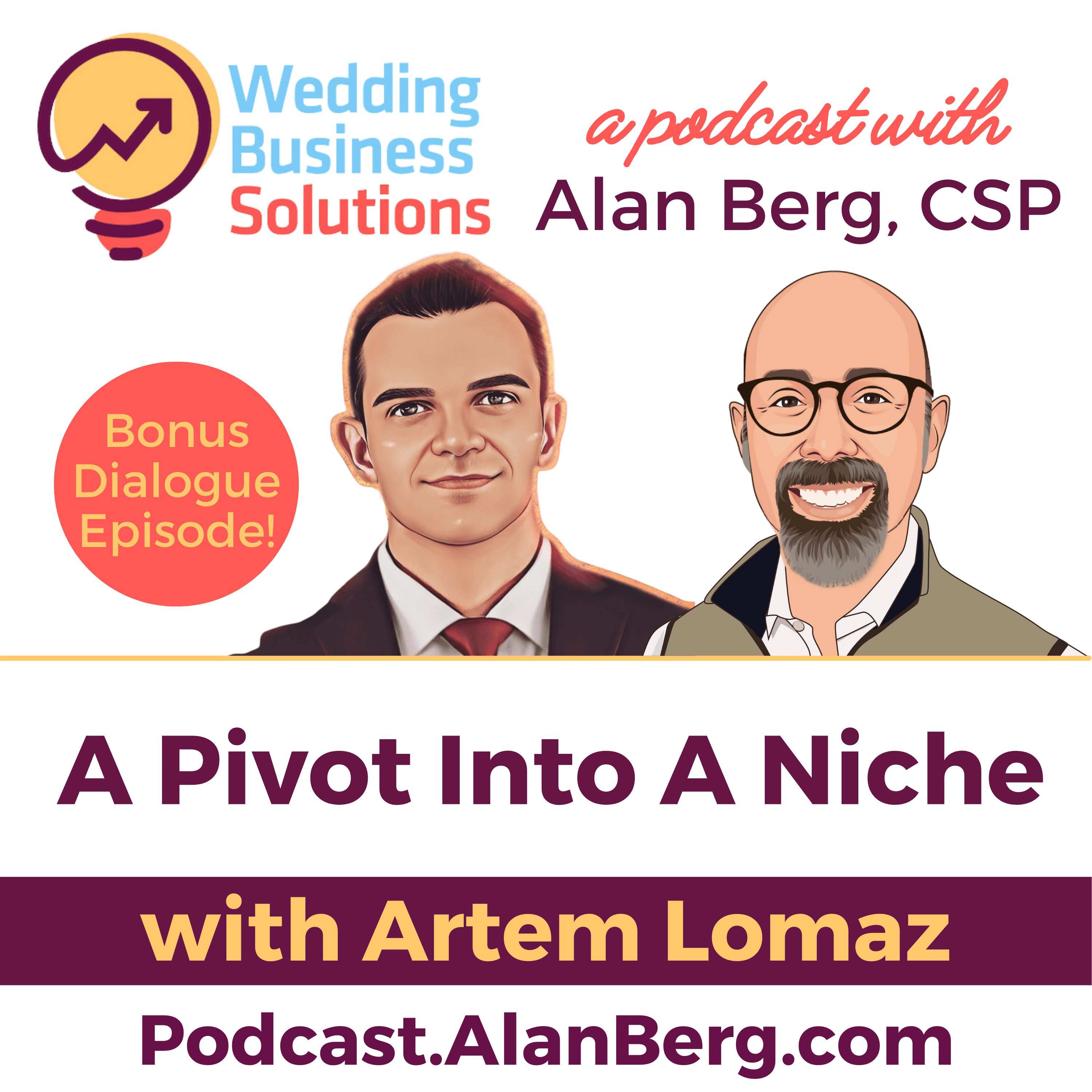
 Artem Lomaz – a Pivot Into A Niche
Some of my guests for these dialogues have carved out a niche, some have made a pivot. I invited Artem Lomaz on because he did a pivot into a niche. His clients and couples saw the need and pulled him in a direction that had led him to a better place. Listen to this new episode for some inspiration on how you might find your own pivot that helps you narrow your niche, to find a better place for you!
Artem Lomaz has been continuously redefining the role of the wedding and event Master of Ceremonies. Whether accompanying a DJ or band, the award-winning MC – honored twice as “Entertainer of the Year” in his career – is known to industry insiders as a meticulous performer with a refined presentation style and personalized methodology that captures the spirit and character of each of his clients’ events. Artem is known for combining hospitality and etiquette, and ultimately helping bring wedding storyboards to life!
Connect with Artem:
Website: ArtemLomaz.com
Email: [email protected]
IG: @ninetythreeentertainment, @artemlomaz
Facebook: @Artem Lomaz
Listen to this and all episodes on Apple Podcast, YouTube or your favorite app/site:
- Apple Podcast:
- YouTube: www.WeddingBusinessSolutionsPodcast.tv
- Spotify: https://spoti.fi/3sGsuB8
- Stitcher:
- Google Podcast:
- iHeart Radio: https://ihr.fm/31C9Mic
- Pandora:
Below is a full transcript. If you have any questions about anything in this, or any of my podcasts, or have a suggestion for a topic or guest, please reach out directly to me at [email protected] or contact me via text, use the short form on this page, or call 732.422.6362
Please be sure to subscribe to this podcast and leave a review (thanks, it really does make a difference). If you want to get notifications of new episodes and upcoming workshops and webinars, you can sign up at www.ConnectWithAlanBerg.com
– Sometimes I have guests on who are Niching. Sometimes I have guests on who are Pivoting. My next guest is pivoted into a niche. Listen to this episode and find out more. Hey, it’s Alan Berg. Welcome back to another episode of the Wedding Business Solutions podcast. I am so glad to have my friend, Artem on. Artem Lomaz, Artem, welcome.
– Alan, how are you?
– I am doing great. And you and I were chatting and you have been in the wedding and event industry. I’ll let you tell people more about you, but you pivoted because of a demand into a niche. So one of these things where, you know, people brought you into that. So first of all, what is your business?
– Sure. First and foremost, thank you for having me. I’m very excited to be here and I’m very excited to be a part of the guest list. I consider it an honor. So, Alan, yes, I am a wedding and event MC, which is Master of Ceremonies, and that’s essentially where I’m coordinating and collaborating with bands and DJs as the designated Master of Ceremonies at the respective event or wedding.
– Okay, and where in the world are you doing this?
– Everywhere. So I, I would say I’m based in the Northeast. I was actually, I started in New Jersey. I was in New Jersey when the business started. I’m currently in Southeast Florida. So still East Coast, but travel wherever we need to travel to make it happen.
– And where are most of your events? Are they in Florida, New Jersey? Or are they in a particular area?
– Most events right now are on that Northeast coast. I would say New York, New Jersey, Pennsylvania area. We are expanding a little. I say we, but obviously I niched into just me. So I pivoted, right? So I am based in Florida and New Jersey. I go back and forth. A lot of it depends on the weather and where I prefer to be that day, but more realistically that month or that week. But I also will go out to the West Coast from time to time and I am very open to other markets such as Europe and Asia and Africa.
– Okay. So you want to get off the I-95 corridor?
– That is correct.
– And go someplace else on that one.
– Absolutely.
– Okay, so you said it’s just you now. Were you a multi-op before this?
– That’s a great question. I was not an official multi-op, but I would bring in other elements. So when I started, and you are I’m sure well aware of this, the trend at the time was everybody wanted to be a one-stop-shop and everybody wanted to say, “Yes, we have DJs on our roster, and we have MCs, and we have photo booths, and we have lighting, and we have everything and anything under one roof.” And that is essentially what I started to go after because that was the trend and that’s where I felt like I needed to compete in that sector of the market. And then obviously as things progressed I pivoted and changed my course, But at the time, yeah, that’s where we were looking at. It wasn’t an official multi-op. I wasn’t sending people out on the same day, but I also knew that I, myself, couldn’t just MC an event without a DJ. And we were bringing in photo booths and with the photo booths, you need an attendant, or the photo stations. You need someone running lighting. So all of that was, it was sort of multi-op per event basis.
– Right. So you were only doing one event at a time, but you had a team that was with you, so it wasn’t just you solo like, “I go and speak.” It’s, “Me, solo, but I get help in a booth.” Right?
– Exactly.
– So I was just at The Marquee Show and I’ve been to PBX and stuff like that. And I have help in my booth, that’s same type of thing, but we’re still only doing one thing at a time.
– Exactly.
– So you were doing the DJ thing, doing it at a very high level. And so tell us about this pivot. Tell us about this pivot from all that other stuff kind of went away. So no more photo booths and no more lighting and no more anything like that. How did that happen?
– Sure. Well, the pivot was sort of, in my eyes, always there. I just, I guess didn’t have that aha moment until a few years down the road, because for me, I come from an advertising background. And so in an advertising creative agency, you have a team that works on campaigns and it usually consists of an art director and a copywriter, and they work hand in hand. They usually throw them in the same office. Right?
– Right.
– Or more realistically, in the same cubicle nowadays.
– Well, when I started, I was at Young & Rubicam. I don’t know if you knew that. So Young & Rubicam.
– Y & R, absolutely.
– Except I was in the basement chained to a desk correcting billing discrepancies, because that was too big of a company .
– That happens there too.
– But you’re supposed to throw the art director and the creative director together because you want to get a cohesive campaign.
– Exactly. And that’s where you feel like if they’re working together and they say, “Hey, I have this idea.” Copywriter says, “I have this idea for X, Y, and Z.” And the art director goes, “Oh, I can make it look like this.” And it’s supposed to work hand in hand. And I took that model and I put it into the event industry where I looked at it myself, as the copywriter, the MC, and the art direction was coming from the musicians, whether that be the band or the DJ. So very frequently, especially early on, it was the DJs I was bringing in. It was people that, that I knew could mix. I knew could handle what I needed them to handle per event and obviously would get along with my insanity, and kind of know how to work an event that I needed them to work. And so in doing that, I would always put myself on as the MC. I was a default MC on every job and then I would select which DJs or bands would join. Sometimes it would be independently brought in for like a client or a planner that said, “Hey, they already have someone,” or, “We have someone that they’ve decided to choose.” And I would just collaborate and work with that.
– Okay.
– And so that’s where my aha moment sort of came, where a couple years in, I got a call from a production agency that said, “We have a couple,” this is for a wedding, “We have a couple. They’re bringing in their planner, but they’ve pretty much already selected everything, but they want you just as the MC. Are you willing to do that?” And in my head, I’m like, “Hell yeah, I’m willing to do that.” I didn’t even know that was an option. So like, yeah, you mean, I don’t have to call the photo booth attendant and check where they are, and I don’t have to check on various things and run back and forth? And so, I always kind of went with the steadfast approach on my end that you always want to be designated in one role. And I’m not saying that, and we have mutual friends that can do a lot of different things. So I’m not saying a DJ can’t MC or an MC can’t DJ. I’ve chosen not to DJ. If a DJ needs to go to the restroom for a couple minutes, I can hop behind the booth, but you don’t want me there for longer, right?
– Okay.
– And so from an MC perspective, I’ve talked to a lot of DJs and band leaders that find it to be something that just falls onto their plate without them really necessarily wanting it there. And so I’ve also noticed in my collaborative efforts with DJs or bands, when someone comes over and wants to speak to them, I’m a great liaison, where they don’t have to bother them. And especially when a DJ has the headphones on and they’re working their laptop and they’re doing their thing, they don’t want to talk to the guests. They put on a smile and they do because they have to, but if you can have someone there like me who can hop in as a Master of Ceremonies and speak to them and then deliver their message discreetly to the DJ or band leader when the time permits, that makes things flow a lot smoother. So taking that formula, putting it into my business, and then realizing even when people were reaching out, you know, the email was contact@93Entertainment, but the body of the email said, “Hi, Artem.” So like they all knew who was behind the company.
– Right.
– And when referrals started to come in, the referrals were because of what I was doing as a Master of Ceremonies. And in that regard, I was like, okay, well, that’s great, because I’m putting myself on this jobs. I’m the copywriter, I’m bringing in all my art director friends, right? If I’m hopping from Young & Rubicam to JWT or wherever else, right? If I’m hopping from agency to agency, so to speak, I get to bring my art directors and that’s great, and they want me for the copywriting. So that was kind of what I was looking at in my head. And then when I got that call and then I realized I can just do this and become presumably really, really good at it, right? I would like to think I am, I guess that’s up for, up for the clients to say. But I just had a flashback when I was, I want to say like eight years old, and I was watching the Food Network and they were interviewing someone. And at the bottom on that lower third, you know how it has their name? And it said “Ketchup Expert”. And I was like, if you could do that one thing really, really good. You can figure out how to make some money and just do that one thing.
– Right
– So I’m not a ketchup expert, but I am a Master of Ceremonies for weddings and events. And I feel like if I can devote myself to just that designated role, that is where I want the industry to understand that every time everyone is operating at 100% capacity, it makes things easier for everybody else on the team.
– Right. So the DJ who’s spinning, doesn’t have to think, “What’s the next announcement? How am I coordinating?” And all that kind of stuff.
– Correct.
– So not talking numbers, but you’ve been able to raise your rate then. And would you say you’re getting paid as much or more just to do this part than to do everything?
– That’s a great question. So initially, I figured, okay, I’m providing, initially, I was providing packages, right? So I’m providing a package with myself, and a DJ, and the photo booth, and all that. So the rate was X, right?
– Right.
– And I’m like, okay, now it’s only me, so I have to adjust it. But then I also saw it as well, before you were paying the rate I want from me, you were paying, you just weren’t aware of what the breakdown was.
– Right.
– So you were still paying it. So I would say I’m still equating it to, I’m still getting what I was getting from my, I guess, in my pocket.
– Right.
– The net, the net-net for me has remained the same.
– Right. Without having to worry, like you said, is the photo booth operator here? And is the printer working? And all this kind of stuff.
– Exactly.
– And you know, both of our good friend, Bill Hermann, same thing, you know, it’s somebody who’s niched into this at a very high level.
– Yeah.
– And I don’t know what your rate is. I know what his is and I’m sure you want to get to where his. And Bill told me a great story. It was a father of a groom or a bride said to him before the wedding, you know, “The kids said they wanted you and I don’t get it. I just don’t understand. That’s a lot of money. I don’t get it.” And at the wedding, he comes over and goes, “I totally get it now. Like I totally understand.” And it’s one of those things you need to experience. If you’ve never been to a wedding or event with a really good MC and then you go to one with a really good MC, now you know the difference. Kind of like the first time, probably the only time my wife and I ever had Dom Perignon champagne and we were like, “Oh, that’s what champagne’s supposed to taste like?”
– Right.
– “Oh, not this other stuff we’ve been drinking over here?” But this is the whole point of the niching. The niching allows you to create this, the demand, like you said. How do you know that you’re good at this? Because people keep asking you to come back, because people ask you to do their… Their friends ask you to do their weddings and events and stuff like that. That’s how you know, because people are asking you. I decided to niche my business in 2013 because I could talk about sales to just about it to anybody. Right? What I talk about, I could talk about anybody, but somebody described my niche as an inch wide and a mile deep.
– Hmm. Interesting.
– And when you niche yourself, now, how far do you want to niche yourself? Like you said, you want to go to Europe, you want go to other places. You know, I have, I have a client who’s a South Asian wedding expert and people bring him around the world, and he brings his team around the world because that’s what he does. You know, he could do other stuff. And if he gets asked, he might do it, but he also might refer it and go like, “You know what? I know somebody who’s better at that. They’re going to do that. But if you need me, because I know all these parts of a South Asian wedding, you want me.” And MCing, like I said, if you haven’t experienced good, you don’t really know what’s possible. Right? People don’t ask for stuff they don’t know exists.
– Correct. Absolutely.
– But if they experienced it. Do you get a lot of your business from referrals, from people that have seen it?
– That’s all my business, essentially.
– Okay.
– Yeah. Because to your point, you know, if you’re eating bologna sandwiches your entire life, and nothing against bologna, I guess, but you won’t know what a steak is or a great plant-based alternative, whatever you want to do. You’re right. You don’t know until you’ve experienced it.
– Right.
– So I don’t, I guess hold that against anybody, but once they’ve experienced it, then they start to realize, “Okay.” And I actually have a similar story that Bill was alluding to. Like, it’s funny because I was talking to a prospect and after our meeting, he said, “I’m really glad we actually took the time to talk because when you said MC over the phone when we first spoke, in my head I had a vision of a guy in like a powder blue suit telling Rodney Dangerfield jokes the entire time.” And I’m like, “Look, that’s very possible if that’s what you want. It’s not me, but I’m sure I can find you someone.”
– Right.
– So it’s everyone’s own definition in their own head. And to your point, you know, yeah, you can obviously give general sales information on a stage, and then it would be up to someone like me to go back home and go, “Okay, how does this pertain to my wedding business?”
– Right.
– But what you do is you connect the dots for us so we don’t have to go through that process.
– Right.
– But if someone called you and said, “Hey, I need you to talk about sales in XYZ industry,” you can adjust, right? But you’ve decided that this is where you want to be.
– I actually am doing that now, I speak to rental groups, and the American Rental Association brings me into their national conference on a day just for events. So that’s easy. Tables, chairs, tents, and stuff, you know, I know that stuff inside and out.
– Right, right.
– But then I got pulled into doing sales training because of some of those companies that saw me and they said, “Hey, listen, part of our business is renting backhoes and Bobcats and forklifts, and you know, post hole diggers and things like that.” And the good news is I’m a DIY guy, so I understand tools and things like that. My garage is just full of tools. My son went to Home Depot one year to buy me a Father’s Day present. He’s walking down the aisle, “Got it, got it, got it, need it, got it,” it’s all there.
– That’s right.
– But I can speak to them because I know a little bit about that, but I’m able to do that twist. I’m actually going to be speaking for a group before this airs. And they said, “Listen, some people in the audience, they’re on the tool side.” I said, “Got that, got that.” I’ve been in rental companies doing sales training for people who do that. A lot of it is lingo. Just showing them that you understand their lingo.
– Of course.
– When I spoke for an HVAC manufacturing company sales reps, I had to learn about, you know, air cooled and water cooled air conditioning units and how many hundred thousand BTUs and stuff like that. Not the 15,000 that’s in my bedroom, but the how many hundred thousand in this building.
– Yeah.
– But it’s lingo.
– Right.
– What sets me apart from people in the industry is I can speak the lingo. If I’m talking to a bridal shop group, you know, I’m talking about, you know, silhouettes, and bodices, and décolletage and stuff. And they’re like, “Oh, this guy understands,” you know?
– Right.
– And then I pivot to the DJs and I’m like, “Are you using Serato?” And they’re like, “Oh, and this guy understands.”
– Right.
– That, you know, but it’s showing the audience that you understand. So you, you got this little pivot here, right? You pivot into this and when did you decide, “I’m giving up the rest of it?” It’s like, “All right, no more lights, no more photo booths, no more DJ. Not me personally,” right? If they want you to get them, you can, you know-
– Sure.
– You used to live in New Jersey, so you have a guy, right?
– Oh yes, yes. There’s always a guy. Yeah. If anything, I call Howard Wallach. He’s got a lot of guys, right?
– Howard Wallach’s got a lot of guys. Right. So when did you decide, “Okay. The rest of this stuff is not me anymore”?
– That was essentially right before COVID. And then I will say COVID expedited the process a bit where it put a pause on everything, right? That’s, like, I guess the best way to put that.
– Right.
– Put a pause on everything, and that’s where everyone started to reevaluate where things were headed. And that’s where I realized, okay, I already kind of made that initial step. And it’s not to say if someone reaches out and says, “Hey, you did something for us 10 years ago,” where you still want to do it. I’m not going to hang up the phone on them.
– Right.
– But there’s always this educational element of saying, “Look, okay, this is what I did.” Essentially, I’m still doing the same thing.
– Right.
– I’m just not bringing everything else with me.
– Right.
– And I can also, the beautiful part of that is I can also now refer business where I can bring in people who I know are going to be able to deliver for me and know my idiosyncrasies. So that way I can piece it all together. So it kind of becomes like every event, you’re putting on a show or a movie where… It’s really funny how people watch TV shows and go like, “Oh, that stinks.” I’m like, yeah, sure. Maybe it does, but you know how many things have to align and how many stars have to really just align and happen for a show or a movie or anything to be really good? You have to have good writing. You have to have good acting who could put that writing into play, and then have good direction, have good production. So that’s not different in our world, right? We’re putting on a show. It’s a wedding, but it’s really a story.
– Right.
– So that’s where I look at it and go, okay, even though I’m not physically bringing this stuff in, and the more I started to work in the worldwide luxury space, I realize it’s not uncommon to have 15, 20 vendors. You know, 15, 20 event partners all on one event. And no one wants to be the one-stop-shop.
– Right.
– And so we’re always referring one another.
– Right.
– And it makes it that much easier for planners who are bringing us in too, because the planners know their teams and the planners also know, “Okay, maybe I haven’t worked with Artem before, but you know, the photo booth person has and they say good things. So I feel a little safer.”
– So, are you, is it planners that are bringing you to these events mostly these days or is it direct customers?
– I would say it’s mostly planners. I would say probably 70/30 right now, planners and direct. And a lot of that direct is from previous clients who were part of the 93 Entertainment family. And so the goal, I’ll be honest with you, Alan, we got to get that 70/30 to 99/1. So-
– You want it to be 99/1 from the planners?
– Correct. Yeah. because I feel like with planners, what it does for planners is it allows them to go to their prospect or their already booked client and say, “I have something that other people aren’t being able to offer you potentially.”
– Right.
– Right? And so when they go in, they go, sometimes they’ll say, “Well, you know, I spoke to the DJ company and they have an MC that they provide,” or, “The band leader can do X, Y, and Z.” I’m saying, yeah, I’m not discrediting their ability to do it, but this is something where I’ve devoted my entire career to doing and I do it a little bit differently. Because I realize what we were doing, I’m going to say, doing the math a decade ago. We’ll make it evergreen, a decade ago, right? A decade ago, what we were doing is we were all offering our clients essentially a two-for-one without realizing it.
– Right.
– They were investing in a talent, whether that be the DJ or the MC, and they were doing both in the same night. And again, we have mutual friends who were really good at both, but I feel like, hey, if you’re good at both, be the MC on Friday and be the DJ on Saturday and then have someone else compliment on both of those days.
– Right.
– So that’s where I felt like, okay, if I can make this known that planners can have this in their back pocket and then present it to their client, and especially those clients that just want something that someone else maybe hasn’t had yet. And let’s be realistic, that’s most clients now, right?
– Right.
– Everybody wants something that someone else hasn’t really done yet. Especially when you get into that realm of like, “Hey, what’s the budget?” We’ll figure it out as we go.
– Right.
– So that’s where I feel like planners, it’s a mutually beneficial relationship. because planners can bring me in and offer something that maybe a client hasn’t seen yet. And for me, the planner is doing a majority of the, “No, you trust this guy. That’s great.” Kind of a majority of the sales process. And then it’s on me to kind of just like dunk the alley loop.
– Right. So you’re trying to get to that 99. So people are listening and going, “Okay, that’s great, but I’m not referred by a planner.” So a little bit of chicken and egg, right?
– Yep.
– If they don’t know you, they can’t refer you. And if you don’t know them, they can’t refer you, and if they haven’t seen it. How are you, what recommendations would you give to people listening and how do you plan on trying to get that 70 to that 99?
– Sure. I think a lot of it is education and I know that’s not the sexiest answer because that takes time, right? That takes time and effort, and I think it’s obviously relationship building, which also takes time. Of course, you’re going to work with a planner and you do a great job, and if you make a planner’s life easier instead of harder, that is the best way to form a relationship. If you have a planner in your market or maybe not even in your market, but you just admire their work, connect with them. Let them know why you admire their work. Not just like a generic, “I love your work, let’s talk.” You know, there’s planners that I’m friends with, but I don’t necessarily love what they do. It’s not going to, you know, discredit the friendship. It’s just more of like, “Hey, that’s cool. It’s just not my style.”
– Right.
– And then there are other planners where I re-look at what they’ve done and go, okay hey, that’s something I want to be associated with. It’s the kind of, whether that’s the style or decor or design or whatever it is, something they’re piecing together. And when I reach out, I let them know why. So I would say when you are forming that relationship, figure out if it aligns with your brand and your style, and then once you’ve found your, you know the cliche is “find your tribe”, once you found the tribe that you realize, okay, this is my group of planners that I really admire their work and want to be a part of their team moving forward, that’s when the relationship building starts. Then obviously you, you know, Alan, more than anybody else, the value of networking events and going to conferences and then just essentially putting yourself where that audience is. So if you want to talk to planners, find out what conferences planners are going to.
– Right.
– So from there, I guess then it becomes realistically educating, and hey, why is it that I need to reach out for a super-specific specialty? Whereas I might have an option where they’re bringing everything under one roof. I think most planners understand that.
– Right. And what you said there, liking their work but also getting to the why, what is it I like? I get, we all get emails all the time. “I was looking at your website and whatever.” I’ve had people call me and I say, “So what is it about my website you liked?”
– Mm-hmm.
– And they have no answer because it’s just a generic cold call, right?
– Right.
– There is nothing there. People, like, you said something very important if people didn’t get that, how do you make their life easier? Right? Planners have a lot going on on a wedding day, on an event day, whatever it is, corporate events and all that, a lot of stuff. And if you’re the thing that they don’t have to worry about, then you’re worth the money. Right? If the result is good and they don’t have to worry about you. I had somebody say to me one time, “Alan, you’re probably our most expensive speaker, but you’re the easiest to do business with.”
– Right.
– I said, “Good, because if I was the hardest to do business with and the most expensive, we wouldn’t be talking right now.”
– Right. I had an email come through from a corporate client a couple weeks ago. We were planning for an event and I was coordinating with the DJ, and I just, basically I picked up the phone, talked to him and then sent a follow up email from the conversation. And she shoots me back an email saying, “My favorite part of that conversation is that it did not involve me.” I’m like, “Okay, great.”
– Right, right.
– I see what you’re saying.
– Right. I have conferences that bring me in and once we’ve picked the topics and the topic descriptions are settled, they don’t give another thought.
– Right.
– There’s just not another thought. It’s going to happen. It’s the 80/20 rule. They have to spend 80% of their time with the 20% that don’t do what they’re supposed to do, you know, make their lives easier. When you’re trying to network, when you’re going out to places, don’t go out with a handful of business cards. Have them in your pocket if somebody asks you, but go out and then just talk to them about what they do. Let them talk, let them light up. I forget the name of the book. I really have to go back and listen again to try to find it. But it’s when you go to a networking event and you ask somebody, you introduce yourself, you know, “Hi, my name’s Alan, what’s your name?” “It’s Artem,” “Great. Artem, what do you do?” You tell me what you do, but then ask a follow up question. “What do you love about that?” And people light up. They light up, and when they light up talking to you, they like you better.
– Of course.
– And then listen, and then ask a follow up question to make it about them and then ask ’em a question, “So what kind of problems have you had before with DJs, MCs,” whatever it is that you do, photographers, videography, whatever it is, and let them vent a little bit.
– Right.
– Because now you know the pain that you don’t want to cause .
– Mm-hmm.
– But you also then want to be the solution that’s like, “Yeah, I hate when that happens as well.” You know, “Planners, I love working with planners because,” you know, and then if you’re at an ABC event, Association of Bridal Consultants, or if you’re at one of the other groups, or if you’re at Engage, or if you’re at Wedding MBA, or any of these places, you know, find the planners. In your case, not just in your area, right?
– Right.
– But the planners that are doing the kind of work that you want to do and form that relationship so that you can be the solution to their problem, which is, “I need somebody who can… and I can rely on,” and there you go.
– Well, it’s funny because you bring up the pain points and that’s obviously like 101 to an extent. You know, you look at the pain points and you try to hit on those. For me, I always try to not sell the negative. Right? So I never want to be like, “Hey, here’s your pain point. Here’s what it is.” It’s a matter of how you present it, right?
– Right.
– It’s all about presentation and approach. So I feel like, to just expand upon that, a lot of times people have pain points they’re not even aware of, or at least can’t articulate them.
– Right.
– So it’s not that, “Oh, this wedding didn’t have an MC and things went 95% great.” It’s a matter of, “Well, you know, this happened, this happened.” It could have been elevated, but nobody thinks about that. Again, if they’re just eating bologna sandwiches, they’re not thinking about the steak that they’re missing.
– Right.
– So I think it’s a matter of yes, finding the pain points and then educating, working off of those pain points and just saying, “Hey, I’m helping elevate something.” Right?
– Right.
– It’s not that there’s a problem, but I’m helping elevate it. It’s more like preemptive.
– Well, but again, people can’t ask for something they don’t know exists. So if they’re happy with what they’re getting, because they don’t know any better, then they can’t even imagine, “Well, what could be better than that?” And this is where something that you’ve done, whether it’s video, it’s testimonials, it’s things like that to show what’s possible. You know, I’m wearing an Apple watch, which I didn’t know was possible, but yet Dick Tracy, in what was it? The 1950s.
– Right. Right.
– You know, had wrist radios. And they’re like, “Oh my God.” And literally my phone wasn’t in my pocket recently and my phone rang. I’m like, oh, I guess I’m going to answer it here on my… And I’m talking to somebody on my wrist. I felt like Dick Tracy, you know?
– Mm-hmm.
– iPads, I’m on my fourth. I remember when they came out, I’m like, who needs an iPad? Right?
– Yeah.
– I’m on my fourth, right? But that was what Apple was so good at was not asking us what we wanted, but showing us what was possible and then we couldn’t live without it.
– Correct.
– And that’s kind of what you’re doing there is once somebody’s experienced what you do, they go and see somebody else who’s doing a good job. Like you said, doing that 90%, 95% of what you’re doing and it’s good.
– Right.
– But it’s not you. And then if they can see that difference, so anybody listening here, whatever it is that you do, whether it’s flowers, or officiating, or invitations, or a venue, whatever, if they can’t see the difference between you and somebody cheaper, they’re going to go with somebody cheaper. But if they can and they want your results, they have to hire you. That’s the key, Artem, is you’re getting your referrals because they’ve seen it and they’re like, “I need that.”
– Well, it’s the differentiator. Right? And that was part of my pivot aha where I was working with a photo booth company where I was subcontracting in the photo stations. And they were a fantastic photo station company, so great that all my competitors were also using them. So we were all getting our photo stations from the same person, right? From the same company. And I realized, hey, that’s not the differentiator. It can’t be because we’re all using them, right?
– Right.
– So, but he had a great business plan. He was the go-to guy for all of us.
– Right.
– So I realized, okay, well, in terms of production, what can I be the go-to guy for? And that’s what I always have been doing. Just kind of put it as part of a package, but didn’t realize that was the differentiator in the package that we were putting together.
– Something that can’t be commoditized is what you’re talking about.
– Exactly. It can’t be commoditized. And then another part of it was I just, again, going back to the whole like looking at it as a show, as a production, for the people that know me and for those that don’t, I’m sure will learn pretty quickly when they speak with me, my favorite movie of all time is “Coming to America”, right? Starring Eddie Murphy and Arsenio Hall, and Eddie Murphy and Eddie Murphy and Eddie Murphy. So, you know, part of the charm of that movie is that Eddie and Arsenio play various roles.
– Mm-hmm.
– And I looked at that, and you know how sometimes popular movies have stage adaptations?
– Yeah.
– And they go and put that on Broadway? You can’t make that into a play and have one person trying to be 20 different characters. It just won’t work, right?
– Right.
– On stage. So that’s the way I looked at it. I’m like, well, you can’t, you know, when you’re trying to be the MC, the DJ, the band leader, the men’s room attendant, the photographer, you’re trying to do all these things. It’s just not going to work. At some point, all the plates are going to drop.
– Right. And that’s again, specializing. And this is what we’re talking about here is the niching. So you pivoted into the niche, like I’ve pivoted into the niche and many people listening have, and some people are thinking about it. So I’m going to leave everybody with one thought here, Mike Michalowicz who wrote the book “Profit First”, which I love, also wrote a book called “The Pumpkin Plan”. I don’t know if you’ve read “The Pumpkin Plan”, Artem.
– I had Mike give me “The Pumpkin Plan”. So that was great.
– There you go. So, and it’s basically about when you’re trying to grow a pumpkin for the state fair and be a winner, you have to keep trimming off all these smaller pumpkins off the vine so that they’re not sucking off the, you know, some of the nutrients and things. And in our businesses, when we trim off these things that we don’t do anymore, it allows us to focus more on the things that we do do and it allows us to bring our expertise up. You know, it allows me by being in this. What I do is not only going to, you know, industry conferences to learn more about what’s going on in the industry, but also to speak in conferences where I can learn more about my craft. And I don’t worry about other things that I could do, and I might even be good at, but just like, you know, like you might be a really good DJ. It’s just like, I’m not going to DJ now. I’m not, I’m not. I’m going to do this because I like this more. People love this and I’m not, I’m good, but I can get somebody who’s actually better than me. Right? I can get somebody who’s better than me to DJ, better than me in the photo booth, better than me to do those other things. So if you haven’t read “The Pumpkin Plan”, you should read “Profit First”, but if you haven’t read “The Pumpkin Plan”, definitely read that. So Artem, we could go on forever like we do at conferences live, but thank you so much for joining me here. I’m going to put into the show notes your social handles and things if people want to find out more about you. If any planners that are listening want a great MC, let them contact you there as well. Thank you so much for joining with me, and I look forward to seeing you at the next conference.
– Likewise. Thank you so much, Alan. I appreciate it.I’m Alan Berg. Thanks for listening. If you have any questions about this or if you’d like to suggest other topics for “The Wedding Business Solutions Podcast” please let me know. My email is [email protected]. Look forward to seeing you on the next episode. Thanks.
Listen to this and all episodes on Apple Podcast, YouTube or your favorite app/site:
- Apple Podcast:
- YouTube: www.WeddingBusinessSolutionsPodcast.tv
- Spotify: https://spoti.fi/3sGsuB8
- Stitcher:
- Google Podcast:
- iHeart Radio: https://ihr.fm/31C9Mic
- Pandora:
©2022 Wedding Business Solutions LLC & AlanBerg.com