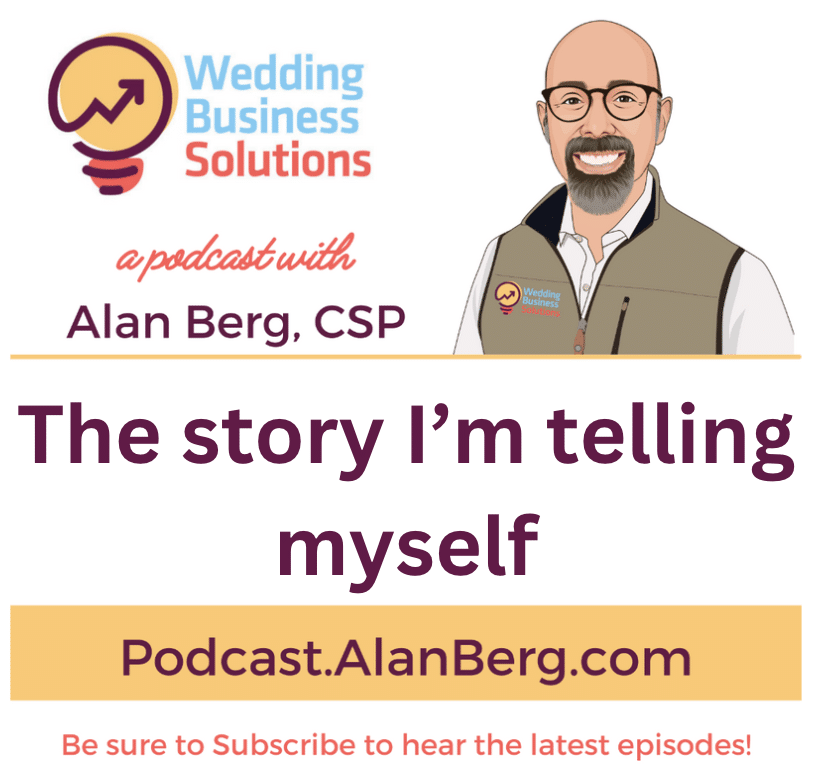
 The story I’m telling myself
I had been meaning to do an episode based upon this phrase after reading it in Brene Brown’s book “Dare to Lead.” And then I got an email about an article in the NY Times talking about the same thing (it’s a sign!). Very often we make assumptions about what happened, what someone is thinking, why someone did or didn’t do something. The problem is that often we don’t really know why someone did or didn’t do something, or their motivations. The story we tell ourselves is very often different than the others are seeing the same thing.
Listen to this new 9-minute episode for some ideas on how you can understand the story you’re telling yourself.
If you have any questions about anything in this, or any of my podcasts, or have a suggestion for a topic or guest, please reach out directly to me at [email protected] or visit my website Podcast.AlanBerg.com
Please be sure to subscribe to this podcast and leave a review (thanks, it really does make a difference). If you want to get notifications of new episodes and upcoming workshops and webinars, you can sign up at www.ConnectWithAlanBerg.com
– What story are you telling yourself? Listen to this episode, see what I’m talking about.
Hi, it’s Alan Berg. Welcome back to another episode of the “Wedding Business Solutions” podcast. I had written down a note to talk about this based upon Brene Brown’s book, “Dare to Lead,” where she used the phrase, “The story I’m telling myself.” And then just today, an article came across my email in The New York Times about using this same phrase when you’re having disagreements with your significant other, with your partner, or anything like that. And I was thinking about how this applies to business.
So let’s just talk about the context of this. The story that was in The New York Times article was a woman, she was in her kitchen, and she was calling into the next room for her husband to help her clean up in the kitchen, and he didn’t respond. And she called again, he didn’t respond. So she’s just making up this story in her head about how he just doesn’t care, and he just think it’s a woman’s job, and all this kind of stuff. And she comes to find out later that he had his earbuds in and didn’t hear her, but the story she was telling herself was all of these things about why he didn’t want to help, and how he wasn’t being helpful, and how he was thinking it was her work and stuff like that.
And Brene Brown talked about something similar in her book where she had a something with her husband. And rather than just going and saying, “Why didn’t you do this?” Or, “Why did you do this, or say this?” or whatever, she said, “This is the story I’m telling myself about what happened. Is that what really happened?” Or, “Tell me what happened. Is that the truth?” And the article in The Times talks about, “This is what I saw,” or, “This is what I heard.” And then you go on to say, “Well, then this is what I made up about it in my head, and then this is how I felt, and then this is what would make me feel better.”
So in the terms of work and what we do in our lives, start thinking about where you make assumptions about what is going to happen, what might have happened, what did happen, what could happen, instead of what really did happen and/or what really might happen. So you make assumptions like, “They’re ghosting me because they’re price shoppers,” or, “They don’t want to have a phone call with me because all they care about is price.” And that is usually not the case, and is probably not the case, but you’re making that up in your head, and therefore becomes your belief. And then you go about acting as if that is the case instead of trying to find out what really did happen.
So whether it’s before you’ve had a conversation with someone, or after you’ve had a meeting with them, or after they’ve come in to tour your venue, or they’ve had a meeting with you in your office, or Zoom, or whatever, and then you’re getting ghosted, and you’re just making up in your head, “Well, they’ve chosen somebody else.” You don’t know that if they haven’t told you that. “The price was the only thing important to them.” You don’t know that if they didn’t tell you that. So, what is the story that you’re telling yourself as opposed to trying to find out what the real answer is in many, many different situations?
The reason someone shows someone else instead of you, the reason that they’re not responding to your messages, the reason that when you present something to someone and it falls flat on them and you’re thinking, “Well, they we’re just not a good fit.” Well, maybe they didn’t understand. I was having a consultation with someone just recently and looking at the way they were presenting their pricing. And it’s like, “I love that you’re trying to be transparent, but we’re really not being transparent. This information is very clear to you.” The story you’re telling yourself is that it’s easy, it’s clear, it’s right here, when in reality, it’s not.
Because to someone who’s not involved in your business every day, who doesn’t understand how you do your pricing, who doesn’t understand what is and what isn’t included, it’s not clear to us, to us on the outside. That’s that curse of knowledge you’ve probably heard me and other people speak about where once you know something, it’s hard to imagine what it’s like to not know it, to go about your life as if you didn’t know it. So the story you’re telling yourself is, “Well, it’s them, it’s not me because this is very clear.” When it’s not. When it’s not. And that happens a lot. I’ve been married long enough to know that if my wife asks me something and I don’t understand, I will ask another question instead of just going about it.
The story I’m telling myself. And we just had this the other day, I’m not going to get into the specific situation, but she was… I was going to say, how should I put it? She was admonishing me for having done something, and she was going with the reasons why, when I was like, “I wasn’t clear about this. Like, that was clear to you, that wasn’t clear to me, and that’s why this is happening.” But again, the story she was telling herself was something that wasn’t the story as I understood it. Now, does that mean that she’s right and I’m wrong? I’m right and she’s wrong? No, it just means we’re looking at it differently.
So this phrase, I thought it was a really great thing. The fact that it came across my desk again today was just saying to me I have to talk about this with you. Because very often, we are telling ourselves these stories, and it could be about our neighbor, that our neighbor is doing something that bothers you. Meanwhile, they don’t know that it bothers you, right? They just have no idea. Or it’s something like, “Well, why does that bother you? Why is that a big deal, right?” I had this disagreement with a neighbor when I put a generator in, and he wanted it to run after 5:00 instead of running during the day to test itself once a week and wanted it to run after 5:00. I said, “Well, our homeowners association doesn’t allow that. It allows it only to go between 9:00 and 5:00. So I appreciate you want me to run it later, but I can’t. It has to run during these hours, therefore I have it run around 10:00 in the morning.”
So the story he was telling himself is, “Well, you do this later, you’re just doing this to bother me. But if you did it later, it wouldn’t bother.” Okay, well, that was his story, not mine. Mine was I was following the rules. So we do this all the time. We make these assumptions and we read into things. One of the stories, I was listening to a book, and they were talking about this. Somebody cuts you off in traffic, and the story you’re telling yourself is, “Oh, they’re a jerk, or they’re just trying to kill everybody,” or whatever. When maybe the real story was that that person had just found out that their child was in the hospital, was in an accident in the hospital, and they were rushing to get there. Would you have felt the same way about that if you knew that was what was going on? Or would’ve you said, “Let me get out of the way and let me let them go, right?” Again, is it likely the case? Eh, probably not. But you don’t know. You don’t know. Have you ever been rushing to get somewhere for a really good reason, and maybe you cut somebody off, and maybe that person flipped you the bird, told you you were number one? Maybe. Maybe, ’cause they don’t know your story.
So yeah, sometimes, people are just being jerks, and sometimes there’s a really good reason for why they cut you off. And we have to remember that it’s our choice on how to react to that. It’s our choice to say… And what I usually do in traffic is like, “You know what? Listen, just don’t kill the rest of us. Just go. If it’s that important to you, just go. Let me get out of the way, you just go.” And that’s a choice because it’s also a choice to do road rage. And it’s a choice to make these stories up in our heads and then we get to a place where we don’t need to be. It’s wasted.
So, think about this the next time you’re making assumptions about what somebody did, didn’t do, might do, could have done, should have done, whatever. What’s the story you’re telling yourself? And maybe the way to approach it is to say to them, “Hey, listen, this is what I just saw. This is what just happened. The story that I’m telling myself is that this is what’s going on. Is that it, right?” It’s a less confrontational way to have that discussion. And the other person might be like, “Hey, I’m really sorry. I didn’t realize that I did that or I didn’t realize that that affected you or other people. I’m sorry, right?” Maybe that’d be the reaction instead. And you, without having a confrontation, you just have a discussion about it. So the story I’m telling myself is that I hope this can help you. So, please let me know.
I’m Alan Berg. Thanks for listening. If you have any questions about this or if you’d like to suggest other topics for “The Wedding Business Solutions Podcast” please let me know. My email is [email protected]. Look forward to seeing you on the next episode. Thanks.
Listen to this and all episodes on Apple Podcast, YouTube or your favorite app/site:
- Apple Podcast:
- YouTube: www.WeddingBusinessSolutionsPodcast.tv
- Spotify: https://spoti.fi/3sGsuB8
- Stitcher:
- Google Podcast:
- iHeart Radio: https://ihr.fm/31C9Mic
- Pandora:
©2023 Wedding Business Solutions LLC & AlanBerg.com