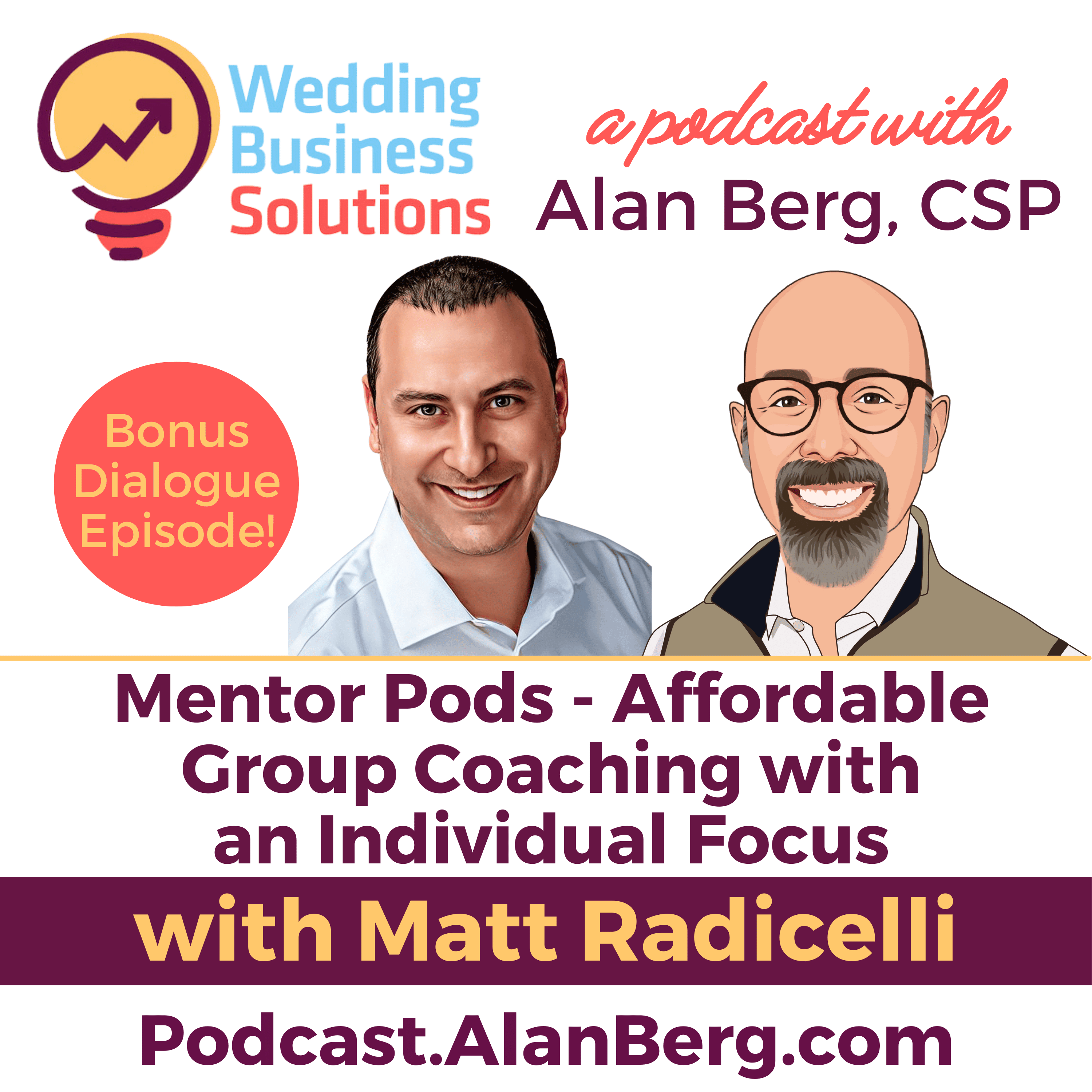
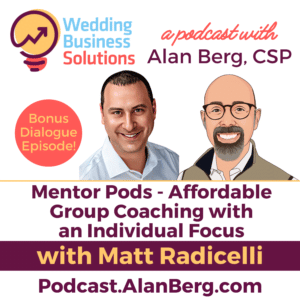
 Matt Radicelli – Mentor Pods – A Pivot and a Niche
I could have interviewed Matt about scaling his business to be the largest in his market, or how he pivoted into coaching. Matt recently asked me to join him in a Beta program on Mentor Pods, his latest venture and niche, and in this episode we talk about how and why Mentor Pods came to be and how it’s different than other learning and coaching programs.
Listen to this new episode and then go to www.MentorPods.com/AlanBerg to see more about our Beta Pod and see if this affordable group coaching, with an individual focus is a good fit for you and your business.
Listen to this and all episodes on Apple Podcast, YouTube or your favorite app/site:
- Apple Podcast:
- YouTube: www.WeddingBusinessSolutionsPodcast.tv
- Spotify: https://spoti.fi/3sGsuB8
- Stitcher:
- Google Podcast:
- iHeart Radio: https://ihr.fm/31C9Mic
- Pandora:
Below is a full transcript. If you have any questions about anything in this, or any of my podcasts, or have a suggestion for a topic or guest, please reach out directly to me at [email protected] or contact me via text, use the short form on this page, or call 732.422.6362
Please be sure to subscribe to this podcast and leave a review (thanks, it really does make a difference). If you want to get notifications of new episodes and upcoming workshops and webinars, you can sign up at www.ConnectWithAlanBerg.com
– Is this a pivot? Is this scaling? Or is this a niche? You know what? It’s all of them. You want to hear this episode? Hey, it’s Alan Berg. Welcome back to another episode of the Wedding Business Solutions podcast. I don’t know what bucket to put my next guest in on because he fits into all the buckets. So Matt Radicelli, welcome to the Wedding Business Solutions podcast.
– Alan, thank you very much for having me.
– I’ve been wanting to have you on, but I couldn’t figure out where exactly to put you in here. And serendipity had us talking recently about something that brings us to this today. So for those of the people that don’t know you, formerly you started and ran and grew Rock The House in Cleveland, which was the largest, or I dunno, at the time you were there certainly was the largest entertainment company in Cleveland, fair to say?
– Yes, sir.
– And then people I know in the entertainment business would always look to you for business advice. So then you started consulting, right?
– That’s right.
– Okay, and then you said, “Okay, how can I do this for more people?” So, no grass grows under Matt’s feet. How can you do this for more people? And you started something called Mentor Pods. So tell us what Mentor Pods is.
– Mentor Pods is a group learning platform that’s based on the idea of learning things in bite size chunks, while getting encouragement every step of the way and building positive behaviors. It’s a 52 week program. It’s an experiment right now, essentially Mental Pods is in its beta, the pilot program. And so far it’s doing pretty well.
– So this is building upon things that existed, but taking what may not have been right about one and then adding something and then going back and forth. So where did the idea come from because you were doing one-on-one consulting I guess, or coaching?
– Yeah, when my kids were young, I started doing consulting on Wednesdays. It was the day that I took off. When I would MC and DJ on the weekends, I would try to have that day off in the middle of the week. And then when my kids went to school, I had this day free and I started doing consulting work. So I would come home from a convention just like you and somebody would reach out and say, “Hey, do you do coaching?” And eventually I said, “Yes.” So over the course of 10 years, I had two different types of clients. I had ones that wanted one-on-one coaching, what’s called open coaching. And then there were people that wanted structured coaching, where they wanted to learn a thing. And then they wanted that thing to essentially be built into their business that integrated. And then they wanted to learn a new thing next week or next month and then rinse and repeat very, very different client types for a consultant or a coach. So Mentor Pods was my way. Once things started to pick up, you know, post COVID, and my way to build it all together and sort of build a different mouse trap.
– It’s one of the things that has stopped me from doing stuff like this in the past is the scalability of it because there’s only so much Matt or Alan to go around. And the one on one limits that. I love doing onsite training, but for me that’s a one day or a two day thing. It might bring me back later or have me do some remote stuff. But I love that, but we always want to do more. We always want to be able to help more people. So, you know, full disclosure here, Matt approached me recently. This is how I found out about Mentor Pods approached me and said, “Hey, you know, there’s only so much, Matt, to go around.” And Matt only knows certain things and Alan knows certain things and there’s a good dovetail here. Or as you said to me, there’s only certain people that you would trust with your clients. So you came to me about doing the sales piece of Mentor Pods. So we are creating this beta. This is a beta program over here, because this is new for me as well. And how to do this, which fits into what I didn’t do before, because I didn’t think I could make it work, to what you’ve been doing and realizing, hey, my skill set goes to here. And then there’s stuff on the other side. Not that you’re not good at sales, my friend, because you certainly have proven that, but that’s my wheelhouse. There is a lot of things that you do when you talk about, and again, you could talk about the performance side as well as the business side. But what people have always looked to you for was the business side. What people always talked about, like nothing personal against your DJing. But when somebody’s talked about Matt, they talked about business. They didn’t talk about, oh, he’s a great DJ. Look at him mixing, you know. Like if we think of Jason Jani, who’s a great business person, but we think of him first as, oh my gosh, you know, he’s an amazing DJ.
– Well, we can agree on the fact that no one is talking about my DJing. And that is for sure.
– I cannot attest your karaoke skills though, because we did that. I was one of your backup singers.
– And yours my friend. Yes.
– There we go, there we go. So lay this out for people here on Mentor Pods. So the idea of 52 weeks. So every week there’s going to be a lesson and then what? Then what? Next week, it’s a different lesson, right? But what’s the idea? What’s the goal here?
– Yeah, like just like we do with any of our clients, I tried to break down all the barriers of all the objections that might be brought up in anybody’s previous history with a coaching relationship that didn’t go well or a program they went in that felt flat on its face. The idea is that every single week you get to enter the week by taking a deep breath and not feeling any guilt about whether last week’s lesson was something that you really caught onto or that you did the homework or not. Everything is optional, right? So if this week I learn about how to read a profit and lost statement and I teach you how to read your own and potentially how to organize it or do whatever. The next week when we learn about something new, it doesn’t matter whether you did any of that or not because there’s no guilt. There’s no pressure. There’s no judgment in what’s happening. So every single week we take a few minutes at the top of the lesson. Well actually we take 30 minutes before. This is really important for me not to skip, 30 minutes before the session actually starts, we have what we call open door focus time. So think of it like a college professor leaving the door open for anybody who has a question about what’s happened over the last couple weeks to go knock, knock, knock, hey, you got a minute? I have a question for you. We do that in open coaching. Remember I was talking about the two different types of clients out there. So anybody with a question about their business, regardless of what that week’s lesson is, can come in and tap everybody in the group or me for knowledge. They can say, “Hey, I’m having a hard time because this person did this thing, I don’t know how to handle it. What would you do?” I have a new logo. Will everybody tell me what they think? That kind of thing. It’s open. But the moment that we begin, we actually just do a very, very brief review of last week’s session before we jump into this week. That’s it. We break the ice, get started, jump in, each week’s actual lesson is about 20 to 30 minutes max. It’s meant to be very, very snack size, very direct. We don’t get too deep on the slides. Lots of examples and things we do. Not only the what, but the how we want you to do it. And then we deliver templates if it’s required, not every lesson has templates that would be required. But the balance of the time is for questions because not everybody learns at the same speed. Not everybody learns the same way. So we leave 15 to 20 minutes at the end, which is the goal of every single hour of time in the full lesson time to answer questions. That’s pretty much the format of how it goes week to week.
– So those questions at the end are specific to this lesson whereas the 30 minutes before is anything?
– That’s a great point. It’s about that week’s lesson until it’s not. So if it’s a very simplistic lesson and we, you know, in sales we say, do you have any more questions? And they say, no, or, you know, sorry, let me pull my Alan hat. “What questions do you have?” Ding, ding, ding. And they say, I don’t have any, well, then we go, okay, it’s time for open coaching. Whatever you guys want then who has another question that isn’t about this week’s lesson? So we switch gears back into that as well.
– Right, but that’s again important for people to know, because what you said, if you guys pick this up is people learn differently. Some people get it right away and that’s it. I love the idea about if you missed last week’s lesson, for whatever reason, you’re not picking up where we left off last week, because this is a completely different lesson. However, if somebody does have to miss for some reason, are they recorded?
– Every single session is recorded and there’s not supposed to be any sentiment of guilt or again, judgment if you’re not there. Business owners and anybody who’s in a C level or middle management positioning is in Mentor Pods. They have things that come up, we all have conflicts, you know. So you’re essentially, you can watch the recording, but one of the things that’s nice is you can gift your seat that day to somebody else on your team if you want to. Or you can even, let’s say we were doing a lesson about sales dashboards and you would like to bring a sales manager or your top salesperson in. They can actually sit shotgun with you. Okay, as long as it doesn’t become the rule and you’re not bringing somebody every week, it’s not meant for a two for one. It’s really just to bring somebody along. So the program isn’t just to serve you. If you have an organization with multiple people in it, it’s to serve your whole optional, opportunity to bring other people in.
– Right, so your webmaster could come in. Whether they’re actually internal, if using an outside, you could let them sit in here. We’re going to talk about website over here. Your bookkeeper can sit in when you’re talking about your P&L and stuff like that. So you can bring the right. So it’s for the business, but it’s meant to be for a person at the business, but we understand not everybody wears all the hats.
– That’s a great way to put it. It’s for the business but we’re trying to make it easy to say yes to the idea that you understand. And we are accepting of the fact that you’re going to miss some weeks and there’s going to be some things that you’re just not interested in, that somebody else in your company probably is, and should probably be learning instead of you to be honest.
– And if you are the company and you’re not interested in that lesson, you don’t have to come.
– That’s right. You don’t have to come or you can at least sit there and learn, because I’ve been told in the feedback forms from all the members there’s currently, a little bit less than 40 people in the program that they get nuggets along the way of things that have nothing to do with the lesson. And I think that’s invaluable. So even if somebody watches an entire lesson and says, this doesn’t apply to me today, I’m going to put it in the drawer. because I know where to come get it when I need it, when I’m ready for this lesson.
– Or I think I know this I’m coming anyway, because I might pick something up. I just spoke at an event and I had a friend of mine, entertainment company, Multi-Op, very successful. And she came to me after my session and she goes, “Damn, you did it again. I said, watch. She goes, “I’ve seen you talk about this, I’ve read your books and you taught me something new anyway.” And that’s because we don’t absorb everything that we hear. We don’t apply everything that we hear. We’re not ready for it at that moment. Even though we heard it, it didn’t sink in because I didn’t need it that time but now all of a sudden that I do. And that’s why sometimes I listen to audio books twice because I missed something or read a book twice because I missed something and love seeing the same speakers. I mean, how many times you watch a movie and you see a line and you’re like, wait, I don’t remember that line. That was a great line. Where would that come? It was there. It just didn’t sink in. We can’t remember everything. What do they say that 37% of all statistics are made up, right?
– I believe that.
– Yeah.
– That’s actually a great point because I believe that the content that we’re trying to deliver in the beta is 101 content. And because everybody learns differently and they’re all at a different place, you know, in time for what their advanced knowledge may be or whether they’re novice, we give them and deliver suggestions about how they can enrich that content with 201, 301, and 401 level suggestions. So even if somebody, when they first join the program’s like, well, I already know how to read a profit and loss statement. We go, yeah, but, or yes and, I’ve got some 201, 301 and 401 for you to consider, to extend this, to learn more, to grow into that advanced section. So even if somebody already knows what we’re teaching about, they probably aren’t in the 301 or 401 category yet, which means they’ve got something to learn. And because the pod is based on the idea of teamwork, collaboration and learning from each other as well, everybody has an accountability buddy. And they have the opportunity to reach out to people through other types of communication, like a closed and private Facebook group. So if we’ve identified that somebody in a pod is an expert at a thing that we just taught, I’ll say, “Hey, you can ask me anytime, or you can go ask Alan or again, Bob, Susie, whoever it is.” And it’s a great way for them to also share, because people learn through teaching as you know, as well.
– Right, when I do my mastermind days, it’s that collaboration that’s the magic because there is somebody who knows more about something than I do or than you do, because this is something they’ve studied more. They came from a background of something else. I remember doing this, during COVID I was doing this virtual workshop and DJ in the UK just starts dropping bombs about Google ads and everybody is like, what? Why do you know all about that? He said, “Yeah, I went down the rabbit hole and I keep going there.” And he’s blowing my mind, I was like, I don’t know that stuff. And that’s the beauty of it. And the other thing is I always struggled with this 101, 201, 301. There is no real consistency to what 101, 201, 301 is because we all come at it differently.
– Yeah.
– And I remember a group that you’re a part of that asked me to come, and this is years ago when I first presented on how to respond to email inquiries. And I was asked, please don’t bring us 101 level. Bring us 301, 401 stuff here. These are successful businesses. You’re bringing us this. And I said, fine. And then I secret shopped everybody. And I fell off my chair. I’m like, whaa! I don’t even know if we’re at 101 here. Okay?
– Right, yep.
– And that’s because some people are successful despite being deficient at something. Whatever it is.
– Some… Wait, wait. Some people?
– Okay.
– Most businesses. – Most businesses are successful.
– Despite that, you know, I see people with horrible websites and they’re successful because of their relationships. Or their socialist terrible. And their website might be great or vice versa or whatever. And we forgive, like if you refer me to someone and I go on their websites, eh, but I’m taking your word because I trust you, I might forgive that bad website. Someone coming off of Google is going to leave. They’re just going to leave. And I just had this today. I was looking for a massage therapist and I go looking around, someone referred someone, I Google, don’t come up with a website, came up with their Facebook page. Come up with their Facebook page, it’s not that active. I’m like, this is your presence to the public?
– Yeah.
– No website and an inactive.. you know, every couple of months you post something on actually looked like the last four posts with the same image, with different wording. I’m like, if I get a good referral, maybe I’ll go. Otherwise I’ll find somebody else. I’ll find somebody else. So what I loved about this idea besides the fact that I’m every other week in stunt and not every week, when you said, listen, there’s homework. Sometimes you don’t have to do it. That really resonated with me because the type of learner I am, I am a visual, audible learner. I hear you say it. I’m watching your body language even if it’s on Zoom and I got it. I don’t need to go do a test. I don’t, that’s the way I learn. And I know that’s not the way everybody else learns, but like all of my books, none of them have a, at the end of the chapter, “Now you must do this exercise. Now you must do this thing”, which some people love. I can’t stand. I never do ’em . I’m just going to tell you I never do ’em. I already learned it. I either know it or I don’t, I don’t need your test to prove that to me in my mind over there. So I love this flexibility for the learning style that we’re not forcing people into that. I’ve seen a lot of programs you probably have also where people created one for the style of their own learning. The way that they learn. Not everybody learns that way. So you have to open it up to this. So what else do people need to know? because we’re I want going to wrap this up soon because I like to keep this a little bit shorter and we’re certainly going to give everybody a link on how to find out more about because my beta pod, what are we doing? Is it up to 48 seats? Is that what it is?
– Yeah, the max, the cap that we’re going to do is at 48. And I think that we’ll launch, you know, anywhere in there, but what else do they need to know? They need to know that I’m excited. I’m excited about working with you. I’m excited about having a series of instructors, including myself, working alongside of you. Again, you’re going to do half the weeks. We’re going to do half the weeks. I’m excited to see what that looks and feels like. I’m stoked for the idea that every single time somebody joins Mentor Pods, there’s something that I learn too. I like learning from everybody else. So that’s what I’m most excited about. What else do they need to know? We built a program to be flexible and to be for everyone, we ask them to your point, what is your learning style? We give them examples because not everybody even knows by the way, you know what their learning style is. So we ask you, when you join the program, once you place your trust in Alan and the program itself, what are you really great at? And we list all the different facets and disciplines of business. And then we ask you, what are you horrible at? And we ask you to rate those as well. And we say, besides that, what you’re good at and what you’re not good at? What do you want to learn more about? We take all of that information. That’s how we build the content. It’s not just like you’re joining Mentor Pods and it’s the exact same content, whatever it is. No it’s customized. And really the cherry on top of the Sunday is that it’s taught live. So unlike Coursera or LinkedIn learning or anything else where nobody can respond to your face, because you’re confused everyone of the opportunities we have to see the body language, because you have to have your camera on. It’s part of the program. When we see that we have a room full of people that have an aha moment, we take a moment and celebrate it and say, yeah. And when we see that people are frustrated or confused, we navigate and pivot whatever we have to do. So that’s pretty much it. Alan, thank you so much for asking about it. It’s going to be a great program. I can’t wait to launch with you.
– Well I thank you for asking me because I consider that an honor, that of all the people you could have asked, you’re like, okay, who do I want to do this with? And again, you’re placing a lot of trust in me. This concept, again, it’s new to all of us. We’re calling it a beta because we’re learning as we go along. That doesn’t mean that the information isn’t good because you’re learning from experts on this. It’s this format that’s the beta. We’re figuring out this format here. So we’ve priced it as such as we’re learning all along. I don’t remember if this is a book title or it should be, but “none of us is as smart as all of us”. I heard that phrase. I’m pretty sure it was a book. I can’t find it on my bookshelf. I thought it was a book that I had read, but that’s what this is also, none of us is as smart as all of us. So we’re going to put the link into the show notes. Mentor Pods, MENTORPODS.com/alanberg. That’s going to be my page right over there. I’ll put that in there again, but it’s mentorpods.com/alanberg If you have any questions, certainly reach out. If you know anyone that would benefit from it certainly do that as well. Matt, can’t wait to get started with this on you. We’re looking at… We’re going to try for November 1st. If we get enough people in the seats by then, going to try for November 1st, because we are now, what are we now? We’re October 3rd as this is coming out. So November 1st on that, we’re going to try to do that. That’ll get us good started. You’re also great if you do weddings and events, engagement season, right? You’re going to get started in there with engagement season and you’re going to have this continuity of it. And again, if you miss a week, go back, watch the recording, ask questions on it. It’s going to be great. Matt, thanks for inviting me. Thanks for joining me today and can’t wait to do it.
– Thanks Alan.
I’m Alan Berg. Thanks for listening. If you have any questions about this or if you’d like to suggest other topics for “The Wedding Business Solutions Podcast” please let me know. My email is [email protected]. Look forward to seeing you on the next episode. Thanks.
Listen to this and all episodes on Apple Podcast, YouTube or your favorite app/site:
- Apple Podcast:
- YouTube: www.WeddingBusinessSolutionsPodcast.tv
- Spotify: https://spoti.fi/3sGsuB8
- Stitcher:
- Google Podcast:
- iHeart Radio: https://ihr.fm/31C9Mic
- Pandora:
©2022 Wedding Business Solutions LLC & AlanBerg.com