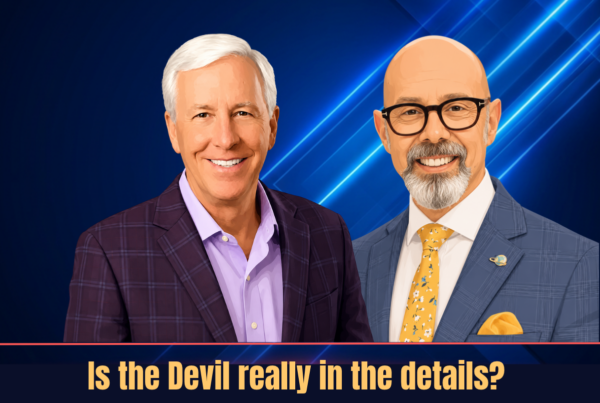
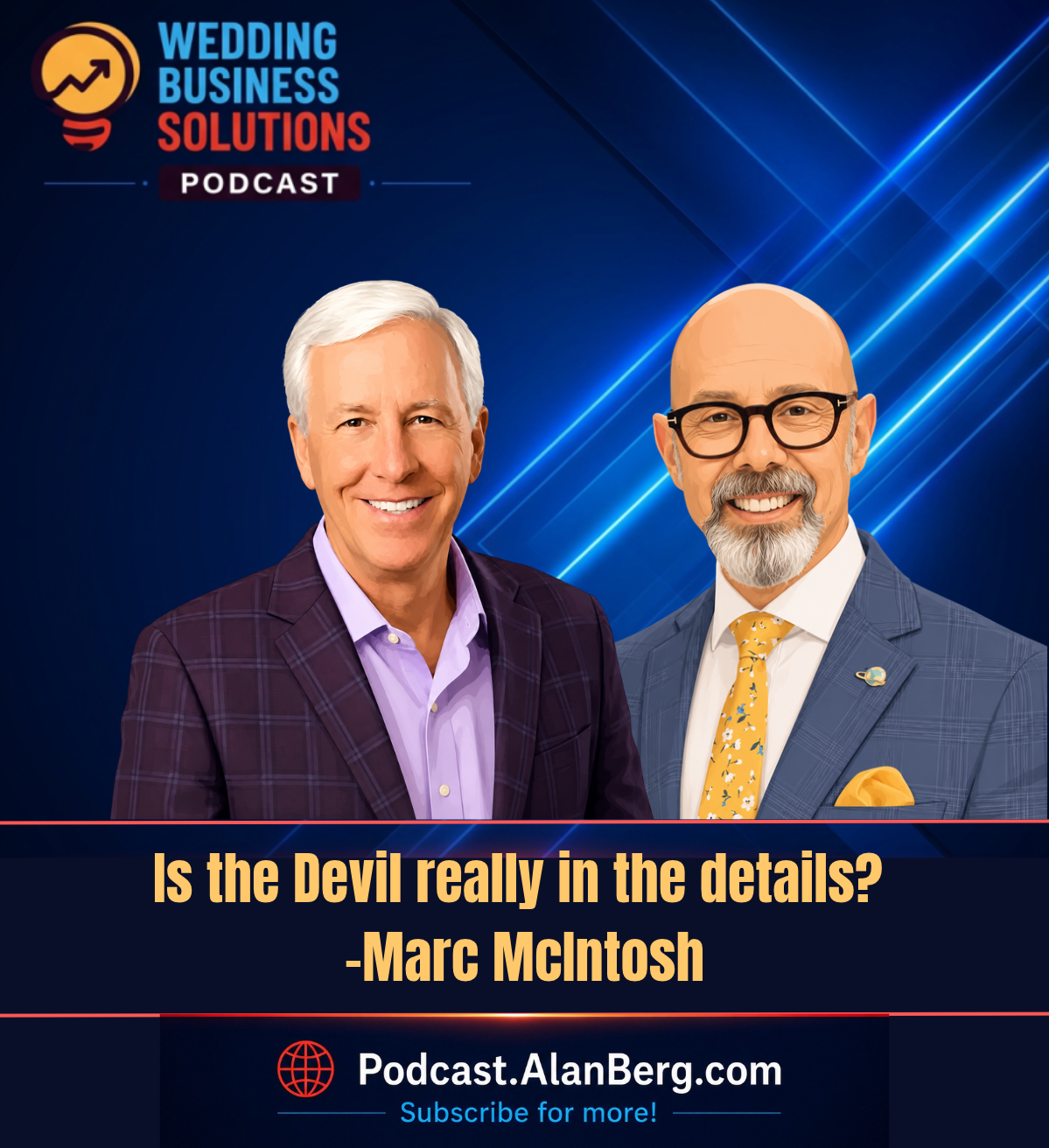
 Marc McIntosh – Is the Devil really in the details?
Is your website turning away your perfect clients before you even know it? Are broken links, cluttered contact forms, or unclear messaging costing you inquiries and bookings? In this special episode with my good friend Marc McIntosh, we dig into why attention to detail on your website and in your online marketing matters more than ever. How clear is your “call to action”? Are you showing your real value, or hiding it behind generic language and complicated forms? Tune in as we ask what details you might be missing and how those could be standing between you and your ideal clients.
Listen to this new episode for straightforward ways to improve your website, make your business easier to find, and compel your best clients to reach out.
About Marc:
Marc McIntosh, known as the “Creator of Awesome Wedding Marketing,” is a marketing strategist, Fractional CMO, and national speaker with over 30 years of experience in events and small business growth. As co-founder and president of Team Wedding Marketing and Winning Team Marketing, he helps wedding professionals and small businesses turn scattered marketing into cohesive, high-converting digital strategies. A former bridal expo producer and past president of the National Association of Consumer Shows, he continues to educate entrepreneurs nationwide through industry training and speaking at major conferences like Wedding MBA.
Contact Marc:
https://winningteammarketing.com/
Phone: 703-489-7758
Calendar: CLICK HERE
If you have any questions about anything in this, or any of my podcasts, or have a suggestion for a topic or guest, please reach out directly to me at [email protected] or visit my website Podcast.AlanBerg.com
Please be sure to subscribe to this podcast and leave a review (thanks, it really does make a difference). If you want to get notifications of new episodes and upcoming workshops and webinars, you can sign up at www.ConnectWithAlanBerg.com
View the full transcript on Alan’s site: https://alanberg.com/blog/
Summary:
In this episode, I sit down with my friend Marc McIntosh to have a real conversation about why attention to detail matters so much in the wedding industry. We talk about how issues like broken website links, confusing navigation, and overly long contact forms can instantly lose you potential clients and damage trust before you even have a chance to connect. Marc shares how important it is to regularly check your own website and streamline every step of the client’s journey, so you never miss an opportunity or unintentionally turn away your ideal couples.
We dive into strategies for structuring your website around the types of clients you want to attract, like creating specific pages that address weddings, corporate events, and other special occasions. This approach not only makes things easier for your website visitors but also boosts your visibility in search engines. We also discuss the power of including the right questions and answers on your site for new forms of search like Answer Engine Optimization.
The conversation covers why being transparent about your pricing is more important than ever and how trying to hide prices usually backfires now that AI and online reviews can surface estimates elsewhere. We emphasize that your website should do the work of attracting your perfect clients and politely turning away those who aren’t a good fit, saving you time and effort on follow-up.
We wrap up by talking about the dangers of poorly thought-out automation and why everything in your marketing—ads, social media, referrals—ultimately points back to your website. Investing in a simple, user-focused site ensures that when someone discovers you, they find exactly what they need and are motivated to take the next step. Throughout the discussion, you’ll hear practical advice, real-life examples, and plenty of actionable tips to make sure your business stands out for all the right reasons.
Is the devil really in the details? Let’s find out where we’re going here. Hey, it’s Alan Berg. Welcome back to another episode of the Wedding Business Solutions Podcast. I am so happy to have my friend Mark McIntosh on to talk about attention to detail. How you doing, Mark?
I’m doing well, Alan. Great to see you as always.
Oh, you know what? We go back a long way. We’re not going to tell people how long. And you and I were chatting the other day and you mentioned something. I think you shared something with me, I think it was somebody’s really long contact form or we were doing something like that. And we started talking about how the attention to detail is just lacking in so many people’s businesses. That’s where we got on this.
Yeah, that is, that is it. Just those little things that add up to turn off what might otherwise be a perfect client.
You know, I had this happen because you mentioned like broken links and things like that. And I had this happen just the other day. Uh, it was something not in our industry, it was something I was trying to do as a consumer, and they sent me a document and I could return it through mail, fax, or email, right?
Fax?
Yeah, fax. Um, and then I found out that my all-in-one unit that I have, which I thought was plugged into the phone line, there’s no phone connected to it. So forget about fax, right? So I was like, all right, so, um, I could go online and just drop it in. I clicked the link, broken link, right? And then I was somebody else’s site and same thing, click and it just didn’t happen, right? These broken links. Now you make websites. When you’re looking at people’s websites and reviewing them, do you see this often?
Oh, broken links, weird things like not enough space here, too much space here, too much scrolling, the contact forms, which is a whole—we could talk about that for an hour in itself, but just those little things that add up to not getting the client to trust you.
Yeah. Well, again, because we expect things to work and we don’t notice when they work, we notice when they don’t work, right? That, that’s what it, that’s what it is.
If it doesn’t work on your website, how’s it gonna work at my wedding?
Right. But it could also just be preventing you from getting the inquiry in the first place.
Right.
Um, today we’re recording, this happens to be the first of a month. And my calendar popped up this morning and it said, check your contact form. And I literally fill out my own contact form on the 1st of every month, make sure it goes into my CRM, make sure I get the notification, and make sure the automations start. And twice in the last year, it didn’t work. One time it was Cloudflare was just getting too aggressive and told me I was spam. Like my website, I was spam filling out my own contact form. Wow. And then another time something else had happened again that it just didn’t work.
It’s technology, right? I didn’t change anything, but maybe WordPress did or something like that, right? So you’re, you’re doing this all the time. You’re making websites for people and, you know, you’re going and reviewing. What are some of the other things you see that people are just not paying attention to?
The not giving a clear direction on where to go, how to get to the information that you need, making them hunt for very important details. And oftentimes it is showing, not showing things clearly that are really your biggest differentiators and having that hidden. I mean, we all get too close to our own businesses.
Right.
And we build our own website, we write the copy, we know how it works, we know where everything is. But you have to take someone who, I mean, the easy, take a 14-year-old that knows nothing about your business, have them go to your website and tell you within 5 seconds what you do and where you do it. And then try to figure out where that next step is that you want them to take that you don’t necessarily make as easy as you think it probably is.
Yeah, it’s the curse of knowledge. Like I said, you know where everything is, you know what you do. I see this all the time as well. I’m like, so what, what, what do you do? I’m looking at your website and I see a picture of a wedding. Well, the average wedding has 12 to 14 services, and there’s probably 9 of them in that picture in some way.
Making your dreams come true.
Right. All of these generic phrases, right? I remember when I was publishing my Wedding Pages magazine, I had 3 customers who were called Affordable Elegance. 3 customers, 2 different types of business of the 3 customers. Affordable Elegance was the name of the business because, again, you know what you do. And, you know, when I look at somebody’s website, I’m looking for, okay, you know, who are you, right? And then what do you do and where do you do it, right? This is what you mentioned, like, where do you do it? What do you want me to do, right? All right, what’s in it for me, I should say? And then what do you want me to do? And I—let me, let me ask you a question. We haven’t talked about this. If somebody is, let’s say they’re an entertainment company and they do DJ and lighting and photo booth and some other services, they do this for weddings, they do it for corporate, they do it for mitzvahs and quinceañeras or whatever. The, the navigation on their top navigation, you’re making them a new website, how would you have that navigation? What would be those tabs, those buttons?
I would—what I like to do and what a lot of people don’t want to do is to sell the result, not the stuff.
Not—that’s what you should be doing. Absolutely. Yeah.
And so I would organize a site, not here’s all the services that we do. And by the way, we do all of these different types of events. I would do what, you know, what I call getting them into the smaller room by having a website that has a page for weddings. And if weddings are your most important, and I see that a lot where weddings are half the business or 3 quarters of the business, but they’re in the same size box as all of the other events. Make weddings bigger, more prominent.
Yeah.
Quinceañeras, nightclubs, dances, parties, all of the things that you do. A venue, even a venue. We just worked on a website for a venue that they rent 4 walls. That’s it. They just, you rent the venue. So what they do for every event is pretty much the same, but they still have a page for wedding receptions, wedding ceremonies, retirement parties, birthday parties, showers, anniversary parties. Everyone has its own page. It serves 2 purposes, super good for search because when you, when somebody’s searching for venue for a birthday party and you have a page about it, you are going to win.
And it’s very good for the customer experience because the customers can then come. They, they have a page that is speaking directly to them instead of just saying, like, walking into a room and saying, I’m a DJ, does anybody need me? You’re like dividing people into the smaller room that they can then find exactly what they need, talking about their type of event, FAQs about their type of event, the lighting and sound and all the effects that you do for that type of event, all in one place, speaking directly to them as opposed to making them say, okay, you do these events. Okay, now let me go look at your speakers and look at your lighting and your dancing on the clouds and, you know, all of that. And that can apply to really any type of business, like sell that result, not, you know, not the bullet point list of stuff.
Right now, I’m happy we didn’t talk about this ahead of time because it’s exactly what I think as well. I come in and you use the get into the smaller room, which a similar metaphor. I say your homepage is your receptionist, right? Because that’s your whole business. Somebody walks in, talks to the receptionist. Oh, how can I help you today? Oh, we’re getting married. They say, great, just go through that door. Now they’re in that smaller room. It’s a mitzvah.
Go through that door. It’s a different door. Right. Kinsei, go through that. And the beautiful thing is there’s gonna be redundancy on those pages because you do some of the same things for each of those things. But that can help you in search because now it says all those things. FAQs. You know, I, I’ve been telling people now, you know, for AEO, answer engine optimization, and GEO, generative engine optimization, you need this FAQ on steroids.
And if you have that on every one of those pages, you’re putting yourself up. I’m not going to say you’re going to come up better in search, but you’re setting yourself up better to come up better in search.
And you’re also giving the prospect a better journey. Everything is in one place and it’s speaking directly to them. We’re working on a website right now for a bridal salon. And this is going to be a 100-page website. Because we are building a page for classic wedding dresses, boho wedding dresses, petite wedding dresses, plus-size wedding dresses, dresses for athletic fits, every iteration, slicing and dicing it. Because when I am doing a search for—I’m a, I’m a petite bride with an athletic build. And I’m looking for a wedding dress and you talk about that, you’re gonna win.
Yeah. Yeah. And that again, people, search is easy and it’s hard, right? It’s easy because it’s just, do you have the words and phrases there? And with AEO and GEO, do you have the questions and answers there that I’m asking? That’s from a high level. It’s easy. You just have to have that. The thing is you just have to have the right words, the right questions, the right answers. And the more you have, the more likely that person is going to find, wow, you’re actually giving me that answer.
And unfortunately for what we see with so many wedding pros, they are like SEO and AEO is like that wizard behind the curtain. You don’t really know. It’s not, you don’t see it. You kind of, it’s there, but it’s very easy to ignore it. And I want people to look at an investment in SEO and AEO and GEO no different than any other investment in advertising because that’s what it is. Advertising, you buy ads to create awareness. You do SEO and AEO to create awareness organically. They accomplish the same thing.
But then when you spend hundreds or thousands of dollars a month on ads wherever you’re advertising or hours and hours on Instagram, social, TikTok, you do all of, make all of those investments, but then don’t make that investment that is the lowest hanging fruit of all. Like it is, you’re leaving money on the table and you’re working way too hard to be found when you’re leaving off that part that is like, again, the lowest hanging fruit in being found is having better SEO.
Right. And your website, you, you paid for it. It’s there. And if you can get more people to it, and then it’s got the right words and all the other things we, we talk about, that’s it. Now, I’ve said for years, I don’t really care about getting business through search because I, people know me and they find me through all the different things that I do. That said, I used to have to say I’ve never gotten any business through search, and now I have to say, well, I rarely do. Because I’ve probably booked 2 or 3 people in the last year, one of whom told me they found me on ChatGPT. And, and what, what he said was, this is a venue in New Jersey that does big South Asian weddings and smaller South Asian weddings and other stuff.
And he said, there’s a guy in India who does for other businesses sales training and things like that, right? And he said, this guy’s really well known over there. It’s not for weddings and events. And he went into ChatGPT and he said, here’s this guy. Right? I want you to find me somebody like this guy, but over here for weddings and events. And he said, that’s how I found you, right? Not because I bought an ad, but because my site answers the questions and has the information that he was looking for. And then I just booked somebody in another sales training I’m going to, uh, the next week. Same thing. They said they were searching for someone to help their wedding and event business, and I came up organically because I did the work.
Right. And it’s—and the work is not just on your website. The work is because AI trusts other people more than it trusts your marketing copy on a website. And this is where, you know, in your case, Alan, you’ve got your podcast, you’ve got videos, you’ve got people talking about you in various places, and you’re on websites of places that you spoke in the mastermind and all that, that whole digital footprint is what got you that response. I mean, now Reddit, there was a big thing like ChatGPT is using Reddit and now just in the past couple of days, they pulled back on that. But it’s still, it is reviews, what other people are saying. And so when someone does a prompt in chat, which I believe that the future of planning a wedding and finding your resources is going to just be a prompt.
Because today I either have to go to a wedding website and go to a region and go to a category and then find all these options and click on storefronts and do all that. Or I go to Google and click on websites and websites I can go to and do a prompt that says, you know, I’m, I’m planning a wedding in Chicago at this venue and I’m looking for a DJ. I want a fun-loving DJ. My budget is this much. Ideally, I’d like someone who’s familiar with the venue. Give me a list of the top DJs that meet my criteria. Give me their average review ratings.
Uh, tell me what people like and don’t like about them. Give me their price range and give me a link to their website. And in 90 seconds, you will have that report. You have now saved hours on that search. Now, is that information completely accurate? Maybe, maybe not, but you just have a shortcut to that goal of planning your wedding efficiently. And it’s how you show up in those results is a multitude of things. Managing your reviews, pushing people to your Google reviews, and participating in Facebook groups, Reddit threads. Those getting the word out there, getting listed, getting on favorite vendor lists on other websites, other people pointing to you.
There’s so many things you can do to move that needle, but then it all comes down really to that content on the website. Now, I know you and I have preached for years about transparency in pricing. There is no reason today to leave it off because if you leave it off, they’re just gonna go to chat and say, okay, I’m looking at this photographer. They don’t have their prices on their website. Can you give me an idea of what they charge? Here’s what’s gonna happen. It’ll go to your website first. And if it doesn’t find it there, somebody somewhere in a review, in a Reddit—there are Reddit posts where, here, I looked at 25 photographers in Des Moines, and here’s what they all charge, and giving this and that’s out there somewhere.
And if it’s, if they can’t find it out there somewhere, it will guess. Chances are it guesses wrong. And so you, the only way, you know, and this is my topic at Wedding MBA coming up is like controlling your narrative.
Right.
Because if you don’t control your narrative, AI will control it for you and it’s not going to necessarily be what you want it to say.
Yeah, I just finished an update to my book, Why Are They Ghosting Me? Because it was 2021 when I wrote it and AI wasn’t a thing and so many other things weren’t a thing. And I have a chapter in there about pricing on website. I just had Shane McMurray on from The Wedding Report because he had done a post about pricing on websites because—and he went out and did a survey and only 17—it was only venues—and only 17% of the venues had any idea of pricing on the website. 17%. That was it. And we know that we as customers are looking for a price. We know couples are looking for a price.
Every time, every time you go look for anything, you want to know how much it is.
But the thing is, people who have more to spend aren’t scared away by a higher number. And I think that’s the mentality as well. But I charge more than other people. Well, good. And the people that book you pay that number.
It will, it will do 2 things. Um, and I heard this analogy, your website should be a car. It should compel and repel. You want to attract your right fit client, show them you do that not only with your pricing, but with your images, your how you write, how it’s designed, the look and feel and colors. And you want to repel, you want to turn away people who are not close to what their budget is, not close to what you charge.
Right?
That are outside of your area, that you’re booked on there. All those, like, the people that will waste your time, you want to repel them from the beginning. And that way you can spend more quality time with the qualified leads. And so, yeah, it will. The reality of it is, if I’m a $3,000 DJ and your budget is $2,500, I might be able to get you up. If your budget is $500, I’m doubtful I’m getting you to $3,000. So why not be clear about that? And then, you know, I, I hear all the excuses. Yeah.
Like you said, everything’s customized. The worst one is I don’t want my competitors to find out what I charge.
I wrote about that in the book. I was like, your competitors already know.
If they’re smart, they know. And you should know theirs.
Well, I was going to say, if you know what your competitors charge, of course they know what you charge. That is the worst reason. But I love the compel and repel because follow-up, we know, is bad, right? You know that, I know that, right? You produced wedding shows for so long and, you know, very few of the people that actually exhibited would even follow up, right? And it’s just as bad now. You know, 5 to 10% is what I hear from the, the show producers these days. So if follow-up is so hard, why would you want more people to follow up with, especially people that can’t afford you? Like, why would you want them on your list? Because a bigger list feels good? No, more feels like more work to do. I’d rather have more time to follow up with the right people than just follow up with—get the wrong inquiries. And maybe, like you said, it could be—I could be losing people because I don’t have price. The right people, because I don’t have price.
And I think you want to be really—that, you know, follow-up is so important, but you really want to be careful with how you do it because there’s a whole lot of automation tools right now that make this follow-up thing so simple. And it can be simple, but it can also just be annoying because oftentimes it’s like, okay, you get into their funnel and like the concept is—and there’s some good ones and some not so good ones, but the typical automation is hide your pricing, hide all the good stuff from your website. The only way you can get the good stuff is to get our PDF, which you then have to enter our sales funnel. And then the fun begins. Text messages and emails and voicemails and over and over. And a month later, are you ready for a tour? Like, that is annoying. And if you annoy them, and because you got to keep in mind that there’s other of your competitors using similar automations.
Right?
With oftentimes the same language.
Right. Well, well, here’s the thing. First thing is putting somebody into a drip campaign like that is not a personal follow-up, right? So if they came in just looking for your PDF of your pricing, it got that drip campaign. Yes, it’s absolutely annoying. Could be done better, but it’s annoying. Then there’s also the I follow up. Well, there’s 2 parts. The one is, and you know we do a lot of secret shopping, we’re close to 1,000 companies now we’ve secret shopped.
Okay, so let’s, let’s take the 17% that never responded. Let’s just put them to the side, right? Because we got nothing back from them, right? Then there’s 52% that send one message and then don’t follow up, which is a disservice to the customer because the customer is busy, they didn’t respond. Pop yourself back up to the top of their inbox, right? All right, and it’s, it’s 40—what is it, 48% or whatever—try twice and then they’re done. It’s, it’s just terrible. So what I wrote in the book was, first of all, don’t automate bad processes, okay? Just because you can automate it doesn’t mean you fix the process. You just made it more efficient to do it badly is what you did, right? Same thing with AI. I have a whole chapter in here about automations, and I talk about how AI is not about the tool. Like, you can go to Claude today, Claude Code, and have Claude build you an agent to respond to your inquiries, but it doesn’t have the training, right? It’ll have generic sales information, but it doesn’t know your business.
It doesn’t have the training to know how couples react today and stuff like that. So, you know, the tool is fine, just like a website. You can go right now, right, and have, have a website built, right? What’s the website? What’s the one like, oh, I forget the name of the one.
Oh, Lovable. Lovable, yeah. There’s Lovable, there’s Base44, Wix has a website builder.
Right, right.
There’s Squarespace has one.
You can build it, doesn’t mean it’s any good. And the difference between what you’re doing with someone versus that is that you understand how people work. You understand the hierarchies, you understand this stuff. So yeah, you know, if you have, if you created a, if you make a dog walking service and you need a one-page website today, fine. Go have Lovable build it for you. You’re fine. But if your business relies on people getting to your website and then taking the action you want, that’s not going to happen as efficiently when you do it like that.
And I think, you know, that’s a very good point because what it seems like a lot of people fail—like, I see this with wedding pros all the time. You’re investing in your stuff. You’re investing in the tools of your trade, your cameras, your, you know, your, your speakers and your lights and your venue and the gazebo and all of your investing in all of that stuff.
Right?
You’re spending hours doing other marketing things, particularly posting on social. You’re doing all this stuff. All roads lead to your website. Even a referral. Somebody hears about you, they’re gonna check you out before they take the next step. Because I’m sure everybody has had this case, you know, that some wedding pro says, hey, I referred you to this person. I never heard from them. Well, maybe they went to your website.
And it’s just, your website’s the hub of everything. All roads lead to it. Should not, shouldn’t that be the place where you put an investment of time and money and effort? Is that because all roads lead to it and it can be the, and you have a, you know, we’ve all said this, you have like 5 seconds, 3 seconds to make an impression when people see any piece of your marketing. But the, you’ve got to remember how people are buying today. They go to the wedding websites, open up a bunch of windows. They go to Google. They have 20 tabs of possibilities.
Yeah.
They’re not going to reach out to 20, 50, or 100. They’re going to narrow that down to a shortlist. How do they get from the big list to the shortlist? I call it subtractive shopping. You do it every time you go to Amazon to buy something and there’s 3,000 of them. You have your own process of narrowing it down. Couples do too. You have just that. They have 20 tabs open.
They perceive that there are unlimited choices.
Yeah.
They are quick to, if they don’t like what they see, if your website is not speaking to them, they’ll bounce because they perceive they have a bunch of other choices. And that again, that right fit client, you’re open on their date, they can afford you. They would be your right fit client, but you lost them because something—and it, it is, the website is your easiest marketing challenge to fix. Once that works, like, you know, as we talked about before, we do, our company does a whole lot of outsourced marketing for wedding pros. So you can come to us and have everything done for you, have everything on brand cohesive, whether it’s digital ads, or website SEO, all of those things. The lowest hanging fruit in every case, you fix the website first and then a whole lot of other things work better because the, you know, there’s 2 ways to grow your business, create more awareness or get more conversions from the people that have that awareness. We look at all the time, like I’m getting, you know, my business is struggling. We look at their analytics.
They’re getting plenty of leads. They just don’t know it. They are dropping out before they take the next step. I call it prejection. They came, they saw, they checked you out, and they left. And you don’t even know that it happened.
Yeah, you can’t, you can’t see it. I said this before. If you could see the people that did that, they got to your website, 7 steps until they got there, but they got to your website and then you turned them off some way. Right, um, which we were sharing screenshots of contact forms. All right, I just want to touch on this before we go because we’re getting close to time now, right? You sent me a screenshot of a contact form. What was there, a dozen? How many fields are on that?
About almost 20 fields.
Almost 20 fields. And how many were required?
Uh, almost 20.
Oh my gosh, right? And I had one the other day, um, a friend of mine, a DJ, was trying to get a hold of a venue. And he couldn’t get ahold of ’em. So he went to their website and he shared their contact form with me. It was 14 fields, all required, but it included the street address. Like 4 of the fields were the address, the city, state, and zip. Like, why do you need someone to give you that required just to make an inquiry? Right? And then I had another client that had, you needed the address of the venue and you needed your own address on there. It, I mean, just mind-boggling.
It’s really, that’s really simple. And I know you’ve talked about this before. I talk about it all the time. Divide all your questions into 2 categories. Have to know to consider the conversation and then like to know just because it’ll make my job easier.
Right.
Only ask the absolutely have to know. If you travel to the event, what is your, the location? What’s the date? Make sure you have availability because I would be pissed. If I was a couple and I filled out this novel of a contact form and you came back to me with one-line reply, sorry, I’m booked on that date, like that, they would—yeah, yeah, you can’t work for them. So you may not care that you annoyed them, but they’re gonna tell somebody.
Right.
And, like, you want to have no barriers to them taking a next step. It might not be the next step that you want because, like, you ask any DJ, the first, their first call to action on the site is book now.
Right. Oh my gosh. How is, what a high commitment.
You have not, I don’t, I haven’t checked you out yet.
Right.
I don’t know if you’re right for me. You don’t know if, if I’m right for you.
Right.
It’s like you’re proposing before the first date.
Right. But the problem, the problem is that not only is it say book now, but it only goes to a contact form. Right.
It’s not, you’re not booking now.
Right now I have, if you wanna hire me for a 2-hour consultation, it says book now. Then you pick the date and you pay. And it’s done. You actually did it. It’s the only place I have Book Now because you’re physically going through the booking process. You can’t do that to hire me. You can’t do it for speaking or anything like that.
Very few people. We’d love it to—they come here, they fall in love with you, they book you.
Right?
They’re not doing that. The typical website visitor is not doing that on the first one. And you turn them off by that.
Well, first of all, you’re not going to get the inquiry because they’re not—never going to get to your contact form because it says Book Now or Check Availability, which may not be their question, right? Price might be their question or whatever. But DJs, they love check availability because it goes to their DJ event planner, and then it, you know, it goes into all those things.
And those are good things to have, and we’re going to need them in the future because everybody—like, if you had an availability, an AI-based conversational availability checker on your website, you would be again compelling and repelling. They can get that question right away. And that’s gonna be, you know, that is building a knowledge base about your company, which we always do when we build a website. First thing we do is we build a knowledge base of a whole bunch of different pieces that go into it. And then we use that to write all of the copy, but you can also use that to write blog posts. You can use that to do competitive analysis, and you can use that to train a chatbot that’s not the sucky chatbots that we’ve all seen before.
Well, but again, it comes back to the knowledge base, right? The chatbot is—technology exists. The training is what made it a sucky experience. It wasn’t the technology that made it that. It worked. It let you have a conversation. It just couldn’t answer you. It’s like hiring somebody and on their first day of work saying, okay, answer the phones and start making sales. Well, hang on.
I don’t, I don’t know anything about you. Right. So, all right. You know what? We are, we are out of time, but we have to do this again because there is so much more to talk about here. Marketing, advertising, all this kind of stuff. But Mark, just tell people quick, it’ll be in the show notes, but how do they find out more about you and what you do?
Easiest way is go to our website, teamwedding.com. And you can always reach out to me. Email [email protected], Mark with a C. Instagram, Team Wedding MKTG. But, you know, our website has all of the stuff that you need to know and a short contact form and you can—and a way that you can schedule a call with me if you want to talk about things in more detail.
So teamwedding.com.
teamwedding.com.
All right. Thank you, Mark. Thanks, everybody. We’ll see you at Wedding MBA.
Thanks, Alan.
I’m Alan Berg. Thanks for listening. If you have any questions about this or if you’d like to suggest other topics for “The Wedding Business Solutions Podcast” please let me know. My email is [email protected] or you can text, use the short form on this page, or call +1.732.422.6362, international 001 732 422 6362. I look forward to seeing you on the next episode. Thanks.
Listen to this and all episodes on Apple Podcast, YouTube or your favorite app/site:
- Apple Podcast: http://bit.ly/weddingbusinesssolutions
- YouTube: www.WeddingBusinessSolutionsPodcast.tv
- Spotify: https://spoti.fi/3sGsuB8
- Stitcher: http://bit.ly/wbsstitcher
- Google Podcast: http://bit.ly/wbsgoogle
- iHeart Radio: https://ihr.fm/31C9Mic
- Pandora: http://bit.ly/wbspandora
©2026 Wedding Business Solutions LLC & AlanBerg.com
Question
How can small website mistakes hurt my chances of booking clients?
Tags:
#websites #clientexperience #sales
Answer
Tiny things like broken links or cluttered forms turn away great clients before they even reach out. If your website doesn’t work flawlessly, people question if you’ll handle their wedding details any better. First impressions matter—people remember what doesn’t work, not what does.
Takeaway: Small website errors can cost you big opportunities.
Question
What’s the most important thing to check on my website every month?
Tags:
#websites #maintenance #details
Answer
I always test my own contact form. Fill it out, make sure it goes to the right place, triggers automations, and actually works. Twice last year, mine failed for random tech reasons. If your form breaks, you lose leads without even knowing it.
Takeaway: Test your contact form monthly—no exceptions.
Question
How much info should I ask for on my contact form?
Tags:
#leadgeneration #websites #clientexperience
Answer
Only ask for what you truly need to start the conversation—like the event date and contact info. Don’t make everything required. If your form feels like a novel, people just leave.
Takeaway: The simpler your contact form, the more leads you’ll get.
Question
Why is clarity so important on my website?
Tags:
#websites #messaging #clientexperience
Answer
If your site doesn’t immediately show who you are, what you do, and where you do it, you’ll lose people. Most visitors scan your site for a few seconds before deciding whether to stay or go. Don’t make them hunt for answers.
Takeaway: Clarity keeps the right clients on your site.
Question
How should I organize my services if I offer different event types?
Tags:
#websites #niching #clientexperience
Answer
Give each event—like weddings or parties—its own page. Make your most important service more visible. When I do this, I help people find exactly what matches their needs, and Google loves it for search.
Takeaway: Organize your site by event type to help clients see themselves.
Question
Is it better to sell services or the outcome?
Tags:
#sales #websites #positioning
Answer
Always focus on the result, not just the features. Don’t just list services—highlight the transformation you deliver for that specific client. When people see their dream event on your site, they reach out.
Takeaway: Sell results, not just a list of offerings.
Question
How does having separate pages for each event help my SEO?
Tags:
#seo #websites #marketing
Answer
Dedicated pages for each event or service boost your chances of showing up in searches. Google connects specific phrases (“wedding venue for birthday parties”) to those pages. More focused content means higher rankings and targeted leads.
Takeaway: Specific pages make you easier to find online.
Question
Should I put pricing on my website?
Tags:
#pricing #transparency #websites
Answer
Yes—if you don’t, people will find an answer elsewhere, or AI will just guess your rates (and often get it wrong). Listing your prices attracts the right clients and filters out the ones who’d never book anyway.
Takeaway: Transparent pricing attracts your ideal clients and saves time.
Question
What’s the value of a strong FAQ section on my website?
Tags:
#websites #seo #clientexperience
Answer
Detailed FAQs help answer real questions couples ask, making your website more useful to people and search engines. The more you address—by event, by service—the more likely you’ll show up for the questions your clients are actually typing in.
Takeaway: FAQs help clients and search engines find you.
Question
Why is SEO as important as paid ads or social media?
Tags:
#seo #marketing #advertising
Answer
Good SEO is just another kind of advertising—it creates organic awareness. If you’re spending on ads or putting hours into social, but ignoring SEO, you’re leaving easy wins on the table.
Takeaway: SEO is your lowest-cost way to boost visibility.
Question
What’s the danger of over-automating my follow-up?
Tags:
#automation #sales #clientexperience
Answer
Automation saves time, but if you automate a bad experience—like hiding info behind forms and dripping endless emails—you just annoy people. The process should feel personal, not like relentless spam.
Takeaway: Don’t automate what isn’t already working well manually.
Question
How do most couples actually shop for wedding vendors today?
Tags:
#clientexperience #websites #sales
Answer
Couples open tons of tabs and quickly remove vendors who don’t impress right away. They’re not reaching out to dozens—they’re narrowing the list fast. If you don’t stand out or answer their key questions, you’re gone.
Takeaway: Get on their shortlist by making an immediate, clear connection.
Question
What’s “subtractive shopping” and why does it matter?
Tags:
#buyingbehavior #websites #sales
Answer
Subtractive shopping is about narrowing options, not starting with just one pick. People open many tabs and quickly close the ones they dislike. Make sure your website keeps you in the running by being easy, direct, and useful.
Takeaway: Avoid being cut from the list by removing obstacles to contact.
Question
Should I use AI chatbots on my site for lead capture?
Tags:
#automation #ai #clientexperience
Answer
AI chatbots need proper training to be helpful. Most fail because they can’t answer real questions, not because of the technology itself. Build out a real knowledge base before launching a chatbot or it’ll just frustrate visitors.
Takeaway: Train your chatbot with real content before deploying it.
Question
Why do so many wedding pros hide their prices?
Tags:
#pricing #mindset #sales
Answer
People fear scaring away clients or revealing rates to competitors, but those aren’t real risks. Competitors already know, and your right-fit clients won’t be shocked by your true price.
Takeaway: Hiding price does more harm than good.
Question
How should a website help “repel” the wrong clients?
Tags:
#marketing #branding #clientexperience
Answer
Your website should make it obvious who you’re right for—and just as clear who you aren’t. Show your pricing, style, and specialty clearly so you attract perfect fits and gently turn away poor matches.
Takeaway: Attract your ideal clients, repel time-wasters.
Question
What’s the biggest mistake with contact forms?
Tags:
#websites #leadgeneration #barriers
Answer
The biggest mistake is asking for too much, too soon. Only request what you need to start the conversation. A mile-long form just sends potential clients running.
Takeaway: Minimize barriers to make it easy for clients to contact you.
Question
Why is the “Book Now” button risky for most vendors?
Tags:
#websites #conversion #sales
Answer
Most people aren’t ready to commit on the first visit. If your main call-to-action is “Book Now” and all it does is open a generic form, you’ll just turn people off. Start with lower-commitment steps, like “Check Availability” or “Let’s Chat.”
Takeaway: Match your call-to-action to the customer’s readiness.
Question
How can I improve my website before investing in more marketing?
Tags:
#websites #marketing #conversion
Answer
Your website is the hub—make sure it’s converting before spending on ads or social media. Fix clarity, layout, copy, and contact options first. Boosting traffic won’t help if the site isn’t working.
Takeaway: Fix your site before pouring money into traffic.
Question
What role does my digital footprint play in being discovered by AI tools?
Tags:
#seo #ai #branding
Answer
AI trusts what others say about you more than your own marketing. Reviews, mentions on other sites, and real client testimonials help you show up in AI-driven results. It’s not just about your website anymore.
Takeaway: Build authority by expanding your digital footprint.
Question
How does transparency in pricing benefit my business?
Tags:
#pricing #transparency #sales
Answer
Transparent pricing filters out the wrong clients and arms the right ones with what they need. People who can’t afford you don’t waste your time. High-end clients aren’t scared off by honest numbers.
Takeaway: Clarity in pricing saves everyone’s time—especially yours.