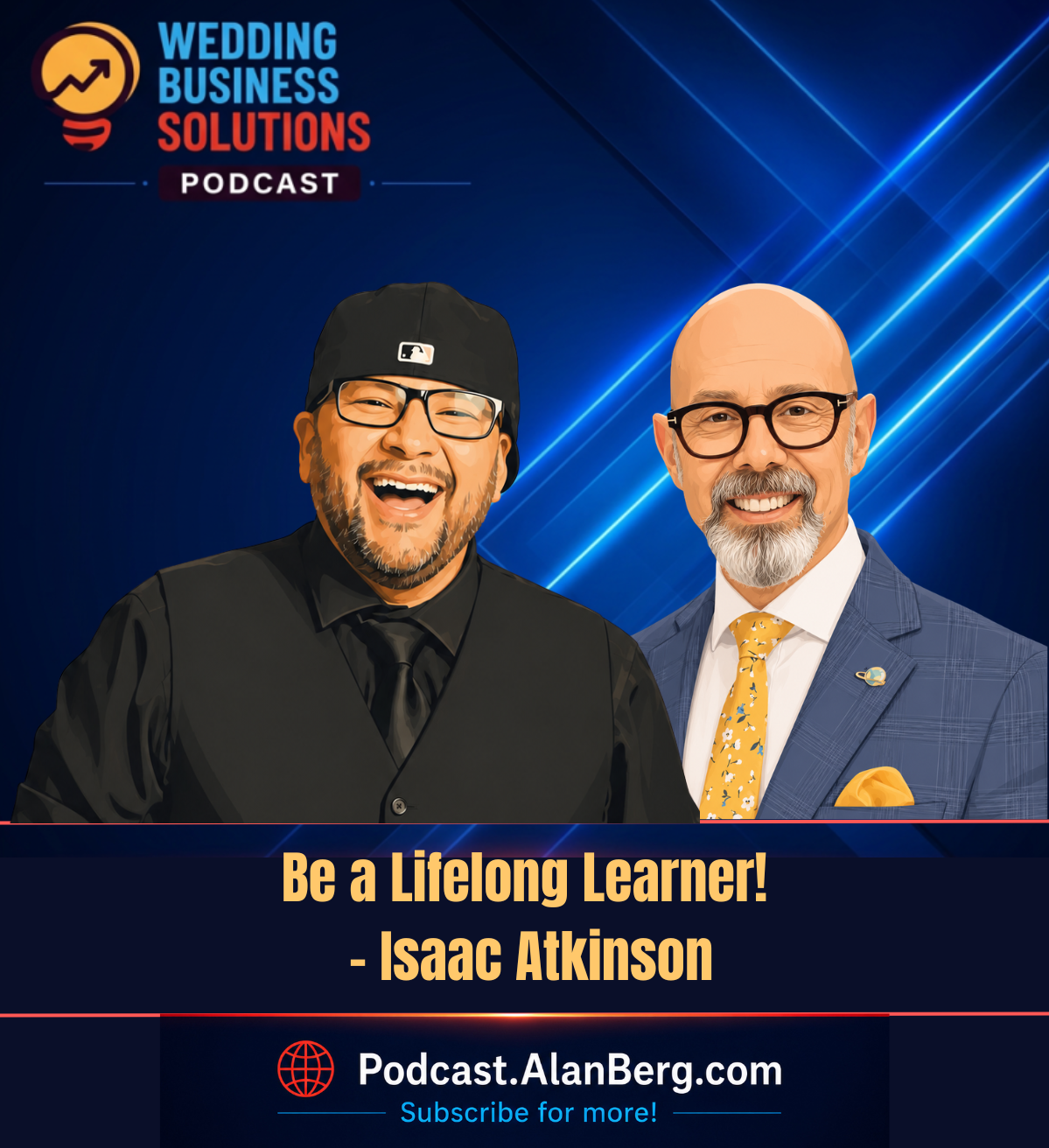
 Isaac Atkinson – Be a lifelong Learner
Are you just copying what others do, or do you truly understand why they succeed?
In this conversation with my guest Isaac Atkinson, we ask: What could you learn if you left your local bubble and connected with peers nationwide? How could building your network, attending conferences, and seeking out those hidden nuggets of knowledge change your business? What happens when you invest in your team as much as you invest in yourself?
Listen to this new episode for insights on lifelong learning, networking, and building a company culture where growth and curiosity are at the heart of everything you do.
About Isaac:
Isaac Atkinson is the founder of GTE Event Group and Kapptured Photography & Videography, two Central California companies specializing in weddings, corporate events, and private celebrations. Over the past 20 years, he’s built a team-focused business centered on training exceptional entertainers, creating scalable systems, and delivering unforgettable client experiences. Isaac is passionate about leadership, company culture, and helping event professionals build businesses that thrive beyond the owner.
Website: www.gteeventgroup.com
Instagram (GTE Event Group): @gteeventgroup
Instagram (Kapptured Photography & Videography): @kappturedphotography
Instagram (Personal): @isaac_atkinson_
If you have any questions about anything in this, or any of my podcasts, or have a suggestion for a topic or guest, please reach out directly to me at [email protected] or visit my website Podcast.AlanBerg.com
Please be sure to subscribe to this podcast and leave a review (thanks, it really does make a difference). If you want to get notifications of new episodes and upcoming workshops and webinars, you can sign up at www.ConnectWithAlanBerg.com
View the full transcript on Alan’s site: https://alanberg.com/blog/
Episode Summary
In this episode, I sit down with my friend Isaac Atkinson to explore what it really means to be a lifelong learner in the wedding business. Isaac shares his journey from believing he had “arrived” just by being successful locally, to experiencing a huge mindset shift after attending industry conferences across the country. He explains how being exposed to new ideas, networks, and different perspectives helped him realize how much more was possible for his business and personal growth.
Isaac reflects on the importance of understanding why successful businesses make certain decisions instead of simply copying their actions, emphasizing that true innovation and sustainability come from deep learning and critical thinking. He talks about how building a network of industry peers has been crucial, providing him with advice, mentorship, and support—especially during tough times like the pandemic when pivoting quickly was essential.
We discuss the idea of adapting what you learn rather than adopting someone else’s path, and how knowledge gained from conferences, books, and podcasts acts as a “bank account” of wisdom to draw from when facing new challenges. Isaac also talks about how showing up consistently at events and investing in his own education pays off not just in business strategies, but also in building a strong, supportive professional community.
Isaac shares practical insights on company culture, leadership, and how he applies what he’s learned to make his businesses—like his DJ company and a successful photography and video company—places people want to work. He points out that treating your people well leads to better client care, and he strives to build organizations where everyone feels valued and inspired to be their best.
We also touch on the benefits of learning from people at all levels, including younger team members, and staying open to new tools and platforms like social media and AI. Finally, Isaac expresses his interest in moving toward coaching and helping others achieve their own business goals, drawing from decades of experience and lessons learned as a passionate, lifelong learner in the industry.
Be a lifelong learner. Oh, listen to this episode, see where I’m going. Hey, it’s Alan Berg. Welcome back to another episode of the Wedding Business Solutions Podcast. I am so happy to have my friend Isaac Atkinson on to talk about being a lifelong learner. Isaac, how you doing?
I’m doing great, thank you, Alan. Yourself?
I am doing well, thank you. And, and I saw something that you posted, I think it was Facebook, and you were just reflecting on all the education that you’ve done and all the meetings that you’ve gone to and, and what it’s meant to your business. And it just really struck with me. So just tell everybody, tell us about that post. What made you decide to just share that?
Well, one, it happened because of some of the employees in my own organization. You know, I feel like it’s easy to say I’ve arrived and I’m the greatest, you know, when you’re only comparing yourself to a local market. You know, I too made that mistake many years ago. You know, I was the guy everyone’s giving me credit, credibility. Oh, you want him? Make sure he’s the one at your event. It wasn’t until I started traveling to conferences, you know, in my industry where I realized like, whoa, I could be so much better. So anyways, that post kind of came from a few different places. One, I was hoping my guys could read it between the lines, which it worked in my post, but also needed the industry to also understand that you may copy some of the reason that the things that another business does, but if you truly don’t understand why that business is making those moves in the first place, cool, you, you, you’re gonna see success for a little bit and not understand when to pivot, you know, make the moves to continue success, if that makes sense.
Oh, it does. And I, it’s something that I’ve spoken about, you know, what you’re copying is the result of their decisions that they’ve made, maybe over a long period of time, maybe just shortly, but you know, you don’t know their business model. You don’t know their profit needs. You don’t know—let’s say, let’s say they own their building and you don’t, right? So you have expenses that they don’t have. They could do different things than you could and still be profitable that maybe you couldn’t do, right? So things like that.
Yeah.
And, you know, I always say when you’re copying someone, you’re copying history because you’re copying what’s happening, which means all the work that went into making that happen, right? So like you were saying, you know, in your market, you know, you’re the man. Everybody’s saying, Isaac, you’re the man. Look at all the kind of stuff. But then your blinders were on because you didn’t know what was happening elsewhere. And when your mind got open to it, you’re like, it’s not that I’m gonna copy that, but it exists. It’s a possibility, right?
Yo, most definitely. It’s, you know, I think when I went to my first MobileBeat conference, I, I, it was, uh, so hard to take it all in because like you didn’t realize what was possible, you know. I mean, here I was thinking like this and realized it could be like this. And over the next few years of going to Mobile Beat and hearing different people speak, I was able to take the best of what I heard, uh, the knowledge I was given, and create who I was, you know. You often hear that, you know, people say, oh, I want to be like you. It’s like, no, no, no, you don’t want to be like me. You want to be like yourself, you know, which is, and hopefully a better version than I am, but for yourself. So going to these conferences really opened my eyes as to what the possibilities were.
And then instead of just copying one person’s thing, I was able to take and learn from many people creating what we have today, which is pretty awesome.
Right. And again, you’re making the best version of you. You’re not trying to be somebody else, right? It’s adapting, uh, you know, not adopting. It’s like, I’m not copying what they’re doing. I’m gonna say, oh, you know what, I like that, I think I could work with something like that, but I’m not gonna do what they do on this other thing because that doesn’t work for me.
Absolutely.
Again, you’re not trying to be the clone. But I think the most important thing is, you know, you started going to these events, and there’s so many people that just never leave their area, and therefore, you know, I can get this online, I can go see this or whatever. Let’s talk about your network. What kind of network have you developed over the years by going to these events?
Well, real—I mean, I wouldn’t say worldwide, but nationally, there’s a lot of people that I could reach out to when I run into certain situations for any one of my organizations, which is really cool. So I kind of want to share this story. It was during COVID or it was maybe we’re in the middle of COVID like 2022, right? I’m at the bar and I have a friend sharing what’s happening in their lives, you know. And as she’s talking, or as they’re talking, she turns to me at a certain point and tells me, Isaac, everything I said must be worse for you. She also—they also owned an entertainment company. And they were really big in the San Francisco Bay Area anyways. And I was able to say like, no, I don’t feel the same way that the problems that you’re running into. And they proceeded with like, that’s impossible, you know? And at the time I was involved in Turo because I had to make a shift when the pandemic hit.
So I was like, hey, Turo seems like a cool idea. Let me just do that, you know?
Mm-hmm.
And I just remember the conviction they had when they were talking to me. Like, I don’t get it, Isaac. How do you not feel the same way that I feel with all the businesses that you own?
Yeah.
And the way they said it made me think, like, if you’re saying it with so much conviction, why is it? And then it hit me after contemplating. I didn’t realize I was being mentored for the things that were going to happen in the future. By me deciding to go to conferences, conventions, always reading books, I never stopped learning. So any problems I ran into when I’m building my businesses, I guess it was easy for me to pivot because I didn’t realize I was being coached ahead of time.
Yeah.
You know, and, and I’m so grateful that conversation I had with them that night because I’d never seen things that way, you know. So I’m—I forgot that then your actual question. But you talked about the network, right? And, uh, the network isn’t just the people that I met, it’s the people that I study from afar. You know, Alex Hormozi, I don’t know him personally, but I’ve been following. And, and so following is one thing, but actually studying, you know, what aren’t they saying? Well, actually, I think Alex says everything, but, you know, reading between the lines and thinking, how do you implement the parts that are missing that they might want to sell to you, the golden nugget? You know, and, and you see all these people speaking, and, and this is why I love going to the conferences. Matter of fact, I feel like a majority of conferences I go to now—I hate to say this, it’s gonna sound rude—they’re a waste of time now for me. But I, I don’t go for what I already know. I go for what I don’t know. And now I feel like I’m mining for little nuggets, little nuggets that I feel like I throw in this knowledge bank account, and I never know when I’m gonna need to tap into that bank account.
For that nugget, like, oh, I remember this. So that’s kind of how I feel now.
Well, so you said you think they’re a waste of time, but yet at the same point, if you get that nugget, it’s not a waste of time, right?
Right, right, right, right.
Yeah. And I’m the same way.
It’s a lot of time to get that nugget.
Right. I mean, I’m in, you know, I’m in the speaking world a long time. I’m—this year is 19 years as a member of the National Speakers Association, although I’ve been speaking longer than that. But as a member of this. And I don’t even look at the program for the conference. Like last year at our conference, I signed up and paid for this year’s conference. That’s how I know I’m going to go. And you’re the same way.
Like, you know, you’re going to go to this conference, this conference, it’s on your calendar, it’s blocked off. You’re not waiting until the last minute to sign up because you might get a gig. No, you’re doing this. I, I only missed one of my 4 speaker conferences this year because I do 4 a year. Uh, one of them’s in the UK again. So we’re talking about not only my ticket, it’s my airfare, my hotel, and all this kind of stuff. And, and my art tickets for art conferences are way more than the wedding industry conferences. Like my ticket, I think it’s $1,500 or $1,600 for my ticket for the one conference this summer.
Yeah.
Not including airfare, hotel, and stuff like that. Right. And I don’t even look at the program because I know I’m going and I know the value that I’m gonna get is going to be both from sitting in a session, just that, that one thing. Or in the hallway, or sitting at lunch, or at dinner, or just that thing. And like you said, the network, the value, the people that I’ve met over the years that I can be like, oh, you know what, I need to ask them something. They’re the right person, and they’ll take my call, they’ll answer my email or my text or whatever. But that only happens by showing up, right? That’s the thing. So I get what you meant by, I don’t, you know, it’s not worth it to me.
Meaning they’re talking to people who are not as established as you, that don’t study like you do, and they’re, you know, maybe giving more basic stuff. Because I hear this at conferences, you know, oh, a lot of the speakers are just—it’s all basic stuff. Well, there are people in the room that need that. Not everybody, but they need that. I understand that when I stand in front of a room, they’re going to be people in that room brand new and people in that room decades of experience. And how do I give everybody value? Because let’s face it, some of those people that are new, they know things we don’t know. They know things we don’t know, right? I’m listening to a book now and they’re talking about—it’s called The Future of Work Is Gray—and how people aren’t tapping into the institutional knowledge of older workers and they just leave and take that institutional knowledge with them. But also that the younger workers also have skills that the older workers don’t.
And they’re having a two-way—the successful companies are having a two-way mentoring. The young people are mentoring the older people, and the older people are mentoring the younger people, and that’s how these companies are successful. But, but you—the gist of that article or the post or whatever it is you want to call it that you wrote was, this is because you showed up, and this is because you spent money and spent time, and you read books and you listened to podcasts, and you, you do those things, and it’s not a waste of your time. It’s, it’s—it was the opposite of that, was the point, right?
Yeah, yeah, yeah. Okay, maybe it came across wrong, but yeah, absolutely. Those golden nuggets, I mean, just, you know, it, um, it keeps me sharp. Yeah, it definitely keeps me sharp, right?
And then, well, again, it’s not that it came across wrong. I know where it was coming from. I go to speaker conferences and I look at the schedule and I go, oh, that looks interesting. And I get there and I sit in, I’m like, no, there’s nothing here for me, right? There’s nothing. Yeah. Put myself in a different point in my life. Okay, so I’ve published 16 books now, but put myself before I’ve published one, no books. Well, everything that’s basic about publishing a book was relevant to me, and there’s somebody today who needs that.
I don’t, right?
But somebody today who needs that. And that’s why the conferences are important, that it has to feed everybody, because if you don’t get the new people right, then you just—everybody ages out. I mean, yeah, then just end up with that. So when, when did this click for you? Okay, so you’ve been doing this, what, about 20 years now?
Yeah, I’ve been in business for 20 years. So I own, you know, the largest DJ company in our area.
Which is what area?
Fresno, Fresno, California, pretty much the Central Valley. And, you know, I want to lead with this legitimate DJ company, legitimate company built the right way. You know, um, I forgot where I read this one time, but, you know, they say that your, your people are your biggest assets, you know, and, you know, wherever I read it, it also said, well, shouldn’t the client be the biggest asset? No, you take really good care of your people because they’re there to take really good care of your clients. So, you know, when we structure things, we structure things. I had to build the company from a sense of what would it need to look like, feel like in order to keep me loyal if I worked for my own company, if I didn’t own the company. So, you know, we do 401 with a 4% match. We—our staff has access to health benefits. Um, you know, um, what else? Uh, we offer PTO, you know, during those slower times.
Um, where did I learn all this stuff? From books, you know, and, and that education. So, you know, here we are, 20 years with the, uh, GTE Event Group, formerly, uh, Good Times Entertainment. And then 10 years ago, I started a photography and video company. I started it because I realized there was a need in the industry. And I’m not a photographer, I’m not a videographer, I know nothing about the actual how-to do that stuff. I knew business, I knew the wedding industry, and I knew that my goals were much bigger than most people’s goals. And because my goals were so large compared to the way most people think, the amounts of money that I was spending already in one company would feed the other company in leads, which was very—it made it very easy for me to hire someone on salary right away. As it is, I would track numbers and I would see how much business I was giving to other vendors.
And it wasn’t by accident. It was all because I had this huge goal of how much money I wanted to spend in marketing and advertising. It’s like I started controlling the leads at one point. So anyways, my point being, all this because of reading. Yeah.
But again, you’re—you have to get yourself outside of your bubble, right? I listen to, I think Audible says over 60 books a year. And some of them are fun. For fun. Some of them are for personal, you know, growth or whatever. Some of them are definitely business related. And some of them are like, I don’t know, this sounds interesting. And then I was just listening to a book where I personally, I thought the author through the narrator, because the author wasn’t the narrator, I thought he was an arrogant prick. I mean, just listen to the book, right? It just—
I’m curious what book.
Very, very elitist. It was very elitist and all. And it was called Fooled by Randomness was the book. And I almost stopped listening a couple of times. But then there was just something like, oh, you know what, there’s an application for that thing. Like you said, there’s the nugget there. And I’ve done this with a few books. I’ve stopped reading some books because I’m like, I’m just not getting anything out of this at all.
Yeah.
And this was, this was interesting. But the author’s elitism was getting in the way. And listen, I don’t mind if you use big words and stuff like that. I’m not, you know, that’s fine with me. I’m a college-educated guy. I’m good. I can get that. But there was a—there was an attitude in it that was very, like I said, I thought he was an elitist prick.
But, but I did get some nuggets, right? I did get some things out of it.
Right.
And that’s why, you know, you never know what you’re gonna get. And I love when, like, one book recommends another. I think that’s how I got this one. Like, some other book recommended this one. And it gets to that. And then sometimes I’ve been like, I’m going to divert this. I’m going to listen to Snoop Dogg’s biography on Audible, which I thought was just so fun, right?
Yeah.
But it’s the constant learning because when you don’t try to learn things new, you actually use less of your brain, right? And I do word puzzles like Wordle and stuff like that, New York Times crossword puzzle, whatever. It’s just stimulation. You know, I do the language lessons. You know, we’re going to France, so I do my French lessons. Now I’m doing ASL because I got to the point where I’m like, don’t say, why should I do this? Say, why not? Like, is there any good reason I shouldn’t? So in 2020, I started learning French ’cause I thought I was going.
Mm-hmm.
6 years later, finally going. But I wanted to learn ASL for no particular reason. I actually don’t have any Deaf people that I could practice with, but I do run into people, you know, in my life. And I was like, you know what, I’ve had a couple of times where there was somebody who needed help and I couldn’t help them except writing something down, which you could help them, right? But I think meeting them where they are to be able to, you know, to sign with them a little bit just shows, hey, I care to try to get inside your world a little bit.
Yeah, you know what, and I gotta tell you, you have inspired me so much throughout the years. I remember one time, I don’t remember where we were, but I remember you saying, hey, yeah, Isaac, this is—I’m going to go speak in Mexico City, I think. And my goal is to speak fluent Spanish in 1 year, or it was something crazy. Like, because when I go give that, I’m going to do my presentation all in Spanish. And I just remember, wow, that’s a short period of time to learn Spanish. And you were so focused and dedicated, and I’ll never forget it, because you remember when people set these crazy goals, right? And, and it’s inspiring. It’s like, okay, cool. You know, whenever you want to go and, and climb a mountain and, and you’re looking at the reasons why you’re gonna fail, it’s nice to remember those conversations of people that had those, their mountains in front of them and like, I’m gonna do this.
Is it, you know, it’s kind of, just kind of nice to have a, that unspoken cheerleader, if you will.
Well, again, it’s where do you get your inspiration? Do you look at the people who play it safe? And I’m not reckless, right? And just to correct you a little bit, I had been learning Spanish for 2 years. And then in January, I said—of the 3rd year, I said, I will present in September, right? So it wasn’t that I was learning in a year, but in 9 months, I was going to go from, you know, Maria, put the pencil on the table, to actually standing on stage and presenting. And the funny thing—
So you remember that? You remember that conversation?
Yeah, but I don’t remember, I don’t remember what prompted me to tell that person in Mexico that I was going to present in Spanish. I remember we were having this Facebook conversation in Spanish, and, and, um, and I said, you know, I confirmed the date and all this stuff, and I said, you know, um, you know what, this year I’m going to present in Spanish. I don’t know what possessed me. This is all like a Facebook message in Spanish. And she wrote back, you’re going to open the conference? And I wrote back, no, I’m not. I said, how about I open in English but I close in Spanish? Because if I open in English, they’re going to—Spanish, they’re going to expect me to speak Spanish the whole time. But I ended up that year presenting in August, the year—a month earlier in Panama and Uruguay, then Mexico, and then 2 years later in Colombia, and then a year after that in Guatemala. And I’ve done some sales training in Spanglish and stuff like that.
And it’s just, we don’t know what we’re capable of. You know, that’s—so many people have these self-limiting things, right? People who don’t go to the conferences, I’m not going to get anything out of that. You go despite the fact that you’re like, I’m probably not going to get much out of the sessions, right? But I’m looking for the nugget. Whereas other people are like, I’m not going to go, that’s a waste of my time. And I, I’ve told this before, you know, my AI journey was a conference, a speaker conference I wasn’t going to go to. I looked at the schedule, I’m like, yeah, I don’t really see anything for me there. And then I kicked myself and I said, no, no, you’re gonna go. And last minute I bought my ticket, I got my flight, and I get there.
And the very first session was 2 people talking about using AI with your own content.
Mm-hmm.
And it blew my mind. And I went from not using AI to being one of the top 3% of AI, of ChatGPT users, and writing a book on AI and having Ask Alan Anything and all. And that only happened because I showed up.
I showed up.
I showed up. And that’s, that’s why, that’s where you inspired me, my friend, because I always see you there. Like, you’re there. I know there’s certain people I know when I show up, these people are going to be there. You know, it’s like me at the speaker conferences. The one I missed this year was because it was the baby shower for my son and daughter-in-law. I was like, sorry, sorry. Yeah, you know, if I’m gonna rank, yeah, yeah, that one, that one ranks higher because family, you know, to me, it’s health comes first, then family, then everything else, right? If you’re not healthy, you’re no, no use to anybody.
And, you know, you have to get that right. Then it’s family, then it’s everything else. So, but other than that, I show up and I could justify backing off again because I spend—
Yeah.
5 figures every year on my education between airfare, hotel, and flights. And, you know, then the tickets themselves and all that. I spend easily 5 figures a year. And I’m going to continue to do that because again, it might be just the person I meet. Just, there’s so much. I mean, how many friends have you made around the country? Like you said, probably some international. You got some Canadian friends, I’m sure, at least.
Oh yeah.
Maybe some Irish friends.
Shout out to the Canadian friends that I have up there. I guess if I didn’t say that, they’d be like, I get a message on Facebook, you know?
Right.
Thanks, Isaac.
Right. And maybe Ireland, you know, like Alan Marshall and friends that come in from Ireland and some, some guys from the UK that come in as well. And that’s the same for me. I, you know, when I travel around the world, I know people in, in all these places because they came, because they did what you’re doing, right? They showed up over here. I can trace almost every international speaking I’ve done to somebody who came to a conference in the U.S. and saw me here and then invited me to come to their country. But you think about it, what is the investment that they made, right? That they flew internationally to come here and buy their ticket and hotel and airfare and meals and all that. And they showed up.
And look what that’s done for me, you know, is bringing me back into these places. So, so what do you—you know, I love, again, the 401 match. I mean, that’s huge. Really.
Yeah.
Kudos. You know, the, uh, the health insurance, it’s so important these days. What, what’s your next thing for you on your, your personal journey of learning and education? It doesn’t have to be work-related either.
You know what, so I love working. You know, I enjoy it. It brings me joy. You know, when I look at DJing, I don’t DJ anymore. But well, I guess I do. But it’s for friends and family. It’s, it’s this, you can’t book me. You know, it’s not one of those type of things.
If I jump on, I jump on. But it brings me joy. You know. Um, talking business brings me joy. Hearing people where they’re stuck and saying, hey, have you tried this? You know, like, oh my gosh, what an incredible idea. Helping people brings me joy. I feel like where I’m headed is possibly, you know, helping other people, teaching people how to be successful in our industry. I’m so proud of Captured, you know, and I think it brings me so much pride because it’s proof that you don’t have to know how to do the job in order to own the company.
So I have some, what is it called, proof of concept. I think that’s the—
Right.
Well, again, you know, the fact that you’re not DJing now, but you used to DJ, right? Yeah, no, but, but this is important for people listening because, you know, those are the separate skills. You are fortunate that you’ve developed the business skills and then realizing, hey, I could have a photography company and I don’t need to know jack about photography because I’m not going to be out there shooting, right?
Right.
Yeah. And I remember when I was selling wedding advertising, the most successful or profitable photography company in the area was this lady who did not shoot, although she did have photography skills in her past. But she didn’t go out and shoot, and she would get all the local photographers that didn’t want to have a business, but they wanted to go out and shoot and make money. And she hired them, and all the single photographers hated her because, oh, look at her, she doesn’t even shoot. So what? So what?
Yeah.
Are the customers happy? And, and I love what you said before. I do want to circle back to this now. Is your staff happy? Have you read the book Setting the Table by Danny Meyer?
No, I don’t believe I read that.
People think it’s a catering book. So Danny Meyer started the Union Square Restaurant—Union Square Hospitality Group, which includes Shake Shack, actually, because he started Shake Shack. But famously in this book, Setting the Table by Danny Meyer, he talks about you take care of your people first, because if you take care of your people, your people are going to take care of your customers. So yes, your customers are important, but if you take care of your customers without taking care of your people, your people leave. ‘Cause they don’t feel valued. Um, and then Unreasonable Hospitality, um, by Will Guidara. He was one of the, ran one of the restaurants for Danny Meyer, ended up buying it, ended up turning into a 3 Michelin star restaurant. Like that’s the top, top, top, right?
Okay.
His book right now, uh, Unreasonable Hospitality is, is on fire. And I saw, I’ve seen him speak and all, and he, he’s great. But Setting the Table, I think you’d appreciate that because he talks about how he takes care of his people first. And then if you read Unreasonable Hospitality, it’s taking care of your people, but also taking care—having them take care of the customers. Because let’s face it, you’re not at the wedding, you’re not at the quinceañera, you’re not at the mitzvah, you’re not there shooting, you’re not there DJing, you’re not there setting up lights or whatever. You have to know that your people are out there representing your group, GTE, right? Representing it the way that you would want it represented. And they do that when you lead by example. And they do that when you, when you treat them well.
Yeah, I gotta tell you, it’s a culture. Team culture is so huge, you know, to, I think, the success of anyone’s business. You know, it’s one thing to pay someone well, but it’s another thing to make them feel loved, you know, and valued. And it’s, and, and it’s one thing to use the word feel just to say it, but another thing is to mean it. Like I said, it’s one of those things where, as I’m building organizations, if I worked for the organization, how would I feel if I was in their shoes? Would I feel valued? That is so important to me. Everyone should be treated with love and respect despite beliefs. Even if you disagree on something, that’s okay. You still love each other.
And I know that if we can grow a society like that where it feels like it’s a win-win for everyone, man, it should be harmony. And to me, that’s priceless. So as I build things, I try to build from that mindset, and I try to hire people that unfortunately, I don’t feel like a lot of people—it’s not that they don’t believe it. I just don’t think they never heard of things possibly being that way. And when they come here, you know, I had one of my, my, one of my team members tell me one time, he goes, Isaac, you have this incredible way of making people want to become better people. Yes, I understand. You know, it benefits you and your company. But it’s not that you necessarily care about how it benefits you and your company.
You realize by us being better, we become better for everyone around us. It was one of the coolest things I’ve ever heard someone tell me, you know, tell me, tell me, you know. And anyways, Alan, I share all that because you asked me, you know, what’s next? And, you know, I don’t know if I’m ready for coaching yet, but I, I feel like I’m not too far off. My experiences has—my experiences have just gave me this wealth of knowledge, um, of how to help people be successful, meet them where they’re at. You know, I was a small business. Matter of fact, I was looking up old notes. I remember hiring you in 2014, uh, we did a, a website analyst, uh, or, you know, you went and looked at my website and tore it apart, you know. But it was one of the greatest things ever because that changed how my mindset around marketing and how I teach my guys about marketing.
You know, they still want to do the DJ thing. If I leave it to them, it’s going to be a black website, you know, very DJ mentality where I need to tell them like, okay, cool. And I actually made, um, sample flyers for my guys that understand the, the, the power of color. So I have pretty much 2 flyers, same design, one based upon a white background, another one on a black background. So when I bring someone in that, that kind of has something to do with marketing, go for one, pick one, whatever. And they pick the white one 90% of the time. Then I go back and tell them, you know, things that I’ve learned from you and from other people in, in my journey. So I guess all that to say that I feel like I’m in a place where I can meet people and help them and really help them understand things are possible.
I’ll give you an example. The people who, oh, Isaac, I’m busy all the time. Yeah, but you’re stealing time away from your family. What does that tell you? Your prices are too low. People value work. It’s okay, lose business. You’ll make it up when you raise your rates. You’re going to find out that you’re going to do the same amount of business, if not maybe a little less, but make more, right?
For, you know, keep more, keep more.
Yeah, most definitely. And guess what? Now you’re able to give the time back that you’re not working to your family. You know, or those, oh, I can’t teach someone how to do what I do. They’re just going to teach, take it and leave. And I think that’s the number one thing that I get, um, all the time is like, Isaac, how are you not afraid to teach these guys, um, what you know and then go and start their own business? I know it’s a possibility, but I remember Mike Walter once saying years ago in a conference, if someone leaves you, you have to ask yourself what you did wrong before questioning why they left.
Absolutely.
I think it was Mike Walter that said that. And man, that was so long ago. And so, you know, here are these little things that, that I’ve always kept with me. It’s kind of like I don’t have it written down, but I just remember. So, so when I run into certain situations, again, it’s that golden nugget bank that I’m able to tap into, like, oh, let me do this and let me do this. All these little knowledge pieces that came from everyone.
And some of the education is just reinforcement of what you already know or have heard and like, okay, I’m on the right track. That comment of, you know, if somebody leaves, you have to, you know, say, what did I do wrong? I don’t know if you’ve read Good to Great and Built to Last by Jim Collins, right? It’s that thing when things are going well, you look at your team and say, hey, you guys are doing a great job. When things are going poorly, look in the mirror, right?
Yeah.
Don’t, don’t point the finger at them. Don’t be afraid to say, hey, I screwed up. I mean, that, that’s one thing for me when as a leader, I wasn’t afraid to tell my team, hey, listen, that was my fault. And even now, just even with like, you know, tech support, I’ll call up tech support and say, okay, listen, the cat did not walk across the keyboard. It was me. I pushed the button. I screwed it up. Right?
Yeah.
But it’s important because, you know, taking responsibility for when things go wrong allows you the credit when things go well. And if you’re not willing to take responsibility when things go wrong, I don’t think you should get the credit when things go well because it has to go both ways. And, you know, you have to empower your people. And I would imagine, just last thought here, you have, you know, people that work for you that are younger, right? You might have same age, might have some older. Have you ever had something where you learned something from one of the younger people? Like, just, you know, something to do differently, something that, you know, like, hey, why don’t we do this?
Maybe music. Oh, you know what? Yes. Not recently, but—
Oh, yeah.
I, I was late to social media.
Okay.
And it was the younger people that were telling me. I, I will never forget my first intern. She came from Fresno State, right? And she had to, uh, do some hours with an event company. And so it was weird to me. I was like, what, what made you reach out to us, a DJ company at the time? Maybe Captured was just a baby. And she goes, you guys seem really fun. I was like, well, don’t you need to actually go into like a event planner side. She goes, let me talk to her instructor.
Anyway, she ended up with us, right? So she’s like, so one of the things I have to do, Isaac, is a SWOT analysis. What the hell is a SWOT analysis? So, you know, then she puts me—what is it?
Strengths, weaknesses, opportunities, and threats.
Right. So she does one of these, right? And she goes, Isaac, she goes, I will never forget this. I don’t understand how you control the market with no social media presence? This doesn’t make sense. Well, anyways, she was the first one to like, okay, Isaac, you need to do this, we need to do that, we need to do this. And I was kind of up in the air. It wasn’t until maybe probably around 2022 before I really took social media seriously. Like, okay, let me, let me jump on this train. I have to, I have to be more proactive.
But it’s definitely the social media side. And that taught me, that taught me not to be naive about things. Again, this is where conferences come into play. As I go to conferences, and I’m pretty sure you see this all the time, and I’m—well, let me go back to this. I’m pretty sure you see this all the time where you hear people like, I don’t have time for social media. I don’t want to do social media. That’s not really my thing. But they don’t realize what they’re costing themselves in not participating.
It’s like, almost saying like, I’m not gonna use AI. Well, you know, your time, I hate to say it, but your time’s limited in your business space if you’re not gonna leverage the power of AI.
But it’s also understanding you can’t do everything.
Right.
You know, and it’s something I’ve learned at the conferences from people, you know, don’t do a bunch of social media poorly. Do one or two really well. Right? Because dabbling gets you no visibility at all. And now you’re just busy, like you’re just busy doing this stuff here, right? And just be smarter about it. I actually just, just before we recorded this, I recorded with Mark Chapman about ChatGPT ads.
Mm-hmm.
Because that’s a new thing now, right? And, you know, should you do it or not do it? Don’t do it. It’s not like, you know, like when you were in high school. Yeah, I wanna go to the party. Why? All my friends are going. No. You don’t do it because all your friends are doing it. You do it because it’s the right business decision for you. Look into it, research it, do those things.
So, you know, I think the worst thing for any business person is to not see the opportunity, like you didn’t even see it, right? The second is to not make a choice. And a choice could be, no, I’m not going to do that, but I made a conscious choice not to do that. Not to just let it pass you by because you decided not to decide, because that’s really a decision. I think we have to keep our eyes open. This is you leaving the Central Valley and going to conferences, opening your eyes and saying, okay, now I know what’s out there, but now I get to decide. I get to decide what I’m going to pull in from here and from there or whatever. And I’m looking at the clock here and we are over as well.
No, no, I’m cool. No, no, you’re cool.
But I try to keep these to a half hour. We’re already way over a half hour. Isaac, I think I have to have you back on again. We’ll have to talk about this some more.
But thank you.
First of all, thank you for the post. Thank you for sharing and being vulnerable and putting that out there and saying, hey, listen, I just want to tell you about this is what’s meant for me by going to these conferences, reading these books, working, investing in myself and in my business this way. So thank you for that. And thank you for sharing your wisdom with us here today. We’ll have in the show notes if you want to follow Isaac, if you want to see what he’s up to, we’ll have his contact information, his socials and all that. And I will see you at the next conference, sir.
Awesome. Awesome. Thank you, Alan, for having me. Hey, Alan, you know, I don’t know if that was our sign-off or if you could put this part back.
I haven’t stopped recording yet. Keep going. All right.
So I do want to, you know, for anyone that is thinking about business coaching, they should do it. Because if I think back to the times when we first started talking, from like talking about ghosting emails to the website analysis that you did for us, to some of our conversations, me sending my staff to you, you’ve really helped me make so much money. You know, it’s, it’s just crazy. And one of the things that probably helped me the most, believe it or not, Alan, is you came to Monterey one time and I remember buying some tickets for some wedding planners, the ones that were referring us a lot. So we went to go see you.
Yeah.
It was me, my general manager, maybe someone—I don’t remember—a very small group of us somewhere in Monterey or Carmel. And, um, when you shared the story about your grandparents and their wedding anniversary—I know, your parents.
My parents.
And how your kids were able to see, like, wow, that’s what Grandma and Grandpa looked like back then. That’s what they sounded like. Me taking your story and then leveraging that in how we sold video for those that were kind of on the fence. So we didn’t like go into that for those people like, yeah, do I really need it? But you could tell that they wanted it. I think just using your story wasn’t even my story. I tell people, hey, this is what I heard. And they’re like, okay, Isaac, how do we make this work? So anyways, thank you.
It was my parents’ 40th anniversary. And I put a compilation together from their wedding, which we had black and white movies from their wedding in 1954.
Right.
And I don’t have video of my wedding and what I would pay today. And I’ll give you a little follow-up to that. On our 40th anniversary, we didn’t have video, but we went, took the whole family away up to Cape Cod to this place we like to go. And we had video of my son, my younger sons, well, both of my sons, swimming in the pool that my son’s son was now swimming. My grandson was swimming in the pool. We had video of that. And my—and his—that son said to me, you know, I watched that 40th anniversary of his grandparents, right? I watched it recently and I cried and I cried, right? And that’s the power of video. So, okay, now I’m going to stop the recording.
But yeah, I just wanted to share that because, you know, I just—I was that guy on the fence. Yeah. I was like, should I spend $250? Well, at the time it was $250. I think it was $250, $450, something like that. I don’t know.
Yeah. Yeah.
But anyways. All right, man.
Well, I’m going to stop the recording now.
All right.
Thanks. Pasted text
I’m Alan Berg. Thanks for listening. If you have any questions about this or if you’d like to suggest other topics for “The Wedding Business Solutions Podcast” please let me know. My email is [email protected] or you can text, use the short form on this page, or call +1.732.422.6362, international 001 732 422 6362. I look forward to seeing you on the next episode. Thanks.
Listen to this and all episodes on Apple Podcast, YouTube or your favorite app/site:
- Apple Podcast: http://bit.ly/weddingbusinesssolutions
- YouTube: www.WeddingBusinessSolutionsPodcast.tv
- Spotify: https://spoti.fi/3sGsuB8
- Stitcher: http://bit.ly/wbsstitcher
- Google Podcast: http://bit.ly/wbsgoogle
- iHeart Radio: https://ihr.fm/31C9Mic
- Pandora: http://bit.ly/wbspandora
©2026 Wedding Business Solutions LLC & AlanBerg.com
Question
How do you avoid hitting a plateau in your business growth?
Tags:
#growth #mindset #learning
Answer
It’s easy to feel like you’ve made it when you’re just comparing yourself to your local market. The reality is, there’s always someone out there doing it better. When I started attending industry conferences, I realized how much more was possible. If you want true growth, keep showing up to learn and surround yourself with people who push you to improve.
Takeaway: Never settle—expose yourself to higher standards and keep evolving.
Question
What’s the real value of attending industry conferences?
Tags:
#networking #learning #events
Answer
The best part isn’t just the sessions. It’s the network you build—the hallway conversations, the advice over dinner, and the people you can call when you hit a wall. Even if I only pick up one golden nugget at a conference, it’s worth every dollar and every minute.
Takeaway: One connection can be more valuable than any single session.
Question
Should you copy what successful competitors are doing?
Tags:
#strategy #competition #originality
Answer
Copying someone else only gives you surface-level results. You don’t see the thinking behind their decisions or know their unique situation—like whether they own their building or have different overhead. If you just copy, you’re following their history, not building your future.
Takeaway: Adapt ideas, but always think for yourself.
Question
How can you prepare for challenges no one sees coming?
Tags:
#resilience #personal-development #adaptability
Answer
Most people panic when things go sideways because they haven’t prepared. I realized all those books, conferences, and mentoring sessions I’d done were actually training me for problems I didn’t even know I’d face. Continuous learning gave me options to pivot fast when the unexpected hit.
Takeaway: Future-proof yourself by learning before you need it.
Question
Is it still worth going to conferences when you know most of the material?
Tags:
#learning #growth #mindset
Answer
Sometimes most of what’s shared feels basic or like stuff I’ve outgrown. But I go for the one new nugget—just a single idea can have a huge return. I mine for what I don’t know, not what I already do.
Takeaway: One powerful insight can justify an entire event.
Question
Why do I invest heavily every year in education and networking?
Tags:
#investment #learning #networking
Answer
I block time on my calendar, buy tickets early, and commit to showing up. That means spending on travel, tickets, and time away from work, but education and relationships pay me back more than anything else. Sometimes I go just for that one conversation that changes everything.
Takeaway: Investing in yourself always pays the highest returns.
Question
How do you create a strong company culture people want to join?
Tags:
#culture #leadership #team
Answer
I ask myself, if I worked here and didn’t own the company, would I stay? That’s why I offer real benefits—401k matching, health insurance, paid time off. But more important is making people feel genuinely valued and loved, not just well-paid.
Takeaway: Build a culture people want to belong to, not leave.
Question
What’s the secret to scaling across different business types?
Tags:
#scaling #business #opportunities
Answer
You don’t need to know how to do every job in your company. When I launched a photography business, I didn’t know photography—I just knew business, the industry, and had ambitious goals. That let me identify talent and create opportunities others missed.
Takeaway: Leverage business skills to scale, not technical expertise.
Question
How do you support your team so they’ll take care of customers?
Tags:
#team #customer-experience #leadership
Answer
If you truly take care of your people, they’ll take care of your clients. Benefits, respect, and growth opportunities come first. When you lead by example and build trust, your staff will represent your brand exactly as you’d want.
Takeaway: Take care of your team—your customers will feel the difference.
Question
How do you raise your rates without losing all your bookings?
Tags:
#pricing #worklifebalance
Answer
If you’re constantly busy but never see your family, your prices are too low. Raise your rates and accept that you might do slightly fewer gigs, but you’ll earn more and have time for what matters.
Takeaway: Charge what lets you live, not just work.
Question
Aren’t you afraid your staff will learn from you and leave?
Tags:
#leadership #training #retention
Answer
It’s possible some will go, but my job is to make them want to stay. If someone leaves, I look in the mirror first. The best insurance is treating people so well they’d rather grow with you than elsewhere.
Takeaway: Retain talent by creating a place no one wants to leave.
Question
How do you adjust when a younger team member suggests new approaches?
Tags:
#learning #team #humility
Answer
I’ve learned a ton from younger employees, especially around social media and marketing strategies I would have missed. Their perspective keeps me from becoming complacent. You hire smart people to help you see what you can’t.
Takeaway: Stay open—wisdom comes from every direction.
Question
How do you handle tasks or trends you dislike, like social media or AI?
Tags:
#technology #delegation #decisionmaking
Answer
You don’t have to love or do everything, but you can’t ignore game-changers. If you’re not using AI or social media, you’re limiting your business. Decide consciously—don’t let fear or laziness decide for you.
Takeaway: Choose your strategy—don’t let change pass you by.
Question
Why isn’t dabbling in every marketing platform effective?
Tags:
#marketing #focus #strategy
Answer
Doing a little bit on every platform just makes you invisible. It’s better to do one or two channels really well than be busy everywhere but unnoticed. Quality beats quantity every time.
Takeaway: Master one channel before adding more.
Question
What if I think a book or session isn’t useful because I already know the material or dislike the speaker?
Tags:
#learning #mindset #growth
Answer
Every book or session has at least one nugget you can apply. Sometimes I hate the delivery or think it’s basic, but if I get just one idea I can use—even from a source I don’t like—it’s worth my time.
Takeaway: Don’t let ego block your next breakthrough.
Question
How do you keep yourself sharp in business?
Tags:
#self-improvement #reading #education
Answer
I never stop learning. Whether it’s reading, listening to podcasts, or challenging myself with something new, I treat every experience as a chance to grow. Lifelong learning keeps me ahead of the curve.
Takeaway: Constant learning is your best competitive edge.
Question
What’s one unexpected benefit of investing in personal development?
Tags:
#growth #confidence #preparation
Answer
You build a mental “bank” of ideas to tap into—solutions for problems you haven’t even faced yet. It’s like getting coached for situations before they happen.
Takeaway: Stack up wisdom—you’ll need it when the unexpected hits.
Question
How should you think about competition in your market?
Tags:
#competition #differentiation
Answer
Don’t get tunnel vision and just focus on your local competition. The real competition and inspiration are outside your bubble. Broaden your horizons if you want to lead, not just keep up.
Takeaway: Success comes from looking beyond your backyard.
Question
Why is it important to invest in your team’s success?
Tags:
#team #leadership #companyculture
Answer
I don’t just invest in my people for my benefit. When they grow, their families, clients, and everyone around them benefits too. That ripple effect matters more than just the bottom line.
Takeaway: Helping your people grow is good for everyone, not just your business.
Question
What mindset shift helps business owners endure tough times?
Tags:
#resilience #mindset #preparation
Answer
The time to get ready for a crisis isn’t after it arrives—it’s every day you show up and learn. That way, when something hits, you’re not scrambling. You’re ready to pivot.
Takeaway: Preparation today is your insurance for tomorrow’s problems.
Question
What’s the fastest way to get stuck as a business owner?
Tags:
#mindset #humility #growth
Answer
Thinking you’ve arrived is dangerous. The moment you believe there’s nothing left to learn, you close yourself off to evolution and get left behind.
Takeaway: Stay humble or your growth will stall.