
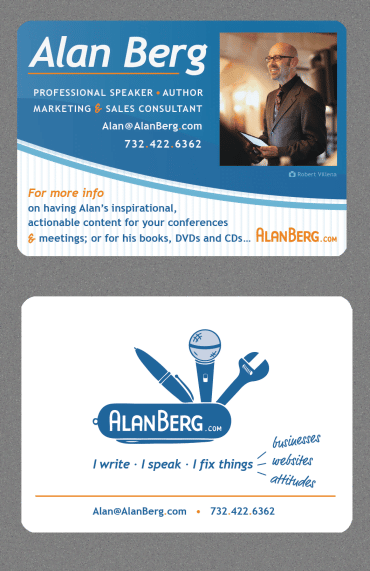
The “two fronts” of Alan’s new business cards – Click to enlarge
As someone who speaks and writes about marketing, often specifically about what your marketing says about you, creating new business cards for myself is no small undertaking. Not only do they have to be functional, they also make a statement to whomever gets them. So, for better or worse, here are my new business cards and the thought process that went into creating them.
Different for a reason, not just to be different
I knew that they needed to be a different size than standard business cards, but what size? I wanted them to fit in my wallet, as the reason I decided to make cards is that my bookmarks, at 2″ x 8″, don’t fit in mine, or anyone else’s wallet. Therefore I was often without a card on me when out in social situations. I’ll still use my bookmarks, but I also wanted something more manageable.
So, if they’re going to be a different size, what’s the right size? A standard business card is 2″ high x 3.5″ wide. I went with 2.5″ high x 3.5″ wide so they’d be noticeably larger, but not too big to fit in a wallet. Yes, I know that they may not fit in a business card file (the pages with slots in them), but not may people still use them and, being standard width, they will still fit in, they’ll just stick up 1/2″.
Peek-a-boo

See how Alan’s business card sticks out from behind another, standard-sized card, but not too much, and how his name is visible even when you have a stack of other cards in front of it.
You can also see from the photo that when you have a stack of other cards in front of it, as you might after a networking event, my card not only sticks up the 1/2″, my name sticks out above the other cards. That was done intentionally.
I often get business cards that are smaller than standard cards and while they do stand out, they also tend to get lost in a sea of other business cards. Sure, maybe yours is the only card they get today, but when they go home and have a stack of cards from other businesses, you don’t want yours to be hiding behind or in the middle.
Does it make sense?
I think that you use multiple senses when someone gives you their business card.
- Sight: this one is obvious; is it pleasing or eye-catching. Does it represent their brand, etc.
- Touch: what’s the weight of the paper (or other material). Too flimsy and you diminish your brand. What does the coating feel like? Is the print flat, raised or embossed?
- Sound: When you’re handed the card you may hear it coming out of the other person’s hand or business card case. Thicker cards have a “heavier” sound.
- Smell: This one is certainly more subtle, but freshly printed pieces have a smell from the ink and paper. This may not be as noticeable with laser printed cards.
- Taste: If you’re tasting the cards, I don’t need to know.
So, I went with 16pt cover stock instead of the 14pt that was standard with my printer (Copy Craft). I had them give the corners a 1/4″ rounding. This gives it a different look and feel and a more impressive first impression.
No Sugarcoating about the Coating
I believe there are no front and back, rather two “fronts” to every business card (more if you have a folded card). I like to think of one side as the branding side and the other as the person’s info side. That way if you have multiple employees, one side is the same for all of them and the other side is their personal info.
On the side with my personal info I went with a UV coating. It’s shinier and has a good feel, however, you can’t easily write on it, and that’s a pet peeve of mine. We intentionally didn’t leave much room for you to write on this “front”, with the pattern and colors, so the UV coating is fine.
On the side with my logo and tag line, “I write, I speak, I fix things”, we went with no coating and a mostly white look. This is not only aesthetically pleasing, but it leaves you lots of room to write, with a ball point pen. I actually got samples of the paper from the printer, with the different coatings, and tested 5 different ball point pens to see if they would write without skipping. I did this for my bookmarks as well. So often when we’re at networking events we’ll get a card from someone and want to make a note, or maybe they’ll ask us to send them something, but when you try to write on their card, your pen just makes an indentation. Or maybe their card is dark colors on both sides so there’s nowhere to write at all.

Not just data but a real call-to-action that tells the reader what else he can do for them (not just his speaking but he also has books, DVDs and CDs) – Click to enlarge the image
Not just info, a call to action
I believe that business cards are marketing pieces, not just a place to put data. If someone finds your card on a table, or at another company who refers you, and they’ve never met you, does it just list your contact info, or does it actually tell someone who you are, what you do and what you can do for them? I like to include a real call-to-action, not just your phone and email.
I’ve included the call-to-action line: “For more info on having Alan’s inspirational, actionable content for your conferences & meetings; or for his books, DVDs and CDs… AlanBerg.com”. This line uses my branding words: “inspirational” and “actionable“, the words my clients and audiences use to describe me, as well as mentioning that I have books, DVDs and CDs. It doesn’t just list my web address, it tells you a little about what you’ll find there.

Here’s the branding side. Notice the phone and email are here, along with the tag line from his website: “I write, I speak, I fix things” – Click to enlarge the image
The fix is in
When I put my tag line, “I write, I speak, I fix things”, I explain that what I “fix” are “businesses, websites and attitudes” and we did it in a handwritten-looking font, so it appears as if I’ve written that just for you. It also lets you know what I might be able to help you fix.
You’ll also notice that I have my email and phone on both sides. If you want to contact me, you don’t even have to turn it over.
Is a picture worth…
I debated using the photo, not so much that I didn’t think it belongs, but rather I speak very often to wedding pros about how they should put photos of their couples, not themselves, to be more aspirational. You want your couples identifying with your other clients. However, my audience is not people getting married, rather it’s businesses and entrepreneurs, both in and out of the wedding and event industry.
As a professional speaker, consultant and trainer, you’re more likely to identify with seeing me than my audience. That said, on the About You page on my website I use a photo of an audience. On my Consulting page I show me working with someone in a consulting situation. On my Speaking Events page I show me speaking at a conference.
For my business card, I went with a photo of me speaking, as you’d likely experience seeing me from an audience point of view. And yes, of course, I gave photo credit to Robert Villena who took the picture at a conference in Colorado.
I’d rather be blue…
We went with the same colors that are used on my bookmarks, DVD and CD sleeves and labels, my trade show signs and banners and even my website. There needs to be a consistent look across all of your marketing. When I’m speaking about collateral materials I like to ask “If I laid out all of your marketing pieces on a table, would they all look like they belonged to the same company?” Very often the answer is, No. Then I can almost hear the Sesame Street song “One of these things is not like the others”.
So, what does your business card say about you? Do you want prospects to hire you for the high-quality work you can do for them, yet you went with the cheap business cards? Have you changed your brand image (colors, logo, fonts, etc.) but you’re waiting to run out of the old business cards until you print new ones? Do you think that “they’re just business cards, who cares?”. Have you ever had someone hand you a bad business card, when you knew they had a good business? Something seemed off, didn’t it?
What do new business cards cost?
I often get asked what new business cards or other marketing materials cost, or even what a new website costs, and the answer is always the same: New business cards, marketing materials or websites cost less than the business you’re losing by having the wrong ones! Oh, and don’t worry if you still have a box or two of the old business cards, they won’t go to waste. Just find a table that’s a little wobbly and put a stack of them under the leg!
If you’d like to learn more about how your marketing and collateral materials might be hurting, rather than helping your business, check out my presentation “Collateral Damage: Update your business cards, brochures, mailing pieces and more!” at a conference near you, or on DVD or Audio CD. You can also call or email me directly to do a review of your marketing materials and talk about how easy it is to improve them, 732.422.6362.