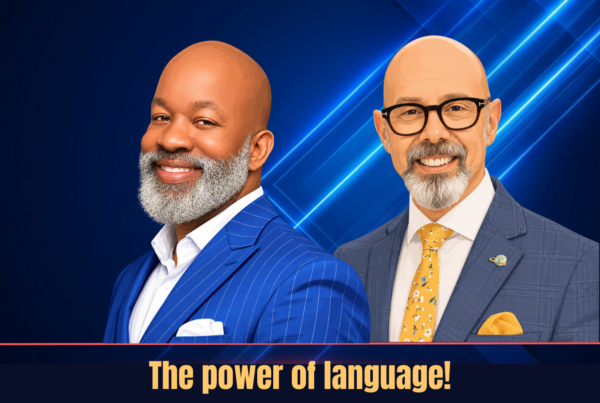
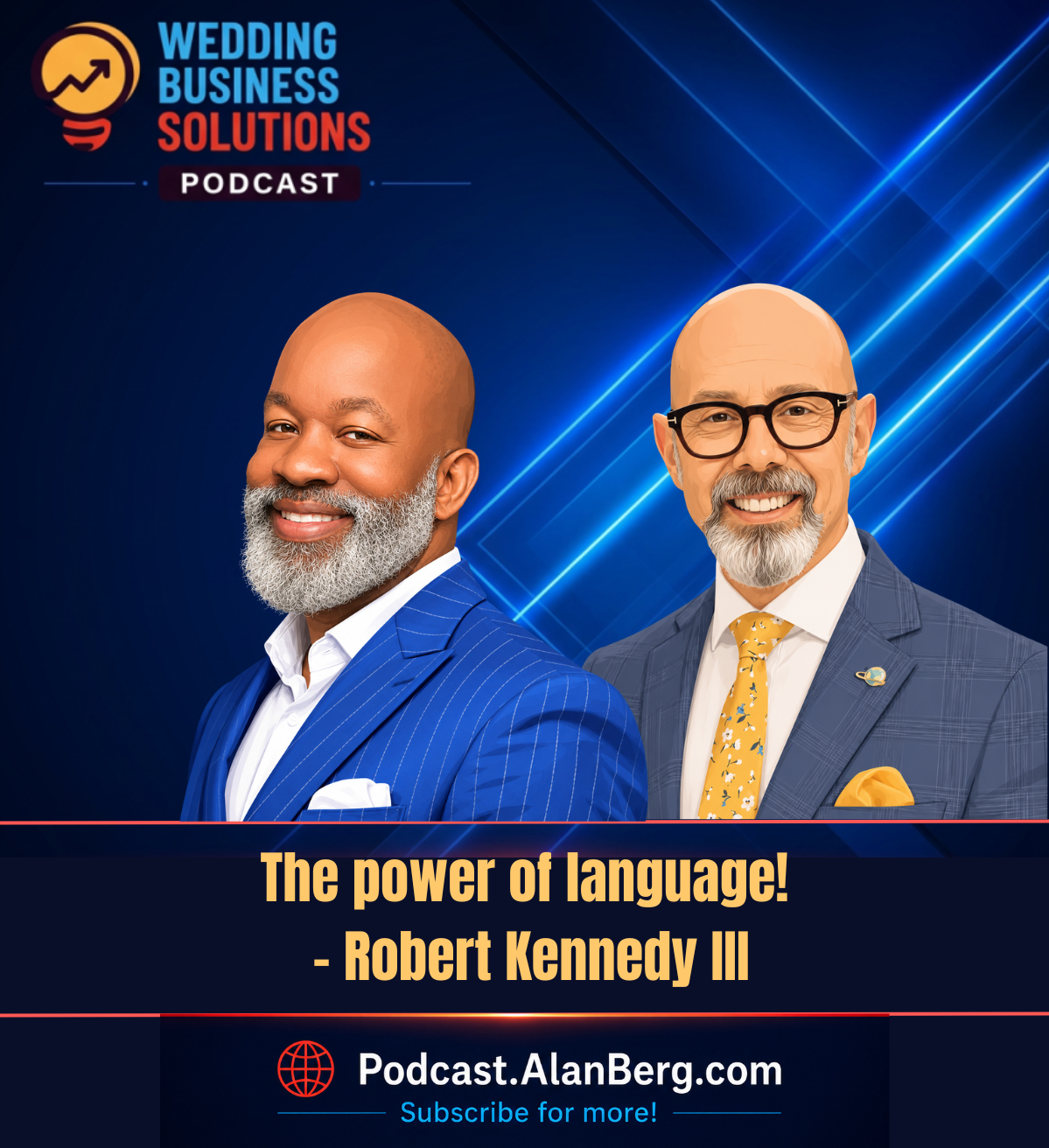
 Robert Kennedy III – The power of language
Are you telling stories that truly connect with your clients, or are you just rattling off your resume? Are you painting a vivid picture of success for a couple’s big day, or jumping straight into a sales pitch and wondering why you’re not closing the deal? In this guest episode with Robert Kennedy III, we get into how asking the right questions, understanding what your couples do—and don’t—want, and relating stories to their experience can transform your sales conversations and website into powerful connection tools that drive action.
Listen to this new episode for ways to deepen connection through storytelling, ask better questions, and use the power of language to convert conversations into bookings.
About Robert:
Robert Kennedy III wants to live in a world where people are no longer afraid to confidently tell their stories…and they can also eat Reese’s Peanut Butter cups for every meal without any repercussions.
His work as a keynote speaker and trainer in the area of leadership communication has led him to work with organizations such as the US Coast Guard, Barnes & Noble, Social Security Administration, Panda Restaurant Group, AARP, T-Mobile, and UNCF as well as appearances on Fox, CW and other networks.
He is involved in his community through various boards including the school boards, Association for Talent Development Maryland Chapter, youth leadership programs and helping non-profits conduct mock interviews. He is also a professional member of the National Speakers Association.
Contact Robert:
LinkedIn Profile: http://www.linkedin.com/in/robertkennedy3
Instagram Handle: @robertkennedy3
TikTok Handle: @realrobertkennedy3
Personal/Company Website: http://www.robertkennedy3.me
Other Social Media Links (YouTube, etc): YT – http://www.youtube.com/robertkennedy3
If you have any questions about anything in this, or any of my podcasts, or have a suggestion for a topic or guest, please reach out directly to me at [email protected] or visit my website Podcast.AlanBerg.com
Please be sure to subscribe to this podcast and leave a review (thanks, it really does make a difference). If you want to get notifications of new episodes and upcoming workshops and webinars, you can sign up at www.ConnectWithAlanBerg.com
View the full transcript on Alan’s site: https://alanberg.com/blog/
In this episode I had a lively and insightful conversation with my friend Robert Kennedy III all about the power of language in the wedding and event industry. We dove into why the words we choose and the way we structure our conversations can make a huge difference in sales and client relationships. Robert shared his expertise on storytelling, breaking it down into four essential elements: context, characters, conflict and conclusion. He explained how using stories isn’t just about once upon a time but about clearly painting pictures for clients so they feel understood and involved.
We talked about practical strategies like the importance of asking better questions instead of launching straight into product pitches. Robert shared how asking open-ended questions sparks the client’s imagination and engages their brain on a deeper level, helping them see themselves in their dream event. I loved his example about distinguishing between transactional questions and those that create a vivid vision of success, such as asking a bride to describe how she wants to feel and look at her wedding.
Robert also highlighted how reframing questions, such as exploring what a client doesn’t want, can prevent missteps and uncover important details. We explored the role of empathy, sharing stories of previous clients with similar challenges, and the difference this makes in building connection and trust. He pointed out that while information transfer is important, true transformation happens when we connect emotionally with our clients.
We also discussed language on websites and email, using examples like Warby Parker to show how to share an origin story that draws readers in and relates directly to their experience, instead of just listing credentials. As the conversation wrapped up, we tackled the common stumbling block of asking for the sale and how fear of rejection often gets in the way. Robert provided actionable tips for guiding clients to the finish line by painting a clear picture of next steps and always creating a call to action.
This episode is packed with actionable insights for anyone in the wedding or event industry who wants to level up their communication, create deeper connections and ultimately drive better business results through the power of intentional language and storytelling.
The power of language. Here’s a conversation you’re going to want to hear. Hey, it’s Alan Berg. Welcome back to another episode of the Wedding Business Solutions Podcast. I am so excited to have my friend Robert Kennedy III, RK3, to us on to speak about the power of language. How you doing, RK?
Life is grand, my friend. Hold on one second. Let me make an entrance. Hold on.
Here we go. For those of you that are not watching, the word yes popped up with confetti all over the place. We have a lot of people that are listening, not watching. You need a sound effect for that because we had the visual effect.
I should probably have a sound effect. Yes.
You should have a sound effect for that. There you go.
Oh, actually—
You got one?
Are you getting— oh, okay. I don’t know if you’re hearing my music or not. Oh, you’re not hearing my music?
Not hearing you guys.
Okay.
Yeah, you got to tie that in there. Technology is a wonderful thing when it’s working. So there we go.
All right, there we go. I think it is.
So like so many of my guests that I have on, I either read a book of yours or I see a post or something. And this was something you posted on LinkedIn because a lot of my speaker friends— so I know RK through National Speakers Association— and you posted something about the power of language. And yeah, I read, I’m reading it, I get your notifications. I’m like, oh, we need to talk about this because the wedding and event industry, a lot of it is about language before the event, right? Because we’re having these conversations. So just tell everybody just a little bit, you know, what do you do?
I run a company called Kinetic Communications. We work with managers, leaders in corporate spaces, small business owners, teaching them how to tell their stories, both on stage and on camera so that they can generate more income, attract their ideal audience. You know, all the things. We believe ultimately that we create connections with humans through story.
Right. Which, you know, listen, life is a story. Every day is a story. The story of you becoming empty nester is a story.
Is a story.
So people listening do weddings. A lot of them also do other events. They do corporate events. They do bar mitzvahs and bat mitzvahs and quinceañeras and communions and celebrations of life and all those things. And all of this is stories. So where do stories come in in the sales process?
Well, they should come in at the beginning, actually. So here’s the thing. When I talk about stories, people immediately think about once upon a time. And stories are not necessarily once upon a time. They are, but it’s more so about the structure of stories. And stories have four main elements: context, characters, conflict, and conclusion. Those are the four.
Do that slower. Go slower. Do it again.
Stories have four main elements: context, what’s happening in the world at that particular time; characters, the people who it’s happening to, the people who are talking about it; the conflict, what the challenge is, or maybe what the opportunity is; and then you’ve got the conclusion, which is the next step.
There’s a framework that I teach my audiences called Challenge, Catalyst, and Change, and that incorporates those. So the challenge is, okay, let’s use a wedding industry story. The challenge may be that there is a bride getting married and the bride is going to all of these stores, all of these boutiques to try to find the perfect dress. The issue is that every time she goes, people are trying to sell her stuff that’s on the rack and she’s got to dig deeper and ask other questions to find what are the other resources.
She’s not seeing what she wants, but nobody’s sharing that with her. That’s the challenge. But the context is, okay, yep, she’s getting married. She’s walking around, she’s doing this stuff. She, the bride, is the character. Okay?
Okay.
It’s important for us to have the character because the character is who we relate to. If I remove the bride from that, it’s simply, hey, people come and they look for stuff at stores when weddings are gonna take place.
Right.
But they can’t find what they want.
Right.
Okay. So that’s the challenge part of it. The catalyst piece of it is what’s the moment that we realize that something different needs to take place or there’s a possibility? So the moment there is, okay, the bride’s running around and it occurs to the bride that, hey, I’ve gone to all these places and I have not found what I want and nobody’s talking to me. I need not just an online platform or dashboard where we can explore. I need a forum inside of that where potential brides or potential marriage people, right, can talk to each other, get feedback, get information, and talk about their problems and their challenges.
So that’s her moment of realization. Or his moment of realization, whatever it is. And after the catalyst, there’s the change. What is the process that is now being implemented in order for change to take place? What are the steps? So therefore what we did was we went on our AI tool and we said, hey, AI Claude Code, can you create a dashboard for me that does this, this, this, this, and this, and then create a marketing strategy for it so that I can make sure that enough people know about it. Right. So all of that is a story process.
It’s a story structure and it’s a story.
Right. So this is someone who’s thinking about creating a wedding business. Now you have a wedding business, it’s already established. How do we bring the story into the sales process? Because what we know is that if we’re talking about ourselves, they’re not connected because this is a monologue, right? How do we make this dialogue and go through those steps? Because we have the character, because we’re having conversation with them. We have the context, they’re getting married.
Yeah.
Now we have to get into that, the conflict and the conclusion there. So from the salesperson’s point of view, right? You’ve gotten the inquiry, the marketing has done its job. You’ve gotten that inquiry. What are some of the things that people do wrong at that point?
Well, they immediately jump to the conclusion and the conclusion happens to be the product, the process, the program. They immediately say, well, we got your email. Here’s what we can sell you. We have these five packages available for you.
Right.
Jumping right to that makes certain assumptions. That this person is simply a transaction. They are a monolith. They only show up in one way. They have one specific need. There could be only one reason on earth that they would’ve called you in the first place. So you make that assumption and you may get some sales with that, but maybe not. The majority of people have other stuff going on in their lives and in their space.
And so when we think about the sales process and we wanna dig into the conflict, I start my sales process by asking some questions. What brings you here today? Or what do you hope to accomplish? What exactly are you looking for? Can you tell me a little bit about what are the challenges that you’ve been having in this process?
And as you ask those questions, they’re sharing with you, okay, yep, this is what I hope. This is what I desire. This is what I want. This is what I’m looking for. And as they’re sharing that with you, especially if it’s something that is traumatic is not the word that I’m looking for, but something that is problematic in some way, now as a salesperson, you can reassure them by saying, you know what? Yeah, I dealt with that very issue previously.
A former client of mine came and they were having this challenge and they shared this with me and here’s how we were able to help them navigate it. Maybe we can do the same for you.
Yeah, yeah. It’s funny because when I speak about sales and handling objections, I talk about feel, felt, found. And you just described that without saying those words, right?
Right.
We are empathizing with you, right? We are telling a story. And everybody’s done this. They just haven’t thought about it, right? You just described, yeah, I had this other client. They walked in the same shoes. They crossed this same bridge and we helped them get to the other side. That’s feel, felt, found. And I hate using the word technique because technique sounds like manipulation. It’s not.
You’re telling a story of someone else who has had this challenge. I see you in this story and I’m going to make you the hero because we’re going to get you to where you want to get to.
Absolutely.
Let’s step back for a second. On somebody’s website, they have an About page, right? And so many of the About pages are basically a resume, a CV.
Yeah.
It’s just, this is what I’ve done. What could they do there to change that narrative so that there’s a story, but it now is gonna engage someone better?
This is a great question. Now I’ve got a really good example.
Okay.
So you are, for those of you that are not seeing this, this is audio. Alan wears glasses, right? And Alan has these nice horn-rimmed glasses, really, really cool, right? Alan, have you ever heard of the company Warby Parker?
Sure.
Okay, so Warby Parker is an eyewear company. If you go to the About page of the Warby Parker company, you will see they have this story there and it says, this is how Warby Parker started. Some years ago, there were a bunch of college students that went on a camping trip. And they decided to go hiking. When they went hiking, one of the students dropped their glasses on the ground. Somebody stepped on it and they were broken. So the college student couldn’t wear the glasses anymore for the rest of that trip.
They went back to college, tried to get some glasses, but the glasses that they— eyewear in the places that were around the college were so expensive that a broke college student couldn’t afford it.
So this college student spent the rest of the semester squinting to try to see the board in front of them. At that moment, we made the decision that no one should be denied access to eyewear simply because of cost.
Yeah.
That’s the Warby Parker origin story right on their About page. It shares with us where the idea came from. It shares with us why they do what they do, why they’re passionate about it, why they’re convicted about it, why they are connected to it. People that come to Warby Parker to get glasses, if anybody says, oh my gosh, Warby Parker is so expensive, there’s immediately a filter that says, nope, Warby Parker is not living through our vision. We’re not living through our mission. Our idea is that you should not be denied care. You should not be denied eyewear because of a dollar sign.
Right. So one thing that I didn’t hear in that story is the word you. And the word you means you who’s reading this are connected. And again, I don’t know if that was word for word, but to me, what I would want to hear is, you know, that little— we call them little confirmation questions, right? Can you relate to this? Have you been there? Things like that, which is now making them part of this.
When I put up the current website that I have, I didn’t really have my resume on there because I figured people coming already kind of knew me.
And then people asked, they said, well, you know, what about your background? I was like, really? Like, you want to have my resume? So I added a tab that says, what have I done that helps me understand you better?
Yeah, yeah. So I literally just pulled up the Warby Parker About page right now. I read the story. Our founders were students when one of them lost his glasses, blah, blah, blah. Later on, it says, we believe that buying glasses should be easy and fun. It should leave you happy and good-looking with money in your pocket.
Right, right. That changes the feeling of the words because you’re— I’m talking to you, right?
Yep.
And I think when I look at websites, I look at the way people email, I look at their marketing pieces, and it’s all about them. It’s all inward facing.
Yeah.
And those little changes over there. So in the conversations that people are having, right, you got the inquiry, you got them to that Zoom call, that meeting, that in-store appointment, that tour for your venue, whatever it is. What are some of the other things that you see that you’re helping people say, okay, no, we need to shift this, right? You got them face-to-face now, whether it’s virtual or whatever. What are some of the other shifts that you try to get people to see?
Well, we want to get people, number one, understanding the audience. Again, I’ll go back to what we first said. A lot of times we typically start with the product, but we want to ask some questions to them. And one of the reasons why you want to ask questions is our brains have this process called instinctive elaboration. It simply means that when you ask a question, the brain cannot help but process it.
The brain can’t help but answer it because our brains are always looking to close loops. Our brains are always looking for patterns. I ask you a question, your brain’s like, did I have that experience? Do I want that experience? Did I not like that experience? Is it familiar? Is it unfamiliar? Your brain is seeking that out.
So we’re looking for anybody, salespeople, speakers, to ask questions so that the audience’s brain can be engaged. And once the audience’s brain’s engaged, especially if you’re asking for a response, you now have additional data that you can work with. You can tell them a story based on that, or you can ask them some additional questions. Oh, since you responded this way, what would it feel like if you were able to do this?
Yeah, what would it feel like? You’re trying to get to the emotional core.
Yes. Yeah.
Yeah, I mean, my most popular book is called Shut Up and Sell More Weddings and Events because the subtitle is Ask Better Questions, Really Listen to the Answers. When we’re speaking, everything we say, we already know.
Right.
Everything you’re saying now, you know. Everything I’m saying, I know.
Yep.
I’m only learning if I ask a question. But I love that your brain wants to complete that because I just finished an update to Why Are They Ghosting Me? Which the core of this is, you know, nine reasons why you’re getting ghosted. But if you don’t ask a question at the end of your message, right?
Right.
But you just— I love this. I love this. I’m going to be sharing this and quoting you, of course. If you don’t ask a question, then their brain doesn’t have anything to try to complete because the period and the exclamation point completed it already.
Correct.
But when you ask the question, you’ve left this open hook, this open hook there. So let’s talk about questions. You could be asking, you know, what do you want? But you could also be asking, what do you not want?
Right.
Right. And when you ask, what do you not want, how does that change how they answer? How does it change this part of this conversation?
Man, that is awesome. It’s like Superman and Bizarro. It’s the opposite. We’re so used to, or we’re so programmed to think about desire. What is it? I want to be rich. I want to have this car. I want to have these clothes, this outfit. I want to have this house.
But if we think about what do I not want, now I’m putting up some additional guardrails. Because when you don’t think about what you don’t want, you can step in a pothole because you weren’t paying attention to it.
Right, right.
But do you want to be in— no, I don’t want to be in a pothole. So I’m going to look a little bit differently at the street that I’m walking down because I don’t want to step in a pothole.
Man, the other day I was outside in my neighborhood walking and I had my headphones on and I’m dancing, whatever. And I hit— so there are the two, you know, the joints in the sidewalk.
Yeah.
I guess trees grow or sometimes they separate.
Yep.
Man, and the front of my foot hit that and I fell flat on the ground, dude. Right? Because I wasn’t looking at it. But what if I said, you know what, I’m walking, I do not want to fall, I don’t want to trip over these things. And so now my mind pays attention differently to this. I’m looking for those spaces. So that’s a really great way to engage the brain even differently.
Yeah, you can’t motivate someone in the negative. Like, you can’t tell a pitcher, don’t pitch low and inside. That’s all that’s gonna go is low and inside.
Right.
But when you say to someone, what have you seen at other weddings and events that you don’t want at yours?
Yeah.
When you ask them what they do want, they’re like, oh, I want it to be fun, I want it to be happy, I want to be dancing, or whatever. What do you not want? Oh my gosh, did you see what happened at this other one?
Yep.
Plus, you’ve identified the pothole, the landmine, whatever you want to call it.
Yeah.
You know, you and I travel a lot and we go to a restaurant, and I love asking the server, hey, what’s popular here?
Yeah.
I hate when they say, well, I like the—
Yeah.
Because I didn’t ask you what you liked. I asked you what’s popular there. And if they say, oh, I love the salmon, right? What if I’m allergic to fish?
Yeah.
Or a story that I’ve told many times, a pizza place in Boston. I’m there with my cousin and the server goes into this— well, first of all, he said we took too long to order. He goes, you guys are lost. I’ll tell you what you’re having.
Okay? Okay.
Hey, I’m good with that. I’m like, okay, pizza boy, tell me what you’re having, right? But tell me what’s popular. Tell me what the thing is. Well, he goes into this oration about meat on a pizza. It’s pepperoni, it’s sausage, it’s meatball. And I’m like Pavlov’s dog, and I’m just like drooling here. And then the record scratch sound comes and my cousin goes, I’m a vegetarian.
Yeah.
Right? And if he would’ve said, you guys are lost, I’ll tell you what you’re having. Do you like meat on your pizza?
Yeah.
He would’ve found out whether he should continue or not. And that’s the beauty of these negative questions, which is finding out what not to talk about.
Yeah. Or ask that question that you just talked about. Hey, I love these. What do you not want on your pizzas?
Right, right, right. Is there anything you don’t want on your pizza? And she would go, meat. Okay, cool. I got that right now. And then, you know, are you okay with meat on his half? She’s not a philosophical vegetarian. So we ended up with meat on my half and not on her half. And that’s what we did. It was fine.
But there was this awkward moment in there.
Yeah.
And, you know, the title of Shut Up and Sell More came from— I was in sales and I had just won a national product information championship. I literally had the trophy to show I knew more than any salesman in the country of this product, right? Chrysler cars. First year they ever held the competition.
And my sales manager came over and said, Alan, you know more about these cars than anyone I’ve met in 20 years. I said, thanks. He goes, good. Shut up. I was like, what? He goes, you’re telling people things they don’t need to know.
They don’t need to know.
Yeah, I’m volunteering information because I think it’s important, or maybe the last customer thought it was important or whatever. And I think so many people do this in their emails, on their website, in their speaking, just blah, data dump. But like you said, it’s products and services. You’re not talking about why I should choose you.
Yeah, yeah. There’s a line that I offer in my talks. And before I give you the line, I’ll set it up. One of the reasons why we use stories is because you can have information for people, but if they don’t understand the context of it and they don’t understand how it applies to them, they won’t connect with it.
So my line is, communication transfers information, but connection creates transformation.
Right? If I want them to move, if I want them to do something with it, I’ve gotta connect with it. And in order for them to move and get connected, they’ve gotta understand, okay, how does this apply to me? Why is this important to me? Why do I like this? Do I not like this? Do I not want to experience? So we’ve gotta move towards connection rather than data dumping or just tossing information over to people.
Yeah. And with a wedding or an event, there’s always guests involved.
Yeah.
It could be a handful of guests, it could be dozens, it could be hundreds, it could be thousands. And I tell people every time you get an inquiry, there is an occasion, right? And one of my clients put it really well. It’s three questions: what’s the occasion?
Yeah.
Who’s coming? And what does success look like, right? You can’t hit a target you can’t see. So you’ve got to remember that for most people— actually, for everybody here— these are discretionary income. Nobody has to spend money on a wedding. Nobody has to spend money on a bar mitzvah, quinceañera, or sweet 16, or whatever. They don’t have to. There’s no law in the world that says you have to. You do it because you want to.
And then they forget about the guests because they make it all about themselves, right?
Yeah.
There’s 200 people coming and they make it about themselves. So you’re always competing against zero, right? When you try to sell them something, like if you try to sell them something for their cocktail hour, you’re competing against zero because they weren’t thinking about spending the money. So any money is compared to zero. Now you need them to want the result because that’s when they’re going to spend more.
Yeah, yeah, love it.
So language now— the way you ask a question, right? What do we want people listening to to say, to think? Okay, I’m going to ask this question because I want to know if they want whatever. They want a headpiece with that dress. If they want the late-night snack, if they want a DVD 4K for their video or whatever, we’re going to ask a question. But again, it’s transactional if it’s, do you want this thing?
Yeah. So we don’t want to ask yes or no questions. We want to ask a question that allows them to create a picture or click play on a video in their brain.
Okay.
So if I’m thinking about a wedding outfit, I might ask the question, what do you envision yourself looking like at this wedding? They’re gonna give you a picture, right? Some people might say, oh, you know, I envision myself looking pretty. Okay, can you tell me a little bit more about what pretty looks like? What does pretty look like for you? Can you paint that picture for me?
Yeah.
So now they’re, oh, okay, yeah, I’ve gotta have this hat, I’ve gotta have this veil, I gotta have this train. They’re talking about all of the different things and they’re giving you descriptive language. They’re giving you descriptors about the picture that they’re seeing in their brain.
So we wanna ask questions, or sometimes it may not be a question in order for you to start the thing happening in their brain. It may be a word of command. For example, the word imagine.
Hmm.
Imagine that you’re at your wedding. Imagine that there are 200 guests in attendance. Now you can ask the question.
Right.
What does that day look like? And when you say imagine, you can even use more descriptive. Imagine you’re at the wedding, there are 200 guests, there are 400 flowers in the audience. The background is blue. You’ve told me you like blue and peach. So the background is blue and peach. There is a mariachi band up at the front. Whatever.
Sounds like a fun wedding.
Yeah, yeah, exactly. This is good.
Well, you know, right. And this is what I tell people is, if you’ve been listening, they have painted the picture for you, right? You have all the paints on your palette there.
Yeah.
Repeat back to them and say, you know what, tell me if I got this right. You said when you arrive, you want this. When your guests arrive before you get there, you want them to have a cool drink because it’s going to be summertime. And the cocktail hour, while you guys are off taking pictures, you want to have a magician walking around because it’s going to be interactive, right? Am I getting this right?
And then you go through the whole thing, and at the end of it— and this is where I can get a little cheeky sometimes— at the end of it, I can go, wow, you know, on September 28th, there’s going to be a beautiful wedding here.
Yeah, beautiful.
To me, it’s just gonna be amazing. Is it going to be yours?
Yes, exactly right.
Because they are imagining it’s theirs until you ask that question, and then like, yeah, of course it’s mine, right? But it was the listening. It was the repeating back their words. If they say fun, you say fun. If they say elegant, you say elegant. If they say boho chic, you say boho chic. Even if you can’t stand the words boho chic, you say it anyway because it’s not your words.
Yeah. And watch their responses. I mean, when you get to that space, if you didn’t hit it, if you didn’t nail it, you’ll see their heads kind of twist, their eyes will kind of scrunch up a little bit. Eh, not quite. We’re not there.
But listen, if you nailed it, it’s like, oh my God, they’ll jump in. They’ll lean in because you set this up. You engaged their brain.
You hijacked their brain to paint this picture that now you’re both sharing.
Right. And then when you repeat it back, you can also say, is there anything missing from this picture? Is there anything missing from this movie? What have we not spoken about yet that is important to you?
Yeah.
And again, I’m going to use this so often now. Asking that question engaged their brain now to think. And if they say, no, that’s everything we want, you say, well, should we get started planning then?
Yeah.
Right. Which is a yes or no question. But at that point, it’s an appropriate yes or no question.
Correct. Correct.
So I don’t want people thinking, you know, you heard RK say, don’t ask yes or no questions. There are times when yes or no questions are fine.
Let’s rephrase it.
Yeah.
Don’t start with a yes or no question. Paint the picture and then gain agreement. When it’s time to gain agreement, then we can go yes or no.
Yeah. Have you read Never Split the Difference, Chris Voss’s book?
Some of it. Chris Voss. I actually just talked about that book yesterday. Yeah.
So it’s interesting because he talks about the three yeses, the counterfeit yes where they tell you yes and they never follow through. You have the confirmation yes, but you kind of need to hear a few yeses to hammer that nail in. The commitment yes, which is yes, but I love the commitment no, which is, is there any reason we shouldn’t go ahead and get started? And they’ll be more excited and go, no, no, there’s no reason we shouldn’t. And that is a yes couched in a no, but a very strong one. And again, language. Is there any reason we shouldn’t?
Right? Yeah.
Or Lois Creamer’s, would it make sense?
Would it make sense?
I use that all the time. I quote her all the time. Would it make sense? Now that’s engaging their brain a different way too.
Yeah, well, because would it make sense? I mean, when I got married, my wife would say this to me when I would say to her, oh no, that doesn’t make sense. She’s like, who made you the arbiter of sense? And I’m like, right?
But what’s happening there is they’re kind of looking at, okay, yeah, did that connect? Did that land? Does that organize in my brain for me? Right? So now they’re going back to prior experiences. They’re pulling on those prior experiences and they’re looking at this new solution that you’re suggesting.
So if Lois says, would it make sense to add a coaching component to this program? Okay, let’s look back at what we’ve done so far. Okay. What did we have coaching before and how did it work? No, Lois, I don’t know if that would make sense, right? Because now they’ve had some terrible experiences with it. So now Lois has some different questions that she can ask.
But if they’ve never experienced it— yeah, go ahead.
The thing that I add on to that is it’s the why. Would it make sense to add coaching so that we don’t just end them at this day and we keep going on? So would it make sense to add the photo booth for something fun for your guests when they’re not eating or dancing? Right? So don’t forget that next part because again, it becomes transactional again. Do you want a late-night snack is transactional. Do you want a jacket with that dress is transactional. But, you know, that time of the year it can get cool at night. Would it make sense to have a jacket?
Yeah, so the would it make sense is getting their brain to engage differently, but we still need to give them the why. We still need to give them the result that’s different. Otherwise, it becomes transactional.
So would it make sense to add a jacket along with your dress? Because, you know, that time of the year it can get cool at night. Sun goes down, temperature really drops. Would it make sense? And now they’re picturing, oh yeah, I always bring a sweater with me when we’re going to be someplace late at night that time of year or whatever. Now it makes sense to them and it’s no longer the transaction.
It’s the, you help me not be cold at night.
Yeah.
Which is the other part of that. So power of language. Run those four things again. The four things, it was—
The story?
Yeah, the four parts of the story again.
Oh, context, characters, conflict, conclusion.
And conclusion. So conclusion is now painting this picture of success for them. Is that what the conclusion part is?
It’s, yes, painting the picture. What are the actual steps? What will we be doing? Not just, oh, it’s going to be a great day. But okay, the day begins. We’re going to do this. We’re going to do this. Here’s what you will experience. Here’s what you can expect. This is what it is.
You’re at the space where you’re just about at contract time and you’re running down all of the— now you’re talking about the product. Now you’re talking about all of the different steps and everything that they will walk through.
Okay, so there’s one last piece here which a lot of people fall down on— asking for the sale.
Yes.
So you see this across industries?
Oh, all the time.
Okay.
All the time.
I mean, what do you think? Why do you think people get to the one-yard line and then just stop?
We don’t like rejection.
Okay.
Yeah, we don’t like rejection. We want— it’s the same reason. So you and I are in the speaking industry, right? And it’s the same reason why people will make videos. They’ll put their speaker one-sheet together. They’ll do all of the logos.
They’ll do all of the stuff and they’ll put it online. And they expect that once they do that, a flood of people will come and say, hey, you’re awesome. You’re great. Great colors. We want you to come speak and we’ll pay you five figures for it. That’s not how that works.
You’ve got to ask some questions. Because people are busy, right? And it’s not so much that they’re sitting there waiting to reject you.
They’ve just got other things on their brains. And so unless you direct their brains to a specific space by asking a question, by creating a call to action of some sort, they don’t know what the exact next step is.
Right. They’re waiting for you to guide them.
Yeah. Yeah. You’re their Sherpa.
Right. This is the thing that I think frustrates me is I see people who are so good at that 95%.
Yeah.
And then they’re like, oh, like you said, well, what if I ask and they say no? Okay, you got a resolution, but you can also now handle that objection. I see so many objections are just speed bumps. They’re not roadblocks. They’re speed bumps.
You know, you’re the first one we’ve seen is a speed bump. It’s more than we wanted to spend is a speed bump, right? You’re not available on my date is a roadblock. Like, you’re not available, you’re not available. That’s it. You know, physically can’t do it is different.
And I love when someone voices an objection because we’re still talking.
Yeah, yeah, right, absolutely.
And I love when somebody asks about price because we call those people buyers, right?
Yeah.
But it’s interesting. So it’s just a human nature thing then, right? It’s like, I’m expecting, I’m waiting for the customer to just say yes, but I didn’t ask the question.
Yeah. But even with the roadblock that you mentioned, a good salesperson, and maybe I’m stepping on people’s toes with this, but it gives you the opportunity to ask some additional questions.
Okay.
Wow.
The 17th of November. Yeah. We’re not available for that, but based on the service that we’ve offered so far, everything, if date wasn’t an issue, would you have chosen us? Okay, cool. Yeah, absolutely.
Okay.
Is there anybody else that you might want to share that with or that we should talk to based on the fact that you’ve enjoyed the entire experience so far? Who do you know? Who do you know?
Yeah. I love it. I don’t ask, do you know anybody? Who do you know? Who do you know that we could help in the way that we weren’t able to help you? Who do you know?
Yeah.
But again, that’s the power of language. Do you know anyone? No, I don’t know anybody. Who do you know? Right? Their brain is now, oh yeah, as a matter of fact, my friend at work, or I was just at the hair salon, I was at the gym.
And I always say to people doing weddings, if you also do holiday parties because you’re slow in December, you know, who do you know that’s planning a holiday party either at your company or through your family or whatever?
Yeah.
What’s the worst that happens? You don’t get a referral. What’s the best that happens? You do.
You get a referral or several.
Right. Or several. That’s what it is. Amazing. Amazing. And we could go on forever, my friend. So if people wanted to find out more about you, we’ll have also stuff in the show notes, but where should they look?
Easiest place, robertkennedy3.me. My social platforms are linked.
That’s the number 3.
The number 3, alphanumeric 3. Yes.
Right.
Robert Kennedy 3.
Robert Kennedy number 3. Right.
.me. Yep. Well, no, .com is my speaker website. .me is the place where all of my social— it’s like my landing page where everything is there. My training company, all of the stuff is there. But I love connecting with people on LinkedIn as well. So if you want to hop on a social platform where I engage quite frequently, LinkedIn is the place to be.
And that’s where I saw your post about language. And that’s why we’re here right now.
That’s why we’re here.
That is why we’re here. So thank you so much for joining me. It has been a pleasure. And we’ll do this again.
Yes, sir. I enjoyed it. Thanks so much, Alan.
I’m Alan Berg. Thanks for listening. If you have any questions about this or if you’d like to suggest other topics for “The Wedding Business Solutions Podcast” please let me know. My email is [email protected] or you can text, use the short form on this page, or call +1.732.422.6362, international 001 732 422 6362. I look forward to seeing you on the next episode. Thanks.
Listen to this and all episodes on Apple Podcast, YouTube or your favorite app/site:
- Apple Podcast: http://bit.ly/weddingbusinesssolutions
- YouTube: www.WeddingBusinessSolutionsPodcast.tv
- Spotify: https://spoti.fi/3sGsuB8
- Stitcher: http://bit.ly/wbsstitcher
- Google Podcast: http://bit.ly/wbsgoogle
- iHeart Radio: https://ihr.fm/31C9Mic
- Pandora: http://bit.ly/wbspandora
©2026 Wedding Business Solutions LLC & AlanBerg.com
Question
What’s the most common sales mistake people make after getting an inquiry?
Tags:
#sales #mistakes #weddings
Answer
A lot of people jump straight into pitching packages or talking about themselves. That turns the conversation into a transaction, not a connection. Instead, pause and ask questions to understand what the client actually wants and needs.
Takeaway: Lead with curiosity, not your sales pitch.
Question
How can stories make my sales conversations more effective?
Tags:
#storytelling #sales #communication
Answer
Stories build instant connection. When I share a story that mirrors a client’s situation, it helps them see themselves in the solution. They feel understood, not sold to. That emotional bond is what moves people to buy.
Takeaway: Stories create relationships that drive action.
Question
What are the four key parts of telling an effective story in my business?
Tags:
#storytelling #framework #sales
Answer
Every great story includes context, characters, conflict, and conclusion. Set the scene, introduce who it’s happening to, share the challenge or opportunity, and then finish with what changed or what was achieved.
Takeaway: Use structure to make every story compelling and memorable.
Question
How do I turn sales from a monologue into a real conversation?
Tags:
#communication #sales #engagement
Answer
Sales shouldn’t be a one-way pitch. I always ask open-ended questions about challenges, goals, and past experiences. This gets the other person talking, so we build a true dialogue, not just a sales speech.
Takeaway: The best sales happen through genuine two-way conversations.
Question
What’s wrong with just listing my qualifications on my About page?
Tags:
#website #marketing #aboutpage
Answer
A resume-style About page is boring. People want to know your story—why you do what you do and how it helps them. I share personal stories and address readers directly so they can see themselves in the journey.
Takeaway: Make your About page about them, not just you.
Question
How can I get clients to open up about what they really want from their event?
Tags:
#sales #questions #events
Answer
I don’t just ask what they want—I ask what they don’t want, too. People light up when talking about what to avoid, and it helps me spot their pain points. Their answers guide me to create solutions they actually care about.
Takeaway: Discover needs by exploring both dreams and dealbreakers.
Question
What’s a good way to draw out a client’s vision without making it feel transactional?
Tags:
#sales #vision #clientexperience
Answer
I don’t just ask yes or no questions. I invite clients to imagine their wedding or event and describe it in detail. This helps them paint a picture in their mind and gives me language to repeat back to them, building trust and excitement.
Takeaway: Help people see, feel, and describe their success.
Question
When is it okay to ask yes or no questions in the sales process?
Tags:
#sales #decisionmaking #questions
Answer
Don’t start with yes or no questions—they shut down conversation early. Use open-ended questions to explore. Once they agree on the vision and details, then you can use a yes or no to confirm next steps or close the sale.
Takeaway: Only use yes/no after building agreement and understanding.
Question
Why do people hesitate to ask for the sale at the end of the process?
Tags:
#sales #mindset #closing
Answer
We fear rejection, so we wait and hope the client says yes first. But people are busy—they’re waiting for us to guide them. If you don’t ask for the sale, you leave them hanging and yourself empty-handed.
Takeaway: Don’t let fear stop you from guiding clients to a decision.
Question
What should I do when a client raises an objection?
Tags:
#sales #objections #negotiation
Answer
Objections aren’t rejections—they’re conversation starters. When someone voices a concern, I view it as a speed bump, not a roadblock. Address it openly and keep the dialogue going to find a solution together.
Takeaway: Treat objections as helpful moments, not dead ends.
Question
How do I make sure my marketing and emails feel personal, not self-centered?
Tags:
#marketing #emails #copywriting
Answer
Shift the focus from you to your reader. Use confirmation questions—”Can you relate to this?” or “Have you been there?”—to draw them into the story. This makes your communication feel like a conversation, not a sales pitch.
Takeaway: Speak to your reader’s needs, not just your own achievements.
Question
How can I use language to help clients envision buying from me?
Tags:
#language #sales #vision
Answer
Use words like “imagine” to transport clients into the experience you offer. The more vividly they picture the result, the closer they feel to saying yes. Give details and repeat their own words to reinforce the vision.
Takeaway: Paint vivid word pictures to move people closer to yes.
Question
What’s the benefit of repeating clients’ words back to them during sales?
Tags:
#sales #communication #clientexperience
Answer
I echo their descriptive words—like “fun,” “elegant,” or “boho chic”—right back to them. This makes them feel heard and validated, and sometimes they’ll even correct or expand on their vision, giving me even more insights.
Takeaway: Mirroring language builds trust and deepens the conversation.
Question
Why shouldn’t I just “data dump” everything I know in a sales meeting?
Tags:
#sales #presentation #mistakes
Answer
Sharing every feature you offer overwhelms people and disconnects them. Instead, I tailor my responses to what matters to them by asking great questions and listening closely. Information matters, but relevance connects.
Takeaway: Personalize information—don’t overwhelm with unnecessary details.
Question
What’s a more powerful question than “Do you know anyone who needs my services?”
Tags:
#referrals #networking #language
Answer
Instead of asking, “Do you know anyone?”, ask, “Who do you know?” That little tweak activates people’s brains to scan their network for names and opportunities, instead of just giving a flat “no.”
Takeaway: Specific questions unlock more referrals.
Question
How does the brain respond to good sales questions?
Tags:
#sales #psychology #communication
Answer
When I ask a question, your brain can’t help but process it. It’s called instinctive elaboration—our minds want to close loops and find answers. That’s why questions drive engagement and keep the conversation moving.
Takeaway: Questions naturally pull people into the conversation.
Question
Why is it important to clarify what a client doesn’t want in their event?
Tags:
#sales #clientneeds #events
Answer
If I only focus on what people want, I might miss the pitfalls. Asking about what they don’t want brings any hidden problems to the surface, so I can avoid surprises and deliver what they’ll actually love.
Takeaway: Sidestep problems by learning clients’ real dealbreakers.
Question
How do I know when the timing is right to close the sale?
Tags:
#sales #closing #timing
Answer
Once you’ve painted their perfect vision, addressed concerns, and confirmed nothing’s missing, it’s time to ask for the sale. Don’t wait for a magical sign—guide them confidently to the finish line.
Takeaway: Close when you’ve built the vision and trust they need.
Question
How can a simple word like “imagine” change my sales approach?
Tags:
#language #sales #persuasion
Answer
Using “imagine” prompts clients to visualize the experience for themselves. When they see it in their mind, you shift from hypotheticals to something real, making decisions feel easy and natural.
Takeaway: The word “imagine” is a gateway to desire.
Question
What can I do if my product isn’t available on a client’s date?
Tags:
#sales #objections #referrals
Answer
If I’m booked, I don’t stop there. I ask if, without the date conflict, I would have been their choice. Then I pivot to, “Who else do you know who needs help?” This keeps the relationship alive and may lead to referrals.
Takeaway: Turn missed opportunities into referral wins.
Question
Why do I need to connect before asking someone to buy?
Tags:
#sales #connection #trust
Answer
People don’t change or buy unless they feel a connection. Communication delivers info, but real connection is what creates transformation and action. Build trust first, and the sale comes naturally.
Takeaway: Real change starts with real connection, not just information.
Question
How can asking about the client’s guests help me sell better?
Tags:
#clientexperience #sales #events
Answer
Remember, most events aren’t just for the clients—they’re for their guests, too. By asking about who’s coming and what will make the party fun or memorable for them, I uncover opportunities to add more value and relevant services.
Takeaway: Thinking about guests unlocks new sales opportunities.