 I used to be competitive
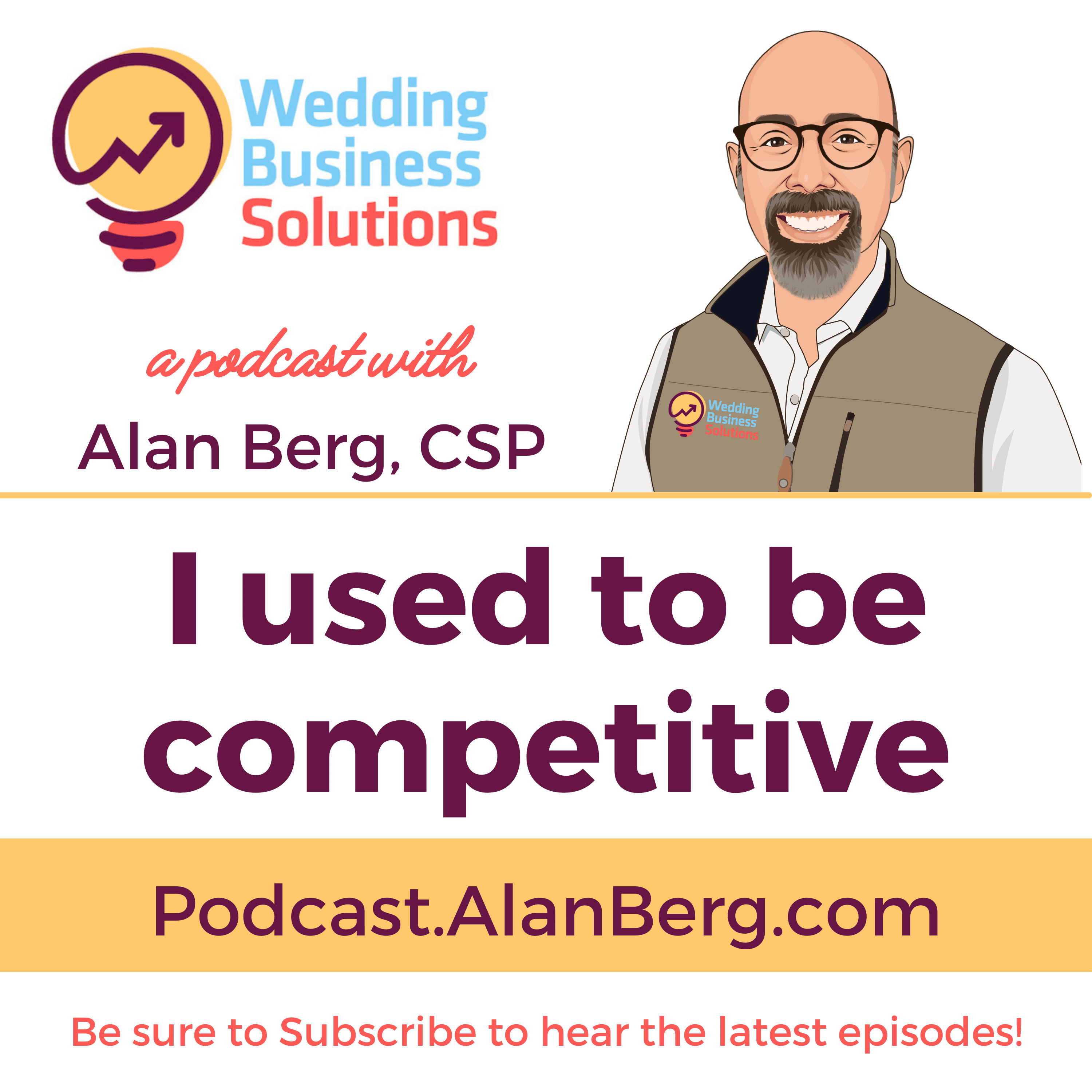
When I was younger, I was very competitive. Whether it’s maturity, or just getting older (and wiser?), but now I look at being competitive very differently. While life has some zero-sum games (sports has winners and losers), most of our efforts are happening in abundant places, where someone getting more doesn’t really affect the rest of us.
Listen to this new, 6-minute episode for some perspective on how you might look at how competitive you are, or want to be.
Listen to this and all episodes on Apple Podcast, YouTube or your favorite app/site:
- Apple Podcast:
- YouTube: www.WeddingBusinessSolutionsPodcast.tv
- Spotify: https://spoti.fi/3sGsuB8
- Stitcher:
- Google Podcast:
- iHeart Radio: https://ihr.fm/31C9Mic
- Pandora:
Below is a full transcript. If you have any questions about anything in this, or any of my podcasts, or have a suggestion for a topic or guest, please reach out directly to me at [email protected] or contact me via text, use the short form on this page, or call 732.422.6362
Please be sure to subscribe to this podcast and leave a review (thanks, it really does make a difference). If you want to get notifications of new episodes and upcoming workshops and webinars, you can sign up at www.ConnectWithAlanBerg.com
– I used to be competitive. Listen to this episode and find out where I’m going with this. Hi, it’s Alan Berg. Welcome back to another episode of the Wedding Business Solutions podcast. I used to be a very competitive person, whether it was sports or whether it was academics or anything like that, I was very competitive. I was competitive with myself, as well as with other people. If I was playing basketball, and those of you that know me in person know that I am not of tall stature, I was still, you know, trying to be a somewhat aggressive player and play. And if my friends and I were riding bikes, you know, we always had the who is faster or who could jump further or whatever it is that we were doing there.
So, I used to be really competitive that way, and as I got older, I realized that being competitive, other than with myself, was really not where I wanted to put my efforts. Because first of all, I don’t control anybody else. I’ve talked about this with my TaeKwonDo training and things like that, where, you know, I could say, “All right, let’s do pushups,” and “Who can do more pushups?” But the reality is, I can’t control how many you do. I can’t. I can’t control if you were practicing between last week and this week more and you can do more than me. What I could control is what can I do versus what I did the last time. And the idea of the zero-sum game, which is, that has to be a winner and a loser, I think is also, something maybe that takes maturity to realize, that there don’t need to be always the winners and losers or you don’t always have to win or that winning makes someone else lose. And, is that what makes you feel better?
Now there are certain times where there are zero-sum games. If you are running a race, there is a winner and everybody else lost. Even in the Olympics, you have your, your gold, your silver, and your bronze, and then everybody else didn’t get a medal. I remember one time there was a woman who had been, pre the Olympics, she had been on all the magazine covers, and she was a runner. I forget what distance that she was running, but she became the darling of the media for whatever reason. And come to the Olympics, and she runs and she came in fourth. And of course, all eyes and all cameras are on her because of all this press that led up to it there. And they came to her and they said, “Well, how does it feel? You know, you didn’t medal, and, you know, you came in fourth.” And she goes, “Yeah, in the world!” which I thought was just such a great answer. You know, came in fourth in the world.
Yeah, there is that zero-sum when you have things like that or if it’s the Academy Awards, somebody wins and everybody else lost. Does that make them losers though? No, being nominated is an honor in itself. You got recognized in there, and yeah, we’re only going to hand out one of those gold statuettes. You know, there you go. You can only have one of those. But I realized that for me, winning that makes somebody else lose is unsatisfying for me, because I guess it’s just more, again, maybe it’s more maturity, maybe it’s just getting older, and I don’t need to see other people lose. That doesn’t make me happy to see other people lose. Don’t get me wrong. I don’t think we should be handing out trophies for eighth place, or participation trophies. I think there are realities in the world that if you’re playing a sport, there are winners and there are losers. Yeah, don’t do that to the four year olds, but as you get older, that is just the reality of that nature of that game. That’s what that is. But that’s not the reality of life.
The reality of life is that you don’t have to lose for me to win, right? For me to be better doesn’t mean you have to be worse. And I think that’s where I’m getting at with this whole idea of where I used to be competitive and now I’m not. I’m still somewhat competitive by nature. I mean, if we play a a board game, if we sit down and play Clue or if we played Monopoly or something, yeah, the point of the game is to win. But I think it’s also, I’m even less competitive with that in some ways. I’d rather be competitive with myself. I’d rather sit down and do a crossword puzzle and see how I can do that in pen and finish the whole thing, right? That, to me, is a competition against myself. It doesn’t make anybody else lose for that to happen. So, I used to be a lot more competitive.
Think about yourself. Think about yourself earlier in your life. Think about yourself maybe five years ago, 10 years ago, some of you 15, 20 years ago, and then think about yourself now. And would you find yourself to be more competitive or less? And what is the satisfaction if you find yourself being as competitive or more, what is the actual satisfaction of that? And is it something that you’re really striving for? So, excuse me for getting a little philosophical on you today with this one, but hope, as always, it gives you something to think about. Thanks.
I’m Alan Berg. Thanks for listening. If you have any questions about this or if you’d like to suggest other topics for “The Wedding Business Solutions Podcast” please let me know. My email is [email protected]. Look forward to seeing you on the next episode. Thanks.
Listen to this and all episodes on Apple Podcast, YouTube or your favorite app/site:
- Apple Podcast:
- YouTube: www.WeddingBusinessSolutionsPodcast.tv
- Spotify: https://spoti.fi/3sGsuB8
- Stitcher:
- Google Podcast:
- iHeart Radio: https://ihr.fm/31C9Mic
- Pandora:
©2023 Wedding Business Solutions LLC & AlanBerg.com