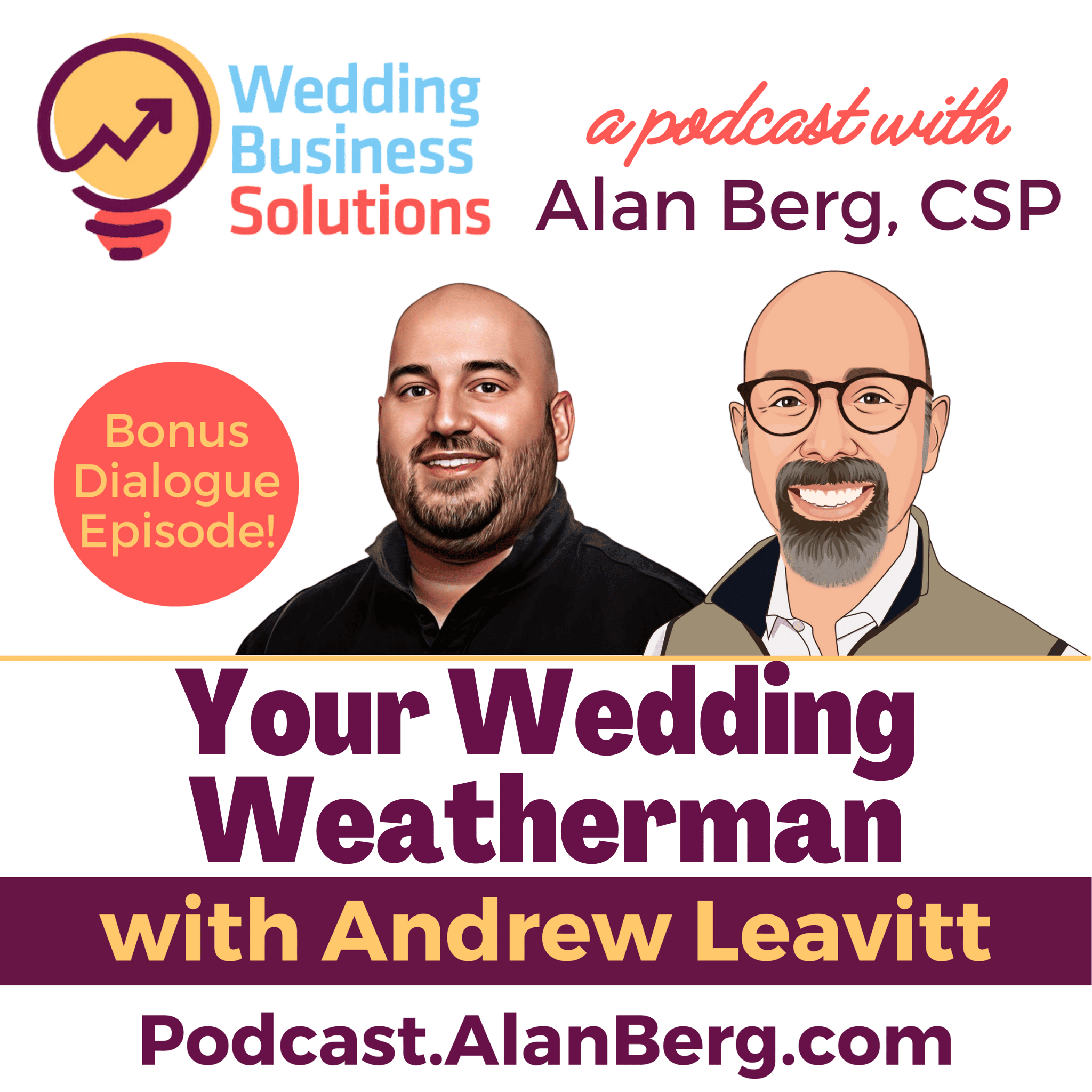
 Andrew Leavitt – The Niche: Wedding Weatherman
Every once in a while, I come across someone who’s carved out a really unique niche in the wedding and events industry. I met Andrew at a WeddingPro COR event and when he told me he provides weather tools for wedding professionals, I was intrigued. Of course weather is a big factor for weddings and events, but why are the apps on our phones not giving us the full picture and how does Andrew, and his team of 20 meteorologists, help couples better prepare for the weather on their wedding day (or weekend), anywhere in the world? Listen to this episode to find out, and to hear some real weather stories.
About Andrew and Ironic Reports
Andrew Leavitt started his career as a wedding and mitzvah DJ at the age of 13. After moving to the concert and festival industry after college, he became an expert in event and weather safety, working on global tours and major festivals.
In 2019 at his best friend’s wedding, a storm started heading towards Newport, RI. As the venue and planner scrambled with multiple weather apps and the tension started to rise, he started tracking the weather pattern, wind speed, and precipitation rate. In about a minute, he realized this would pass in 30 minutes, so the best move would be to bring the cushions in from the chairs outside, let the kitchen know to hold the food, and move everything back 45 minutes, but when he told this to the maid of honor, he was promptly told to get another drink, sit down and shut up! Want to see how this turned out? Listen to this episode.
So, with the help of endless free time in 2020, he founded Ironic. Since launching, Ironic has helped over 2500 engaged couples plan for their wedding through Historical Weather Reports and Concierge Wedding Meteorologist.
- Website: www.IronicReports.com
- Bio: Weather Tools for Wedding Professionals – Concierge Wedding Meteorologist
- Instagram: @Ironicreports
Listen to this and all episodes on Apple Podcast, YouTube or your favorite app/site:
- Apple Podcast:
- YouTube: www.WeddingBusinessSolutionsPodcast.tv
- Spotify: https://spoti.fi/3sGsuB8
- Stitcher:
- Google Podcast:
- iHeart Radio: https://ihr.fm/31C9Mic
- Pandora:
Below is a full transcript. If you have any questions about anything in this, or any of my podcasts, or have a suggestion for a topic or guest, please reach out directly to me at [email protected] or contact me via text, use the short form on this page, or call 732.422.6362
Please be sure to subscribe to this podcast and leave a review (thanks, it really does make a difference). If you want to get notifications of new episodes and upcoming workshops and webinars, you can sign up at www.ConnectWithAlanBerg.com
– A wedding meteorologist? Who would’ve thought? Listen to this episode and find out. Hi, its Alan Berg. Welcome back to another episode of “The Wedding Business Solutions” podcast. I have a guest on that I met at the Wedding Pro event in Chicago, and we were casually talking, and I found out that he is a wedding meteorologist. So, Andrew Leavitt from Ironic Reports. Andrew, welcome.
– Hey, how’re we doing? Thank you for having me on here.
– Well, thank you for joining me here. I’m glad that we ran into each other, because I’m always looking for something different. I have a segment on my podcast called The Niche, and I would say that this definitely qualifies as a niche for you over here. So, give us a little bit of background here. I know there’s a funny story about how this started. So, how long have you been a meteorologist?
– So I should always say this to everyone, I am not actually a meteorologist, but what I do is I work with meteorologists closely. My background is an event producer. So at 13, I started doing mitzvahs, you know, in a button cover and tuxedo vest, and the whole thing. Ran that world until I was mid-twenties. Then got into concert production. So I became a weather specialist working on Coachella, Panorama, Paul McCartney, tour dates, and basically anything-
– Hang, hang on. How does one become a weather specialist for events? You were planning events, producing events, but, so how did that happen?
– So actually, it was a kind of a mix. I got involved in the Event Safety Alliance. And went to the Event Safety Alliance first meeting. Then they had a special weather summit in Norman, Oklahoma. And I went out to Norman and fell in love, went to the weather center, saw all the science behind it, took all the classes, sat in a bunch of different breakouts really, and just became obsessed with what the weather can do to an event, and how safety is a huge issue, and how basically, which I had to do once, is you sometimes have to cancel a 40,000 person event because lightning is an hour away and people don’t know that it’s coming, but it’s coming. And when it happens, it’s going to be an issue. So we did one event, Panorama, in New York, where 40,000 people were on set at Randalls Island, and I had to go run around in a golf cart stage to stage, coordinate all the production managers, let everyone know, and then start the evacuation. And that was like, I’ll joke about it, say my big test. But you get excited and nervous. And weather’s interesting. It’s beautiful, it’s crazy, it’s dangerous. So, I got very into the weather side of events. And then when the pandemic hit, had an idea. I joked about for years quitting concert touring to go back to wedding planning. And then when the pandemic hit, I had an idea for Ironic early on. I was supposed to go out in a global tour with a rock group, doing, you know, Foxboro Stadium, throughout Mexico, and everything else in between. And pandemic happened, so was very bored for about two weeks. And then started Ironic Reports as a side hustle just to pay rent. And now it’s turned into a full-time business.
– Now, you had told me a story about you were at a wedding, and weather was going to come in. Tell me about this.
– Yeah, so it was my best friend’s wedding. Newport, Rhode Island. I won’t say the venue. Beautiful, harbor side. Price tag was, I’ll say, a small house in a nice suburb. And for two years, we had laughed at the price tag, and just kind of, first friend of ours to get married in such a way, in that luxury market. And best way of wording it, we started all the groomsman’s traditions earlier in the day, from a couple drinks, to a get ready, to a Nerf gun fight. You know, all the typical things that happen. The weather started coming in about 15 minutes after we got to the venue. And I basically pulled out my phone, looked at this, sort of saw, made some calculations in my head, thinking, okay, we got about 30 minutes, storm’s going to pass. Nothing behind it, we’re golden. Just hold for 30 minutes. And when I had that idea, we were about five minutes from do we move this inside or do we move this outside? Saw a wedding planner who I’ll say was younger. You know, maybe on the greener side, kind of running around, making decisions, asking questions. And I noticed on her phone, she just had Apple Weather, just iOS weather. Which is a great weather tool for should you go outside and go for a run, should you go to a baseball game. Not for how to handle a multi, I’d say couple hundred thousand dollar wedding. So I voiced my opinion to my friend Brenna, who was the maid of honor, and was promptly told, “Sit down, finish your drink, “get another drink. “Do not say anything to anyone. “Let the venue figure this out.” So we moved to wedding hall, I joke about it, say wedding hall C. Had not been air conditioned. It was June 19th. I mean, just about as hot and muggy inside of this room, with giant, beautiful glass windows that would been great in the winter. And as they were walking down the aisle, everyone kind of looks behind them right where they’re standing, and clouds start moving to the side, rainbow comes through, and the lighthouse in the background is, like, picture perfect. And we went out and we faked the wedding 15 minutes after that. We took photos and made it look like the wedding was outside. And I kind of had that eureka moment of, wait, this is something. There’s a whole group of people, and I was from this world for 10 plus years, that just use weather apps. But when I started even thinking about things, we used MapQuest instead of using Apple Maps to get to the events that we were doing. So there’s this new technology that has formed over the last 10 to 15 years of weather apps. But even that, the insights and the context are still, should you go outside, or is it a good day for tennis? And I had the idea for Ironic. I actually wanted to call it, like, Wedding Clear Sky Tech Service. My business partner, a lot more clever than I am, he called me into the office and he basically said, “I have a name. “It’s great.” And he says Ironic. And it took me a minute. Then I started hearing a chorus from Alanis Morissette in my head. And now we have Ironic years later. So yeah, that’s sort of how we came to existence, or how my trajectory in this world was. Bar Mitzvah wedding DJ, roadie, best way of wording it, favorite term, but really working on, like, Coachella, and all the big Beyonce performances, and things like that. And then a pandemic that really changed how weddings went from inside to outside, in a time where people wanted to be outside or needed to be. And we finally had a service that could help them with their planning process, and then day of or the couple days before, and working with meteorologists. So we built a team of meteorologist, and have really kind of brought concierge meteorology to the wedding industry over the last two years.
– So are your customers the venues, the planners, the couples? Who are your customers?
– So we have two different product lines. Both are mainly for planners, venues, and event professionals. We started out by working with couples. It was really, from a business standpoint, it was a good mistake, and I’m happy I learned it. I went down the road of, I was on a call once with a tour manager, and he was telling me about a, they were working on a McCartney gig, and I was trying to explain to him the difference between the dewpoint and humidity, and how that relates to fondant versus buttercream. And he called me out and was like, “Just stop. “Like, what are you doing with your life?” So we went down the road very close for the couple side, and then we realized that this is a better sales tool for the planners. So our historical weather program takes 30 years of historical weather data, looks at the 10 miles surrounding a venue or the wedding location, wherever it is, anywhere in the US, and then provides information like odds of rain, the chance of precipitation, the highs, the lows, golden hour, sunset, sunrise. But then we built in the insights that the couples still might need, but it’s not focused to them, like fondant versus buttercream, and humidity, but more things like wind speed and hairstyle. So figuring out that we know it’s going to be windy, it’s better to have a backup hairstyle for your hair to be up, if it’s going to be windy. Whereas the day of, you’re looking through Pinterest, but you’re also slowing down the timeline of everyone getting their hair done, which then slows up the timeline for the event, and things are off schedule.
– And we need to have more cases of hairspray.
– Yeah well, it’s funny, we went down a whole product line. I spent, I want to say 20 plus hours, maybe more, with a bunch of different wedding hairstylists, and cosmetic artists, and attire, from what gram weight of suit. But when it came to hair, we come up with a conclusion like, we’re going to let you know what the wind speed is, what the humidity is, and what the temperature is. So, what your hair will do in the wind, how frizzy it will get, and then if you will sweat. But we are not going to tell you what to do with your hair. Just, I’m not one to be able to say what to do with your hair, obviously.
– Well, neither you or I are qualified in this area.
– Yeah.
– Maybe the beard, maybe the beard. We could tell what to do with the beard, yeah.
– Exactly. So we started that product line. We’ve done about over 2,500 reports that have gone out to couples, through planners, through DJ services, through wedding planners, through venues. The venues find the tool really great because they can run a search for all of their weeks that they have available. And when they have prospective clients, they can say, these are the five days that we have, or, you know, June 3rd and November 5th. And they can show what the venue looks like at that time of year for a couple that wants to book there, but just doesn’t know exactly what it’s going to be like. We’ve had, again, DJ companies use it as a tool for why hire us, because we’re thinking ahead. So they provide this to their clients when they give all of their promotional information and pricing. Planners have been using it for every possible way. Odds of rain, looking at should we budget for a tent 18 months out and know that we need to put this money allocated to that. If it’s six out of seven days will rain, yes, let’s budget for a tent, let’s budget for flooring, let’s find a venue that has a flex space. So, there’s a thousand different ways that professionals can use it to really kind of helps steer their clients in the way, 18 months to, we can really go two years out, to how to plan accordingly, and at least correct your budget ahead of time and set expectations. And that’s really what that tool’s for. Our Nowcasting, which is our on call meteorologist, and we’ve got a team of 20 plus meteorologists, they’re around the country, they work internationally, that product is really for the planners. And that’s a direct, you can do text, phone call, email. We start the reports, with a lot of our clients, six days before the wedding, so beginning of the week. On Wednesday, we make a call about tents and rain plans. We check in on Thursday and Friday for the load in. We then track the wedding, if it’s a weekend or Saturday wedding, track the wedding weather all day. And we’ve had some really good case studies and success stories with hail and lightning coming in, and basically informing the planner with enough time that this is your window of opportunity to build your production, this is your window of opportunity to visqueen or plastic wrap everything that’s going to be outside. This is when the storm is going to let up, and this is when you can then set it for the night. So it’s just a new way for planners to be super dialed in when it comes to the actual day of show.
– Okay, so are you tracking your accuracy?
– Yeah, so I joke about this all the time, and everyone hears this. Historically, we joke and we say, and it’s a bad joke, but we’re 100% accurate. It’s everything’s happened in the past. That does not mean that we are 100% accurate. When you look at historical, you have to look at climate. So the climate itself is how you feel outside, which goes into, like, a global thermal comfort index, which is, I’m from New York, it is July, I know that it will be 80 degrees. But if I were coming from Florida in July, I would feel like this is a colder climate. So it’s what your body’s used to. So we break down where people are coming from and then where they’re going, as well as what the average climate will be, and give you sort of an idea. That accuracy falls into the 50 to 75% range. But we, and I learned this about meteorologists, which everyone makes jokes about, it’s the words they use, or the words that we use, I should say, to explain that something potentially will look like this, will likely be like this. It’s a lot. On that side, it keeps it vague, but it says this is what you should expect. Wind speed has been like this every year. You know that you’re going to get five out of seven days of rain, and you’re looking at doing a wedding at the bottom of a hill. Over the last couple years, there’s 0.3 inches of rain every day. It will most likely flood at the bottom of that hill where the venue is. Talk to your venue, figure out a flooring plan, figure out a drainage plan. It’s that side of it. Very tricky. But it’s all about context and understanding that going in. For Nowcasting, we always say sort of the rule of thumb in this world is 90% accuracy, but it’s live. A lot of that came from event space where you’d actually have, I hate to say mass casualty incidences, you know, the state fair where you had a stage collapse. Where if you go back and you look at all the data, and you look at who’s involved, winds were moving at 60 miles an hour 60 miles away. No one figured out the math that this was going to be here in one hour. That part of the business is the safety side, where it’s, we know that the lightning is 40 miles away, we know what the wind speed is, we’re actively tracking it through satellites. We are going to give you enough time to make the calls. We had an event in Montana recently, oh sorry, Wyoming, where we had lightning that reached within two miles of the venue. We start tracking the lightning at 20 miles. We’re first alerted at 15 miles, at 10 miles, and then we track when it’s inside your ring. So it’s working with the planner to basically say, pull everyone inside, shelter in place, then move to the next part of the evening and just call the 90% accuracy a safety measure that you’re taking into effect, and an action plan that you’re going to move forward with. We did have one wedding that we did, which crushed me, because it was actually for a friend, at Forest Hills Stadium in New York. They are a festival producer who has been using meteorologists for years. Every day leading up, we thought we were going to get a huge storm. And we stood at the top of the stadium and watched the storm 10 miles away kind of veer off. And this is after we moved everything under tents and inside. But it happens. You know, that that falls into the 10%. But at least everyone’s safe.
– Yeah, a friend of mine, they had a multi-day wedding in Charlottesville, and it was 85% chance of rain each day. So their first day, they’re like, do we do the tent, do we not do the tent? So they pulled the trigger on a clear top tent, which looked really beautiful in the pictures, and it didn’t rain. It was hot and humid, but it didn’t rain; It was August, it was hot and humid. And he’s like, “All right, “I’ll get lights in case it’s dark.” And the tent company, rental company shows up, puts the tent up, the lighting people come, put the lights in, they said, “Where do we plug in?” He said, “What do you mean, where do you plug in? “You brought the lights.” It was like, yeah, well you have to provide the power. He’s like, “What?!”
– Yeah, this is fun.
– Yeah, the things you don’t know. So the rental companies, the tent rental companies, they would be a client for you as well, right?
– Yeah, so we’ve talked with a couple tent rental companies. One of the big things with them is wind speed. And this is sort of my background. Spent a lot of time looking at different tents, different structures, making sure that everything is done in a safe way. So we look at wind ratings, we look sort of at structural engineering, and then what we work with a couple different structural engineers to then look at what the wind speeds are and if this is an option. It’s gotten to the point where we really want to be weather and safety. And that’s just kind of the things that I’m oddly passionate about. So, it’s not a fun part. Insurance companies love us. But it’s really looking at this is what the client wants, obviously they tell their planner everything they want, and they want to figure out the right way to do it. We joke about power a lot. Right now we’re looking at rolling blackouts and about fires. It’s a real thing that we look at in the west coast. And a lot of people say, well California, you don’t need your product. We’re perfect out here. And then I kind of, there’s some things that you guys should- Yeah, there’s some things you should consider. Yeah. And like, even Hawaii. Recently there was a video that was going around with a wave that crashed over the side of the barrier, or the sea wall, and then kind of went over into the wedding. And everyone stood around and watched this wave come in. And it was funny, about three or four weeks before that, we did a wedding for a planner, and the planner actually asked us, ’cause they were traveling to the island that it was going on, “What’s the best time not to get seasick?” So we actually ran a wave study and gave them a window for the executive. They were kind of, like, the heads of the company to head over there. Just because they were worried about themselves getting seasick. So, we can track anything anywhere, it’s just about how you use it. Right now we’re doing sun studies to figure out how much shade is going to be cast off at a certain time on a beach, knowing the local landscape and trees.
– So, what’s your sell to the planners, the venues and all? Because this is, well we’re getting into the scary stuff here, lightning and all that stuff.
– Sorry, sorry.
– No, no, no, that’s okay, but that’s part of it. What are the things that ruin an event are the scary things, right? But people don’t like to hear the scary stuff, especially when it comes to a wedding, because my wedding day going to be perfect, and it’s going to be sunny. Although the photographers listening are going to go, “You don’t want a bright sunny day on your wedding; “You want even, overcast.” What we call god’s diffuser is what you want for your lighting there, so you don’t get dark shadows. I guess you could predict that too, right? Are you going to have-?
– Yeah, we do a cloud coverage system, which is traditionally used by hedge funds to figure out when to not put money into solar panels. We use that to figure out for photographers what the clouds will look like. But yeah, the real sell, I think, for the planners, for the onboarding or the front end of it, 24 to 18 months out, or if it’s sort of in this kind of season we’re approaching, so the engagement season, is it’s a tool for you to use to help your clients see that you’re thinking ahead. It’s a tool that is designed for you to plan ahead and to sort of catch all the surprises, especially if you’re not from the area. If you’ve done an event with the family, they say that they’re going to fly ya in somewhere ’cause that’s where one of the partners is from, and you’re not familiar with it, but you know that you can reach out to your groups and networks to find all the vendors there, but you still just want to have a little bit more than what a site visit might offer. We joke about it. It should be done as the, we’re the uplighting of weather. Cross-rent us, sell us, add us to your package, whatever you want to do. God bless, enjoy yourself. So, we really try to make this a tool that planners just have in their sort of arsenal, or have ready for themselves. When it comes to the Nowcasting side, it’s really, it’s a money saving tool. It’s a money saving and safety. So, we’ve had events where we have made the $20,000, or at least given input to the $20,000 tent question. Should we rent a tent? And that is a question that everyone who’s listening to this podcast has probably had to make, or a decision that’s been made. And sometimes you’re just not sure if that’s the right move. So what we do is we provide all the information we can, more information that you’re going to find from any of your standard weather apps. And we do that in a form of reporting. We gather the information and start a week out. We look into the future. Our forecasts are modeled through satellite, through weather stations, through NOAA. We gather all of this, we provide the information for you to make your call. And then when it’s the safety side of it is really, you know, it’s the day of show, or the day of wedding, I should say. And for us, seeing is believing. So, we’ve worked with planners that, you know, everyone always jokes, well, why would I trust this, why would I use this? But then when the lightning is actually striking, but you knew about it ahead of time and everyone’s safe, it makes sense. And that’s sort of the duty of care. It’s also a liability side of it. And you want to always protect yourself, you want to protect your staff, you want to protect all the guests. So it’s really turned into this full safety kind of option, I’d say, or service, to kind of help you gain the clients, show ’em that you’re thinking about things in the future, and then when you’re on site, giving you all the tools and the resources to make the right calls.
– Right, so anybody who’s doing any kind of events, especially outside, especially in seasons where you could have lightning, tornadoes, right, all these different events there. So if people want to find out more about this, they would go to where?
– IronicReports.com. What we have is two different models. We have a a single purchase for the report, and then we can do a subscription for the report. And then you can also, on our website, reach out to myself. There’s links to book a meteorologist. We set up a talk. We run it similar to an advance for a show or for a wedding, where you’ll sit down, we’ll do an advance Zoom call. We ask the questions about the layout, the landscape, are you at the bottom of the hill, what’s the drainage situation like, what your client and what you guys are sort of designing. We look at CADs, we get all of the run of shows. All of our meteorologists see everyone’s production schedule. They’re aware of every and all the timing. So it’s not like you are calling a meteorologist saying, “Cool, we booked it. “They’re going to call me if something goes wrong.” It’s, no, tell us every little bit of detail. So if it’s seat cushions that need to come in because we see that there’s going to be a 0.2 inch rain earlier in the day, we can see that the cushions were put on the seats at 3:00 and the rain’s coming at 3:30, and we’ll catch it. We’ll send a note saying, hey, by the way, rain’s coming in, let’s cover the cushions, let’s pull ’em inside. And that way it’s just one less headache for you to deal with later on.
– Okay, so IronicReports.com. We’ll put that in the show notes as well. Andrew, this is really interesting. I hope people listening have gotten some ideas here. And if you have run into weather issues where your weather app tripped you up or it wasn’t enough information, this is certainly something to talk to over here. I’m glad we ran into each other there. Thank you so much. I’m going to ask you about my trip to St. Lucia next week, so you can tell me if I’ll have a hurricane or not.
– I’ll give you all the information you need. And yeah, I really appreciate this, and it’s great to kind of spread the word about wedding meteorology, and get the word out there. So thank you.
– All right. All right, take care.
– Bye.
I’m Alan Berg. Thanks for listening. If you have any questions about this or if you’d like to suggest other topics for “The Wedding Business Solutions Podcast” please let me know. My email is [email protected]. Look forward to seeing you on the next episode. Thanks.
Listen to this and all episodes on Apple Podcast, YouTube or your favorite app/site:
- Apple Podcast:
- YouTube: www.WeddingBusinessSolutionsPodcast.tv
- Spotify: https://spoti.fi/3sGsuB8
- Stitcher:
- Google Podcast:
- iHeart Radio: https://ihr.fm/31C9Mic
- Pandora:
©2022 Wedding Business Solutions LLC & AlanBerg.com