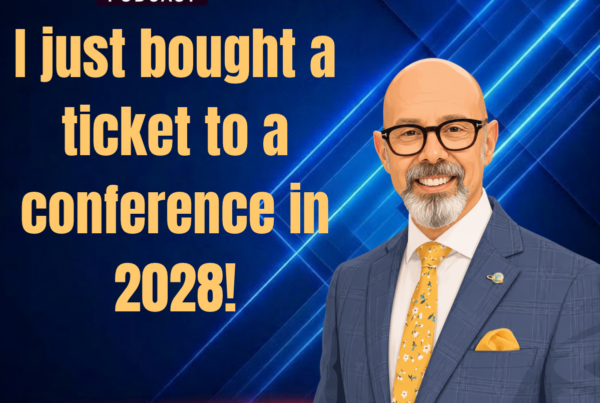
Rod McMahon – Rightsizing your business
I’ve had guests on who have scaled their businesses way up. And I’ve had some on who’ve intentionally scaled their businesses down, some down to just them. I’ve asked my friend Rod McMahon on to talk about how he’s scaled his business up, then down, to the right size for him. Listen to this episode and hear how he’s profiting more, doing less events, so you can get some ideas on how you might do the same.
About Rod McMahon
53 year-old father of 2 amazing young adults. Volunteer with Rotary International. Enjoyer of travel, fine drink and delicious food. Find pleasure in getting outdoors with friends in the Canadian Rockies. Student of the world who loves to travel and explore. Staying connected to business through my laptop and cell phone. I truly enjoy my career and it has provided the time and financial rewards for an amazing life.
Contact Rod:
Call/text 647-549-6642
#maximumDJ
Listen to this and all episodes on Apple Podcast, YouTube or your favorite app/site:
- Apple Podcast:
- YouTube: www.WeddingBusinessSolutionsPodcast.tv
- Spotify: https://spoti.fi/3sGsuB8
- Stitcher:
- Google Podcast:
- iHeart Radio: https://ihr.fm/31C9Mic
- Pandora:
Below is a full transcript. If you have any questions about anything in this, or any of my podcasts, or have a suggestion for a topic or guest, please reach out directly to me at [email protected] or contact me via text, use the short form on this page, or call 732.422.6362
Please be sure to subscribe to this podcast and leave a review (thanks, it really does make a difference). If you want to get notifications of new episodes and upcoming workshops and webinars, you can sign up at www.ConnectWithAlanBerg.com
– Let’s talk about rightsizing your business with someone who’s scaled up and then down a little bit. Listen to this episode. Hi, it’s Alan Berg. Welcome back to another episode of the “Wedding Business Solutions Podcast.” I am so honored to have my friend Rod McMahon on. Rod, how you doing today?
– Doing great.
– We were talking about rightsizing, you and I, because you’ve scaled your business, but let’s step back for everybody. So first of all, tell everybody your business name, where you are.
– Sure thing. And that gets a little complicated. The business is straightforward, it’s Maximum Music, and we’re a wedding DJ service in Toronto, but I haven’t lived in Toronto since the year 2000. So I spent 20 years on the East Coast, living in rural Nova Scotia, raising my family. And then for the last two years I’ve lived in Calgary, Alberta. So both of these are 2000 kilometers away from where the business is.
– And that was something that you and I, when we did a mastermind day up in Hamilton, Ontario, we did one and everybody else there was thinking, you know, you have to sit across the table for someone to make the sale. And you’re sitting there with a little smile on your face in the corner going, uh, I don’t do that. I don’t do that. So when was the last time you actually met a couple face-to-face?
– For a while in, you know, the earlier 2000s, I still had that mentality that you’ve got to meet with people. So we kept an office, had a salesperson and an operations manager, and we still followed that bricks and mortar model. But over time, it just realized that it wasn’t necessary. So there was a point where I pulled the plug and I started to rent the storefront of our building out to another tenant and took everything to be remote as far as sales. But that was in like the late 2000s before it was cool to not go to an office. And so I felt like I was ahead of it. When COVID kicked in, it just was no concern as far as virtual, you know? We had been virtual over 10 years by that point.
– Right, and again, you’re making the sale, you’re having conversations with people, you’re finding out what they want. So let’s give the quick history for you. You started out as a DJ and it was just you?
– It was just me. It was one of those high school things where a few buddies are using an older brother’s equipment. Everybody starts to go off to university. And I decided to keep doing it. And you know, still following that traditional model, in rural Canada, nobody runs a full-time DJ service. So pursuing education, started working with a high school dance company that did video dances all across Canada, and did sales for them. And they were moving their head office from Halifax, Nova Scotia to Toronto, Ontario. I went with them and within the first year, my wedding business went past my salary. So it’s, you know, 1994 and I’m like, all right, this is full-time. And never looked back from that point. I guess the interesting thing is I haven’t been an active DJ since the year 2000. So through the ’90s I was hustling to build the business, but then kind of stepped back to run it remotely and focus on raising a family and that sort of thing. So yeah, I haven’t been an active DJ for a very long time.
– Right, and at your peak, how many weddings were your company doing a year?
– We were into that 700, 750 weddings, you know, 15 to 16 on a Saturday night full-time. Two full-time operations people, the van, the warehouse, the office, everybody was making money except me.
– That’s actually a common story with some of my other guests and people that I speak to, is that you grow to a certain point where the gross looks really good, but the net is worse than when you were smaller. So now you’ve brought that back down to how many weddings a year would you say you’re on target to do and you’re looking to do for next year?
– This year we pretty much got the numbers. So for 2022, we’ll clock out with about 250 weddings. And with us it’s weddings. I mean, of those events, there might be 10 or 15 that are just those odd things that come through the door. But we decided to tailor and to focus the website and the marketing and everything to be wedding experts in a world where most DJs want everyone’s business. You know, we’re corporate, we’re AV, we’re photo booths. We just, you know, we don’t do big light shows or big sound systems. It’s very simple wedding music.
– Yeah. It’s something I spoke about. I just came back from a speaker’s conference and speakers were always enamored with my niche because it’s so narrow. And they said, you know, your niche is an inch wide and a mile deep, and what it allows you to do, this was a conscious decision of mine, like a conscious decision of yours. By focusing on that you put the blinders on and say, yes, there’s other business out there, I’m not concerned with it, and I get to grow my business instead of scattering all around. And just like you, occasionally somebody comes to me outside of the wedding and event industry, says, “Could you help me with something?” If I’m the right guy, yes. If I’m not the right guy, no. I’ll have somebody for you there.
– And your market, oh, sorry. Your market is international. You are the person, you’re the brand, you can travel. With wedding services, you tend to have to be local, and fortunately being in Toronto, we need a very small percentage of the market.
– Right, right. But again, what’s beautiful here for everybody listening, is here is Rod not sitting in his market, running a business, not doing the production work, right? So think about this, if you’re a photographer, if you’re a florist. It’s different if you’re a venue, the venue’s going to be in that particular area. Yes, you could run a venue from outside, you don’t have to cook, right? You don’t have to set the tables and things like that. So for those of you that are thinking about your next step, your transition as you’ve been in the business for a while and saying, you know, ’cause you know Rod, there’s some guys that are like, “Oh, I’m 40, I can’t DJ.” Like, um, hello. We know people in their 60s that are killing it out there. And the same for some of the other things. There is a business model like this where you don’t have to be out there every Saturday night doing that and have a successful business. So when was that transition for you? When did you say, okay, I’m just not going to DJ anymore?
– That was the physical move to Nova Scotia. So when you leave your market, so that’s 23 years ago now, and it’s never looked back. And from a sales perspective, I find it very easy to always speak about how great their DJ is. So someone in our industry, and I don’t want to misquote it, but they referred to the Diana Ross and The Supremes, like there’s the headliner, which is the guy who owns the DJ company or the lady who owns the DJ company, and then there’s everybody else. Whereas I can take a sales approach of I do what I do best, which is, you know, keeping the details organized and finding their songs and being their point of contact. And the DJs get to do what they do best, which is rock the party. So my perfect DJ is, you know, mid-30s to early 50s, technically a really good DJ, but someone who grew up and they got a mortgage and they got a career and they don’t want to run a DJ company, but to get paid really well to go out on a Saturday is a perfect side hustle for them. So I’ve become a great place for DJs to move into as they tire of the clubby scene.
– And also not wanting to do the advertising, the marketing. Do many of your DJs have other jobs?
– All but two or three.
– Right.
– It’s amazing, I’ve got an at home dad. So Monday to Friday he’s looking after the kids. Friday night, Saturday night, he goes out and makes what he feels was the equivalent of a week’s work.
– Right. Curious any of your people, teachers?
– I don’t, and I’ve heard on other podcasts, the teachers make great DJs. I think the Canadian DJs get, or teachers, get paid a little better.
– They don’t need the side hustle over there.
– I’ve heard that the American model, that’s it’s, but it’s a real diverse crowd and there’s a good number of women. So because we don’t do a big production, we’re just two speakers and a DJ controller, it’s very accessible. We’ve had great success with a lot of female DJs, especially with the, you know, the size and weight of speakers coming down, the venues within in house sound systems, it’s been great.
– So if somebody wants lighting, you just refer it out to another company?
– We have very basic lighting, but we don’t push those. I mean, again, you talk about, you know, unique selling positions and differentiating, and I’ll digress. Having been to your workshops and seeing you speaking in Vegas, there’s always something different. So wherever you’re at in your trajectory with your business, you can see a presentation and pull different nuggets out of it. So I’ve done that a few times with you where it’s like, okay, what will be relevant this time? I think I may have digressed and gone off topic. What was the question again?
– Well, talking about, you know, you’re not doing the lighting, you’re not doing the photo booths, you’re not doing all those things. You know, again, that’s a conscious decision, right?
– And I take the approach because I’m doing all of our sales that, what is best for you and what will give you as the couple the best outcome? You know, are people going to go to brunch with you on Sunday and say, “That was the coolest light show and the deepest base I ever heard. Too bad the DJ sucked.” You know, like said no one ever. So whereas most DJs want to bring someone into a showroom, upsell lighting and photo booths and interactive things, I’m telling couples that they don’t need that. And it’s amazing how many people that resonates with.
– But if they do want it, somebody else can do it.
– Someone else like, it tends to be a bit of a package. So when I talk about our ideal client and what I’ve done over the last 20 years, projects to figure out who is our ideal client, where do they live, what do they do, what do they listen to? We have a lot of, well, all of our clients don’t want a entertainer. They don’t want a DJ who’s going to come out in front of the booth. You know, we may facilitate some announcements and do some light master ceremonies duties, but we’re not going to be taking over the evening. And fortunately, that’s counterintuitive to the message that most of the other DJs are giving a couple. So if a couple chooses to talk to three companies, they’re going to have two that are talking about photo booths and MCing and sound systems and gear. They’re going to have me talking to them about DJ, who’s a team player, who works with your officiate and your photographer and your caterer, and keeps it smooth and makes sure that the maid of honor doesn’t sneak out to the washroom just before her speech. And those things resonate with the couple and they start to truly see that we do understand weddings and we’re not about the production in the show. And I think, you know, I know you like to give takeaways and give people different ways to look at things. I feel in the DJ industry and maybe in other parts of the wedding industry, there’s too much focus on the stuff. Like, look at my camera, look at my DJ speakers.
– Right. Well, it’s really the experience, and that’s what you’re talking about is the experience. But the other thing that you mentioned, again, if people miss this, you know, you’re in a market, Toronto, which is a big market and even 250 weddings a year, which is a lot of weddings, is a tiny fraction, ’cause I think it’s the fourth largest city in North America. So the people that want something different, the people that want a big light show, the people that want to have, you know, two band teams, the people that want to have live musicians and all these other things, which you can have, if that’s right for that couple, you’re not the right fit and that’s okay because-
– It is okay.
– It’s okay, yeah.
– And I did used to be that guy who wanted everything. So if it was an off night or a Friday or less hours, I would negotiate or take a bit off the pricing and now, you know, and I don’t mind sharing, we charge 1,975 Canadian for a DJ with two speakers. That’s it.
– What is that, like $200 US these days?
– That’s about right. It’s about the equivalent. It’s become a fair price. So, often with couples they’ll say I’m in the middle. We called three people. There was one more expensive, there was one less expensive. So I’m not losing people on price. If I lose someone, it’s usually it has to do with we really wanted a photo booth and the other company would include that.
– That’s fair. I take that.
– Right. And again, that’s okay. Again, that’s something you chose not to do and that’s important. Everybody listening here, you chose not to do that. It’s like, I chose not to have anybody else on my team. If you’re going to get someone to train, I just got off a call with someone, I’m going to do a remote training call for her team, she wanted me, she wasn’t looking for somebody else, she wanted me. So it sounds like you charge the same price for all of your DJs, right?
– Yes, there’s no one who’s better or worse, and they don’t get their DJ assigned when they book. I do that about four months before the wedding.
– Okay. And you’re explaining that up front to the couple. Let’s say you have multiple DJs available. How do you decide who gets it?
– It’s not an exact science. It’s, for me, 35 years of gut feeling and trying to make good notes when I’m on a phone call with them to suss it out. You know, we have multicultural weddings. I would say we’ve created a niche doing fusion weddings where if both bride and groom are Greek, they’re going to get a Greek band and it’s going to be a Greek wedding. But when you’ve got a Greek bride and a Caribbean groom or, you know, a Greek bride and you know, some sort of rural Canadian, country music loving, they can’t hire one niche. They have to find someone who can pull it all together, share time. So we’ve really created a niche in fusion weddings of cultures and ages, and people seem to like that.
– And Canada is quite the melting pot, so. And Toronto itself is quite the melting pot.
– Well, it’s not even a melting pot. I think, you know, again, the American model is you come in and you all melt and you become American. And in other countries, and I know Canada fits this, we don’t want to, so they stay very Greek, Italian, Portuguese, they’ve got their communities. They really keep their identity. So they don’t melt here as much as maybe they do in other parts of the world.
– Probably the wrong phrase. There’s just a lot of different cultures. So I grew up in New York City in a county called Queens County, one of the five boroughs in New York, which I heard is the most ethnically diverse county in the entire United States, that one county. And literally drive down the street and look at the signs on the stores, and three blocks later their a different language and three blocks later their a different language. It’s like that. So how many different DJs do you have access to then?
– I would say my list is 20, and at the most this point we’re doing eight weddings, which is almost uncomfortably too many.
– But you used to do how many, what was the high point?
– 15 or 16.
– 15 or 16 on a Saturday night. You’re doing half of that and you’re almost uncomfortable with that now, but you’re profiting more than when you were doing-
– Oh yes. Oh yes. Yeah. You know, finally I see a retirement horizon.
– Did everybody hear that? Everybody hear that? This is what rightsizing is all about. It’s not about just more and more and more, more, more. It’s about finding the sweet spot in your market, in your profit where when we do X, we’re profiting the way that we want to without the headache, like you had there Rod, with twice as many people out there. I have a speaker friend, same thing. He reached this milestone, which let him get into a certain group and when he was grossing half of that, he was profiting more. He had bragging rights, but bragging rights don’t send you to retirement. Bragging rights don’t send you on holiday.
– Yes. Again, how many people in the DJ industry can leave and go to Europe and East Africa for the entire month of July?
– Right, right.
– When you’re the only employee full-time in your business. So I was working remotely for the entire month of July. And then everything came off without a hitch. Again, you know, to give some takeaways, if I could talk to 20 year old me, find a mentor, find people. Go to the conventions, meet people, do training. Don’t get caught in that trap of bigger is better. Don’t get into that trap of, you know, if you’re going to have a storefront or something, own your business the sooner, or own your building, the sooner you can own your building-
– Right. This is the business of weddings, not the doing weddings.
– The art of weddings, yeah. The art of weddings is the creative.
– And people looking from the outside and every time, again, this speaker conference I just came back from, you know, they say, “Oh, so you love doing weddings?” I said, “I’ve never done a wedding.” I’ve never done a wedding, I don’t want to do a wedding. That’s not what I do. I want to help the people that love doing weddings to have a better business so they can profit more and retire and, you know, travel in East Africa for the month of July and do what you want. This is a business now. And another thing to tell your 20 year old self, you know, don’t follow the next shiny object piece of equipment. And there’s some other podcasts I’ve done here where I’ve talked about, short story, somebody called me and said, “Hey, do you think I should buy two flat screen TVs?” And I said, “Why?” And he said, “Well, all my competitors have them.” I said, “That’s the worst possible reason for doing something.” Don’t price yourself based on your competitors. Don’t buy what they have ’cause it could be sitting on their shelves for all you know. Let’s find a way to streamline it and streamline the profitability. And if you decide to increase your volume, each event is that much more profitable. And that’s really the key is work on the profitability first, then work on the volume. Somebody called me one time up in Boston, they were doing 200 weddings a year and they said they want to do 500. My first question is, “Why?” That’s the first question is, why? Somebody in Dallas, “I want to do 250 weddings.” And there were just two guys in this company. And I said, “Why?” And he said, “Well, I’ll be seen as a bigger player on the market.” I said, “I want to feed your family, not your ego. So let’s work on that part of it.” All right, so a couple last things. We know what you would tell your 20 year old self there, but how would you coach somebody, give some tips in terms of finding that right size, finding that sweet spot? What should they be looking for?
– I applied profit first for the accounting. And some people will know, other people might be surprised, but if you go find-
– It’s a book.
– “Profit First.”
– Right, Mike Michalowicz is the author. Definitely buy that book.
– And he’s been a DJ, you know, Vegas presenter and stuff as well over the years. I started to apply that principle in 2018, 2019. Thank goodness I was applying it back then before COVID kicked in. And that really opened my eyes to my expenses column versus my owner’s compensation. So my operating expenses. And so, you know, to pick just numbers out of the air, you know, if you have a $250,000 a year business and you can keep 150,000 of that, that’s a darn good business. If you’ve got $1 million business, but you’ve got trucks and people and gear and you know, you might only take home 75,000 and you’re working more hours. It’s just mind boggling. I recommend figuring out what you need and then scale based on how you can pay yourself first.
– Yeah, if you haven’t read that book, what Rod’s talking about is different bank accounts. One of them is called Profit. And I’ve mentioned this before. My wife said the refrigerator was going and I said, “Which one do you want?” And she pulled it up and I said, “Hang on a second.” I went to my phone, went to my bank app, looked at that account and said, “Go for it. Go for it. It’s there. The money’s there.”
– October 1st, I just gave myself $2,500, which is half of what was in my profit account.
– In the profit account. Right. And you leave some in there because that’s part of that book, we’re not going to spoil it for you. And Mike’s got other books there, Mike Michalowicz, “The Pumpkin Plan” and some other ones which are also helpful there. So the takeaways from this in terms of rightsizing is, it’s easy to look and say we need to be bigger, bigger, bigger, bigger. But if you’re not watching that bottom line, if you’re not watching that profit, you’re going to miss the fact that bigger sometimes isn’t better because the bottom line is going to be worse. And you’ve been there, I’ve been there. Rod, thank you so much for sharing your thoughts on this and then the selling remotely again, he was ahead of the curve folks. He was doing this decades before it was popular. You don’t have to be face-to-face, you just have to be able to have a conversation with someone. That’s really what it comes down to. So Rod, thank you-
– We need to win with confidence.
– Thank you so much for sharing this. I can’t wait to see you when I’m up in Calgary next month. It’s actually going to be next month now, which will be probably around the time this comes out. Maybe before, I have to see when the timing of that is. But thanks so much for joining me. Thanks everybody for listening and we’ll see you on the next episode.
I’m Alan Berg. Thanks for listening. If you have any questions about this or if you’d like to suggest other topics for “The Wedding Business Solutions Podcast” please let me know. My email is [email protected]. Look forward to seeing you on the next episode. Thanks.
Listen to this and all episodes on Apple Podcast, YouTube or your favorite app/site:
- Apple Podcast:
- YouTube: www.WeddingBusinessSolutionsPodcast.tv
- Spotify: https://spoti.fi/3sGsuB8
- Stitcher:
- Google Podcast:
- iHeart Radio: https://ihr.fm/31C9Mic
- Pandora:
©2023 Wedding Business Solutions LLC & AlanBerg.com