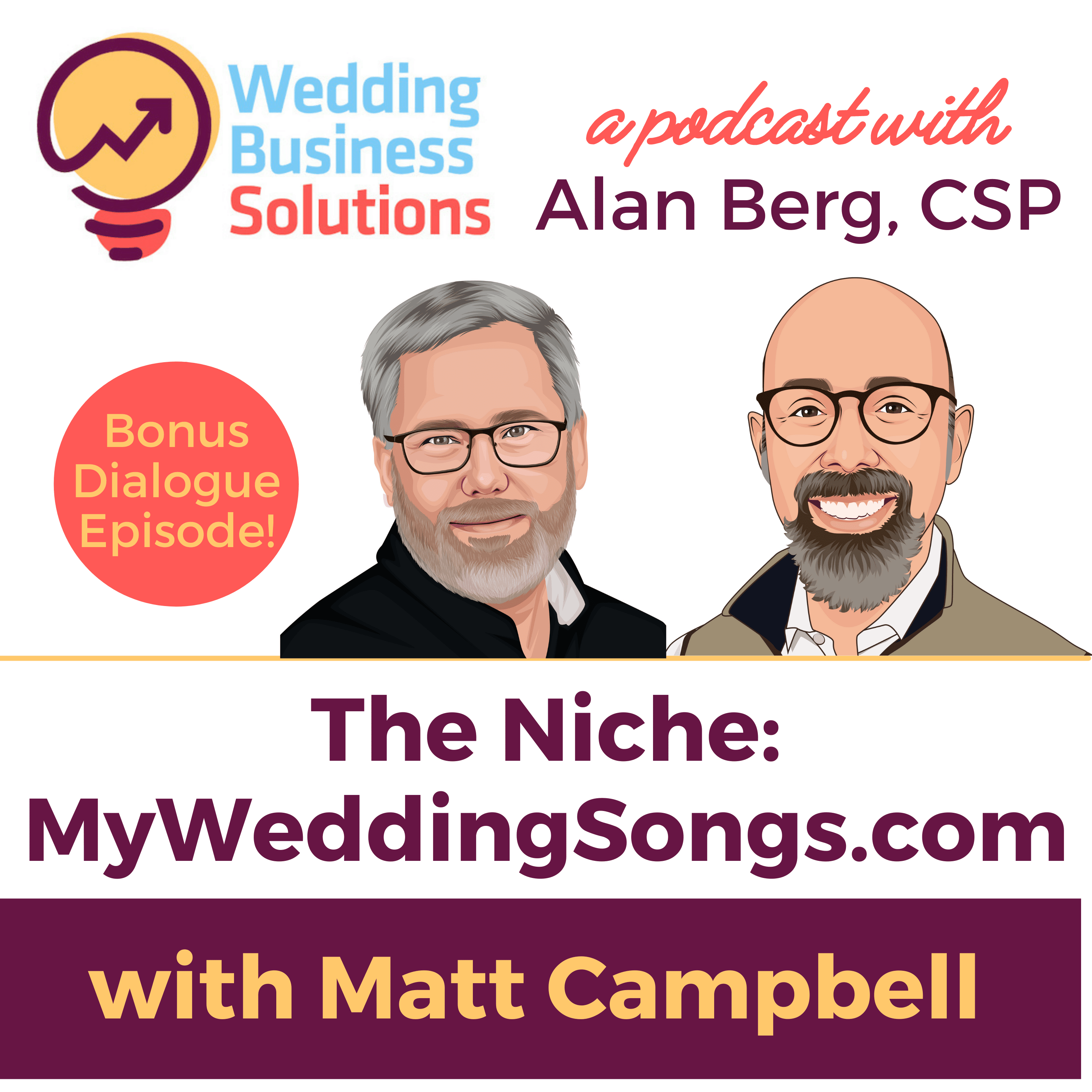
 Matt Campbell – The Niche: MyWeddingSongs.com
In my series on The Niche I come across so many interesting people with even more interesting niches. I’ve known Matt Campbell for a few years but I never really understood what he did, or what his business model was. In this episode you’ll hear how Matt combined a knowledge of SEO (Search Engine Optimization) to create a business that brings him income without having to deal directly with his customers… and it’s working while he sleeps.
Matthew (Matt) Campbell is the owner of My Wedding Songs. He has written for Rolling Stone, Mobile Beat Magazine, and DJ Times. Matt hosts the Wedding Songs Podcast and is the author of the Wedding Music Playlist. His work has been referenced in Forbes, The Knot, and Style Me Pretty.
Books Matt Mentioned on the podcast:
- Play Bigger – https://amzn.to/3lui0DZ
- Blue Ocean Strategy – https://amzn.to/3in3CeJ
SEO Tools Matt mentioned on the podcast
- Ubersuggest – https://neilpatel.com/ubersuggest/
- Google Keyword Planner (part of Google Ads) – https://ads.google.com/home/tools/keyword-planner/
- MozBar for Chrome – https://chrome.google.com/webstore/detail/mozbar/eakacpaijcpapndcfffdgphdiccmpknp?hl=en
- Yoast SEO – https://wordpress.org/plugins/wordpress-seo/
- Google Analytics – https://analytics.google.com
- Bonus tool! Screaming Frog – https://www.screamingfrog.co.uk/seo-spider/
If you have any questions about anything in this, or any of my podcasts, or have a suggestion for a topic or guest, please reach out directly to me at [email protected] or visit my website www.AlanBerg.com
Please be sure to subscribe to this podcast and leave a review (thanks, it really does make a difference). If you want to get notifications of new episodes and upcoming workshops and webinars, you can sign up at www.ConnectWithAlanBerg.com
Listen to this and all episodes on Apple Podcast:
Watch this and all episodes on YouTube: www.WeddingBusinessSolutionsPodcast.tv
Below is a full transcript. If you have any questions about anything in this, or any of my podcasts, or have a suggestion for a topic or guest, please reach out directly to me at [email protected] or contact me via text, use the short form on this page, or call 732.422.6362
Please be sure to subscribe to this podcast and leave a review (thanks, it really does make a difference). If you want to get notifications of new episodes and upcoming workshops and webinars, you can sign up at www.ConnectWithAlanBerg.com
– So when I was thinking about my series on “The Niche” this next guest came to mind immediately because he’s got a very unique niche, and you’re going to want to hear this. Welcome back to another episode of the “Wedding Business Solutions Podcast,” and my series on niching your business called “The Niche.” And I have a good friend on here. He’s got a really unique business. Matt Campbell from My Wedding Songs. Matt, how you doing today?
– I’m great, Alan, how are you?
– I am well, thank you. When I thought about this series of “The Niche” you came to mind immediately because a lot of people they do specialize kind of stuff, but yours is a very narrow niche here. So what is My Wedding Songs?
– My elevator pitch is My Wedding Songs is a free source for couples to help them plan their wedding songs, but not only for couples. Of course, we get a lot of wedding planners, a lot of DJs trying to get music ideas as well.
– Okay, and what’s your background? How did you come to that?
– Everybody asks that, why weddings, why music? So in the ’90s I was a wedding DJ in Montana. I’ve DJ’d over 100 weddings from ’93 to 2000, and moved to Vegas in 2000. And when I did that still had the love of weddings and music, but didn’t want to restart everything again. So I started a broadline wedding planning website that was competing against the big guys, and realized that 80 to 90% of our traffic was going to the song list that I was creating. So then we flipped the script in January of 2017, and rebranded to My Wedding Songs. And since then just explosive growth.
– So people listening here, you follow the audience, right? You created a site, and most people listening know my background. I was vice president of sales at The Knot. I published two wedding magazines before that. I consulted wedding websites around the world. It’s really hard in the U.S. to compete with WeddingWire and The Knot because they’ve been around longer. They’re really big. They’re really good with their SEO, and the other stuff that they do, and people would come to me all the time when I was there, and say, oh, I got this site it’s better than The Knot, or it’s better than WeddingWire. I’m like, okay, well, where’s your audience, right? Because if you don’t have an audience, you don’t have anything to sell because that’s what they sell. Just like newspapers sell audience, billboards sell audience. So following your traffic to they love the songs that you’re putting up there, you said, well, let’s forget about this other stuff. And this is what the niche is about is not trying to be everything to everybody, but trying to be the thing to people, and enough people that it makes sense. So you had this site, it was wedding planning. You cut it down to the songs, My Wedding Songs. What’s the business model, right? What’s the business model? Because you have the songs up there. You don’t have advertising, right?
– I do, that’s my main source of income is advertising. We’re part of an ad network. And so just getting eyeballs to the site is the main source of money.
– Right, and that’s what people are doing on social media. That’s when you hear about all these social stars, they’re getting the views. And then there are businesses that want those people that are doing the views. In your case, it’s people that are getting married, and, therefore, there’s a lot of people that want those people I’m sure inside and outside the wedding industry, right?
– Correct. Yes, we have over 600 curated song lists on the site. So, yeah, I don’t want to write all about wedding songs all the time, so it’s very broad, yes.
– But, again, it’s called myweddingsongs.com is the site, but when people are Googling and finding you, because I imagine that’s how they’re finding you, they’re going to specific song lists, specific content, right?
– Exactly, so as an example, if you Google Taylor Swift love songs, we’re going to be in the top two positions. So then they’ll go directly to the Taylor Swift love songs song list.
– That’s great, that’s great, so you have all of these. Now before we started recording, you dropped a little nugget on me that creating content, you’ve created an awful lot of content, and I’m sure you have to update, obviously, whatever the top songs are, but there’s gotta be a lot of evergreen content, right? Stuff that just it’s always going to be good, but maybe needs a little tweak. So is that a big part of your traffic as well?
– Very much so. So the evergreen, what I consider is our core wedding song list it’s about 50 songs those get updated, a lot of them monthly, at bare minimum annually. And then just to backtrack just a little bit. So when we had all of this content for wedding planning one of the things that happened was we had over, let’s say 1,000 articles on our site. 250 of those articles were strictly for wedding planning, totally deleted 250 articles from our site. Nothing happened because all of our traffic was going towards those song lists. So, yes, Google always wants the freshest content, and to compete against the big guys that you mentioned, you always have to compete against them, “Brides,” The Knot, WeddingWire, even Columbia Records. There’s a lot of, like you said, big guys out there.
– And SEO is something that you have become an expert in. You have gone through my site and helped me with that. And you and Brian with my title tags and my meta-tags, and all the stuff that I don’t want to know about, all the backend stuff there. So what are some of the tips that you’ve learned so the people listening are everything from venues, and caterers to photographers and videographers and DJs, and officiants and invitations and limousines, and you name it. What are some of the things that you think people should focus on? Because you could get distracted with little shiny objects, and stuff out there. What is the stuff that has the most impact?
– First and foremost user experience. You have to answer the questions of your potential customers. No matter what industry that you’re in, even in my industry, if somebody is looking for processional songs, you better have the processional songs there. You better have current songs, you better keep it updated. It’s all about that user experience. And just to find out how you’re going to rank against these people, you just Google that, and see what other people are doing as well. Even though you may be at the top, people are always trying to overthrow you, and will overthrow you. And then so you figure out, okay, what are they doing? So one of the things I notice even in my space is a lot of people are adding clips of lyrics to the pages. So, okay, now we’re going back and adding those clips because that’s what we’re saying the user experience. If you can keep them on the site longer, you can create more engagement. It’s all about that user experience. And Google is looking at all of that stuff.
– So recent content, like you said, updated content. If you have not touched the content on your site, Google they just stopped coming back and indexing because they figure, hey, it hasn’t changed in the last six months, it’s not going to change?
– Correct. I can’t tell you how many businesses that I’ve talked to. Oh, we have this shiny new website we just launched a year ago. Great, what have you been doing since? Well, yeah, that’s why your traffic is going down because you haven’t done anything.
– Right, now there’s also lots of discussions about what’s behind the scenes on the coding, and what’s on the page, which one is more important?
– Both, you have the technical end of it. And then you also have what the visitor sees, and both are extremely important. I would say more so I’m going to start with the user experience. Of course, you have to make sure your website’s crawlable, that Google can find you, and all that technical stuff, but you’re looking at what is on the page, but then also the title tag and the meta description. That’s what shows up on Google search results. Are people going to click you? Because Google is looking at that as well. If you’re in the first position, and nobody’s clicking on you you’re going to fall. Whereas, potentially, if you’re in position three, and you’re getting more clicks than the people above you, potentially you can move up.
– Right, so for those of you that don’t know what Matt’s talking about if you go to a browser, and you have a bunch of different tabs open, and if you look at that tab up at the top what does it say, right? If you hover your mouse over that what does it say about you? And if it doesn’t say much, then how are you going to be found? So in the backend, back in the old days, which is probably like five years ago, people used to throw a lot of code into the back that wasn’t the title tag, wasn’t the meta tag, but wasn’t on the page. Google’s paying more attention to what’s on the page that can be seen by the user these days, correct?
– Correct.
– Right.
– You never want to have content, or code that’s on the page. I don’t know what the technical term is, but you never want to hide anything from the user that Google sees because that could be very detrimental to your website.
– Right, it could actually make you come up lower in the ranking as opposed to coming up higher, which you’re trying to fool the search engine. And what you said about the user experience what are people looking for? What do you do that helps them, solves their problem whatever it is? And when I said I don’t pay a lot of attention to SEO, other than the technical stuff you did it’s because I just write to my audience all the time. I mean, that’s what I do. I just write to my audience. What I’ve done with the podcast here is I put the transcripts of these conversations on the website. And since we’re talking about things that are of interest to my audience, all of these words that we’re saying are going to be on the site. They’re going to be on my blog, which is that fresh content, but then again, there’s the evergreen content. There’s things that people will need. Let’s face it in the wedding industry, what your couples need this year if you are a fill in the blank, a videographer they need next year. So what are some suggestions on how to tweak that? How much do you need to update that for Google to say, hey, this is still relevant content.
– I would be looking at it and updating it at least once a year, probably every six months, but my big tip for everyone today, don’t write articles just because you think that’s what your potential customers want to know about. I would do a Google search for whatever topic, let’s say, limousine. So you own a limousine company, and you are based in Detroit. So you can just Google Detroit limo services, okay. And then you go through the Google search results. And then inside of that Google search results is a section called People Also Ask. And that is a goldmine of content for your pages. And you go through that and you can click on each one. It will start with four, five, or three, whatever it is, but as you click and open up each one more questions will come up. And then so by the time you’re done, there’s potentially 20 questions that actual customers are already searching for on Google. Don’t try to figure out what they’re already asking. Google is telling you what they’re already asking.
– And this is on YouTube as well, right?
– It is on.
– Because when you type in a question, or something on YouTube, it’s making suggestions and those suggestions are, well, Google owns YouTube, right?
– Yes.
– So it’s the same idea that those questions that are already being asked.
– Right.
– Are the things that you want to help answer. I tell people when you’re looking at analytics, you have to know what you’re looking at a little bit because people see numbers, and then they make decisions based upon numbers that they really don’t know what they mean, like bounce rates and things like that. I have a blog post from, I don’t know, five, six years ago, that is always in my top 10 pages viewed. And I’m getting no business from it because they’re not my audience, but it’s what’s your one, three, and five-year plan?
– Right.
– And people are Googling I need a one, three, five-year plan because somebody told them that, or they read it in a book. And I wish I was getting business from this, but I’m getting a whole lot of traffic that doesn’t stick around very long. And the bounce rate on that page is like 97%, or something like that. And for those of you that don’t know that we just geeked out on you here. When someone goes through a site like you’re a user, you go to a web page and then you leave. You don’t look at any other page. You don’t click on anything else you just leave. You’ve bounced that’s all it is, you just bounced. A bounce is not necessarily bad. That’s actually one of my other podcasts, Matt, was basically the three things that you really need to know on Google analytics. And I don’t care about my bounce rate. I care about my calendar and my P&L. If my calendar is full and my P&L looks good, profit and loss statement looks good, who cares how many people are bouncing off my site. It’s when you’re not getting the business, not getting the traffic, then you want to say, hey, am I getting the wrong traffic and stuff like that, so, but let me get back into it. We’re going to talk about two things here because you’re so good with SEO, but the idea of this niche. So how do you decide what’s the next content to put up? You have so much content there already. And I know that you said you work on, oh, I’m sorry. Let me go back to one thing we’ll come back to this. How much needs to be new when you update that page for Google to say this is new now, or this is fresh now, instead of, uh, it’s the same one?
– Great question. So the goal would be at least 100 words that’s different.
– And not just juggling words around, right?
– Correct.
– Just adding 100 new words.
– Correct, adding, or maybe you’re rewriting existing words where you’re saying, okay, these few paragraphs that doesn’t really pertain to what it is in 2021 or 2022, let me just totally rewrite that content.
– Okay, and I’ve been going to my site lately, removing all my COVID related content, updating, putting new videos on. And one of the things that I always add is I add new testimonials. Like I’ll update my testimonials because that’s text, right? Google doesn’t look and say, oh, that’s testimonial text versus what Alan wrote. It’s just text, right?
– So I just want to make sure that people understand that you’re not copying that testimonial from other platforms. So not from Google reviews, not from Facebook reviews, not from WeddingWire reviews. It’s gotta be original content. It could be a letter. It could be a personal note because you never want to duplicate content from other websites.
– So if I took one sentence that was posted someplace else, and put that that’s bad?
– One sentence is not going to kill you. When you’re doing whole paragraphs that you’re copying that’s bad.
– No, no, so people listening will have heard some of my other stuff. I want you to put speed bumps on your website of these testimonials, single sentences. And if you pulled these from all different places, WeddingWire, The Knot, Facebook, Google, but you’re only pulling a sentence out. And then adding the attribution of who wrote it, the city and state, or the venue, city and state, that’s going to look fresh. And I don’t want you to taking the whole paragraph because nobody wants to read it, first of all.
– Nobody will read it, frankly.
– Nobody will read it, and you want them to read it because they’re saying things about you that other people can’t say. I mean, that nobody’s saying about you, that’s your brand. So at least 100 words that are different. You can rewrite what’s there. You can add something there. If you think about what 100 words is. If I was to take five testimonials with the attribution, and swap out for five new ones on a page, there’s 100 words, I mean.
– Yes, that’s one way to do it, but I would try to make it content that is beneficial to the reader, not just the testimonial.
– Okay, right, and this is a challenge, and it’s going to be a challenge for everybody listening, because how much is there different about what you do for your audience this year versus last year? I give a warning, a caveat to people. If you’re not trying to get business from search engines, because you’re getting enough leads from WeddingWire, or The Knot, Facebook, Instagram, et cetera, SEO doesn’t really play because SEO is search engine optimization. The user experience matters no matter where they came from. So Matt said this already, and if you didn’t hear it, if you didn’t get that point, the user experience is first. It’s always first. SEO doesn’t come first that comes first. And, Matt, you and I have seen the sites where SEO comes first, and they kind of read like Rain Man wrote it.
– Right.
– I had one, I was in Philadelphia at this venue, and I’m reading their site, and it was, if you’re looking for the best catering in Philadelphia, then you need Philadelphia’s best catering because people in Philly who are looking for catering. And this 25, 26-year-old kid sitting next to me, and I looked at him and I said, Hey dude, do you speak that way? Is this the way you talk to people because your brand has a voice, and I’m pretty sure that’s not it.
– And don’t get me wrong. That worked seven, 10 years ago.
– Yes.
– But Google is getting smarter.
– Yeah, and people are getting smarter because if they get to your site, and that’s the way it reads, they’re not hearing about themselves. They’re not feeling like you can do what they need. And it’s hard to read that text. It’s just really cumbersome to try to read something with it’s just stuffing keywords in all the time. So let’s get back to the new content on your site. You’re updating the content that you have there, but you’re also adding new content. And what’s your decision process as to I need new content, or what that content might be?
– I’ve really changed over the last year just because Google is focusing so much on fresh content. And I read an article recently that’s talking about the billions of articles that are going to be written over the next year, and how Google is going to decipher all of this content. It’s just mind-numbing the amount. And now we’re getting AI and now we’re getting articles written by AI it’s just incredible.
– Artificial intelligence for those of you that don’t know what that is. And so articles that are actually written by a computer based on an algorithm of something.
– Yeah.
– Wow.
– It’s mind-numbing. So that’s why we’re talking about making sure your content’s unique. You’re helping that visitor out. Like Alan said, okay, maybe we have an 88% bounce rate on our number one page, but they’re there nine minutes.
– Right.
– Okay, that user experience tells me that you’re answering that. So I’ve really focused on, so getting back to writing new articles, the number one thing that we always do is keyword research. This call is definitely way shorter then we have to talk about keyword research, but always start with what people want to know about, and what people are already searching for because you don’t want to just say, hey, I’m a limousine. I’m going to write about great limousines. Well, is that really going to be a benefit to your reader? Are people searching for that? So definitely keyword research would be a place to start.
– Now I had read something a while back about people search in questions, right? Like how do I, or what are the best wedding songs, or whatever. I’ve done this on a bunch of pages on my site where my headings are actually the question. And then the content is answering that. Is that still a good thing?
– It’s very good, yes. And then what you would do is answer more questions as you’re going down within that main question as well.
– Right, within the content itself there.
– Right.
– And this is where an FAQ page that is written well. Again, it has to be written well, if you ask the question that your customers might be asking, they might find that. Getting back to bounce rate. So my site has a very high bounce rate for a simple reason. I’ve siloed content about specific topics onto individual pages, as opposed to cramming all the content onto one page. So if I had exactly the same content, but it was all on two or three pages instead of on eight are my eight separate pages that are specific topics, is that going to rank higher?
– That’s interesting. So I would look at the results for that. A great example is I just republished R&B father-daughter dance songs.
– Wow.
– So, okay, that’s very specific that’s the micro. The macro would be father-daughter dance songs.
– Right.
– So now when somebody searches for R&B father-daughter dance songs, which gets a lot of searches, so we’ll rank number one position, let’s say number one position for our R&B father-daughter dance songs, but then the number two position will be the father-daughter dance songs. So now we have two positions on the top of the results.
– Right, and that micro versus the macro is the long tail of searching, right?
– Correct.
– So those of you that don’t know, there’s a book called “The Long Tail” and the idea very simply, if you looked at the top songs that are played, you’re going to find Taylor Swift, and some of these other people that are just way, way high up, but then if you look at all of the other songs that get these ones and twos and three plays that line if you’re looking at a graph, that line goes on and you can’t see the end of it because there’s just so many songs out there, millions of songs that get a little bit, and it’s the same thing with searching. More people search for father-daughter dance songs than R&B father-daughter dance songs, which is why you’re coming up both there, but the people that search for R&B dance songs, it’s like you can own that.
– Correct.
– Because you’re up there. And the competition is going after father and daughter dance songs, not specifically R&B father-daughter dance songs. I would bet that your conversion on a page like that is better because it’s a more specific thing. And that’s what I did. So there’s one page for website reviews, and business consulting. There’s one page for speaking, one page for sales training. And I put a contact form on that page. So you land on the page, find what you need, fill out the contact form, email me, text me, call me, whatever, and leave you got what you needed you leave, and you’ve bounced, but you’ve also done what you and I want.
– Exactly, and then you, what we call silo. You silo, let’s say you have your speaking page, so then you would have your speaking tips, and everything that’s related to speaking all interlinked all within that silo.
– Right, and so I use a lot of tabs and toggles on my pages. Those of you not familiar, and certainly, if you’re not watching on video, if you think of the file folders that you put into a filing cabinet, they have the little tab with the name is on the left, and then it’s a little bit over, and then it’s in the middle, and then it’s on the right. Well, there’s a feature on websites called tabs where instead of having to scroll down to get that content it’s behind. So, Matt, content like that, if it’s not the first tab, it’s the second, or third, Google is still reading all of that?
– So we have your goal is every page on your site, that’s important to you should be no more than three clicks from your homepage.
– Right, so for me if you go to sales training from my homepage that’s one click.
– Right.
– The rest of the stuff that’s on the page, you might have to click, but you’re not going to another page to see it like opening a toggle or there. If it’s in a toggle that’s closed, and those are those little plus signs that you see on a website. And then all of a sudden it opens that content when that is closed is Google seeing what’s inside of that?
– They have gotten smarter, and they have said that they are reading that information.
– Okay.
– My thing is, let’s say, like I was saying, you go to a speaking page and then you have speaking, you have a blog post about speaking tips. So now you may have a link from your main speaking page to your speaking tips page. So now we’re talking that page would be two clicks from the homepage.
– Right, so I’ve put so much content onto the pages, partly because when I look at my traffic only 30% is mobile versus most people listening who are going to be 50% or more mobile because my audience is you folks listening as opposed to brides, grooms, and others who are with a wedding, much more likely to be looking at a mobile device. So I know that I have content that on mobile, although it works fine, it’s fully responsive, works perfectly. Some of those pages are a little longer than I would like them to be on mobile, but 70% of you are going on desktop. So I’m good with that, I’m good, but the toggles and the tabs allow me to cram some more of that content as opposed to making another page, like actually going to another page. So thinking about, again, we’re thinking about niching, your niche, you are writing content specifically for your niche. You’re not getting distracted. People that are in the wedding and event industry, and somebody let’s say does weddings, and they also do bar mitzvahs. They also do quinceanera, and maybe they do corporate work. Are they better off having separate websites, or putting those on separate pages siloed the way we said on their own site? What would you think?
– So I would look at it as how much content are you going to have on those pages? So let’s say you are, let’s just say a DJ, and you have a corporate DJ brand. If it’s going to be another brand, I would separate that out into its own website. If it’s all under the same brand, and in the same, I’d have to say, unfortunately, I have to say it’s a case by case basis, just because it gets a little bit tricky.
– But if it’s the same company name, same company name, and you do weddings, and you do corporate, and you do mitzvahs, and you do other stuff there. And, obviously, you could go either way on this one, but if SEO is important to you. So getting traffic from search engines is important. A site for that company, same name for corporate, and a separate site for that company for weddings. Could those sites have a better chance of ranking higher exactly the same content, could they rank higher because there’s no dilution with those other things, or does it not matter because it’s separate pages anyway?
– I would keep it under one roof just because under one site, just because you’re having your most authority on that site. Now, as an example, if you are a venue, and you have a limo service, that’s a completely different name, or if it wasn’t a completely different name, I would change the name just because those are two totally different things.
– Right.
– And then create your own website just for the limo service.
– Got it, got it. I remember a woman who did wedding cakes, and she had a bakery, regular retail bakery, so bread and cookies, and whatever. And she asked me one year at an event, do you think I should have a separate site for my wedding cakes? And I said, well, I would. I said, you can go either way, but if you had a separate site for wedding cakes, and they linked through from WeddingWire, or The Knot, or whatever to that site, there’s no distraction of cookies and bread, and whatever else you do. And the next year I met her at another event, and it was six months into the year. And she said she had already done 50% more wedding cakes than the whole previous year.
– Wow.
– Because it was blinders on wedding cakes. Now, if you also do cookies for weddings put them on there, and donut walls put them on there, but it was all about weddings, whereas, the other is, hey, what hours are your bakery open? And can I get a loaf of bread? That’s not what these people came for. So you can certainly go either way. And I have clients that have. One site is a client of mine in Alabama. And we did what we just said here, which is same company name. And there’s a page for weddings. There’s a page for corporate, there’s a page. And we did tabs on the page. So when you go to the page for weddings, it had tabs for all the services. So DJ and photo booth and lighting, and whatever. And then when you get to corporate, it had different tabs, team building, and whatever, but DJ was still there, photo booth was still there. And we made it so that once you get to that page, you don’t have to leave that page. Contact form is on the page. Calls to action are on the page. Testimonials are on the page. And just being a niche within that company because it is one company name. And then there’s also the, hey, you never know. Somebody who is getting married who needs a holiday party, right?
– Exactly, the way to think about it, too, would be as a DJ is the customer the same for a wedding, a corporate, and a school dance? Well, not really. So if school dances are really your target market, and 80% of your business, personally, I would not have a school page on your website with the weddings and the corporate. Create a different brand. Focus on those school dances. Don’t just have a website where, hey, I’m planning my wedding. And then all of these school pictures, I’m going to be totally turned off by that.
– Right, however, mitzvahs, quinceaneras, schools, that makes sense because now you are looking at pretty much the same audience there, or at least a crossover audience. And I always advocate people in the wedding industry, they’re like, well, I’m not getting a repeat customer. You should be marketing to your former customers for their referrals, but, again, those people are working, and they work for companies, and own companies, and those companies have company things. So market to them for that, but when they’re looking for their wedding, put your blinders on and do wedding stuff there. So we’ve crossed over into the SEO world. And I’m going to have you back for that, specifically, but the whole idea, if you heard the beginning, I hope of this, where you had a wider scope, and then you narrowed it following the customers, and then go there. I’m going to give you a phrase, Matt, that was said about me in the speaking world, when I go to a conference and people say, oh, what do you speak about? They expect me to say leadership or healthcare, or whatever. And I say, oh, I speak about the business of weddings and events. And there’s that record scratch silence, like what? Right? And I’m sure you get that as well it’s such a niche, but your niche like mine is an inch wide, but it’s a mile deep, right?
– The one tip I would give for niching down would be the book “Play Bigger.” And one of the authors is Christopher Lochhead. And he’s just somebody that is a little eccentric, but that book was definitely a turning point in my business of do you want to be a percentage of the big pie, or do you want to have the whole pie to yourself?
– Right.
– You could have the whole pie to yourself. Other books like “Blue Ocean,” and all of these other books that talk about niching down. Hey, if you’re in a category all to yourself, that’s really where you want to be. Same as DJs, you’re all talking about the same, anybody in the wedding industry, you’re all talking about the same thing.
– Right.
– What’s going to make you stand out from everybody else? Like we were saying, maybe you focus on the mitzvahs, or whatever that is, then everybody in the industry knows, hey, I have a venue. I’m looking for a venue for mitzvahs. That’s this is the place to go.
– Right, and what do you want to be known for? So the whole reason for this niching series is I’ve had other people on they may come out after this, or before this. One is a wedding planner who does South Asian weddings, for 25 years, and she’s a Polish woman, right? It’s like, how does that happen? But she’s the go-to, right? I’m the go-to in the industry. I made a choice when I left The Knot 10 years ago, do I want to be a guy that speaks about sales and business, and websites and the things that I do, or do I want to be that person in the wedding, and event industry where I can bubble up to the top of that and be who is the one. And very often people come to me and say, hey, we’re having an event. And you’re our reach, right? Can we possibly have you come as opposed to, oh, they’re just another speaker and they want me, and that’s where you’re also able to charge because you’re able to charge when they want you, and not somebody.
– Right.
– Every DJ does the same thing on paper. Every wedding planner does the same thing on paper, but when they want you to do it, they have to pay your price. And that’s how I’ve been fortunate to speak in 14 countries. And all the stuff that I do is because I don’t speak about weddings. I don’t speak about this is the “Wedding Business Solutions Podcast.” I don’t talk about weddings. We talk to people that do them, talk to people that do events, but what I speak about applies outside. And I do a little bit when I’m asked consulting and speaking outside the industry, I don’t have to look for it because of the niche. That’s the whole case, so. Matt, I’m going to ask you for those books in the show notes, so I can tell everybody, because some people like, what was that book? I don’t want to have to go back. And I will put into the show notes links, and bio for you, but what is the website, again, if people want to see you?
– Myweddingsongs.com.
– Myweddingsongs.com. And if you Google just about anything related to wedding songs, this is the niche, and you’re going to find Matt on there. So, Matt, thank you so much for joining me. I look forward to seeing you at Wedding MBA in November.
– Yes, very much so. Thank you, Alan. Thanks for having me.
I’m Alan Berg. Thanks for listening. If you have any questions about this or if you’d like to suggest other topics for “The Wedding Business Solutions Podcast” please let me know. My email is [email protected]. Look forward to seeing you on the next episode. Thanks.
Listen to this and all episodes on Apple Podcast, YouTube or your favorite app/site:
- Apple Podcast:
- YouTube: www.WeddingBusinessSolutionsPodcast.tv
- Spotify: https://spoti.fi/3sGsuB8
- Stitcher:
- Google Podcast:
- iHeart Radio: https://ihr.fm/31C9Mic
- Pandora:
©2021 Wedding Business Solutions LLC & AlanBerg.com