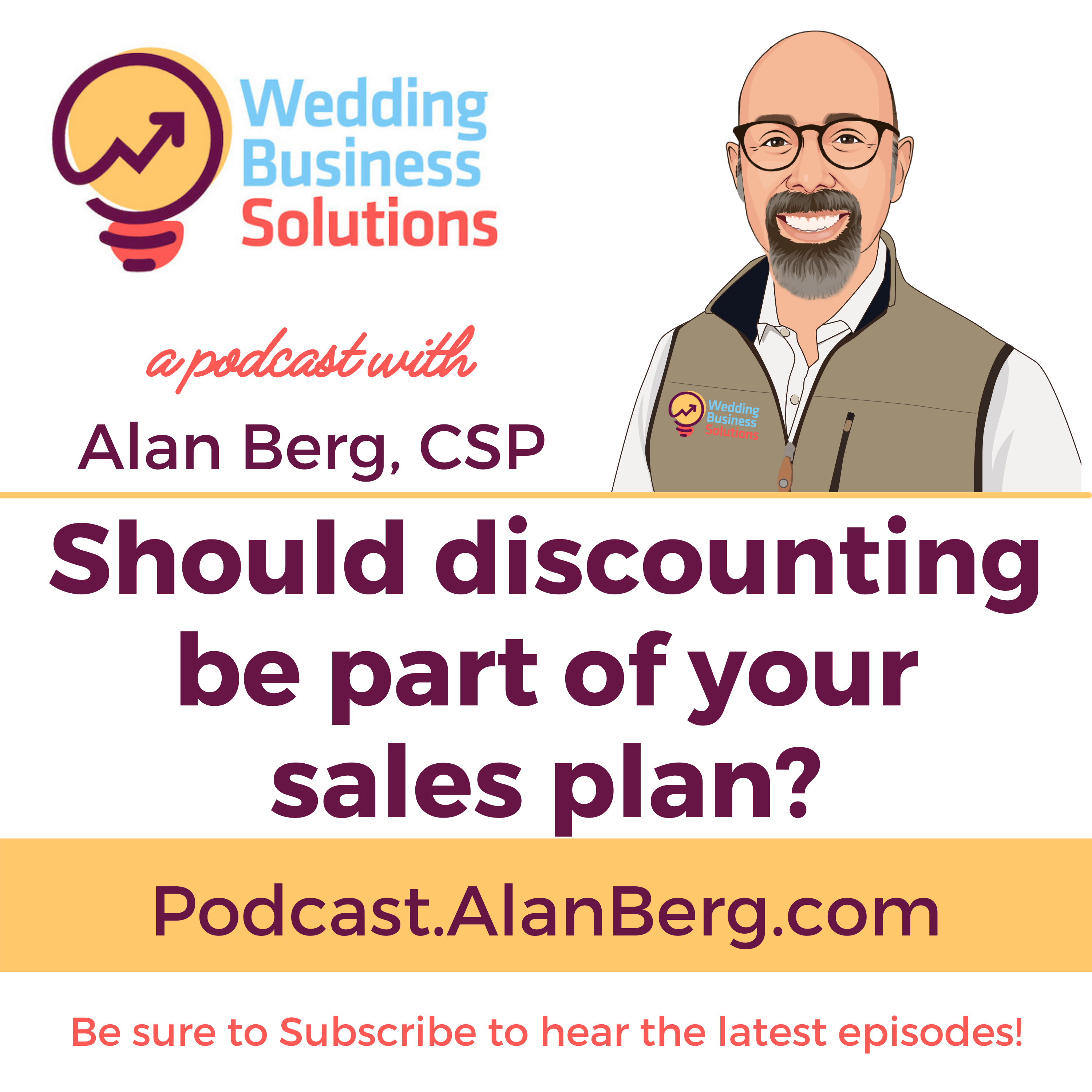
 Should discounting be part of your sales plan?
Discounting is always a hotly contested topic, whether for my speaking or consulting. This was a listener suggestion (thanks, and keep them coming) and whether you’re a solo-preneur, a small group, or a large company, coming up with the right pricing strategy is key to profitability. While I’ve spoken and written about this for years, and my clients, businesses just like yours, ask me about this, a lot, I thought this would be a good discussion for us.
Listen to this new 11-minute episode for ideas on how and when discounting might (or might not) be part of your sales and pricing plan.
Listen to this and all episodes on Apple Podcast, YouTube or your favorite app/site:
- Apple Podcast:
- YouTube: www.WeddingBusinessSolutionsPodcast.tv
- Spotify: https://spoti.fi/3sGsuB8
- Stitcher:
- Google Podcast:
- iHeart Radio: https://ihr.fm/31C9Mic
- Pandora:
Below is a full transcript. If you have any questions about anything in this, or any of my podcasts, or have a suggestion for a topic or guest, please reach out directly to me at [email protected] or contact me via text, use the short form on this page, or call 732.422.6362
Please be sure to subscribe to this podcast and leave a review (thanks, it really does make a difference). If you want to get notifications of new episodes and upcoming workshops and webinars, you can sign up at www.ConnectWithAlanBerg.com
– Should discounting be part of your sales plan? Listen to this episode for some ideas. Hi, it’s Alan Berg. Welcome back to another episode of the “Wedding Business Solutions Podcast.” This is another listener suggestion. This one from Dave Hulinski. Hey Dave, if you’re listening to this, thanks for this. He wanted me to talk a little bit about discounting. And I know I’ve spoken about this. I’ve done some presentations, discounting versus negotiating. It’s been a very popular topic. It’s certainly a big thing when it comes to my clients when we’re working on pricing strategies and profitability strategies and come up with the idea of discounting. So I wanted to give you a few of my thoughts on this. The first thing is we need to understand that almost everybody, when they’re the customer, they like getting a discount, right? Just think about yourself. Do you like getting a discount? Yes. Do you buy sometimes when you don’t get a discount? Yes.
And if you’re listening with an Apple product, unless you got a discount because you’re military or a teacher or an employee or something like that, friends and family, you didn’t get a discount. I have my Apple watch over here. I have my MacBook Pro, my Mac Mini, my iPad. No, didn’t get a discount. Bought them anyway. So there’s the first rule there that you should be aware of is that, not a rule, it’s just a fact that people will buy. if they don’t get a discount, if they perceive that the results they want are still the results from that particular product or service.
So your key is, if you’re providing great results and people are perceiving those results to be worth what you’re charging, then you don’t have to discount. Discounting comes in, in terms of supply and demand. And actually, let me just do a little side note on this. I’ve spoken in 14 countries around the world. I understand that culturally in certain places, certain places, domestically certain places, internationally, certain, you know, ethnic groups, that discounting is part of, just, it’s a normal part of the thing, right? It’s just a normal thing to do. I remember being in a mall in Dubai, I mean an actual shopping mall, not like a little store on the street, a real shopping mall. And I bought something and somebody asked me, did you get a discount? I said, no. I was in the store in the mall. And here in the states, I would never ask for a discount if something wasn’t on sale. It wasn’t on sale. There it is. But apparently they’re able to discount 5% to 10% because so many of their customers are used to negotiating, haggling, if you will, on price that they won’t buy just on principle if they don’t get a discount.
So if that’s the case where you are, you just have to price yourself so that the net price you get is the price that you want. And then just raise up, and that gap that you’re going to discount is basically the throwaway. Like, you know, you’re going to do it, but you’re going to end up where you want to end up, as opposed to starting where you want to end up and then having to discount and ending up lower. Because every dollar you discount, if you remember nothing else from this podcast, every dollar you discount without getting something of value back is profit you gave away. That’s right. Profit that you gave away. So how much profit do you want to give away? Because that’s your mortgage payment or your rent. That’s your car payment. That is your college education, or your kid’s college education. That’s your next vacation. That’s where profit goes. It goes to those things.
So don’t discount just as a matter of course if you don’t have to. And I know people that do that, they think that they need to discount to make the sale because they’re afraid if someone asks for a discount, if they don’t give it, they won’t buy, because they as a customer would like to get the discount, so they like to give one. And again, if that’s going to be the way you’re going to do business, then just make sure your prices are high enough that when you do discount you’re getting the number that you want to get. But are you selling the value of what you’re providing or you selling the discount? Because if someone’s buying the discount, they’re not really buying the value of what you do. They’re buying because they got a deal. And that means that whoever gave them a better deal is who’s going to win the next sale. And somebody could always do that to you. So to me, that’s not a good place to be.
Discounting is usually done, usually, traditionally done when you’re trying to have the supply and demand work more in your favor, which is that if the supply is too high and the demand isn’t high enough, then in order to move that inventory, in your case it could be dates, right, to move that inventory, you have to lower the price. Or the perception of the customer is that you’re charging too much for the value that they’re getting, which either could mean that you’re not advertising and marketing in the right places. It doesn’t mean your prices are necessarily wrong. It could mean that you’re fishing in the wrong ponds.
I have a lot of people that I’ve met that are trying to do everything free and cheap, right? All their marketing and stuff, they’re trying to do all the free social stuff that they can do. They’re not paying for any advertising. And then they’re complaining that they’re getting price shopping customers who aren’t looking in those places where people are looking and they’re going to pay more. They’re also looking for the free and cheap stuff. So you’re a good match there because you’re looking for free and cheap, and so are they. Well, sometimes you have to invest in your business the way you want others to invest in you. You might have to invest in better placement and in paid advertising to get in front of a better audience so that you’ll get people paying more. That’s just business. That’s just natural business.
Just remember, if you are the one that’s always looking for everything free and cheap, don’t complain when your customers are doing the same thing. So back to discounting. Discounting, again, is trying to move inventory where the supply is greater than the demand. Otherwise, if the demand is greater than the supply, you shouldn’t have to discount. You shouldn’t have to lower your price to get somebody to buy something when they want it more than you have to give. So I’ve spoken about this on some other episodes. I have one where I’m talking about your inventory. I’m not sure if that’s coming out right before or right after this one. But if you haven’t heard that one, look for it or listen to that one about your inventory, because you need to know that. But in terms of discounting, when I’m working with my clients, I’m actually trying to get you to discount less, or use discounting to encourage higher, profitable sales.
So let’s say you go to a wedding fair, a wedding expo, and you have your booth over there, your stand. People are coming by and you have an offer. that’s trying to get them to buy today or trying to get them to buy as a result of the show. The thing I don’t want you to do is take the cheapest thing you have and then lower that price because you’re giving away profit. What I’d rather you did is do added value, which is if they buy at a certain level or higher, you’re going to give them even more. Because if you give them money, money is dollar for dollar profit you give away. If you give them services or products, those things don’t cost you dollar for dollar the value that the customer would have to pay. So for instance, if you were a wedding photographer and you said, if you buy this package or above, I’m going to give you $500 towards album credit, it’s not going to cost you $500 because that’s your retail value that you’re giving them the discount, but you’re going to pay the wholesale value to get that album. So it might cost you $200 or $100 or $300, whatever your markup is on those things. I’d rather you did that than actual discounting dollars.
And I’d rather you did that on your middle and higher packages, not your lowest one. We shouldn’t have to incentivize someone to buy the cheapest thing that you have. We want to incentify them to buy the more expensive things. And that’s where having packages can work to your benefit. Because with those packages, you can put more things in, show the higher price and then apply a discount, because they’re buying more things, which means you have more profit in there and you have more wiggle room now. And now because your average sale has gone up, and if you priced it correctly, your profit has gone up, the discounting is encouraging the behavior that you want them to do. So if you do multiple services, so Dave who’s listening here, he does DJ, photography, video, photo booth, lighting… We have all those other things underneath those umbrellas within there, all the things they can get under photography and video and lighting and so forth. If they buy a package that has all of those services in there, yes, there should be a discount versus them buying them a-la-carte because you want them to buy them all from you as opposed to getting the DJ from you and getting the photographer from someone else. Or getting the DJ and the photo booth from you and getting the video from someone else.
You’re incentifying them to buy more from you. And that’s okay now because your profitability is going up and the discounting is doing what you want it to do, increasing your profitability as opposed to lowering your profitability when you just discount your basic service, and they’re not paying more. Back when I was VP of sales with a company, I got rid of negotiating, but I kept discounting. The discounting had a structure. The structure was designed to get people to buy more and the discount got better, the more you bought. I do the same thing on my shop. If you buy one book, you’re going to pay the price of the book. But if you buy five books, they’re discounted. If you buy 10, they’re discounted even more. So the book club bundle, which I put on my site because somebody had come to me and said, “Hey, well, you have a book club. Can we get 10 books? Is there any discount?” I was like, “Sure, I’d love to give you a discount to buy 10 books.” You know, otherwise people are buying ones and then some people were buying five because they wanted to give them away. Like DJs were giving my catering book and venue book to caterers and venues, because if they book more business, then you’re going to get more referrals. So could they buy five books? Was there a discount? Yes, there was. I want to encourage that sale.
So I’m okay with that discount. The fact that you bought five gave me more profit than if you bought one. And even after the discount, I’m still profiting more. So you’re encouraging the behavior that you want them to do. So that’s what I want you to think about is, is the discounting that you’re doing encouraging the behavior that you want them to do? And I don’t mean just buying, encouraging more profitable sales for you. And if it’s not, then you need to rethink that. If you need help with that, you know where to find me. Thanks.
I’m Alan Berg. Thanks for listening. If you have any questions about this or if you’d like to suggest other topics for “The Wedding Business Solutions Podcast” please let me know. My email is [email protected]. Look forward to seeing you on the next episode. Thanks.
Listen to this and all episodes on Apple Podcast, YouTube or your favorite app/site:
- Apple Podcast:
- YouTube: www.WeddingBusinessSolutionsPodcast.tv
- Spotify: https://spoti.fi/3sGsuB8
- Stitcher:
- Google Podcast:
- iHeart Radio: https://ihr.fm/31C9Mic
- Pandora:
©2022 Wedding Business Solutions LLC & AlanBerg.com