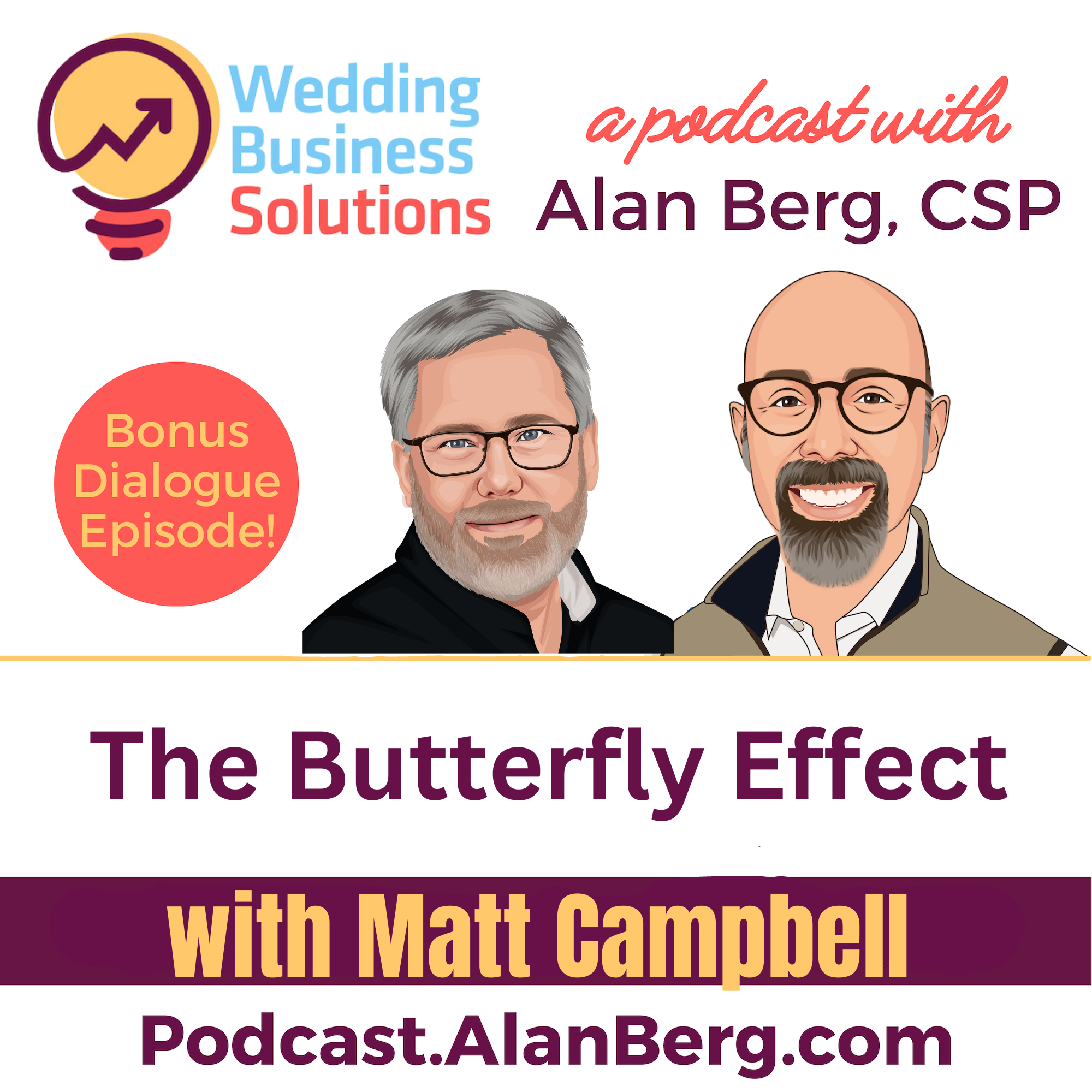
 Matt Campbell – The Butterfly Effect
Matt and I were both commenting on a post on Facebook and he replied “The Butterfly Effect”, and I said that we have to come on the podcast to talk about it. What is the Butterfly Effect? It’s that a small change can make a big difference, often far away and without any real connection. We’re expanding on that in this episode. Tune in for some ideas on how small decisions and opportunities probably got you to where you are today, and can get you to where you want to go.
Matt Campbell is the founder of My Wedding Songs – a resource of wedding song suggestions. He is the author of two wedding planners: ‘Wedding Songs Planner‘ and ‘The Wedding Music Toolkit‘. Matt hosts the ‘Wedding Songs Podcast‘. Matt shares music inspiration in his weekly newsletter the ‘Wedding MusicLetter‘.
Search Engine Optimization is on the minds of many wedding and event pros. Matt Campbell became knowledgeable about it for his business, MyWeddingSongs.com and he and I are had a follow up conversation to our one about his niche. In this new episode we talk about SEO and how you can learn to improve it for your website.
Matthew (Matt) Campbell is the owner of My Wedding Songs. He has written for Rolling Stone, Mobile Beat Magazine, and DJ Times. Matt hosts the Wedding Songs Podcast and is the author of the Wedding Music Playlist. His work has been referenced in Forbes, The Knot, and Style Me Pretty.
Books Matt Mentioned on the podcast:
- Play Bigger – https://amzn.to/3lui0DZ
- Blue Ocean Strategy – https://amzn.to/3in3CeJ
SEO Tools Matt mentioned on the podcast
- Ubersuggest – https://neilpatel.com/ubersuggest/
- Google Keyword Planner (part of Google Ads) – https://ads.google.com/home/tools/keyword-planner/
- MozBar for Chrome – https://chrome.google.com/webstore/detail/mozbar/eakacpaijcpapndcfffdgphdiccmpknp?hl=en
- Yoast SEO – https://wordpress.org/plugins/wordpress-seo/
- Google Analytics – https://analytics.google.com
- Bonus tool! Screaming Frog – https://www.screamingfrog.co.uk/seo-spider/
If you have any questions about anything in this, or any of my podcasts, or have a suggestion for a topic or guest, please reach out directly to me at [email protected] or visit my website Podcast.AlanBerg.com
Please be sure to subscribe to this podcast and leave a review (thanks, it really does make a difference). If you want to get notifications of new episodes and upcoming workshops and webinars, you can sign up at www.ConnectWithAlanBerg.com
– The butterfly effect, what is it and how does it affect you? Listen to this episode with my guest and find out. Hey, it’s Alan Berg. Welcome back to another episode of the “Wedding Business Solutions Podcast.” I am so happy to have my friend Matt Campbell back on with me today. Matt, how you doing?
– I’m doing great, Alan. Thank you very much for having me on again. This is awesome.
– This came from something on Facebook. There was somebody made some comment or maybe it was one of my podcasts, and you commented the butterfly effect. And I was like, “Wait, that definitely applies.” I can’t even remember what it was we were talking about online, but it definitely applies because we wanted to, I wanted to have that conversation. And since you brought it up, I thought, who better to have the conversation with? So for those people that don’t know what the butterfly effect is, how do you define it?
– I define it as if you started all over again, what would you do differently in your business? I’m going to leave out life ’cause that would be a five-hour talk. So we’ll just talk about business and what you’d do different.
– Yeah, and there was a movie. I thought it was a not very popular one with Ashton Kutcher, I think, where he goes back in time and it keeps changing one little thing, and then how does it affect his life later? The butterfly effect is really when they talk about if a butterfly flaps its wings in India, could that create a tsunami someplace else, is just as it amplifies and amplifies. But what you brought up is the same thing. It’s these little changes, and how does a little change today make a big difference, in a positive or a negative way, later, right? So what are those decisions that people make? And so you said it, what would I do differently in my business, right? If you could go back, right, if you went back in time and told yourself or did something different, what comes to mind to you, something that you think you’d do differently?
– Well, just to start off with, I wanted to say that I would, I’d pick three things that were more generic and that would help everybody more so than just my business. So the first one I have to say is, as a business owner, you want to solve a problem, and you want to be known for solving that problem. Whatever that is, that’s what you focus on.
– Okay, I was actually having a consultation today with a speaker in the UK. I spoke over there, and they asked for donations for their foundation, which helps speakers who have trouble, and I always donate some time. And I said to this speaker that same thing. I said, “What problem do you solve?” If you want to be a speaker, be a professional speaker, you want to do this, who do you want to speak to, what problems are you going to solve for them? And when I got to her website, I didn’t see that. That’s what I’m looking for. So I asked her first, so does the website fulfill that promise? So instead of products and services, if I’m hearing you, instead of focusing on the products and services, focus on the problem.
– Exactly. ’cause people don’t care about you. They only care about themselves and the problem that they have.
– Right, they care more about their experience than your experience, right? That’s what it is. So is there a problem that if you could go back that you would like to solve or that you would’ve liked to worked on solving?
– For myself, I would have solved the problem of being a resource of suggestions that will walk them through their whole process instead of, “Hey, this is who I am. This is what I’m doing.” No, no, I’d be focusing on the problem. And actually I have two separate, two separate types of customers, so I would have the wedding pros, the DJs, the wedding planners. Those are the type of people that are dealing with the music, trying to help the couples, and then also the couples themselves, walking them through how to select their winning songs.
– So how do you think that would’ve been different? How long have you been doing this, first of all?
– Too long. 2003. Okay, so 20 years. And what do you think that would’ve changed early on in your business had you had that focus instead of whatever it was back then?
– I would’ve had success faster.
– Okay. All right, there you go. All right, what’s the other, what’s the next thing on your list there?
– Next one is to focus on revenue. And if you don’t have return on investment, it’s a hobby. And an example that I had written down was diversification as well. So it’s kind of I’m combining that all into one. I think of like a cake baker. So let’s say you’re making wedding cakes. You become known for wedding cakes. Well, everybody has wedding cakes. Now they’re on the outs. So then maybe you make cake pops. Maybe you make other things besides that, other than just wedding cakes.
– Okay, so diversification, which is always good in any kind of investment. The only thing I would change on the beginning of what you said is focus on profits and not on revenue, right? I think if I could talk to my younger self and talk to people as I do with my consulting, and I think maybe it’s the frost in our beards that gives us us the wisdom that we didn’t have back then, but that’s why we’re sharing it here. The idea of focusing on profits and not focusing on sales because too many people focus on the top line number and then the bottom line suffers. I know many people where the top line grew to a point that they were happy, only to find out they were making less net than they were when they were grossing less because the expenses to get there were too high. So I think that’s, I think I would do that. My first full year in business after I left The Knot, that was 2012, and the top line looked great, and the bottom line did not look so great. And I had to redo my pricing to, I think one of my five times what I was back then in, what is it, 11 years? Right? Something like that. And I had to do that because if I want the bottom line to be where I want it to be, I have to affect the pricing and the services I provide, you know, not doing that. So what’s number three on your list?
– Actually, just want to say one more thing. One of the things that I did was create a spreadsheet of all money going out, and that becomes very enlightening. If your hand is not on that dial of where that money’s going, that could be very detrimental as well.
– Yeah, I use QuickBooks, and my routine is when I’m home, first thing I do when I open my laptop every day is I go to QuickBooks, and I download all my bank transactions. I match them all up there so everything balances. And then I look at my P&L, my profit and loss statement, and I look at it as a comparison versus the year before so I can see where I am, not just top line but also on bottom line. And it has every line broken out, so I can see that my travel is more than it has been. I can see that furniture is less ’cause I don’t need it this year or maintenance is more or less or something like that. And there are things you can control and things you can’t, like maintenance issues, but the ones you can, you need to be paying attention to stuff like that and saying, “Okay, here if I see…” Like when I started the podcast, the year before was zero and that line was there, well, I can’t change that, I can’t change that, but year to year I can see what that’s going to be. I think if you don’t understand your financial statements, and QuickBooks makes it pretty easy. I mean, you don’t need an accounting degree, even though I’m the son of an accountant and my degree is accounting and marketing. You don’t need that to look at this and say you’re up or you’re down line by line, and where is the money going? It’s a thing that people should do personally as well as professionally. It’s scary and it’s ugly , but again, if the barrel is leaking, and you don’t know where the the holes are, you’re just going to lose all the water.
– Yeah, if your marketing is 10X year over year and your revenue’s the same, then there’s a problem.
– Right, exactly. And things change. This year, last year was not a good year to compare it to. The year before was not a good year to compare to. The year before was not a good year to compare to. I was having that conversation with a client on a consultation just before. You kind of have to go four or five years ago. To look at anything that might feel anything like 2023, you have to go to 2018, or 2019 was a really good year for a lot of people, so I wouldn’t even count that one. And if you’re really looking at your finances and saying, “Why am I spending more?” one thing that happened to me looking at my P&L during COVID, my top line was way down, but my expenses were also way down ’cause one of my biggest expenses is travel. Well, when you’re home for 16 months, that’s no hotels, no airfare, no Ubers, right, none of that stuff. That’s one of my biggest numbers. My percentage of expenses to income was lower than it was before and after COVID because my expenses went down percentage-wise more than the revenue. But then, of course, I start traveling again, that number goes back up. But, of course, the top line went up again. That’s what I’m looking at. Okay, what else is on your list there?
– Great stuff. Make more connections. So I have being part of a community or building your own community and having, you know, build an email list so that way you control your customers. If you have repeat customers, like a lot of the people in the wedding industry, they get married, then they’re done, but if you could have an email list that’s valuable to even other vendors, then I think creating that community and being part of that community is so valuable. There’s nothing like face-to-face communication.
– Yeah, Seth Godin talks about your tribe, right? That’s the thing. I had a few years ago, my email list had grown to 19,000, and my open rate was not that great, and my click-through rate was not that great. And those of you that don’t know what I’m talking, I’m talking gibberish to you, when you send out an email, a certain percentage of people open the email and a certain percentage take action, click on a link or something like that. And when you’re sending to very large lists, which even 19,000 is not considered a large list, but it’s pretty big for me, you look at the percentage of people that open it. And I used to not joke, but I used to say, “I’ll bet there’s 5,000 in that 19,000 that actually pay attention.” And I was wrong. It was 6,000 . ‘Cause MailChimp, which I was using at the time, will score people and it’ll say, “These are A’s, B’s, C’s, and D’s and E’s,” I think that was how they did it, or 1, 2, 3, 4, 5, whatever. And the ones that open almost everything, those are your best, and then second, third, fourth. Now interestingly, the people that open the most may not be your best customers in terms of how they pay you. They might just want to consume their free content, which is fine. I’m offering free content. They’re fine to get it. So I literally cut that 19,000 list down to about 6,500, and I archived the rest of ’em. First of all, on MailChimp, you pay for how many people are on your list no matter how many emails you send. And what happened is the number of opens, the number of opens didn’t change, but the percentage went from like 10% to 45%, which 45% is huge. That’s a huge number. And that’s because the people that are really interested are the only people who I left on the list. And when people unsubscribe, I’m perfectly fine with that because if you don’t want my content, that’s okay. I’d rather have a smaller list. And what you’re talking about with this network is having this group of people that want to work with each other, that want to refer each other, that want to support each other. I was talking to a wedding vendor just recently, and he said he used to be part of a local networking group, and it became more of a social thing. He said, “That’s nice. I don’t mind going out and getting a drink, but what I really want is, how can we help each other? How can we help our businesses?”
– Yes, those connections are extremely valuable because, like you said, they’re the ones that are going to refer your business.
– Yeah, so let’s go back to something you said earlier about diversity, having different lines of business or different opportunities there. We know there are some people in the wedding and event industry that they only do weddings. The question is, do you have different options there for you to get to the number you want? And this is, if you’ve been listening to the podcast, you know I talk about right sizing, right? Not upsizing, downsizing, just right sizing. And there are people that want to do 20 weddings a year, and there are people that want to do 200, and there are people that want to do thousands, right? We have all across the way there. Finding the right size for you is part of this right sizing, but it’s also, what are the lines… What are the lines. What are the services and products that you offer that are the most profitable? And what is it Warren Buffet called it? How deep is your moat, right? How wide is your moat? Which is, how protected are you from somebody coming and taking market share from you? I think if you’re only trying to do 20 or 30 or 40 weddings a year, you’re more protected than someone trying to do hundreds because it’s easier to get 40 out of 5,000 in your area or 10,000 in your area or 1,000 in your area than it is to get 2,000 out of 10,000 in your area, right?
– Exactly, and I was going to say too that it’s creating those evergreen products or services. So that could entail maybe writing a book, something that you could, like you have experienced writing a, you write a book once, you’re going to make sales forever. Same thing goes for a learning course, a educational course. Of course, trends are going to change over time, but then maybe you’re only updating chapters of that, not the whole thing. So it’s just finding that item that’s evergreen that you can change and grow with. And I still go back to creating your community. What going to bring your, as you said, tribe together?
– Yeah, we are only as strong as our network. I’m amazed how many people I know ’cause I don’t know that until somebody asks me a question. I live in New Jersey, so the joke is you have to have a guy for everything, right? “So, Alan, do you have a guy who,” and the answer is, “Yeah, I probably do have a guy who.” You know, Matt’s my guy for certain things. Brian’s my guy for certain things, right? I have different people for things. And it’s over the years we just developed this community, and that’s what I love about WeddingMBA and some of the other conferences, is you get to see people face to face, and there’s something different about it. We all have relations with people that we’ve never met in person because of a physical distance, And it always surprises me when I see someone, and they go, “Hey, I’m glad to finally meet you in person.” I’m like, go, “Wait a minute. I know you for like five years. You mean we’ve never met in person?” So you can make relationships this way, but it’s different when you can meet someone in the hallway, you can sit down at the bar, right? Like, I love going to the bar at the Renaissance Hotel where I stay in Vegas for WeddingMBA, and just walking through, and there’s somebody, and they’re like, “Hey, come on and sit with us.” Yes, yes. That’s where we make these connections, right?
– Absolutely. It’s so funny you said that. Yeah, I got approached at the WeddingMBA as well, and when they say, “Yeah, I listen to your podcasts,” and I’m sure that happens to you way more than me, but it’s like, “Really, I actually have people who listen to what I have to say?”
– Well, we don’t get a list of who listen. And I get that, people walk up, and they say, “Hey, I really enjoy your podcast, thanks so much,” and that’s a validation for the work that we put in. But you and I, we met through the industry, and we were at the, what was it? The Photo Booth Expo. And I remember we went down to the bar together, and I got a pleasant surprise that the, what was it? That the Jack Daniels Single Barrel that was $8 at the South Point Bar, and I was like, “You mean 18?” He’s like, “No, eight.” I was like, “Hit me.” But again-
– Make it a double.
– But again, there’s you and I sitting there, or you and I and Brian and Karen and Sharon, going out when we were at The Marquee Show. This is the stuff that happens in person. But getting back to the whole idea of the butterfly effect, what does that change? The fact that you and I met somehow, which led to you being on the podcast before and on here again. Now you commenting to me and us going out to dinner, that started at some point, which could have not happened. It could have not happened had you not been there or I not been there, or somebody didn’t make the connection between us, right?
– Absolutely. I think of the people that refuse to go to conferences. They’re missing those relationships, like we were saying, that really enhance your business and creating those connections, even deepening the connections. You’re doing business, like you said, with somebody online. Maybe you’re dealing with a wedding planner you never see, and then now you’re seeing them in person. That’s such a valuable connection that you can strengthen that relationship that much more just even by saying hello and shaking their hand.
– I had Rod Baker on. Rod Baker’s a DJ in Dallas. Rod and I did an episode on networking for introverts. So if you didn’t hear that one, go back and listen to that. And he said he walks in the room, and he said, “Look for the most uncomfortable person in the room.” He said, “And if that’s you, look for the next most uncomfortable person in the room.” And he went to this networking event, and he saw this person standing against the wall, new to the organization or the group, whatever, the meeting. He walked over and started talking to them. It was photographer, and they had a nice chat. And that weekend he goes to the wedding, and that person’s the photographer. And now they had this relationship already. They weren’t strangers going and meeting. They had this relationship outside of them doing their work. I think in my personal life, I’m not sure how much of this I’ve shared before, but there were so many ways my wife and I could have not met. And I don’t know if that’s with you and Sharon the same way, but we could have not met. We lived both in New York City and Queens, but we didn’t go to the same elementary school. We didn’t go to the same middle school. She was not supposed to go to my high school because there was one closer to her, but they were doing these busing things. I was supposed to go to a different high school because they were doing the busing, but my sister was at this school, so because you had a sibling there, you could go. She’s 10 months older, so when I was in the seventh grade, she was in the eighth and a different school, but then I didn’t take the eighth ’cause this program they had in New York, so we were both in ninth and different schools. And then in 10th, we’re in the same high school but in overlapping groups of friends, and you go down all these possibilities there. It was a really, really good chance we could’ve never met had she gone to the other school, had I not taken that program, right? All these things, and then what does that lead to, right? And then how did I, I don’t know about how you ended up with your jobs when you were younger, but most of it is through who you know. I couldn’t get a job in advertising, so I was installing burglar alarms because the guy that was putting one in my parents’ house said, “Hey, work for me until you get a job.” I went to sell cars ’cause my friend’s father opened the Chrysler dealership, right? It’s just all these things that lead to where we are today and who we are today.
– Absolutely. I don’t want to top the host, but Sharon and I met in a Yahoo! chat room .
– Okay.
– So that is extremely unlikely to ever happen again.
– Right, right, and but again, that comes back to this whole idea of the butterfly effect, is that little thing, had you not logged on that day or had you not been part of that community, or if you decided AOL was better than Yahoo! or whatever, whenever. I’m not trying to date you on that one, but whenever that was. It could have been Usenet, right, if you go back far enough. But some people dunno what I’m talking about there. But that was the real geeky stuff, getting into the real geeky stuff there. But these are all those little differences. I took a job in the wedding industry, with a brand new industry, commission only, when my wife was pregnant because I hated the job I had. Well, what if I’d loved that job? Then I wouldn’t be here, right? It’s just all these different things there, and that’s that same butterfly effect. I think it comes back to opportunity. Do you notice the opportunities in front of you and do you make a conscious decision to go or not go for it as opposed to letting somebody else make that decision? Would you agree?
– I was thinking the exact same thing of seize the moment. What if I would’ve said no to Alan Berg the first time he said, “Why don’t you come on the podcast?” Yeah, I feel the same way. You have to seize your moments when they’re there because they’re not going to last for very long.
– And I’m listening to a book now by Adam Grant called “Hidden Potential.” I’ll talk about that more on a future podcast, but I love his books, so I’m listening to this one. And it’s same thing. He was talking about, again, what is the hidden potential? And a lot of people that have reached great success, like musicians, we’re not the child prodigy, right? Where is that opportunity to learn? And just a quick hint about what I’ll talk about later was, are you okay with discomfort? Are you okay with failure? And this is, again, you know, what happens if you don’t try because you’re afraid to fail or you’re not good with the discomfort. When I’m doing my language lesson, and as of, let’s see, today was 1,042 days of French lessons, or something like that, in a row. And some of my favorite days is when it’s kicking my butt. I don’t want it to be easy. Maybe that’s a personality trait, but I don’t like when it’s easy. I like when it challenges me because if it’s too easy, I don’t feel like I’m learning. I don’t feel like I’m growing, right?
– Absolutely. I’m reminded of a famous quote that I love, is, “A ship is not meant to stay at the dock.”
– Yeah. Yeah. And I just watched a movie called “The Boat that Rocks” about the pirate radio ships off the UK coast in the ’60s, and they had this revelation that they could actually move the ship. They didn’t need to leave it in one place where the police could find them.
– Police.
– And their sail, well, then it ran aground and it sank, but that’s another story. But it’s just funny how they’re like, “Oh, wait, this is a boat. We could actually move it here.” If you’re sitting still in business, like not trying new things, not coming up with new ideas, somebody’s passing you by. And for everybody that complains about the new competitor, I’ve said this before, I’ll say it again: everybody listening here was the new competitor at one time. And if you’ve succeeded, allow somebody else that same privilege of succeeding as long as they do it the right way. When they do it wrong, they make us all look bad, right? But if they do it right, it keeps you on your toes. So try that new thing. And I know I’ve done a podcast called this: “What’s The Worst That Could Happen.” In most cases, cost you some time, maybe cost you some money. I think I did mention I have t-shirts from when I went skydiving that say: Skydiving, what’s the worst that could happen? Of course, we bought them after we came down, so . It was a little safer that way. But yeah, this whole concept of a little change and what difference would it make? What difference would a little price change make? A customer I was talking to just before I got on here has raised his prices again, ’cause you realize the customers he’s going after are less price sensitive. They’re a higher end. He’s a higher end product. It’s more expensive. And he said the wedding is not where they’re going to skimp. In a lot of cases, it’s wealthy parents paying. In this case, he said, “They’re not skimping on their child’s wedding to do that.” And like I always say, somebody that won’t pay today’s price won’t pay a higher price, but somebody that will pay today’s price might pay a higher price, but you don’t know if you don’t try. And I think you probably know as many people as I do, Matt, that have raised their prices and always say, “I wish I would’ve done it sooner.”
– Yeah, absolutely. I’m, yeah, thinking some of those right now.
– Yeah, ’cause what was that price of your book? It was $30, right?
– Right, right.
– There it is.
– It’s no longer 20.
– You know you shouldn’t, not supposed to say that.
– Oh.
– They weren’t supposed to know it was 20. There you go. The paper cost went up, printing went up. There you go. Which it did, by the way. My printer raised my prices on that.
– New version.
– New version, second edition. There you go. But that’s moving forward, right? And that’s moving forward. I like the challenge because I don’t want to be skating through. I’m not doing this for the money. My biggest reward is people at WeddingMBA coming up to me and saying, “This is how you’ve helped me.” And, yes, the money is part of the equation, but I’ve said at WeddingMBA on the stage, on the main stage, that it’s a privilege. Every time someone chooses you for their wedding, it means they did not choose everybody else that they could have for their fill in the blank, venue, catering, photography, video, music, flowers, invitations, dress, officiating. You go down the line, they’re choosing one of you. In almost every case it’s one, not more than one, which means they didn’t choose anybody else, and that has to be a privilege. Somebody listening to this is a privilege for me that you’re tuning in. Putting me on a stage is a privilege. It’s I’m not there… They didn’t hire me ’cause they wanted me to speak. They hired me because they wanted me to educate you, entertain you. That’s what it is, and you have to keep that focus on them. And what’s the effect of this, taking that next chance? What’s the effect of saying yes, and it’s okay if you fail? It’s only okay if you fail if you’re okay with failure because you learn something. And that’s, again, we can go back to that butterfly effect again. So any last thoughts about the butterfly effect?
– Just I would say come out of your comfort zone, and, well, try something new. Don’t be stuck in your old ways, and everybody fails, we all fail, but as long as your main focus is to, like you’re saying, helping your customer, I think that’s the win.
– So thank you for bringing up comfort zone. So one last story. WeddingMBA, bunch of years ago, I did a presentation about coming out of your comfort zone. And I had a custom blanket made with a big egg with someone breaking out of the egg, right? Breaking out of your shell, and it was on this blanket. My plan was to walk out on stage wrapped in the blanket, turn around and hold my arms out, and unfold it, and show it, and then start my presentation. And something happened backstage that Will, the promoter WeddingMBA, asked me to, I dunno if I did, I do a voiceover, I did something. He introduces me, and I come running on stage, and the blanket is backstage. It’s custom blanket I had made. Now nobody knows this but me, right? So I’m on stage and I start talking, and I realize, “You don’t have a blanket. like this blanket you custom made.” Like months before I had to plan this whole thing out. I’m talking to the audience, and I said, “You know how you just get comfortable? And I said, “You know, hang on.” And I kept talking as I walked backstage, got the blanket, came back up and then said, “You know you get comfortable with your woobie or you blanket as a kid here?” And then I held it out there, right? So I saved it, but nobody knew that but me. Nobody knew how it was supposed to go. And again, what did I learn? I learned if you’re going to do that much planning, don’t forget the darn blanket when you go on stage. But that idea, or this year when the mic went out and my screens went out, and I just kept talking, and people are like, “Wow, you just kept going.” I said, “Yeah, ’cause it’s not my job to fix the problem. It’s my job to educate the audience, and I’m going to do that with or without a microphone with a thousand people in the room.” But that’s what professionals do. To me that was like every wedding that everybody does that people think is perfect, but you know that behind the scenes you were scrambling to make it look that way, and that’s all that mattered, is that the customers felt that. So thank you for bringing up this idea of it. There’s so many ways we could, people can think about little changes have brought them to where they are and reflect on your successes because of it, but I think if you reflect on your failures, you’ll see how it’s made you stronger and made you more resilient for the next one. That goes along with the butterfly effect, again. So I look forward to seeing your updated book.
– Awesome. Thanks, Alan.
I’m Alan Berg. Thanks for listening. If you have any questions about this or if you’d like to suggest other topics for “The Wedding Business Solutions Podcast” please let me know. My email is [email protected]. Look forward to seeing you on the next episode. Thanks.
Listen to this and all episodes on Apple Podcast, YouTube or your favorite app/site:
- Apple Podcast:
- YouTube: www.WeddingBusinessSolutionsPodcast.tv
- Spotify: https://spoti.fi/3sGsuB8
- Stitcher:
- Google Podcast:
- iHeart Radio: https://ihr.fm/31C9Mic
- Pandora:
©2023 Wedding Business Solutions LLC & AlanBerg.com