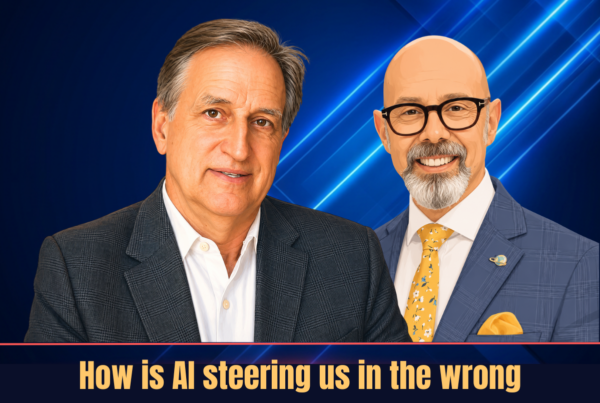
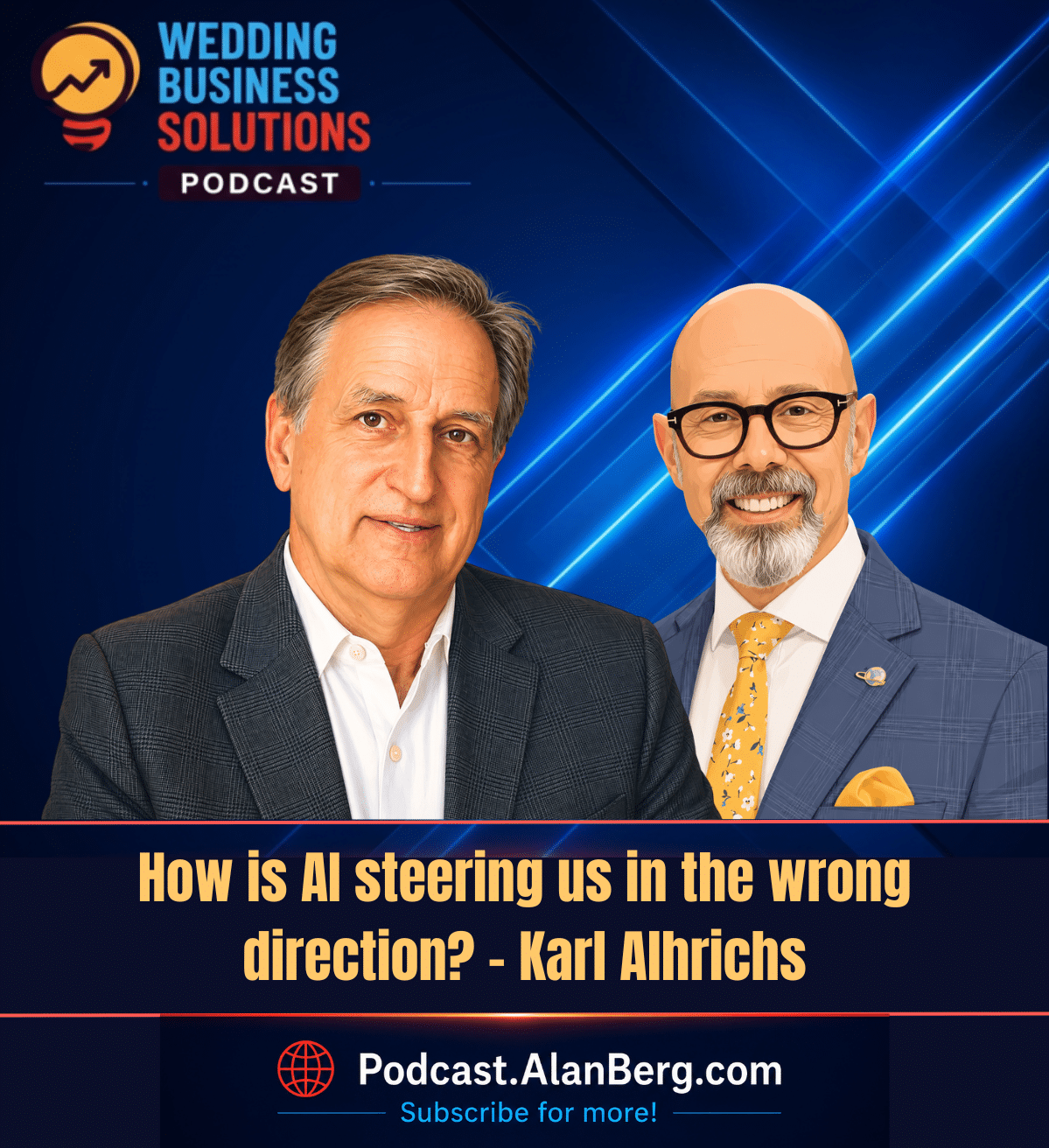
 Karl Alhrichs – How is AI steering us in the wrong direction?
Are you blindly trusting the first answer AI gives you? What risks are you taking when clients arrive with AI-generated timelines or contracts that might be logistically impossible or even dangerous? In this episode, guest Karl Ahlrichs and I question how much faith we put in AI and explore the real value wedding professionals bring as the ultimate auditors and truth tellers. Could your critical thinking and wisdom be the competitive advantage that keeps you ahead of the AI slop?
Listen to this new episode for ways to safeguard your business, elevate your expertise, and ensure you’re still adding uniquely human value in an AI-driven world.
Bio:
Karl Ahlrichs knows weddings. He had a hand in planning 2 weddings as a groom, attended 54, and paid his way through college by doing videography and photography for 183. As a business consultant he has broad experience in the “human capital” of modern organizations with expertise in Human Resources, Operations and senior level problem solving.
He is a national speaker and author, presenting on the people issues in organizations, ethics, critical thinking, and professional skepticism, and is often quoted in national media. He has been named the SHRM Human Resource Professional of the Year for the State of Indiana and holds the SHRM-SCP and SPHR certifications. In the National Speakers Association, he is one of fewer than 700 active Certified Speaking Professionals.
Contact Karl:
www.ExpertSpeaks.com
Instagram – @kahlrichs
Facebook – @kahlrichs
If you have any questions about anything in this, or any of my podcasts, or have a suggestion for a topic or guest, please reach out directly to me at [email protected] or visit my website Podcast.AlanBerg.com
Please be sure to subscribe to this podcast and leave a review (thanks, it really does make a difference). If you want to get notifications of new episodes and upcoming workshops and webinars, you can sign up at www.ConnectWithAlanBerg.com
View the full transcript on Alan’s site: https://alanberg.com/blog/
Summary:
In this episode I dive into a conversation with my friend Karl Ahlrichs about the ways AI is impacting the wedding industry and how it may be steering us in the wrong direction. We discuss the temptation couples and vendors face to trust AI-generated content without verifying its accuracy and how this can create some real challenges during the wedding planning process. Karl and I share stories about AI-generated wedding agendas and contracts that can end up being logistically impossible or legally risky. I talk about my own experience using AI to update my book and how important it is to double check everything AI provides before putting it into the world.
We get into the real-world implications of relying on the first answer AI offers and why most people do not take the time to refine their prompts or double check the information. The conversation highlights the dangers of taking AI at face value whether it is putting together a complicated timeline for a wedding or drafting a contract. We stress the importance of wedding professionals acting as auditors for AI outputs and reclaiming their authority by using their own expertise and critical thinking.
As we explore the impact of AI on research and vendor reputation, we also address the risks of AI-generated images and generic text making their way into the industry. Karl brings up the analogy of fixing a six dollar haircut and how professionals can add value by correcting AI slop. We reflect on the trend toward value-based pricing and how results and experience are what matter most not just the hours spent or the tools used.
Toward the end of the episode we talk about the growing desire for more authentic human touch as analog methods make a comeback. I encourage everyone to be curious and suspicious of AI outputs and share lessons about verifying content before sharing it with clients or the public. The overall message is that AI is a useful tool but it cannot replace the wisdom human professionals bring to the table. The discussion closes with an emphasis on using AI thoughtfully trusting but always verifying and finding ways to add an authentic human element to every wedding experience.
How is AI steering us in the wrong direction? Listen to this episode and find out. Hey, it’s Alan Berg. Welcome back to another episode of the Wedding Business Solutions Podcast. I am so excited to have my friend Karl Olleryx on to talk about how AI is steering us wrong. Karl, how you doing?
I’m, I’m pleased to be here because I’m scared about the future.
Well, there you go. Uh, so Carl is another friend of mine through the National Speakers Association, and we connected at our CSP Summit, which is only for people that have our CSP designation or Hall of Famers. And then we hung out in Indianapolis because we’re both gearheads as well. And we were talking just the other day, and Carl said something, and I said, you need to come on because we need to talk about this. And it’s about how couples and you are relying on AI and how much we might be trusting that what it’s telling us is accurate. And really, we don’t know. Is that where we got started here, Carl?
It is. And we have to remember, AI is like training a puppy and it’s still young and it doesn’t always get it right.
Yeah.
Yeah. Let’s go to where people are familiar.
Okay.
Our good old friend Google. So we type in a query, how to fix a remote flash in a wedding environment, whatever. If I’m—I’m a wedding photographer, by the way. I’ve been a part of hundreds of weddings. That’s how I paid my way through college. Okay, so we type in a question and we get 1,200,000 answers, which Google sorts for us and puts their sponsored ones at the top, which we ignore and head on down to the ones that are the real answers. And we use our critical thinking to go through and go, yep, yep, nope, nope, nope, nope, nope, yep, that’s the one.
Okay.
So we vet the answers for the one that really fits.
Okay.
Okay, remember that. Now we go to the world of ChatGPT or Claude or whatever, and we give it a prompt. How many answers does it come back with? It goes out and reads the entire internet and takes a clean sheet of paper and writes us how many answers?
One.
One.
Yeah.
The number of us that actually refine the prompt and drill deeper is like, I don’t know, 15, 20%.
Wow.
Most people take that first answer as God’s honest truth and go with it.
Yeah.
Let me do the Lois Kramer lean in for the—for effect. Stop it. Absolutely use the new tools. Absolutely don’t trust them.
Right.
Let me make it more visceral.
Okay.
If we were to do a live poll of your audience and ask them in their use of generative AI, how accurate is it? The number, if we were to get the median, the number I usually get is around 80%. It’s 80% good. Okay, let’s take that. All right. Um, tonight you’re going out to your favorite Italian restaurant and the waiter comes around and says, tonight’s special is the carbonara. It’s 80% sanitary. Alan, are you eating it?
No, I don’t want to know what’s going on in the kitchen.
Yeah. Okay, let’s get wedding real on this.
Okay.
Let’s agree that AI can be useful but not trustworthy.
Okay.
Let’s agree that the very nature of how we work with it has us trusting it more than we should and has us not being curious about whether that’s real and has us not using our critical thinking skills that we learned early in life, but just blind. Yep, that’s it. Sounds good.
Right. So we’re not doing trust but verify. We’re just doing trust.
There’s where we need to go.
Right. Okay. Yeah.
So, so now that I’ve made that point, let me give you a couple of wedding-specific examples.
Okay.
Uh, and, and I don’t know where you are in the wedding process, if you are a, a general vendor, if you are a specific vendor, or if you are somebody who is truly a wedding planner. Um, you have customers showing up with AI-generated agendas and timelines that may be logistically impossible.
Right.
We have to reclaim our authority of parsing that agenda and saying, you know, you’ve got only 15 minutes for posing the group shots, and it’s, you know, 8 bridesmaids, 8 groomsmen, and ancillary. That’s an hour.
Herding cats.
Herding cats. That’s why I would always try and get a lot of those shots done before the ceremony.
Right?
Just saying. Um, so I guess the main point—watch for my main point of the couple things I’m going to go through here. Your role as wedding professional is to be the auditor of what they come up with and be comfortable doing it. You may be presented with a contract that’s not really boilerplate, it’s AI-generated slop. It can introduce risky clauses and you need to have a strategy for responding if something that is, you know, basically have to say my AI is smarter than your AI. No, no, it’s your wisdom that’s smarter than their knowledge.
Right. If you put your name on it, if you put, put it out there, it’s yours. I actually had somebody just recently at a conference and he said he had AI make the proposal to give to the client and ended up having to fulfill things in that contract that were not what he originally said. But no, it was in the contract and they signed it and they gave him money and he had to then give them stuff that he wasn’t getting paid for.
Yeah, it’s like, really? Yeah, really.
Yeah.
Understand that AI is programmed to try to please the person who is prompting. And so you’ve got a client feeding your contract into AI and saying, make this more fair. Mm-hmm. Okay. You can’t take AI to court for giving legal advice, not being a lawyer.
Right.
So we’ve got AI-modified contracts as a danger out there. AI-modified budgets where it creates unrealistic price anchors. It’s like those poor people going in to trade their car believing that the Kelley Blue Book means something.
Right. So this is not new to AI.
Nope. But AI, AI is a new channel—
Right.
—of misinformation that needs to be audited. That’s my main point in our discussion.
Right, right, that you are the arbiter of what goes out and what doesn’t go out.
Yeah.
Uh, so let me—I’ll tell you something I just had recently. I just updated a book I wrote 5 years ago because—
About time.
I know, so much has changed. Uh, it’s my book, Why Are They Ghosting Me? And AI wasn’t a thing back then, and some other things, and how many times I told people to follow up and these secret shopping stats that I have and all. So I wanted to update the book, and I’m using AI to help me parse all of the things that I’ve spoken about in the last 5 years, which is a lot of stuff, a lot of podcasts.
Good use of it.
Thank you. Well, this is where I, I always say, and I wrote about it in my book AI for the Real World, I’m not asking AI to do something I couldn’t do myself. It’s just going to help me do that. So if I feed it 400 podcast transcripts and if I feed it, uh, workshop, uh, presentation transcripts, uh, speeches, presentation transcripts, that’s a lot of data. So what I asked it to do is, here’s the original book, what have I been speaking about that’s not in the book? And it came back and it was great. I said, okay, now we need to find what to update, what to get rid of, what to add, right? That’s—
Now let me, let me call you out a little bit. You got that list back. Did you put any time in confirming the list was correct?
Oh, absolutely. I went through the list before we decided to move forward.
Thank you. That’s the point I want to be the big takeaway from our time together.
Right now, despite the fact that it helped me write the instructions for the project that I created in ChatGPT because I decided to do this as a project, it’s not a GPT because it’s not a repeatable process. It’s a one-time thing for this thing. And it helped me write the instructions. It still didn’t follow the instructions as we go through. What? I know, crazy. It’s amazing, you know. So I stumbled upon something on the 4th draft. I stumbled upon something where it would give me something, and instead of taking it and reading it, I asked it, are you happy with that? And it came back and would go, not quite.
And it sometimes would be like, I’m 92 to 94% okay with this.
Oh, are you eating that carbonara?
But then it would tell me what it was stopping it from being 100% happy with what it was. And I was curious why, why wouldn’t you just make it 100% the first time, right?
Well, why don’t you write a better prompt that includes that?
Right. So part of that was on me, but part of it was no matter how good the prompt was, I would ask it, are you happy with that? And sometimes it was like, yeah, yeah, no, that’s what you were asking for. But a lot of times it wasn’t. And sometimes it was 70 to 80%. I was like, whoa. So I also, I did something else and I, this’ll be, I think it’s coming out before this episode. I invited ChatGPT on the podcast as my guest.
I remember this. That was fascinating. Tell the story.
I did another one. I did another one yesterday where I invited it on and I said, I want to talk about how—where did this go wrong? Like, why didn’t you follow the instructions? And why, when I asked you, are you happy with this, you then told me what was wrong with it? And what it said was what you said just before. It’s trying to please me with its first answer. And when I say, are you happy with that? It took the hat off, the Please Alan hat, and it put on the critic hat. And now it was looking critically, which you can put into your prompt. And I’ve done that. Use your critical, cynical personality.
And I’ve got the Please Alan hat.
You got the Please Alan hat. Yeah, I have my, uh, if you don’t ask, the answer is always no hat. There’s my—
My hat wins.
I like yours. Yours got sequins. Yours definitely wins. Those of you that are listening and not watching, Carl put on a fedora with black sequins on it. So—
You know, think Michael Jackson.
There you go. I think my, my 9-year-old grandson has that, has that hat. So, but so this was what was interesting. What you said is it’s trying to please you, but in trying to please you, it’s not necessarily giving you exactly what you want. It’s giving you what it thinks you’ll be happy with.
No.
But, but you have to be the one that says, no, I’m not happy with that. You know, well, don’t just take that.
You and I know someone smarter than both of us, Jennifer Elder, CSP. She and I were working on a project that almost got derailed because she—but it wasn’t derailed because she followed up. She was working on a presentation on the impact of AI in accounting.
Okay.
I know, really thrilling. And she asks for 10 journal articles on that subject and boom, gets a list of 10. And the first one looks like a bullseye. It’s the impact of Accounting on AI, and it’s by the Accounting Association, the mothership. Cool. She clicks on the link. 404 not found. She goes back and says, give me a new link.
That one’s not working. And it does. It says here, click. 404 not found. Well, she puts on her curiosity hat and she goes to the mother web—the association website, which she is a member of, logs in, goes to the master search, and types in that title.
Right?
404 not found.
Wow.
She calls out AI and says, I really want this article. What’s, what’s hap—what’s—why is it wrong?
Yeah.
And AI said, and I quote, I’m sorry, I made that one up.
Wow. Wow. Now, now, was she using ChatGPT for that?
Yeah.
See, I, I use Perplexity when I’m looking.
I’m a Perplexity fan. I also use Claude. I, you know, I’m, I’m an omnivore.
I am as well. But for research stuff, I find Perplexity gives me—doesn’t give me the broken links. Right.
It’s got better sources.
Better sources. And that is what it is good at. And when I do my AI workshops, I put up a slide with the strengths and weaknesses of ChatGPT, Perplexity, Claude, Copilot, Gemini.
Yeah.
And they’re not all good at everything. And—but ChatGPT is really good at making stuff up.
Yeah. Yikes.
Yeah.
But also in the wedding industry, your reputation is as good as your last wedding.
Sure.
And AI can misrepresent vendor capabilities. You know, you’re looking for somebody who—I was at a wedding the other day and in the reception they had a dude working the room wearing a cannoli factory on a shelf in front of him.
I’ve seen that, yes.
Oh my God, um, I, I want that at my next party.
Yes.
But how do you find that? Well, you know, AI could misrepresent the capabilities of the vendor and say that he’d be using ice cream, not just, uh, ricotta.
Cream. Yeah.
Uh, they’re inaccurate, they’re outdated. Um, but, but we have to vet—I mean, a lot of in the wedding industry, as everybody starts using AI, we, the professionals within it, will become the auditors of what is accurate, will become the auditors of what is edible, if you will.
Yeah. Yeah. What’s interesting is the backlash that I’m starting to see with the AI images. And, and the AI text where people are clearly not reading it and it’s obvious.
I have, uh, if, if your viewers could see, I would imagine a 2-panel comic strip. First panel is a strip mall store festooned with balloons and a line out the door, and they’re advertising $6 haircuts. That’s AI. And then 2 doors down is the old mom-and-pop barbershop, and its sign is taped up and it says, for $40, we fix $6 haircuts.
Right.
That’s us. We’re going to add value because we fix $6 haircuts.
But again, this is ethics, which you and I have spoken about. You know, you’re putting it out there. It’s you. It has to be you. And at the CSP Summit where you were a wonderful moderator of our group, I learned about HeyGen through Susan Frew, who’s very big into AI. And this is where you can make a video of yourself and then you could upload different scripts and it’ll make videos of you saying those things.
In different languages.
In different languages, right? More than I speak, right? And, and I signed up because I was excited about the prospects. And I realized the first mistake I made is my video was too close so that when it makes me saying these other things, my mouth, it didn’t look natural. And if I had been a little further back, that might have worked. And then I could have had to do an avatar. I was like, okay, well, that looks a little better. And then I canceled my subscription. And I decided that if you ever see a video of me I made it. That was me.
I said those words. That’s me.
I love it. This is Alan. I own it.
Right. And, and listen, I’m a professional speaker. If you want me to make a promo video for your event, uh, for 30 seconds, it takes me 30 seconds to make that video because this is what I do. And it’ll take me longer to give the script to HeyGen than to actually make it. But I want you to see a video of me and say, that was Alan.
Let’s, let’s go down this rabbit hole just a second. Let’s say that I’m a wedding professional and mentally I have been charging by the hour or the day.
Say a photographer?
Yeah.
Okay.
And with these modern tools, I am getting to spend less time to produce a good result. Because I am being more efficient with the new tools. Do I lower my rates? Or here’s the correct answer. I move to value-based pricing and project pricing, not hourly.
Right. Well, the, the, the, the answer is no matter how long it takes you and no matter what tools you use, you should always be charging for the results that only you can provide.
But that’s not how we’ve done it. A lot of times people with imposter syndrome who feel that it’s, you know, I’m just glad to be making above minimum wage. Oh my God. Don’t understand the power of value-based pricing.
Yeah, I actually learned this from my dad. My dad was an accountant and—
That explains a lot.
It does explain a lot. And I spent 2 years as an accounting major and then switched to marketing. I can sit with the creative director and I can sit with the CFO. I understand both.
You have power. You have superpowers.
I have superpowers. And I remember him telling me a story. And now my dad passed at 93 a few years ago. So this has got to be 25, 30 years ago that he tells me this story that someone was referred to him, got referred to my client. And the guy said, I was referred to you by one of your other clients. And he said, you’re the best accountant. And my dad said, well, thank you very much. Tell me what you need.
And he said, I need you to do my taxes. And my dad asked him some questions. And my father said, you don’t need me to do that. That’s not really that complicated. And he said, well, my friend said you were the best. He goes, yeah. Now, remember, this is like 30 years ago. I charge a minimum of $425 to do a tax return.
Okay. Which, a long time ago, right?
Yeah, that was real money.
Real money.
You could buy a car for that.
Yeah, well, not quite. Not a Model T. Not quite that far back. And the guy said, wait, but you said my taxes weren’t that complicated. My father said, right, right. But if you want me to do them, I charge a minimum of $425 because it’s not how long it’s going to take me to do the return. It’s the experience that I have that makes me what your friend said is I’m the best accountant for him. And that’s—
That’s powerful.
And that was a lesson I learned a long time ago is it doesn’t matter how long it takes you to do it if they get the result. I learned this when I hired virtual assistants. I used to pay by the hour, and now I pay by the month. And this is what I need you to do. And some months you’re going to take more time, and some months you’re going to take less time. But this is what—this is what it is. Because I found that when I paid by the hour, it took longer.
Amazingly, it took longer for them to get stuff done. Oh yeah. So, um, I, I had a DJ I was sitting with, and he got an inquiry. How much is your 5-hour package? That’s the way a lot of people sell, 5-hour package. And he said, oh, here we go again. I said, how long does it take you to do a wedding? All the prep, all the communications, all—
Everything. It’s not 5 hours.
No, somewhere between 20 and 30 hours. There you go. Depending on what was involved.
Yeah.
And I said, you know, people are charging for the 5 hours, not for the travel, not for the setup, not for the communications, not for the music planning, not for all that stuff. I said, so why don’t you write back and say, hey, thanks so much for inquiring. I’d love to help you have an amazing wedding and you and your guests saying it was the most fun you’ve ever had. I don’t have a 5-hour package, but I would love to tell you about the 20 to 30 hours that I’m going to spend to make sure that those 5 hours are incredible.
I like how he did that. Yeah.
Yeah. Right. So that’s, that was what I said. This is what you want to say back to them because they’re only valuing the 5 hours they see.
Yep.
But, but again, you’re a photographer. How many hours did you spend after a wedding? Oh, right. Countless. Way more than you did on the day.
Torture. Although it makes you a better photographer over time. You, you, you light it right, you crop it right.
Right?
You, you’ve got it nailed in the viewfinder and don’t have to be a slave to Photoshop.
Right. And before that, you know, proof passing. I remember the proof passings where you’d have to print out the proofs and sit there and go through the physical photos with them. My, my daughter-in-law shoots weddings as well. She and my son will do them sometimes. And I said, how many, how many images are you shooting?
Oh.
And she told me this. Thousands. Thousands.
Oh, yeah.
And it was way more than what I would expect to hear from my professional photographer clients. And I said, why? I said, you have to go through all those. She goes, yeah, but I love that. I go, okay, but you know, that’s not the correct—
Answer.
You’re not getting paid for that. Now, this is not her full-time thing, right? So that’s—she’s looking at it differently. If this is your full-time thing, that time is time that you could be spending with your family. That time is time you could be spending getting more business, networking, and all these other things. But let’s circle back. So AI is a tool.
Yep.
Right. And we’ve had tools throughout the years.
But it’s like a dangerous, untrained puppy.
Right. And Photoshop is a tool. And when you—when Photoshop first came out, it was the devil incarnate. And then people, you know, I have to—I can’t live without this. AI is kind of there.
Yeah.
But I think Photoshop, you still had more control. It wasn’t doing it for you. It was letting you, you know, dodge and burn. It was letting you do all these different things. But AI is really kind of—is doing this for people and they’re just saying, yeah, okay. Okay.
Yeah, looks great.
Publish it. Publish it. Publish it. Yeah. So, so what, what are the, what are the pitfalls of that? What, what’s the other shoe that’s going to drop for people that have just said, here it is and go?
Well, everybody is gonna get burned. The, the way as adults, the way we learn is failing.
Right?
And, uh, it’s kind of like when, um, here I’m holding a—here we are—I’m holding a multiple terabyte hard drive.
Okay.
There’s 2 kinds of people in the world: those who have lost data with no backup and those that will.
Right.
And once you have done it, you graduate to owning a ton of these. Mm-hmm. Until you lose it.
It’s not—
You’re arrogant about your world.
Well, insurance. Insurance is betting something bad is going to happen. And it’s such an odd thing because I’m betting that I’m going to have a car accident. I’m betting my house is going to burn down. I’m betting I’m going to die. Right? That’s what it is. I did not have the data loss myself. I had a close friend that did.
And now there’s a 5 terabyte hard drive on this Mac Mini that is Time Machine backing up all the time. Everything is in the cloud on Dropbox and then backed up to the cloud again through another—
Yeah, you gotta have it 3 places because 2 will fail at the same time.
Right. And when I go—
Says the man who had it happen.
Yeah. And when I go to a conference, I have it on my device, whether it’s my iPad or my laptop. I have it on a flash drive. I have it in Keynote and PowerPoint, and it’s in the cloud. So, and I have had it happen where there was a thing with Macs where the Macs, they wouldn’t work with the devices or whatever, and I needed to give it to somebody on PowerPoint right now. There it is, right back up.
Can I predict something for the future?
Sure.
Analog is coming back.
Okay, what does that mean?
Well, in the examples you were just giving, some of my most powerful presentations are on an easel pad here, right? Right here on an easel pad.
Yeah. Live. If you can’t see, Carl has a good old-fashioned flip chart and the biggest marker. I know because he gave me one. Thank you. Yes. So what—so, so why is analog coming back?
People are getting hungry for the human touch and getting hungry for real.
Yeah.
And we’re going to see proper use of AI tools in the production of weddings, but we’re also going to see an increased importance of the human professionals involved who are there, they look at everything and say, you know, I’ve got an idea. Look at this space and look what we might do. And AI can’t do that.
No, it could help you render it if you, if you described it well enough, but you still had to come up with the idea.
Yeah, look at this space. You know, it’s, it’s, let’s, what if we were to, and that’s the magic we all bring. Right.
And if you—
And that will never—that—
Yeah.
They can’t automate.
Right. And I think the other problem a lot of people are having is you’re getting a lot of generic content.
Yep.
Because they’re taking the first thing that it does.
We call it AI slop.
AI slop. Something else, and I’m, I’m, I’m gonna say this out loud, a lot of people are using the free version.
Yep.
And the free version doesn’t let you put in your history and who you are and all these things.
It’s a, it’s a $6 haircut.
It’s a $6 haircut. It’s just a vending machine that’s just gonna give the same output. Better prompting will help. But yeah, I always say, listen, if you’re getting value, pay ’em the $20 a month. I mean, it’s $20 a month. Right. You don’t have to go $200 a month. Pay ’em the $20.
I get that value probably on the first day of every month. Yes. And I pay several different AIs because I’m using them in different ways. And you know what? Some months I don’t use Gemini LM. I have to say that because I keep thinking Notebook LM, but it’s now Gemini LM.
Wait a minute. Are you really Alan Berg or is this an avatar?
Right. So several times a month, I, you know, there are times in a month I may not use some of these tools, but I pay them every month because it’s there waiting for me to help me. And this goes back to that same thing, not to do it for me.
Yep.
To help me. And you are the arbiter. I’ve lost count how many solo podcasts I’ve done about that because I’ve seen the AI slop and I see, you know, here’s the issue. We just had, we have an email group with our CSPs and somebody had sent an image that conference had made of them and the image didn’t quite look like them. And I have this happen a lot, whether I make it or somebody else makes it. And the question is, what do you do? And yeah, the consensus was go back and say, hey, you know what, that image didn’t quite come out like me. Here’s a better one.
Or here you go. You’ll see Carl’s avatar on my—on the—Yeah.
Looks, looks better than me.
Now, now that avatar, Carl sent me a couple of pictures. And I created a GPT in ChatGPT with instructions to keep it lifelike. Do not change features, but make this an avatar. Not a cartoon. Yeah. Not a cartoon.
Yeah.
Right? And, and, you know, just between friends here, you know, the avatars have a few less wrinkles than we do. And, you know, just a couple of nice things there. There you go. Um, but it took me a while to get that prompt right. Yeah. And every once in a while I have to remind it, no, no, no, no, no, you made this this way. Or, you know, they say the camera adds 10 pounds. And my favorite line from Friends is, just how many cameras were you wearing at the time? Right.
But, you know, you see them sometimes and it’s like all of a sudden I just gained 15 pounds and like, wait a minute, that’s not exactly me. But again, this is the, this is, this is the arbiter. You know, if you’re putting that out there, are you okay with that? I guess it also could come back to, you know, is your LinkedIn profile photo from 15 years ago? You know, I see some of those, I’m like, hmm.
Yeah, no.
Right? Dating sites, all that. I guess we’ve always been and always should be the arbiter of, of what’s true. And you have to stand behind it. So give us the, the gist of this. What do you want people leaving with and going, hmm, okay?
You said it. Trust but verify. Be suspicious. Be curious. Uh, to quote Walt Whitman, be curious, not judgmental.
Okay.
Um, yeah, we need to move into a value-based world where we are the auditors and we are the truth tellers, and that’s our value.
Yeah. And I think, I think what I’d leave people with is that question I asked AI, are you happy with this? I think you have to ask that to yourself. Are you happy with this? And you’re gonna, you’re gonna put that out.
Oh yeah. And I think you could have your wedding industry professionals become more Socratic and ask those thoughtful questions early in even the sales process. Be known as the person who asks, you know, the wedding is done. How do you know we got it right?
Yep.
How, how will you feel?
Right. If we do all the things you’re asking.
Yeah.
Is that, is that gonna give you the wedding of your dreams? So—
Yeah.
So AI, it’s a tool. It’s not going away.
Yeah.
But I think the backlash is warranted because of the AI slop.
And figure out where you can add analog into your wedding services, because I think that’s where it’s gonna go back to. The AI is not going away, but your focus on the human side of what you offer will be a real good competitive advantage.
Absolutely. Well, Karl, thank you for sparking this the other day. Thank you for coming on and sharing. And I’ll put in the show notes. But if anybody wants to find out more about you, the easiest way is?
My website is expertspeaks.com because nobody can spell Ulrichs. And you can text me at 317-250-9081 and I will respond immediately.
There we go. Thanks, everybody, for listening. Thank you for joining me, my friend.
Thanks for having me.
I’m Alan Berg. Thanks for listening. If you have any questions about this or if you’d like to suggest other topics for “The Wedding Business Solutions Podcast” please let me know. My email is [email protected] or you can text, use the short form on this page, or call +1.732.422.6362, international 001 732 422 6362. I look forward to seeing you on the next episode. Thanks.
Listen to this and all episodes on Apple Podcast, YouTube or your favorite app/site:
- Apple Podcast: http://bit.ly/weddingbusinesssolutions
- YouTube: www.WeddingBusinessSolutionsPodcast.tv
- Spotify: https://spoti.fi/3sGsuB8
- Stitcher: http://bit.ly/wbsstitcher
- Google Podcast: http://bit.ly/wbsgoogle
- iHeart Radio: https://ihr.fm/31C9Mic
- Pandora: http://bit.ly/wbspandora
©2026 Wedding Business Solutions LLC & AlanBerg.com
Question
Why can’t I just trust AI answers for my wedding business?
Tags:
#AI #criticalthinking #weddings
Answer
AI is helpful, but it isn’t always accurate. Most people take the first answer and run with it, but that can easily lead you in the wrong direction. I always double-check—use the new tools, but never trust them blindly.
Takeaway: Always verify before trusting AI-generated answers.
Question
How do I handle clients who show up with AI-generated wedding timelines?
Tags:
#weddings #AI #clientmanagement
Answer
I’ve seen clients bring in timelines that just aren’t realistic—blame AI for that. Your job is to step in, audit their plan, and explain what actually works based on real experience. Don’t let software boss you around.
Takeaway: Be the authority when AI gives clients bad advice.
Question
What’s the biggest danger with using AI to draft contracts?
Tags:
#contracts #AI #risk
Answer
AI-drafted contracts might look official, but they can include risky terms or mistakes. If you sign without reviewing, you could end up agreeing to things you never intended. Always make sure your experience—not the AI—is guiding what you sign.
Takeaway: Review everything; your expertise matters more than any AI draft.
Question
How accurate is AI when generating wedding-related information?
Tags:
#AI #weddings #accuracy
Answer
From what I’ve seen, AI gets things right about 80% of the time. That sounds pretty good—until you remember that 20% wrong can ruin someone’s big day. Accept the help, but keep your standards high.
Takeaway: “Mostly right” isn’t good enough for weddings.
Question
What should I do when a client presents an unrealistic budget created by AI?
Tags:
#weddings #budgeting #AI
Answer
AI tools can set unrealistic price expectations. If a couple comes in with a budget that doesn’t match reality, you need to anchor them in real numbers and explain where AI got it wrong. Don’t let faulty info drive the conversation.
Takeaway: Manage expectations—don’t let AI set your clients’ budgets.
Question
Why do some people blindly trust the first answer from ChatGPT or similar tools?
Tags:
#AI #humanbehavior #decisionmaking
Answer
Most people don’t dig deeper with AI. They accept the first answer without using their own judgment. I think it’s critical thinking that separates professionals from everyone else. Don’t skip that step.
Takeaway: Trust yourself more than a machine’s first response.
Question
How should I use AI in updating marketing materials and books?
Tags:
#AI #contentcreation #marketing
Answer
I use AI to help organize and parse large amounts of content, but I always go through the results myself before making updates. You can let AI do the heavy lifting, but don’t outsource your judgment.
Takeaway: AI can help, but you control the final edit.
Question
What’s a practical way to get better results from AI?
Tags:
#AI #promptengineering #productivity
Answer
I’ve learned to ask AI, “Are you happy with this?” Sometimes it will even tell you where it fell short. Dig in, refine your prompts, and force the tool to think more critically. That’s how you avoid mediocre results.
Takeaway: Keep prompting and questioning—never settle for the first answer.
Question
What’s the lesson from AI making up sources or links?
Tags:
#AI #research #accuracy
Answer
I’ve seen AI generate impressive-looking sources that don’t exist. Always follow the links and verify details, especially with research. Trusting AI without checking can seriously damage your credibility.
Takeaway: Always check the facts—AI invents things more often than you think.
Question
How does AI impact vendor reputation in the wedding industry?
Tags:
#weddings #AI #reputation
Answer
AI can misrepresent what a vendor offers or get key details wrong. Since your reputation is everything, don’t let AI inaccuracies set expectations. Take control of how you’re represented, both online and in contracts.
Takeaway: Protect your reputation—don’t let AI speak for you unchecked.
Question
Is cheaper AI-generated content good enough for my business?
Tags:
#branding #AI #quality
Answer
If you use free or basic AI tools, you often end up with generic, low-quality content. It’s the $6 haircut problem—looks easy, but you’ll spend more time fixing the mistakes later. Invest in quality and always personalize.
Takeaway: Cheap tools cost more in fixes—quality and oversight win.
Question
Should I lower my prices if AI helps me work faster?
Tags:
#pricing #AI #valuebasedpricing
Answer
Just because AI makes you more efficient doesn’t mean you should charge less. Focus on value-based pricing—charge for the results and experience you deliver, not just your hours. Clients pay for transformation, not time.
Takeaway: Price the value you bring, not just your time or tools.
Question
How do I show clients the real value behind my package pricing?
Tags:
#sales #clienteducation #weddings
Answer
When someone asks for my “five-hour package,” I explain all the behind-the-scenes work it takes—setup, planning, communication—not just the visible hours. Paint the full picture so clients understand what they’re truly getting.
Takeaway: Educate clients on your true value, not just what they see.
Question
How do I avoid ending up with “AI slop” content?
Tags:
#marketing #AI #content
Answer
You get “AI slop” when you settle for the first answer or use free versions that can’t learn your voice. It’s worth paying a little more and always rewriting or editing so it’s truly yours.
Takeaway: Personalize and edit—don’t publish straight from AI.
Question
Is there a risk in over-automating my marketing or proposals with AI?
Tags:
#AI #automation #branding
Answer
Absolutely. If you let AI automate your voice or image without oversight, you lose authenticity. I’d rather clients see the real me—even if it takes a bit more effort.
Takeaway: Authenticity beats automation every time.
Question
Why is analog, or “human touch,” making a comeback?
Tags:
#trends #customerexperience #weddings
Answer
People crave real connections. In a world crowded with AI content, the human element is becoming your best competitive edge. Offer personalized touches whenever you can.
Takeaway: Real human connection always stands out.
Question
How can I stand out from competitors using AI-generated content?
Tags:
#branding #differentiation #AI
Answer
Make sure your content reflects your unique ideas and voice—not just generic AI output. That sets you apart when everyone else sounds the same. Be the expert, not the echo.
Takeaway: Your voice and experience can’t be automated.
Question
What should I do with AI-generated images that don’t look like me?
Tags:
#branding #AI #visualcontent
Answer
If an AI-made image or avatar doesn’t look like you, don’t accept it. Provide a better photo or adjust the instructions until it’s authentic. Control your brand image, down to the details.
Takeaway: Own your visuals—don’t let AI misrepresent you.
Question
How can I use AI wisely without sacrificing quality?
Tags:
#AI #productivity #quality
Answer
Let AI do the grunt work, but make every output your own before sharing. Your value comes from your judgment and that personal touch—don’t let the tool run the show.
Takeaway: AI is a tool, not a replacement for your expertise.
Question
What mindset should I have toward AI as a wedding professional?
Tags:
#weddings #AI #mindset
Answer
Treat AI with curiosity, but also skepticism. Always verify and be comfortable pushing back when something feels off. Your role is to be the auditor and truth teller.
Takeaway: Be curious, but trust your professional instincts above all.
Question
How do I ensure my AI-enabled workflow doesn’t lower my standards?
Tags:
#AI #workflow #qualitycontrol
Answer
Every time I use AI, I ask myself, “Am I happy with this?” It’s a simple gut check that keeps me from putting out subpar work. Don’t rely on the tool’s confidence—trust your own.
Takeaway: Your standards—not AI’s—define quality.