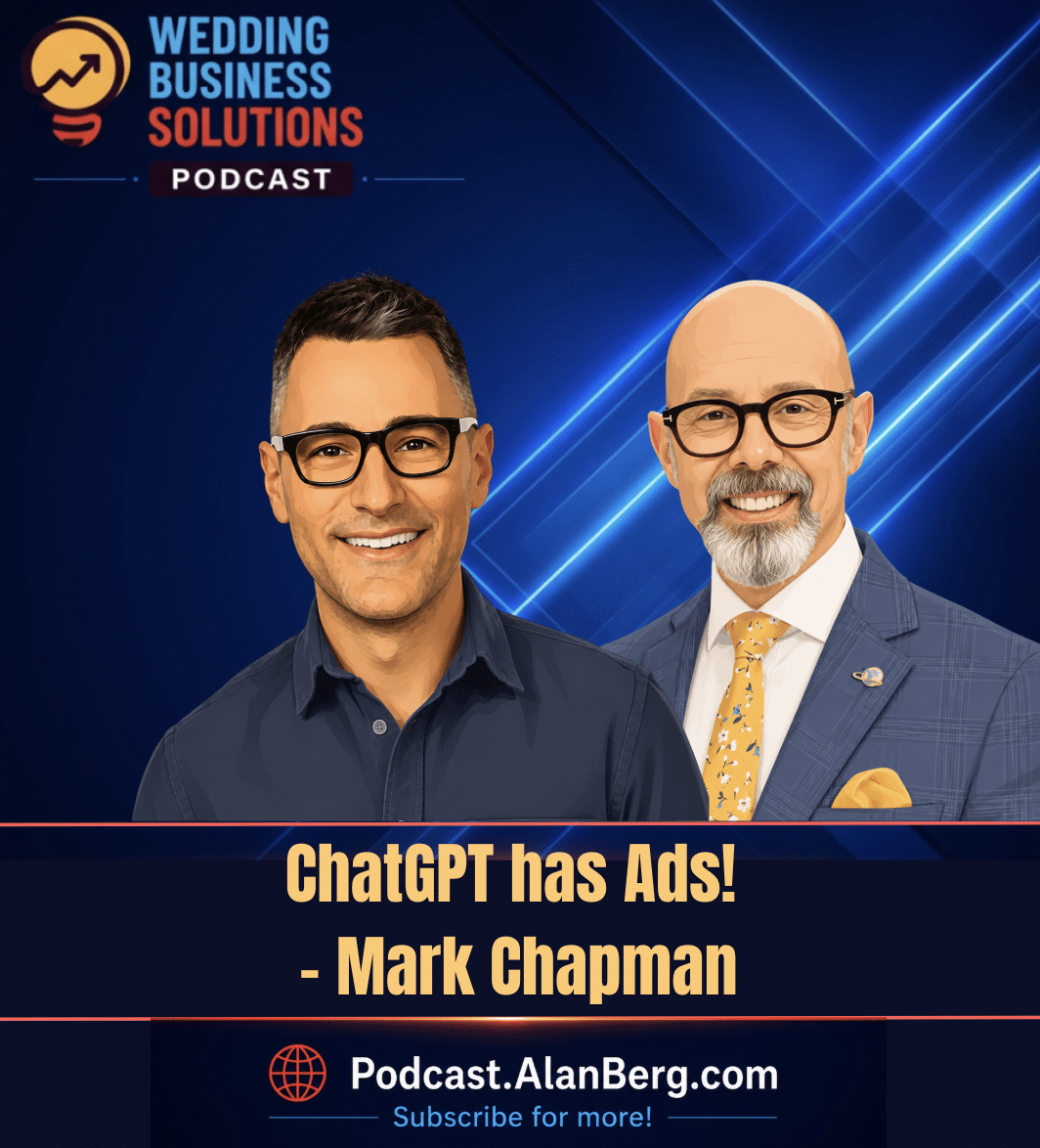
 Mark Chapman – ChatGPT has ads
Are your ads really connecting to engaged couples or just blending in with everyone else? What would happen if you could be the only ad a couple sees while researching their wedding plans on ChatGPT? How do you make sure your ad budget is working smarter, not harder, and actually delivers real results? In this guest episode, I welcome Mark Chapman back to break down the new ChatGPT ads, explore the best ways to target, test, and refine your messaging, and uncover what truly sets your business apart in a crowded digital landscape.
Listen to this new episode for actionable strategies to target better, craft standout ads, and make your marketing spend truly count.
About Mark
Mark is the wedding industry’s authority on paid advertising. His deep fascination with paid ads started way back in 2010 when he cracked the code of Google Ads for his family’s wedding business. After mastering ads for himself he started helping others > and fast forward to now, his team successfully manages $30M per year in paid ads for wedding businesses across the country. When he’s not studying advertising data and trends you can find Mark snowboarding, hiking and enjoying everything mother nature has to offer at his home in Mammoth Lakes, CA!
Contact Mark
Email: [email protected]
Text: (760) 647-0403
Web: TheIDoSociety.com
Socials: @theidosociety
If you have any questions about anything in this, or any of my podcasts, or have a suggestion for a topic or guest, please reach out directly to me at [email protected] or visit my website Podcast.AlanBerg.com
Please be sure to subscribe to this podcast and leave a review (thanks, it really does make a difference). If you want to get notifications of new episodes and upcoming workshops and webinars, you can sign up at www.ConnectWithAlanBerg.com
View the full transcript on Alan’s site: https://alanberg.com/blog/
Episode Summary
In this episode, I sit down with my friend Mark Chapman to dive deep into the brand new world of ChatGPT ads and what these mean for wedding professionals and business owners in our industry. We break down exactly how ChatGPT’s advertising works, including the types of accounts that see ads, budget minimums, and how the context hints feature shapes targeting. Mark Chapman explains where ads appear within user conversations, why there’s only one ad per conversation, and how this exclusive real estate can be a real advantage compared to more crowded ad platforms.
We get practical by discussing the process of creating strong context hints and why keeping them specific to your service or offer is so important, especially since ChatGPT is different from platforms that let you target age or other demographics. Mark Chapman walks through campaign structure, geographic targeting all the way down to zip codes, and how you can set specific ad runs for time-sensitive promotions like trunk shows. We also get into the creative side, including best practices for headlines, descriptions, and images given the tight character limits in ChatGPT ads.
We talk cost and ROI, addressing concerns about minimum spend, click pricing, and how to judge if your investment is yielding meaningful inquiries and bookings. Mark Chapman shares early campaign results, conversion tracking, and A/B testing insights, and together we highlight the value of differentiating your offer in a way that truly stands out. Most importantly, we emphasize that success comes from consistent testing, optimization, and embracing the natural delay between advertising and seeing actual sales in the wedding space.
By the end of our conversation, you’ll have a clear understanding of whether ChatGPT ads are right for your business, how to approach this evolving platform, and why being an early adopter can give you a competitive edge as more couples are using AI tools for their wedding planning journey.
ChatGPT has ads now. Ooh, what do we need to know about that? Listen to this episode and find out. Hey, it’s Alan Berg. Welcome back to another episode of the Wedding Business Solutions Podcast. I am so happy to have my friend Mark Chapman back on again, this time to talk about ChatGPT ads. How you doing, Mark?
I’m good. Always good to be here. There’s always so much changing in the world of paid advertising, so thank you for having me back. I can’t wait. Let’s talk about ChatGPT ads.
Well, I saw you posted about it, so I’m like, okay, you gotta come on and talk about this.
Okay.
Because we’ve talked about, you know, the other ads. We’ve talked about not having the phone field required and all these things that I’m quoting you when I’m out there.
Yeah.
But, you know, ChatGPT for a lot of people was a place that was another place that didn’t have ads.
Yeah.
But now it all of a sudden does. So first thing, just let’s clarify this. Is it ads only in the free version or is it ads also in the paid version?
Two versions of ChatGPT now show ads to users. That’s the free version and ChatGPT Go, which is the $8 a month version. The $25 a month and up, those versions do not have paid ads showing to users.
Okay. $25? I thought I was paying them $20.
Uh-oh. $20, $25, I forget. I’ve been paying them for a while.
Well, maybe it’s if you sign up annually instead of monthly or something.
I think that’s what it is. Yeah, yeah, yeah.
Yeah, I didn’t know they had an $8 version. So there you go. There’s that. ‘Cause I wasn’t paying attention.
It’s a win-win for everyone.
Yeah. I already have the $20 version. So the free version, I totally get it, right? If you’re getting something for free, they have to make money somehow. So this certainly makes sense. That’s why on Facebook, Instagram, LinkedIn, TikTok, Pinterest—
The internet is not free. Newsflash. Yeah.
Who was the one that said it? If you’re not paying to be there, you are the product, right?
Yes. That’s so true.
Yeah.
Your data and your information. It’s so true. Right.
They’re selling us. We were talking about that before, the algorithm and what shows up in my feed, this very eclectic set of ads that show up. So let’s talk about ChatGPT. So where do the ads show up?
Yep. So ChatGPT ads are really interesting because they show up at the bottom or just above someone’s conversation in ChatGPT. And one thing I’m gonna fast forward just a tiny bit really quickly. Because when we think about paid advertising, we’re like, we know Google Ads, right? It’s like three or four ads at the top of the search. On Instagram and Facebook, there’s a bunch of ads in your feed as you scroll through. Same thing with TikTok and other platforms.
The interesting and crazy thing about ChatGPT ads right now is there’s only one ad in the conversation. So it’s encapsulated, it’s unique to that user. Your ad is not competing against other people’s ads in that same space. And that’s a really big differentiator. And even though this platform is very new, we don’t have a lot of information yet, it’s really cool that that differentiator exists because a lot of couples are using ChatGPT to research and plan their wedding.
So is it then using their conversation to know that they’re a couple planning their wedding and that’s how it knows to place the ad?
Yep. So in a similar way to how Google works with keywords, ChatGPT uses what are called context hints. And there’s a box when you’re building your ChatGPT ads campaign and you put in context hints, and it’s really a little bit unclear at the moment what they’re looking for.
But, you know, same thing with Google keywords. If you are a wedding DJ in Toledo, Ohio, your context hint is going to be wedding DJ Toledo, Ohio, or wedding DJ Toledo, so that ChatGPT takes those context hints and matches them with the conversations people are having when they’re using the platform for their research and planning.
Okay, so from my standpoint, as someone who does business with the wedding professionals, my context hints would be different, obviously. What would I say then? Because these are people, again, this is, let’s just say the DJ in Toledo, Ohio. What are they? I have to figure out what they’re using chat for to know how to hint it.
Right. Like in your case, it would be like wedding business sales or wedding business marketing. You know, the service that you provide and dumbing it down in a way and making it a little bit more broad. But yeah, that’s the context hint for ChatGPT.
Could I ask ChatGPT to make the context hint for ads that I would buy?
Yeah, we’ve totally played around with that. Actually, it’s kind of funny because it’s super meta and super full circle. But yeah, you could totally ask ChatGPT, hey, what context hint should I put in my ChatGPT ads campaign? This is my business. This is my website. Have at it.
And honestly, I think because ChatGPT context hints in the ad platform are very unclear of how they’re using them, it’s a fine practice, but we really don’t know if that’s the best practice just yet.
It’s going to evolve like anything else. And sometime between when we record this and when people are actually hearing it, the algorithm has changed 1,000 times.
So, so true. Yeah. Welcome to digital marketing.
So what’s great about that is, like you said, there’s one ad. You’re not competing against the other ads. It is very much in context. Which in a perfect world, it’s putting in front of people something that they need, right? That’s what it’s doing. So let’s talk about cost. How do you buy these? Is this by impressions, by clicks, by what?
Yeah, ChatGPT Ads has a minimum budget of $25 a day. So you have to spend $25 a day. That equates to $750 a month. So it’s not the cheapest ad platform, but that minimum budget was like $200 a day just about two months ago. So they’ve lowered it, they’ve made it more reasonable, and I wouldn’t be surprised if that goes lower in the near future.
But at the moment, $25 a day is the minimum. And just like any other advertising platform, you basically pay per click. The campaigns that we’ve built and we’re testing right now, we’re seeing that if clicks don’t happen, the full budget isn’t spent.
So if people do click on your ad and it’s relevant to them, it is spending the budget. But then sometimes, if the context hints aren’t quite there, or that’s not matching up with enough people in your area where you’re targeting, the whole budget isn’t spent.
And so it’s kind of neat because ChatGPT is working to ensure that if your ads are shown to someone who’s relevant and they click on it, you pay. But if there’s not enough people or it’s not relevant in that moment, it doesn’t show and you don’t pay.
So how do they determine how many clicks it’ll take to use up your budget?
Yeah, that’s the mystery of every advertising platform. You can set click limits though. So for example, we’re seeing right now that a click limit of about $4 a click is high enough to make sure that your budget gets spent and enough people see your ads, which is kind of expensive, I’ll be honest.
But considering that the ads are very targeted, very encapsulated and very unique, and you’re the only one there, it’s not a bad deal compared to like $2 a click on Google where your ad is shown among everyone else. And Google’s more utilitarian. ChatGPT is more emotional and more people are more invested in that conversation.
Yeah, I’ve spoken about this. I think I did a podcast recently about this, about not using the word expensive, right? Because expensive means you didn’t get a return. And I remember hearing about how lawyers—we’ll call them the ambulance chasers—they’re paying $50 a lead or more because the value of that is so much higher.
Well, if you’re charging $1,000, $2,000, $5,000, $10,000, $20,000, $4 a click isn’t a lot if it’s working.
True. That’s so true.
And, you know, every click isn’t going to work. So how many clicks to make sense? But so many people, they think, oh, well, again, it’s the internet, it’s cheap.
And here you’re talking $750 a month, which, you know, you said it’s kind of expensive. My comparison is I’m thinking it’s not expensive compared to other things to put yourself in front of the right audience.
Yeah.
Because you don’t buy ads, right? You don’t help people buy ads. You help them get in front of the right people. The ad just happens to be the medium, just as a billboard is a medium or a TV ad is a medium, or the Valpak that still shows up. Not that everybody checks their mailbox, but it still shows up.
What’s a mailbox? Just kidding.
Well, a little sidebar. I’ve already talked about how we have a new grandson as of April 7th. We stayed out in California and I would go do the laundry, which is really funny ’cause I don’t do it at home. Apparently I don’t do it correctly, so I’m not allowed to do it at home.
But I would go do the laundry for the baby, for ourselves, for my son and daughter-in-law, and I would check the mailbox. And the mailbox was stuffed with stuff. And a lot of it was junk, of course. But there was stuff in there. Like, you know, there were statements or checks or whatever in there.
And I was like, do you guys ever check your mailbox? They’re like, no, not really. I’m like, they said everything comes digitally. I said, well, clearly not because there’s stuff in there.
There’s stuff in the mailbox. Yeah.
And, you know, things like my mother-in-law still likes to send out a check with a birthday card, right?
Yeah.
And it drives her crazy that my son doesn’t cash the checks. You know, my son who’s a CFO who doesn’t cash the checks, and they just sit there. They just pile up. And he tells her, listen, I’ll get to it at the end of the quarter. And she’s like, wait a minute, what do you mean the end of the quarter?
What does that even mean, man?
Do this. She’s 87. Like, just do this now.
All right. So what do people need to know about chat ads? Somebody catches you in the hallway at Wedding MBA and says, okay, Mark, what do we need to know about these ChatGPT ads?
Got a quick bullet point list. $25 a day is the minimum. You got to commit to that at least right now. You can target by state, by DMA region, which is designated market area. So like a greater Toledo, Ohio region, or by zip code. So you can get pretty specific when it comes to geographic targeting.
You can set start and end dates for campaigns. So there’s a lot of businesses in our industry, right? Like bridal stores that are doing a trunk show or something like that. So they have short-term campaigns, that’s possible with ChatGPT ads, which is—
So it’s $25 a day, but there’s no day—how many days minimum do you have to do that?
No, there’s no minimum number.
Okay.
Like there’s no boundaries on that. You can do it for—
You could do a one-day sale.
You can do a one-day sale.
It probably wouldn’t benefit you to do that, but yeah, yeah, yeah, we’re on the same page. So you can set start and end dates. They show on the free version and ChatGPT Go, the $8 version, and then context hints are really the foundation of these ads.
The last little bullet point is the ads are very simple. You have the headline, which is 50 characters long at most, a description, which is 100 characters long at most, and an image. There’s no video, there’s nothing else. They’re super, super simple.
So it’s really, really important to get that headline, description, and image correct.
Okay. Now, where do you recommend that they then link? Because there’s a link, obviously, right? If somebody clicks on it. So you can send it wherever you want, correct?
Yep. So it depends on what you’re advertising. Let’s do an example of a bridal store. We’ll do a couple different examples for businesses in our industry. Let’s say you’re a bridal store and let’s say you’re running a ChatGPT ad campaign for plus-size wedding dresses. Link it to your plus-size inventory on your page, right?
Right.
Let’s say you are a multi-op DJ company and you’ve got DJ services, you’ve got photo booth, you’ve got lighting, and you’re gonna advertise DJ services and your photo booth in ChatGPT ads. Your photo booth ads, your context hints are all about photo booths. It’s not about your DJ services, and it links to a photo booth landing page on your website.
Your DJ ads are all about being a DJ. They’re not about your photo booth services, and they link to your homepage or to a specific page about you as a DJ on your website. So being very clear about what you’re advertising and leading them down a specific path to the page on your website that is that offer.
What about using a landing page instead of one of the pages already on your site?
Yeah. Landing pages could be, to be honest. So ChatGPT, like one part of this conversation is ChatGPT has just opened up to everyone in June. So I don’t have enough data to tell you use a landing page with an offer versus your homepage right now, because ChatGPT is quite general and we don’t understand in depth what context hints do.
I would say send people to your homepage or a specific page on your website that matches the product or service that you’re offering and don’t worry too much about creating an offer there.
Yeah. Now, this is a side discussion because, you know, take that multi-op DJ that does DJ, lighting, photo booth, etc. They also do weddings and corporate and mitzvahs and proms and all these things.
So my preference of their website is that the website has a wedding page that talks about all the things that they do, right? Instead of the services split. But you could still create a landing page because, remember, that DJ is putting an ad out for weddings for DJ and photo booth. You could now create a page on your site that talks about weddings just for this purpose, even if you don’t have one right now.
Yes.
So let’s go back to the targeting there. I love that the geographics, man, you can get down to a zip code. That is very, very specific. And again, DMAs, if you don’t know it, it’s the greater X area, right? The greater metropolitan Toledo area, the Quad Cities, the whatever, that kind of thing.
Yeah.
So the three things I always talk about with ads is, so you have the geographics, you have the demographics. So this is gonna have to be in your hints, right? We’re looking for people that are—now, would you get down to age demographics? You say I’m looking for people 25 to 35 who are currently engaged.
It doesn’t offer that just yet.
Doesn’t offer that. Okay.
It just offers context hints, which is why it’s really fascinating.
Okay. And then the psychographics of it is, why would they pick you instead of another photographer, instead of another dress shop, instead of another whatever? But again, it sounds like you can’t quite get there yet either the way you could on Facebook, let’s say, or something like that where you can put in these other things. People that follow Equine Today and are engaged, they’re my horse people who are engaged.
Yep. You know, and there’s so much information that people put out about themselves on Facebook and Instagram, which is why the demographic targeting is so much more clear there.
Where ChatGPT, you sign up and maybe they know something about you, but you’re not sharing your personal life. You’re not giving ChatGPT’s algorithm information about what you had for dinner last night. And maybe it knows for other reasons, but like—
Okay.
That’s a great point. So the demographic options in the ad platform that we’re discussing now don’t exist, which makes the context hints super important. And I can’t emphasize enough, the hill that I’ll die on, or beating it as much as I can, is making sure that your context hints are super related to the page on your website and your ad itself.
DJ services, DJ services, DJ services. Photo booth, photo booth, photo booth. Don’t mix those things because no one in ChatGPT is talking about both of those things at the same time.
Right. They’re talking about their wedding and different things there.
Now with the free version or the $8 version, is Chat remembering the other conversations that it had so it knows that you’re asking about organic cat food and things like that? Because it may not be in that particular one where they’re trying to find the best fill-in-the-blank, officiant or videographer or whatever.
But if it also knows that you’ve searched organic cat food and whatever, this is getting into some of the psychographics. I know with mine, I have memory turned on, so it does remember, but mine are supposedly private. We’ll find out about that.
Yeah, yeah.
Is it able to target based upon all of their, however they’ve used chat?
They have not explicitly said that.
Okay.
So the answer is probably yes, because I think, you know, by default everyone leaves their memory on. Most people are not like, oh, I want a fresh ChatGPT, you don’t know me, conversation every time. That doesn’t really make sense for anyone.
So people are leaving that on. And when you sign up for any of these platforms, you don’t read the agreement, the legal agreement, but you’re literally agreeing to let them use your data in any way that they want. So they don’t explicitly say it, but, you know, I think you and I know the answer.
Yeah. Yeah. And I actually have with Gemini, I have it turned off that it’s not going to do that and it can’t train the model with what I ask it, even though I do have a paid version there.
But with my chat, I have it turned on because I wanted to remember. And I have custom GPTs and I have projects that I’ve set there and Perplexity. But I’ve done some research and some things in Perplexity and then I’ve deleted those, because I might be showing up on a screen and I don’t want it necessarily showing something personal that was searched on the screen.
You know, my wife might say, hey, search this new drug that the doctor told me about or whatever. I’ll be like, okay, here’s your info. Take, you know, get rid of it. Or what the old joke, you know, a good friend comes to your funeral, a really good friend clears your browser history.
That’s awesome. That’s so true.
There’s a question that folks might be asking about, like when they hear, oh, it only shows up on the free version or the $8 version. In terms of like, oh, that’s probably not my target audience or those aren’t my people.
But I want to actually dispel that myth because there’s probably some people who are paying for Claude, but not ChatGPT, but they’re using ChatGPT too. So I think that we’ve had this conversation with some folks like, oh, it’s not my audience, but I actually disagree because you don’t really know why someone’s paying or not paying for a tool like this.
Well, I would say you’re spot on, but I’m going to kind of call out to people listening here, because when I’m in a room and I’m saying, okay, who’s using AI? A lot of hands go up. I say, okay, who’s paying to use AI? And most of those hands go down.
Yeah.
So, you know, think about yourselves. If you’re using the free version of ChatGPT yourself, why would your couple not be doing that or your client not be doing that? Because not everybody sees the value. That’s what I do in my AI workshops is I show people how to use these tools better. And people are like, listen, you’re getting more than $20 worth of value.
Yeah.
So give it back. But if you’re just occasionally dabbling and you have the free versions, right? I pay for ChatGPT, I pay for Perplexity, I pay for Gemini, I pay for Claude through Ask Alan Anything. That’s what’s powering it right now, which actually costs me a lot more.
But, you know, I believe if you’re getting value, you should give value. And I get way more than $20 in value, and especially since OpenAI said I was in the top 3% of all ChatGPT users last year.
There’s also a lot of context. Someone may have a paid version of ChatGPT through work and they use it a lot in their life, but they’re like, well, I’m not going to pay for it at home because I don’t need it enough to pay that $20 a month, even though I have plenty of money, because people with money love saving money just the same as people without money.
So there’s so much context to that that I’m glad we’re having this conversation about dispelling that possible myth.
No, I think there’s more people obviously using it free than not, otherwise they wouldn’t come up with this platform.
Right.
It wouldn’t make any sense if that wasn’t the case. And the—what’s the word—freemium, right? It’s a freemium platform, which is there’s a free version and a premium version, and then there’s super premium versions and all those things there.
And, you know, I think we all dabbled with it free first. Let me see what it is and see what’s going on. And think about a couple who’s—well, actually, we know they’re using AI because we know that The Knot has their own, I’m not even sure what it is. It is a custom GPT or prompts or something that they’ve created. I haven’t looked to see where to find that in there.
But obviously, they think couples are going there and using it as well. So if that couple is going there and using it, well, if they’re not thinking so, then you should probably think so as well.
Because they’re doing their homework on a much larger scale.
Much larger scale. Okay, so now, have you been using this already for some of your clients?
Yeah, since day one. It was early June that they opened up the $25 a day minimum budget, which allowed it to make it reasonable for our clients.
Right.
So yeah, we’ve been using it since day one with different categories of businesses in our industry. What we’re finding is that the click costs are a little bit higher, like we talked about.
Click-through rate, which is a measure of how many people saw your ad versus how many people clicked on it, click-through rates are really similar to Meta ads. So Facebook and Instagram ads, very, very similar, which is really good.
And then also we set up conversion tracking and we’re seeing conversions come through where people go to the website, fill out the form, book a meeting or whatever. We’re starting to see those come through now, which is really cool in such a short window of time.
Which is why I’m so freaking excited about this and passionate about this. There has never been an ad platform that just showed up on the scene and delivered results to wedding businesses this quickly. And it’s really crazy to see how it might evolve.
And I know it’s not perfect at the moment, but I’m just really passionate about it. And I think it’s crazy to see that leads are coming through within a few weeks of this ad platform even existing, which is mind-blowing to me.
So let’s talk about best practices. So you have 50 characters and then 100 characters, you have an image. And is the image square, rectangle, vertical?
It’s a square with rounded corners and it’s like the size of your thumb and it’s really tiny.
Okay. So hard to show a lot of detail, which says do not show something that’s got a whole lot of detail in it because they’re not gonna be able to see it. And I would say, you know, go on your own phone and take a look at these, which I guess if you’re paying, you won’t be able to do.
But you could go to Google, do a Google search for it and you can see.
See how small that is. So 50 characters. Again, we have the context hints. I know you do A/B testing, ABC testing and stuff like that. Anything standing out working better in terms of headlines?
Putting your location as the first word of your headline.
Okay.
A lot of couples, when Instagram figures out they’re engaged, they start seeing ads. And so many wedding businesses—I’m going to get to the specific answer in a second, but there’s context to it—so many wedding businesses set up their ad campaign on Instagram, they do it wrong, and they don’t understand the geo-targeting or whatever.
And these couples see ads for businesses or venues or whatever that are actually nowhere near them or not relevant to them.
Right.
So they’re really kind of burnt out. And what we’ve found, whether it’s Instagram ads or ChatGPT ads, whatever, putting the location, putting your location, your city, whatever region you’re doing business in as the first word of your headline makes it relevant to that couple immediately.
And then you follow that with whatever you’re offering them. So Toledo wedding DJ. It’s so not sexy, but I promise you it is literally the most relevant thing to them in that moment.
Don’t try to be swirly, twirly, and floofy. They just need to know, hey, here’s a wedding DJ option in my area that ChatGPT is recommending to me. And ChatGPT knows everything that I want, all my emotions, all my feelings. And it’s really powerful to make that connection.
And geography is the way to make that bridge. And it sounds crazy, but that’s what works.
So 50 words or 50 characters for the headline?
50 characters.
50 characters.
You have like four words.
Yeah, four words and not big ones. No Double Jeopardy words going on here. Okay. And then the message itself was 100 characters.
It’s called a description and it’s 100 characters.
Right. So if you remember the early days of Twitter, it’s less than that.
Yeah, exactly.
They had 140.
They had 100.
That’s characters and spaces, right?
Yeah, it’s characters and spaces together. So a space counts as a character.
Right. Yeah. So it’s not 100 words, it’s 100 characters. You need to really hit them. So, okay, we put Toledo wedding whatever, Toledo wedding officiant, photographer, invitations, whatever. And then in the message, what are we gonna say? We’re an officiant in Toledo, Ohio.
Okay. You’re gonna immediately say what makes you different.
Here’s the context to that. There’s a book I read recently. It’s by Pete Martin, and I feel like I forget the name of the book at the moment. Sorry. So he studied businesses that grew solidly and quickly and compared them to businesses that were stagnant.
And what he learned was that in those businesses’ marketing messages, the businesses who shared what made them different, not what made them better, were the ones that succeeded and grew faster.
So his phrase, which I’m saying like a million times a day, is different is better than better.
Tell people in the description of your ChatGPT ad what makes you completely unique. What is it that you offer that people can’t get anywhere else? Because if you just say, oh, you’re going to have a great experience with us, you’re going to have a better experience with us, that is completely subjective to people.
And if you’re asking me to pay you several thousand dollars and for you to show up on the most important day of my life, you better give me a good experience. That is not a differentiator. That’s not motivating.
Table stakes.
So stop saying that you’re better. Stop saying that you have a good experience and tell people what makes you different.
Right. Which is what we do in the workshop, is using the reviews. And when we do competitive analysis, we say, listen, let’s take your great competitors, the ones that get 5-star reviews, probably your friends, and let’s use AI to find what’s different about your results.
Because like you said, better is subjective. And since you’re doing a wedding that no one else will ever get a chance to do, we’ll never know if you did a better job. You only know that they perceive that your results will be better and that’s why they chose you.
So I guess one way to look at it is if whatever you said there, your competitors could say the exact same thing—
You just wasted $4 every time.
Every time, you just wasted $4 or $25 that day because you just kept running that same thing over there. And then try different things, right? Just test different ones.
There’s a lot of things that differentiate our businesses. And I know it’s really hard as a business owner to come up with those things because you have it all in your head. But you’re right, having someone help you determine what makes you different is—and test those things, test those differentiators.
Yeah. And again, we use the reviews, excuse me, because the reviews talk about the results from the perspective of the person who got the results. I mean, that’s what it is. And now it’s distilling that down. And again, you can use AI for some of that stuff.
So let’s talk about the backend, the platform of this. Somebody makes an ad, can they have different versions? Can they do their own A/B testing?
Yeah, they can. Yep. It’s really cool. You can put as many ads as you want.
The structure of a ChatGPT ads campaign is this: you have a campaign where you choose your location and your budget. Really simple. Then you have ad groups underneath, and ad groups are where you delineate your products or your services.
Wedding DJ as an ad group, photo booth as an ad group, plus-size wedding dresses is its own ad group. Justin Alexander wedding dresses is its own ad group. So you get the idea.
You’re differentiating your products and your services at the ad group level. And that’s where you put in your context hints, at the ad group level.
And then the ads themselves, you can make as many as you want. A little bit of what’s annoying about ChatGPT ads at the moment is you can’t duplicate ads. Like, you actually have to create each one manually. And I don’t understand why they launched an ad platform without a duplicate button, but here we are.
So create four to five different ads if you have the time. Create three at the minimum, but create more if you can.
And does it automatically rotate those? Is that how it goes?
It says that it does.
But we’ll never know ’cause we’re not on the receiving end.
We don’t know yet. But we do see in the campaigns, if you have like four or five ads in an ad group, that they all are getting impressions.
Okay. And have you noticed a difference when you had four or five different ads? Have you noticed some performing better?
Yeah. These ad platforms want to make sure that the users are having a good experience too. So when they identify an ad that works better than another ad, they’re gonna keep showing the one that works the best. Because their user experience is equally important as you getting results.
So that we don’t have to do that manually to say this one’s working better, I’m going to have that show more. But we could go and create a new ad that’s something similar to that and say, oh, well, let me see and let’s see what bubbles that up. And that’s why you have to be an active participant.
You know, you can’t always be testing. Always be testing. Don’t let it stay stagnant.
Right. Or have Mark do it for you.
Amen.
Well, you know, all of this is evolving. And what I love about your business is it’s so specific to the industry, ’cause other people do what you do for other industries.
Yeah.
Right? I was talking to somebody recently about, have you been found on AI? Have you gotten business from AI?
Yeah.
And there’s a venue here in New Jersey that found me on AI. And he told me, he said, there’s somebody in India that does something like what I do, but they do it for other businesses in India.
And he went into AI and he said, okay, this guy over here, I want somebody like him, but for my business here in the United States. And he brought me in for a day of sales training.
That’s cool.
And it was, give me somebody like that, but give me over here, right? So, you know, just finding that thing. And I work outside the industry when I’m asked. I don’t look for it. And nine of my 16 books will work for any business.
But that’s because what I talk about, like what you talk about, you could do this for somebody else. But you do it for the industry, means you understand. Like, how many other people would say Justin Alexander? You know, they’d say a dress shop, but they wouldn’t say Mon Chéri or Justin Alexander or whatever.
Yeah.
Because you understand the industry and that’s—
We really love being industry specific. I’ll be honest. There’s a whole story of why I used to be a wedding photographer. It’s a whole story of how it came to be.
But I have sat in the chair of a wedding business owner. I was the wedding business owner, and I’ve sat across from couples and I’ve had those hard consultations and I’ve tried to sell them stuff.
And I think what I’m so proud of having built is that I took that experience and I solved a problem for other wedding business owners that’s really difficult because I know what it’s like to be in their chair.
And I’m forever grateful for all those hard conversations and being a wedding photographer. It was really wild, but I’m really glad to be industry-specific because I know what it’s like.
Right. And that’s the key. So whether or not you should do this, this comes down to you in terms of what you’re trying to accomplish. Notice I didn’t say your budget. I said what you’re trying to accomplish.
Yeah.
Because I don’t want you to say $25 a day is expensive, right? Because I never judge something by the cost. Although right now I understand you, everybody listening, you’re comparing this to zero.
You’re not comparing this to Meta ads and Instagram ads or whatever, because you’re not doing this now. Means you’re comparing it to zero. So you have to say to yourself, do I need more inquiries than I’m getting now?
Yeah.
What is my possible return? And then if you were trying to say to somebody, okay, they’re trying to get their head around, it could cost me $750 this month, right? What’s a reasonable thing to say if I invested $750? If I return at least X, I can consider this successful?
Because some people would say, well, $750, you paid for it. I said, but you’re no better off than you started, right? So what do you do? Any kind of multiple? Twice, three times, four times, five times?
I mean, I’m gonna play devil’s advocate for a minute because even if you made $750, let’s say—we’ll use a bridal store example again. Let’s say you sold two dresses or one dress and you actually made the $750 back.
You also have a chance to have that person refer business to you, to her friends refer business to you. So I think advertising is a little bit tricky in our industry because we’re not selling products that equate to immediate sale.
The span of time that it takes from someone to discover that you exist, book a meeting with you, and then write a check is months and months and months.
And so oftentimes wedding business owners come into paid advertising with this mindset of like, oh, I’m going to spend $750. I need to know that I made it back right away.
It’s just not how couples shop. And there’s no way around that.
So if that’s your mindset, you either have to not advertise and live in that mindset or give up that mindset and say, hey, you know what? I’m going to invest in my business and making more people know that my business exists and more people know what makes me different from the competition and keep on it for the long haul.
So I apologize if there’s not a perfect financial answer there, but it really comes back to the fact that the span of time that it takes from couples’ discovery to writing you a check isn’t something that’s trackable like selling a $10 dog leash through a TikTok ad.
Right. And let’s face it, for most wedding professionals, they charge more than $750.
Yep.
Right. Most, not all. And that’s not profit. Even if we go with profit there, most wedding professionals could profit before expenses $750 on one sale.
Yeah.
But that’s been forever. The ad salesperson’s thing is like, you only need one to pay for this. There you go.
Yeah.
But I always say, listen, are you getting enough leads? Right? Because, you know, I speak about conversion so much because so many people just aren’t following up with the leads they’re getting.
Right. Which is a whole other discussion for another podcast.
Yeah.
But, you know, this could be good for you because it’s new. It’s new, which means a lot of your competitors are not using this right now.
You’re going to have to figure it out. If it doesn’t work for you in the first few weeks, it doesn’t mean it doesn’t work. It could mean it’s your ad that’s not working. Change the copy and stuff like that.
It really is, like not just ChatGPT, but any advertising platform. You’ve got to be in it for the long haul because it’s just not an immediate one-to-one scenario.
And that’s okay, right? The more couples we reach over the long term, even if you do some sort of math like that and you got your money back, you also have people that are going to refer business to you, and there’s a lifetime value of that customer that well exceeds whatever money you spent on the paid ad campaigns.
And it’s also the name recognition. They see it, they see it, they see it. There’s name recognition there as well.
If you look at just standards in terms of if you’re a new business versus an established business, how much should you be spending on advertising and marketing? The number that I’ve heard forever is if you’re trying to grow your business, investing 10 to 15% of your anticipated revenue is what you want to look at.
And once you’ve established that, you could back off a little bit. But let’s face it, Coca-Cola advertises and FedEx advertises and UPS advertises and Target advertises. Not like we don’t know their names, right? But it’s staying top of mind.
Yeah.
Most wedding professionals, if you look at how much you’re actually investing in paid advertising and marketing to get in front of the right audience, it’s way less than 10 to 15% of anticipated revenue. Remember, not your revenue today.
Yep.
Anticipated revenue. So if you’re trying to do $100,000, that’s $10,000 to $15,000 invested. And I just heard some people fall off their chairs.
Yeah, yeah, I know, I know. That equation is a super old-school way of thinking though. Like, it’s really just all about getting in front of couples multiple places, multiple times and whatever you can do to do that.
Yeah. But it’s still about ROI, right? It’s still about ROI. So if you’re trying to grow your revenue and you’re growing your revenue doing what you’re doing, it ain’t broke, don’t fix it.
Amen.
But if you’re not, or as a lot of people are finding these days, what used to work isn’t working.
And yeah, yeah, we are in a time of massive, massive change. That’s a whole conversation too, right? Everything is changing. What couples want is changing. That’s always changed.
The tools that they’re using changes. The information—yeah, yeah, yeah, it’s all changing.
All right, we got to cut this off. Got to cut this off. But I’ll have you back. I’ll have you back again.
Mark, thank you so much. The show notes will have Mark’s contact information. Again, it’s the iDo Society. Mark has generously offered, if anybody wanted to have a consultation with him, there’ll be a link in there.
He’ll give you 30 minutes to tell you about this, tell you what you’re doing. And, you know, if you want to ask him, pick his brain, there you go.
So thank you again for that. And Mark, thank you so much for joining me, and I’ll see you at Wedding MBA.
Thanks, Alan.
I’m Alan Berg. Thanks for listening. If you have any questions about this or if you’d like to suggest other topics for “The Wedding Business Solutions Podcast” please let me know. My email is [email protected] or you can text, use the short form on this page, or call +1.732.422.6362, international 001 732 422 6362. I look forward to seeing you on the next episode. Thanks.
Listen to this and all episodes on Apple Podcast, YouTube or your favorite app/site:
- Apple Podcast: http://bit.ly/weddingbusinesssolutions
- YouTube: www.WeddingBusinessSolutionsPodcast.tv
- Spotify: https://spoti.fi/3sGsuB8
- Stitcher: http://bit.ly/wbsstitcher
- Google Podcast: http://bit.ly/wbsgoogle
- iHeart Radio: https://ihr.fm/31C9Mic
- Pandora: http://bit.ly/wbspandora
©2026 Wedding Business Solutions LLC & AlanBerg.com
Question
How do ChatGPT ads differ from Google or Facebook ads?
Tags:
#advertising #digitalmarketing #chatgpt
Answer
ChatGPT ads show up as just one ad per user conversation, so you’re not competing with others in a cluttered space. This means your ad stands out and is highly relevant to what the user is talking about, instead of being one among many in a feed or search results.
Takeaway: One ad per conversation lets you own the spotlight.
Question
Where do ChatGPT ads appear for users?
Tags:
#ads #placement #digitalmarketing
Answer
ChatGPT ads appear at the bottom or just above a person’s conversation inside ChatGPT. It’s a unique placement—right where people are actively researching or planning, instead of passively scrolling.
Takeaway: Ads show up exactly where conversations and decisions happen.
Question
Who actually sees ChatGPT ads?
Tags:
#advertising #targetaudience #ai
Answer
Ads are shown to people using the free and $8 “Go” versions of ChatGPT, but not to those on the higher $20+ plans. Don’t dismiss these audiences—many users (even business owners!) stick to the free tier.
Takeaway: Don’t underestimate free users—they’re often your real audience.
Question
How does targeting work for ChatGPT ads?
Tags:
#targeting #ads #context
Answer
Targeting uses “context hints”—phrases or keywords relevant to your business. It’s not about detailed demographics or interests; it’s about matching what people are talking about in their conversations.
Takeaway: Context hints create relevance where it matters most.
Question
What’s the minimum daily budget for ChatGPT ads?
Tags:
#budget #ads #digitalmarketing
Answer
You have to spend at least $25/day, which comes out to $750/month. There isn’t a required minimum number of days, so you control how long to run your campaign.
Takeaway: $25/day is the ticket in—plan your spend for results.
Question
Are ChatGPT ads pay-per-click or pay-per-impression?
Tags:
#ads #budget #strategy
Answer
You pay per click. If your ad isn’t clicked, you don’t spend your full budget. The cost per click is higher than Google, but you’re not competing for attention in a lineup of ads.
Takeaway: Pay only for engagement, not just eyeballs.
Question
What’s the most common mistake people make with ChatGPT ad content?
Tags:
#adcopy #differentiation #digitalmarketing
Answer
Focusing on how you’re “better” isn’t enough. In your 100-character description, you have to say what actually makes you different—something your competitors can’t easily claim.
Takeaway: Speak to your difference, not just your quality.
Question
What works best in a ChatGPT ad headline?
Tags:
#copywriting #ads #bestpractices
Answer
Start with your location. Leading your headline with the city or area you serve immediately signals relevance and grabs attention from couples searching in their area.
Takeaway: Location first makes your ad instantly relevant.
Question
How much detail should I include in my ad image?
Tags:
#ads #visuals #design
Answer
Keep it simple. The image is tiny—a square about the size of your thumb. Avoid clutter and make sure it’s crystal clear even at a small scale.
Takeaway: Simplicity wins—make it legible even when tiny.
Question
Can I run short-term or one-day campaigns with ChatGPT ads?
Tags:
#campaigns #ads #events
Answer
Absolutely. You can set custom start and end dates, making it a great fit for quick events like trunk shows or short-term promos. There’s no required minimum run.
Takeaway: Run campaigns as short or long as you want—total flexibility.
Question
Should I link my ad to my homepage or a specific landing page?
Tags:
#webstrategy #ads #conversion
Answer
Always link to the page that exactly matches your ad’s promise. If you’re promoting plus-size wedding dresses, link directly to that collection—not your generic homepage.
Takeaway: Match your ad’s message to the exact landing page.
Question
Can I target really specific locations with ChatGPT ads?
Tags:
#targeting #localmarketing #ads
Answer
Yes, you can target by state, DMA (like a metro area), or even zip code. That gives you detailed control over where your ads show up.
Takeaway: Pinpoint your audience as broad—or local—as you want.
Question
Do context hints go beyond keywords?
Tags:
#ads #targeting #ai
Answer
Context hints are currently the only way to target, and they’re broader than keywords but less specific than traditional demographics. They guide the AI to match your ad with relevant conversations.
Takeaway: Think like your customer—what would they type to find you?
Question
Can I rely on instant ROI from ChatGPT ads?
Tags:
#ROI #ads #expectations
Answer
Instant results are a myth in wedding industry ads. It can take months from an inquiry to a sale. Don’t judge your campaign just on what you make this month—factor in referrals and long-term value.
Takeaway: Play the long game—ROI unfolds over time.
Question
How often should I test or update my ads?
Tags:
#ads #optimization #testing
Answer
Always be testing. Don’t set it and forget it. Create multiple ad versions, see what performs best, and keep iterating so you don’t stagnate.
Takeaway: Testing fuels growth—keep refining your approach.
Question
Is the $4 per click cost worth it?
Tags:
#ads #budget #value
Answer
If you’re charging thousands per sale, $4 a click is a small price for qualified leads. Don’t worry about “expensive”—worry about what delivers results.
Takeaway: Judge value by what you earn, not what you spend.
Question
Should I use the same landing page for different services?
Tags:
#ads #webstrategy #conversion
Answer
No. If you advertise DJ services, link to your DJ page; if it’s a photo booth ad, link to your photo booth page. Mixing services dilutes your ad’s impact.
Takeaway: Match every ad to a focused landing page for best results.
Question
How detailed should my context hints be?
Tags:
#ads #targeting #chatgpt
Answer
Be specific and repetitive. Don’t mix different services in one ad group. For example, keep “DJ services” and “photo booth” separate, and use those hints repeatedly for clarity.
Takeaway: The clearer your context, the better your targeting.
Question
Does ChatGPT remember users’ past conversations to target ads?
Tags:
#ads #privacy #ai
Answer
ChatGPT hasn’t explicitly confirmed how much history it uses, but if users haven’t disabled memory, it’s likely factoring in their chat history to choose relevant ads.
Takeaway: Your conversations may inform the ads you see—assume smart targeting.
Question
What’s the difference between “better” and “different” in ad messaging?
Tags:
#positioning #ads #marketing
Answer
Saying you’re “better” is subjective and unprovable. “Different” is concrete. Tell potential customers your unique angle—what you offer that nobody else does.
Takeaway: Different beats better—make your uniqueness obvious.
Question
Can I run A/B tests with ChatGPT ads?
Tags:
#ads #testing #optimization
Answer
You can create multiple ads within an ad group, and the system rotates them, favoring the best performers over time. Just note you’ll need to create each version manually for now.
Takeaway: Multiple ad versions reveal what your audience actually responds to.
Question
Does it matter if I’m not the first to use ChatGPT ads?
Tags:
#timing #competition #digitalmarketing
Answer
It definitely helps to start early. Most competitors aren’t using ChatGPT ads yet, so it’s your chance to reach couples with less competition and gain brand recognition early.
Takeaway: Early adopters grab attention before the crowd shows up.
Question
Is $750/month too much to invest in ChatGPT ads?
Tags:
#budget #roi #advertising
Answer
If even one sale covers your ad spend, you’re ahead. The real win is in extra referrals and long-term branding. Think return, not just the upfront number.
Takeaway: Focus on results, not just the price tag.