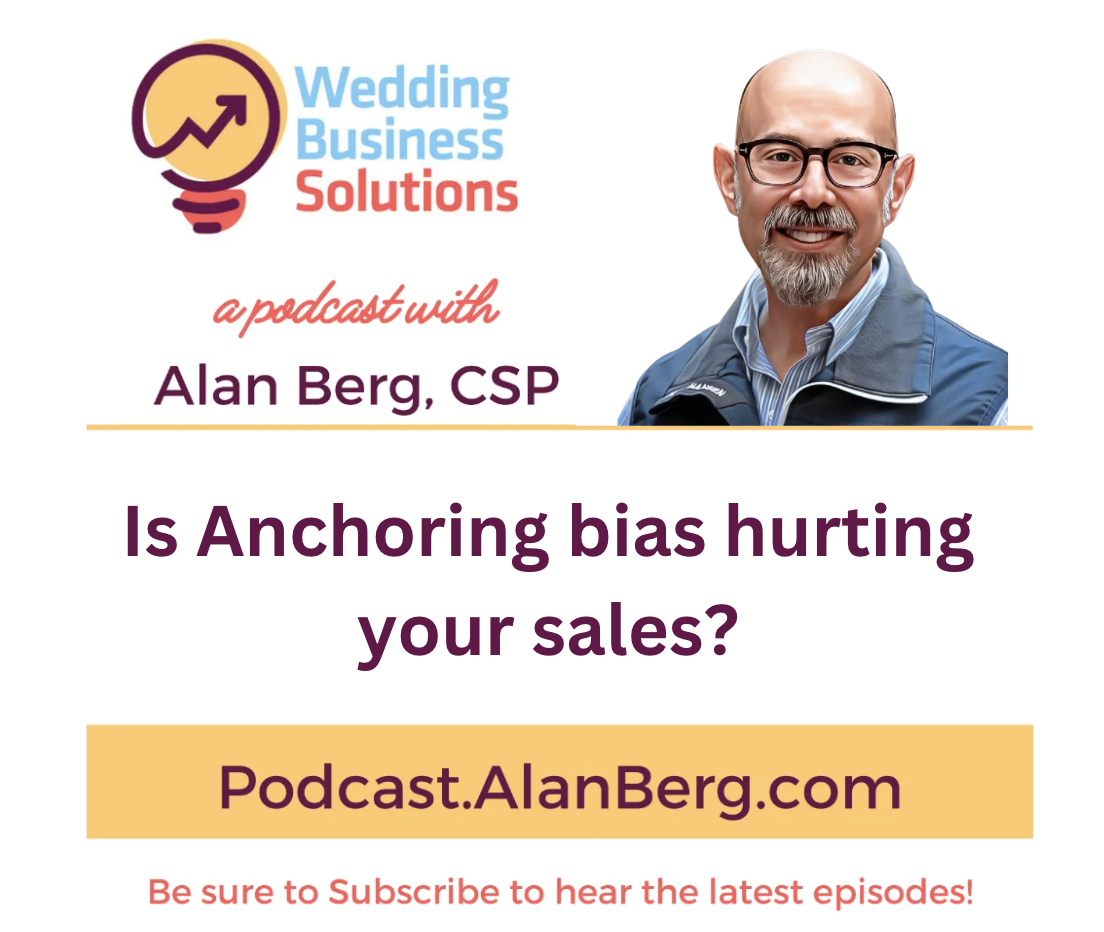
 Is Anchoring bias hurting your sales?
Is your starting price telling customers more than you think? Are you anchoring expectations too low—and then working uphill to justify your real value? What happens when clients see “starting at” and then get sticker shock when the actual results they want cost more? In this episode, I challenge the use of starting prices, reveal the power of anchoring bias, and discuss how reframing your pricing approach could help you sell for value—not from the bottom.
Listen to this new 8-minute episode for a fresh perspective on presenting your prices and why a range might work better than a starting price.
If you have any questions about anything in this, or any of my podcasts, or have a suggestion for a topic or guest, please reach out directly to me at [email protected] or visit my website Podcast.AlanBerg.com
Please be sure to subscribe to this podcast and leave a review (thanks, it really does make a difference). If you want to get notifications of new episodes and upcoming workshops and webinars, you can sign up at www.ConnectWithAlanBerg.com
View the full transcript on Alan’s site: https://alanberg.com/blog/
Your starting price is an anchor. Listen to this episode, see where I’m going.
Hey, it’s Alan Berg. Welcome back to another episode of the Wedding Business Solutions podcast. I’ve been talking about this book—I call it a book, but it’s an online course, one of the Great Courses on Audible—about critical decision making, critical thinking. I already talked about the sunk cost bias, and this is called the anchoring bias.
The anchoring bias is that when you’re negotiating—right, I’ll just talk about this in terms of negotiation—the first number that’s quoted is the number you negotiate from. And if you change that first number, the negotiation changes.
So how does this come into play? Well, let’s call it, with a car—it’s the example they used—you have the MSRP, the window sticker price, and that’s the number that you negotiate from.
If the car is in very high demand, they might say that’s the price, no discount. Or even worse, they might say you have to pay a premium on top of that price because supply and demand is so short. I remember seeing that when I got my car. There was a car in the showroom they were asking $10,000 above the asking price because this was such a rare vehicle.
So supply and demand, of course, comes into play there.
This comes into play with all of us. Why I’m so adamant against using a starting price in most cases—unless there isn’t a big range of pricing. If there isn’t a big range of pricing for something, then a starting price is fine.
But going back to the car example, if you think of car ads and they say “starting at,” but then if you look at the fine print, it says “price as shown.” And it could be 10%, 20%, 30%, 50%, or sometimes more than that because of all the options that are in there.
I remember I was talking to a friend of mine who was looking to sell his business, and I had said to him, “You give the number. You give the first number.” And somebody else that he had talked to said, “No, don’t give the number. Let them give the number.”
And it turned out that the number they gave was way lower than the number that he wanted. And I said, “Right now, you’re negotiating up—or trying to—from their number instead of from your number. They’re trying to negotiate you down to their number.”
And the starting point is the anchor.
That’s why only one number—a starting price—is hurting you. Because you have people that, first of all, think you may not be able to do better work than that because you say this number. And people that can afford more very often are reluctant to pay less because they’re not going to get the results they want.
And you’re selling from the bottom.
How many people actually buy that starting-price thing? It’s rare, right? Most of the time, you don’t.
If you have a range of pricing and it’s this 50% difference or double or triple or sometimes more than that from bottom to top, how many people buy that bottom thing?
Every time I see an ad that says “starting at,” I wonder how many people actually get that. Like an ad for tires—how many people actually buy the $50 tire? I know every time I’ve gotten a tire in the last 10 years or more, it’s been hundreds of dollars. I don’t know what that $50 tire is. Maybe it’s a bicycle or something like that.
So starting price is anchoring this.
If you have on your website or on your brochure or in your advertising “starting at,” what you’re doing is anchoring that number, and that’s what somebody thinks they’re going to pay, just like you and I do. Human nature.
If you see “starting at,” it’s almost like the words “starting at” don’t exist. It’s like, “That’s what it costs.” But then the one you want doesn’t cost that because it’s got other features, other things in it. Again, supply and demand could be in there as well.
I’ve said this—I can’t even remember how many years I’ve been talking about this with pricing. It’s got to be a decade or more where I’m talking about the four ways to talk about price: tell them, don’t tell them, starting price, and range. Written about that in Shut Up and Sell More and Why Are They Ghosting Me?
And the reason the starting price is not good in most cases—not all—is because you’re anchoring that low number, selling from the bottom.
We should be selling to their results. We should not be selling to their budget.
When they see a number and then you talk about results, they associate that number with those results. Then you give them a different number, and there’s a disconnect—there’s dissonance—between the number they thought it was going to cost and the number you tell them.
That’s why giving them a range, especially if that range goes past what most people spend, matters. Now, when you tell them a number that’s lower than that top number, all of a sudden they feel like, “Oh, well, you’re not trying to sell me the top thing you have.”
Because that’s also not right for most people. For some people it is—they just want everything.
Most of my clients who have three packages sell the middle and the top. The middle sells the most, the top sells the next most. Most people don’t buy the bottom.
That’s why if you only had a starting price, it would be that bottom package. You have packages, the bottom package number, and now you’re trying to sell them the middle or the top, which is usually significantly more.
So this is, again, a type of bias called an anchoring bias.
If you’ve never bought something before, you don’t have any idea what it should cost. That’s called framing. We frame this decision based upon previous decisions we’ve made.
Well, if we’ve never made this decision before, we don’t know what it costs. That’s why, without a number, without anything to compare it to, any number you say sounds like a lot because they’re comparing it to zero. Zero is what they’ve spent before. Now you’re asking them to spend money—anything is more than that.
That’s why when you give them a range and you tell them a number that’s less than the top number in that range, you’ve anchored those two numbers. You framed it that way. Now that number has something to compare to.
I’ve been talking to a company that I’ve been consulting with about this, about pricing. I said, “This is a new product. This is something they’ve never spent money on before. Therefore, any number you tell them sounds like a lot because they’re comparing it to zero.”
So is there something we can compare this to? How would they solve this issue without this? Now put a number on that.
Or if you want to talk about opportunity cost, can you quantify what they’re losing or missing out on in terms of sales and profits by not doing this? Now there’s a number to compare it to and say, “Oh, it’ll only cost us this to not lose this money.”
That’s what framing is all about.
But the anchoring bias says if you just do a starting price, we’re negotiating from that number, and you’re working harder to work from the bottom up than from the top down.
Much easier to tell someone it’s a higher number and then take things away to work your way down to a number that works for them and for you, that they’ll be buying the results they’re getting from you and you’re happy with the profit you’re getting at that number.
Now again, I’ve said this before, I’m not going to belabor it here, which is: if you lower the dollars, you have to get something of value back in return. So reducing the products or services, right? Or something that’s giving you value back. Otherwise, you’re just giving away profit. And we don’t want to give away profit.
So be careful of the anchoring bias.
If you’re using the starting price, I would take a really hard look at that and say, “Is this the best way to do this?”
Or could I have some more price transparency—which I spoke about on a recent episode—and have a price range instead?
So now I’ve put two numbers instead of just anchoring in this low number that almost nobody is ever going to buy at.
Hope it gives you something to think about. If you need help with it, you know where to find me—or Ask Alan Anything.
I’m Alan Berg. Thanks for listening. If you have any questions about this or if you’d like to suggest other topics for “The Wedding Business Solutions Podcast” please let me know. My email is [email protected] or you can text, use the short form on this page, or call +1.732.422.6362, international 001 732 422 6362. I look forward to seeing you on the next episode. Thanks.
Listen to this and all episodes on Apple Podcast, YouTube or your favorite app/site:
- Apple Podcast: http://bit.ly/weddingbusinesssolutions
- YouTube: www.WeddingBusinessSolutionsPodcast.tv
- Spotify: https://spoti.fi/3sGsuB8
- Stitcher: http://bit.ly/wbsstitcher
- Google Podcast: http://bit.ly/wbsgoogle
- iHeart Radio: https://ihr.fm/31C9Mic
- Pandora: http://bit.ly/wbspandora
©2026 Wedding Business Solutions LLC & AlanBerg.com