I was conducting a private group mastermind the other day and the discussion turned to investments versus expenses. I remember reading that business people, including most CEO’s, always look at the cost of an opportunity, before asking about the potential return. I guess it’s just human nature that when presented with an opportunity you want to know how much it’s going to cost you. Then it dawned on me…there’s always a cost, but it’s not always money.
What’s the cost? Whether it’s for your business, your family, or in a personal relationship, there’s always a cost of taking, or avoiding taking, action. Your cost may be: Read More
I was conducting a group mastermind the other day and the subject of handling problems and issues came up. While we all agreed that making the customer happy should be paramount in our decision making, that’s easier said than done in the real world. It’s even harder when it’s your business, and your money that’s at stake. The connectivity and access of today’s world adds another dimension. So how should we react when something goes differently than planned?
The worst thing you can do is to look for why it happened. The customer doesn’t care why, they only care that it happened to them. The importance and emotions of a wedding day are just fuel on the fire. Advertising and marketing sells the idea of having a ‘perfect’ wedding, but that’s an unattainable dream. There are just too many variables Read More
This article was published in the November/December 2015 edition of Wedding Planner Magazine entitled You Win Some, You Lose Some – 5 WAYS TO HANDLE LOSING A SALE. If you would like to use this on your site or blog, emailAlan to receive the .pdf and Word versions, along with the attribution to include.
You Win Some, You Lose Some – 5 WAYS TO HANDLE LOSING A SALE
By Alan Berg, CSP, WWW.ALANBERG.COM, Kendall Park, NJ
In a perfect world, we’d get every sale we want, for the dollars we want. But we don’t live in a perfect world, do we? There are no trophies for second place when it comes to winning a sale. You either get the sale, or you don’t, so what’s a wedding planner to do? Here are five ways to handle losing a sale:
1) Rejection is in the eyes of the beholder. When you don’t get a sale, you might feel like you’ve been rejected, but that’s not usually the case. They just liked/trusted/believed in someone else more. Is that semantics? I prefer to call it optimism. When it comes to choosing a wedding planner, there can be only one winner—that doesn’t make everyone else losers. Prospective clients may like you enough to hire you, but they have to choose one pro among the many available. How many weddings do you do each year? That’s how many times clients chose you and not another planner. Are you the winner? Yes, but you may not have been their only choice. Had you not been available, they would have chosen someone else, someone very capable, nice, and likely at a similar price point. This isn’t like second grade, where everyone gets a trophy these days, there’s a winner and then there’s everyone else.
There’s a lot of talk about how today’s couples, the millennial generation, has a
strong sense of entitlement. Rather than appreciating the opportunities, they often act as if it’s their right to have virtually unlimited choices. It makes sense since they’re the children of the baby boom, a time of unprecedented prosperity and hope in our country. It makes sense when you think that they can search on Google for free, interact on Facebook for free, and read/post reviews online for free.
What’s your first thought when you receive an inquiry?
The wedding industry is one that should be based upon gratitude. It costs very little to get married, just a license and someone to perform the ceremony. Yet, billions of dollars are spent on wedding celebrations each year, money they don’t have to spend if they just want to be married. Read More
We live in a society driven by goals, whether in sports, school or business; but I had my perspective on goals changed a few years ago by my uncle. He told me not to use the word GOAL because goals, by their nature, can be self-limiting. If you’re trying to achieve the goal, you may deprive yourself of achieving more. In other words, if we just do our best, every time, we’ll achieve exactly what we’re capable of. On the surface that sounds plausible, but does it work in the real world?
When are goals good?
When you’re driving down the road you need to know the speed limit, as that’s the maximum allowable speed for that particular road. Did you know that many roads also have a minimum allowable speed? If you drive 20 mph on the interstate (when there’s no traffic slowing you down) you can get a ticket for driving too slow. Your car is capable of much more that any legal speed limit, but you have to hold it back to the target speed (or something close to it ;-).
Minimum goals, or targets, have their place as well. Besides not driving too slow to be a danger to others, it’s OK to have a minimum target when it comes to your sales and/or income. We all have to cover our expenses, put a roof over our heads, feed our families, etc. Many theme park rides have signs “you must be this tall to go on this ride”, and that’s for your safety. So, there are times when a minimum is good.
I often see heated discussions on social media about whether you should charge the same for Friday, Sunday, weekday, and off-season weddings and events, as you do for Saturday nights. There are passionate arguments on both sides. Some people contend that you’re doing the same work, therefore you should charge the same. That’s a sound platform. Others say that they’re only going to do a limited number of events per year, therefore they hold to their price, also a sound argument.
The other side speaks of not getting as many inquiries for Fridays, Sundays, or weekday events—so they offer a discount to encourage those to book. That too is a sound platform. There are successful businesses on both sides of this discussion.
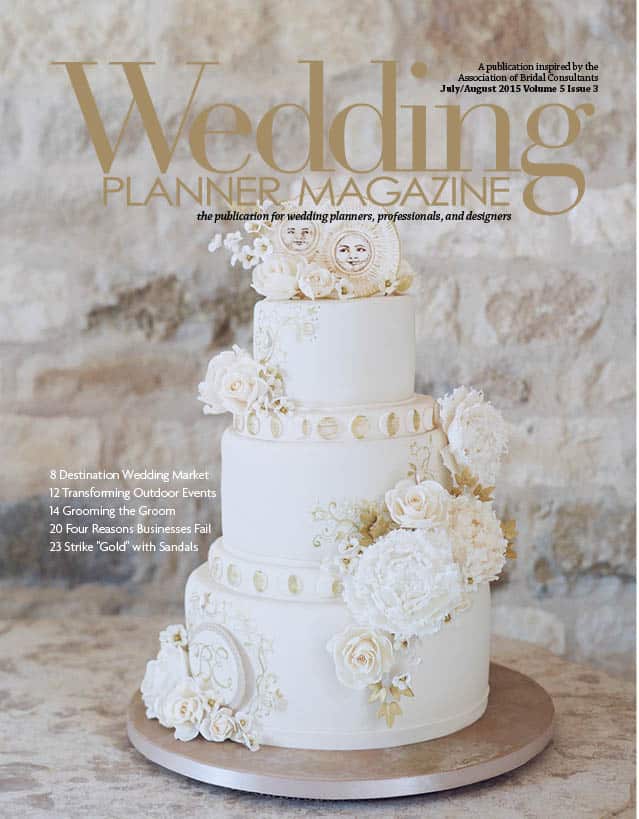
This article was published in the July/August 2015 edition of Wedding Planner Magazine entitled “Four Reasons Business Fail–and How to Avoid Them”. If you would like to use this on your site or blog, email Alan to receive the .pdf and Word versions, along with the attribution to include.
Four Reasons Businesses Fail—and How to Avoid Them, by Alan Berg, CSP
The things that make you great at planning weddings don’t necessarily make you great at business. That’s a harsh reality, but one you have to address if you want to have a successful wedding planning business. The skills and tools you need to be successful in business are available to you through the pages of this magazine, through the Association of Bridal Consultants, and at the myriad of conferences held locally and nationally.
Here are some of the top reasons businesses fail in the wedding industry:
For as long as I’ve been in and around the wedding industry, businesses have been chasing the “high-end” client. When I ask them what they mean by high-end, they usually say that it’s someone who’s spending a lot on their wedding. In theory that sounds right, but is it in practice?
What makes it high-end?
A high-end client sounds like an aspiration, but just because someone spends a lot, doesn’t automatically make it classier, or creative or (in plain words) better. Lots of couples spend lots of money on things that make others scratch their heads and go “Huh?” We wonder why the money went to those elements of the wedding, while there may have been elements that seem a little lacking—at least in contrast. Read More
I attend a lot of networking events and conferences each year and I’m amazed at how unprepared some people are for the experience. You never know who you’re going to meet, what you’re going to hear and what opportunities might present themselves. Life is full of wonderful surprises; yet, there are people with no business cards, no elevator pitch and (in some cases) no interest in being there. I started thinking about the difference between showing up and actually being present.
Showing up is the easy part
Of course not showing up is even easier, and there are always other things to take up your time; however, if you never show up you’re an outsider in your own industry. No matter how long you’ve been in business, there are always new people to meet, new things to learn and new ideas waiting to be discovered. Being present and being a participant are harder than just showing up but that’s where the magic happens. I’ve made some terrific connections that have led to
business and friendships by showing up at events, often unexpected events.
I’ve spoken over the years about the DIY (Do it Yourself) wedding couple. While many weddings have some element that was done by someone involved in the wedding (family and/or friends) there’s rarely a wedding that’s truly all DIY. Did her mom make the wedding dress? Did his/her aunt cook the food? Did his friend take the pictures or play the music? More likely they made the programs, possibly decorative items for the tables or church.
Why are they doing it themselves?
It might be their budget, or it just might be that they enjoy the creative process. I’m a DIY when it comes to home improvements and repairs. Rarely is it to save money, because many of my DIY projects wouldn’t get done if we had to hire a professional carpenter or handyman. They’re not emergency repairs, rather improvements or artistic expression.
So, when couples try to do things for their weddings…
Contact Alan about private sales training, speaking, a mastermind day, a website review or business consultation. Complete this short form or text or call Alan directly at 732 422 6362, international enquiries 001 732 422 6362
Join my list!
Want to stay up to date on where I’m speaking and get updates on my latest podcasts as they launch? Click the button to join my list (I won’t sell your info or spam you… promise!)


 mastermind the other day and the discussion turned to investments versus expenses. I remember reading that business people, including most CEO’s, always look at the cost of an opportunity, before asking about the potential return. I guess it’s just human nature that when presented with an opportunity you want to know how much it’s going to cost you. Then it dawned on me…there’s always a cost, but it’s not always money.
 problems and issues came up. While we all agreed that making the customer happy should be paramount in our decision making, that’s easier said than done in the real world. It’s even harder when it’s your business, and your money that’s at stake. The connectivity and access of today’s world adds another dimension. So how should we react when something goes differently than planned?









 I’ve spoken over the years about the DIY (Do it Yourself) wedding couple. While many weddings have some element that was done by someone involved in the wedding (family and/or friends) there’s rarely a wedding that’s truly all DIY. Did her mom make the wedding dress? Did his/her aunt cook the food? Did his friend take the pictures or play the music? More likely they made the programs, possibly decorative items for the tables or church.