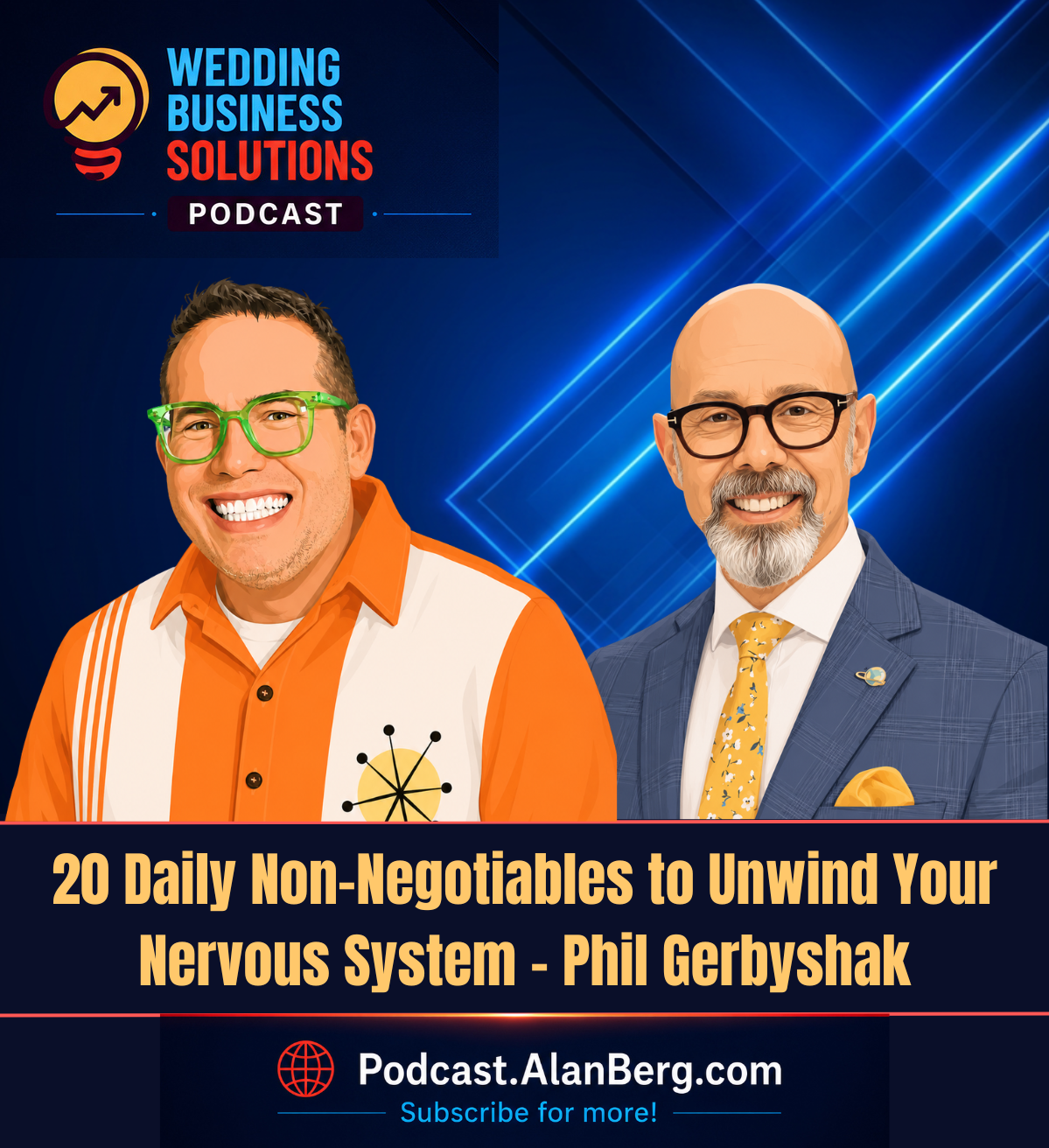
 Phil Gerbyshak – 20 Daily Non-Negotiables to Unwind Your Nervous System
Feeling anxious or overwhelmed as you hustle through your busy days? What if a few simple, daily practices could help you unwind your nervous system and show up more calm and present—for your clients and for yourself? In this special guest episode, Phil Gerbyshak joins me to talk about the “non-negotiables” that help him slow down, find stillness, and appreciate what’s right in front of him. What would your work—and your life—look like if you let even one moment be enough?
Listen to this new episode for down-to-earth tips from Phil on reducing stress and embracing slow happiness, even in the busiest seasons.
About Phil:
Phil Gerbyshak is a high school IT instructor, speaker, and happiness instigator who helps people create stronger human connection in a world full of distraction. Before stepping into education full time, Phil spent more than 25 years in leadership, sales, technology, and training roles with organizations ranging from startups to enterprise companies.
Today, he brings that same energy to conversations about relationships, communication, burnout prevention, and creating experiences people actually remember. Whether he’s teaching students, speaking to business leaders, or connecting with event professionals, Phil believes the best moments happen when people feel seen, valued, and like they truly belong.
Contact Phil:
Instagram: @PhilGerb
https://happyaf.substack.com
If you have any questions about anything in this, or any of my podcasts, or have a suggestion for a topic or guest, please reach out directly to me at [email protected] or visit my website Podcast.AlanBerg.com
Please be sure to subscribe to this podcast and leave a review (thanks, it really does make a difference). If you want to get notifications of new episodes and upcoming workshops and webinars, you can sign up at www.ConnectWithAlanBerg.com
View the full transcript on Alan’s site: https://alanberg.com/blog/
Unwind your nervous system. Listen to this guest. See where we’re going. Hey, it’s Alan Berg. Welcome back to another episode of the Wedding Business Solutions podcast. I am so happy to have my friend Phil Gerbyshak on again because you’ve been on before to talk about unwinding your nervous system, which I saw on a LinkedIn post that you did, because I love reading your post over there. Phil, welcome back.
Hey, thanks, Alan. It’s great to be back.
You know, I love reading your stuff. You have a unique voice, as we all do, but, you know, I love your voice on that stuff. And I was reading this post, and it was. What was the title of it?
20 daily non negotiables to unwind your nervous system.
Right, so that got my attention. Okay, so. So give us an idea. Don’t. We’ll get into some of these over. Give us an idea. Where did that come from? Because we all get inspired to write something. So we.
Where did that come from?
Well, I, you know, I get stressed out, I get nervous, I get anxious. And I thought, hmm, how can I be less of that? Because that’s not productive. It’s not helpful at all. So I said, let’s do some research. Let’s see what you can find about how to unwind your nervous system. So I did some research, and I found 20 of them. So I thought, okay, let’s group them into tens, and here we go. And there’s probably more, but I found the 20 that I like the best, and I wrote about it.
Okay, now, this isn’t doing all 20 of these every day, right?
Oh, yeah. You got to do them all, man. Otherwise you’re screwed. No, of course not. Of course not. Only two or three, Right. And maybe only one, Right. If you can just hum a little bit every day.
If you can just hum just a little bit every day, or you can walk outside in the. In the grass a little bit every day, you can be a lot more calm, and you can unwind your nervous system. So.
So how does humming unwind your nervous system?
Yeah. So humming actually increases your vibration. Of course. It’s a vibration. So that will change the anxiety into peace and calm.
Okay, so if you’re feeling anxious, just
take a minute, Take a second. Yep. And hum. Hum for 30 seconds.
So not humming a song, Just.
Just hum. You could hum a song if you want, but you could just hum. You could just hum, and it’ll make you feel better.
So what’s your go to? Like, if you’re just, like, all of a sudden you’re feeling nervous. What’s filled.
Yeah, I hum, I hum. That’s why I use that one. Yeah. Because it’s easiest. I wish I walked outside more in the grass. That would be the one that I would say that I’d like to do more of, for sure. But I don’t do that nearly as much as I’d like to.
Yeah, I go out for a walk every morning now. I’m doing my duolingo or I’m listening to an audiobook, but. But it’s just something I, I. That versus being on a treadmill. I could go the same distance. It is completely different experience.
Yeah. Yep.
Yeah. Yeah. And I don’t have one of those screens that looks like I’m walking outside when I’m inside. I just have a treadmill and that’s it. So from the, the people that you’ve shared this with, what are some of the more popular ones besides humming that? People. That just keeps coming up again.
So moving gently is a big one. So just move just a little bit, stretch it out, you know, get your arms moving, get your legs moving, get your head bobbing back and forth. That’s a big one. That resonates with people looking at something beautiful. You mentioned walking outside. That’s a big one. People like, you know, people find that if they can focus off in the distance, find something beautiful to focus on. That’s why I post flowers, actually, Alan, now and then on Facebook give people something different to look at.
So that’s another big one that people resonate with. And then one of my favorites, but I don’t do enough of is laugh or smile. I say that I don’t do that enough because I don’t read joke books, I don’t watch comedy, I don’t have a tv. Right. I wish I laughed more. I do smile a lot. I’m pretty, pretty contagious about my smile. Right? I mean, that’s a, that’s a big one, man.
But that being said, I, I don’t do that nearly enough. But that’s one that is pretty easy, right? Because you can fake a smile and even faking a smile increases your vibration. Makes you feel better.
Yeah, but laughing definitely does. It definitely changes my, My wife and I have a routine. So we watch some TV at night, turn off the tv and then we do wordle and a couple of other word games together. And it’s literally just us sitting together, being there, doing this together. And then we have to go on Instagram. Right now she wants to see Baby stuff, because we just had a grandbaby. She wants to see baby stuff. But other stuff shows up in the feed.
And there’s always these, you know, people doing stupid things or whatever. And we cackle at some of these things. Right. And that’s the laughter. But you just feel better. Your body feels more relaxed. And I mean, some of these, it’s to the point of, you know, crying and your face hurts. You know, thank God it wasn’t me that just did that thing over there.
I will go to take the trash out on trash night, and if it’s a clear night, I just stop and look up at the stars. And I wish I lived in a dark sky area. I don’t. I have to kind of cup my hands, if you’re listening, is to cut my hands so I can actually see the sky because of the street lights and stuff like that. But it’s just very peaceful to me just to look up at that, you know, and. And then you get into the science, you know, that light isn’t happening now. That light happened. You know, whatever.
I don’t care. I don’t care. It’s beautiful. It’s beautiful. Just do that. Is that another one? Just appreciate the beauty of things.
It is. It is. Absolutely. That’s the. Look at something beautiful. You also, you combine that with the humble stillness of just standing there and just being still or sitting there and being. Doing something still. I know for me, that’s a big one as well.
I love to kind of just lay still and just think about my day and let it go and then just release it all. And that works as well.
Yeah. On my walk this morning, I’m walking down the street, I’m coming back and I saw something in the street. I was like, I don’t remember there being something in the street. And it was a little turtle. And actually not a baby turtle either. And of course, it’s like, hasn’t made it across the street. And all I’m thinking is the next car, even though it’s a quiet street, the next car. And I went over and I picked it up.
Of course, he tucked his head in its head and legs in or whatever and put it over on the grass on the other side. And just doing that made me feel better, you know, I’m not going to come back the next time and see Squash Turtle road in the road. But, like, all right, you made it this far. Okay, I’m going to give you help. And that. It was like a dopamine rush, right? That’s. That Thing. Yeah.
So what are some of the other ones on the list?
So naming what you feel is a big one. You actually have to call it out. Name out. I feel angry, I feel happy, I feel sad, I feel anxious. Right, that’s another big one. Because we need to name what we feel. You know, fighter pilots actually find that that’s why they, they talk as they’re. They’re in flight, because it helps reduce the anxiety.
And actually Vasavi Kumar wrote a book all about that. Say it out loud. I think that’s the name of the book. Don’t quote me, but I know Vasabi’s name. But yeah, that. It’s all about it, right? All about it. Because it helps you regulate, helps you feel better, helps you feel stronger. You know, slowing your sip or your first bite is another good one, right? I mean, we drink bourbon and it’s not like we’re chugging this bourbon.
We’re slowing down, taking a little sip, thinking about it. How does it taste? Are there any notes? What’s there? So that’s a big one. A lot of people, you know, just inhale and I’ll tell you, I’m guilty of that a lot of times. So I need to be better at that. I need to be better at slowing that down.
I’ve been trying to be better at that too. Just eating slower because I’m going to eat less. That’s part of it, is I’m going to eat right, but just. But eating slower and appreciating the food. I mean, I’m not getting totally into mindfulness, you know, like that noodle in my mouth feels like whatever, I’m not getting there. But with the whiskey, you know, people are surprised to see how little I actually drink with how much I love, you know, whiskey. And one of my favorite things is when that. When Glencairn glass is empty and I just leave it sitting next to me because I’ll pour with dinner.
Like last night I made a post that was my dad’s birthday. He passed a few years ago and we made a special whiskey blend for him. And I had it and I poured at 6:30 and I didn’t finish it until maybe 9:00 o’ clock because I will just pick it up and smell it sometimes. Right, right. And then put it down. And when the glass is empty, I let it sit. I don’t know if you’ve ever tried this, Phil, but the alcohol has evaporated. But there’s still the smell in the glass of the wood.
There’s still the smell in the glass. And I just leave the glass there and just pick it up and smells. Oh, that smells like an old, old warehouse, right? Oh, no, no, that smells like fresher wood or whatever. We were just talking about port wine, and it’s that same thing. Drinking for me is not for getting drunk. Drinking for me is an experience. And, you know, appreciating that. I’m really bad at saying, hey, Phil, this tastes like green apples with pencil shavings, you know, and.
And charcoal or whatever. Right. But I can tell you I like it or I don’t like it, you know, that’s it. But that slowing down, just slowing down in everything. Right. I remember as a kid, my father was always telling me, slow down, slow down, slow down. And then I became a father and I became, hey, slow down. Yeah.
Yeah.
It’s interesting. So that’s why my next book is called Slow Happiness. That’s what I’m working on, because it is all about slowing down. I think that the reason that we’re not happy more is because we don’t slow down enough to appreciate what’s going on around us.
Yeah, yeah. We’re. We’re looking ahead, ahead, ahead, but we’re not looking at here.
That’s right.
Yeah. And, you know, then. Then you get into the stories of, you know, the people that wait to retire to have fun, and you’re like, no, no, some people don’t make it there. We know people that haven’t made it there. And, you know, my wife and I are. It’s like, I love traveling. She’s a homebody. But she.
I need Star Trek’s, you know, transporter, because she. She loves being there. She doesn’t like getting there. And I say, I don’t love getting there, but I don’t mind getting there because I know what’s there. I’m gonna get there. And we’re getting better at doing that. She still agonizes a little bit over it and the travel, but once. Once we’re there, it’s like, oh, this is beautiful.
Wherever we are, you know, it’s like people ask me, what’s your favorite whiskey? I say, the next one, right? Yeah, There you go. What’s my favorite location? I said, the one I’ve not been to yet. Right. That’s trying to appreciate, you know, that. So what else?
So putting your hand on your heart, just feeling your heart, just being quiet. Listen. Feeling it, you know, realize that it slows down as you do that.
Yeah.
Just naturally it slows down. So if you’re someone that feels anxious. Just put your hand on your heart. Really?
I, I, I, if I’m laying down, I, There’s a pulse point down by your groin where it’s pretty strong from your femoral artery. Feel that? And, and just thinking and breathing. If you’re just focusing on that, slow it down. Slows down, slows down, slows down, slows down. What that was that the biofeedback, right? That’s, that’s biofeedback. Yeah. But again, being, being aware of it. Oh, my heart is going faster.
Oh, why? Okay, no, no reason. Let me slow that down. So, yeah, great. What else?
Yeah, so softening your gaze is a big one. So just like you’re doing there.
Okay.
Just close your eyes just a little bit. Soften your gaze. The world gets a little, little blurrier and it slows down for you. Whether you like it or not, it’s going to slow down.
So, so that, so can I, can I just take off my glasses to blur my gaze?
You could. That might not do the same thing, but you can certainly try. Okay.
Yes, I, I, you know, I’ve done that. I don’t know if I’ve done it. And I mean, I’ve done it intentionally, obviously softening my gaze, but I don’t know that I’ve thought about. Hey, just do that right now. That’s, wow. Okay, cool. What else?
Well, one that we’re doing today, listen, without fixing, just really being present with somebody else. It’s really important. It’s really easy to pick up the phone, call someone, and don’t try to fix it. Just listen. Listen to how they are, listen how they’re doing, listen to what’s going on in their life, really be present with them. You know, it’s interesting that that’s one of my favorite things about when I get to be on your side of the microphone is I love to listen. Love to find out, ask questions, learn more about that person. Give me 20 to 30 minutes, and here we go.
Yeah, it’s a lot of fun.
Yeah, we have that tendency to, some of us, you know, to want to be the fixers. And, you know, I’ve. Part of our happy marriages I’ve learned over the time is, you know, tell me if you want me to help fix this or tell me if you just want me to listen.
Yeah, yeah.
And it’s tough. It’s tough.
Yeah.
Being present, I mean, again, with kids. You have kids? I have kids. I have grandkids now. You know, being present, especially in the world we live in with you know, beeping and bopping and all these distractions everywhere. Actually watching on Instagram with my wife. The thing about babies, you know, a car goes by, we don’t even pay attention. But a baby, everything is new. Like the baby’s always jumping around because the plane sound is new, the siren is new, you know that somebody knocking on a door, slamming a door, that’s all new.
We just keep going because that’s part of the noise we’ve learned to tune out. But part of what you’re saying here is sometimes we need to just focus on that. Oh, okay, listen. These are things going on. There’s a bird chirping, right? There’s, you know, all those things. It’s. Yeah, but being present is hard. I learned to be present when I did martial arts.
Oh, yeah.
Because if I was thinking about the email that I want to write while you and I are sparring, you were going to hit me. So you better start focusing on what’s in front of you and tune out the rest of that. And it actually translated into other parts of my life, which was very cool. Unexpected, but yeah. Okay. Yeah. What else? What else we got?
Pause between activities. So you mentioned sparring, right? If we’re going from person to person, having to wait for the next person is a great way to do it. Think about when we’re lifting weights or we’re going from treadmill to something else. We have to slow that down, pause between activities. Now, that being said, if you’re doing high impact interval training, that’s probably not the time to slow down. But sometimes we’re working on our own. That’s a great time to slow it down, pause between activities and really give some thought to the next one that we’re going to do.
Yeah. Yeah. Clear. Clear your head from.
That’s right.
Yeah.
Discard what’s there and move forward into what’s. What’s to be.
Yeah. And that’s what you’re talking about just before, as we go from one thing to the thing to the next to the next to the next, there is no time for your brain to slow down. There is no time. There’s no time to focus on what just happened. Like to take in what just happened and to let that process. That’s why we don’t remember a lot of things because we jump from one thing to the next and we haven’t had a chance to file that, you know, when the next thing erases it.
Y Y.
Cool. Yeah. What else you got?
So reducing one input, making sure that one thing is a little less noisy in our life. Could be turning off more notifications. Could be taking our phone and putting in the other room. Right. I know a lot of us use it for an alarm and that’s okay. So put it on the sleep mode so that notifications don’t bother you while you’re sleeping.
Sleep.
Simple thing. You don’t have to put an airplane mode anymore. You can just set the mode and you can determine. Oh my gosh, I’m worried that my grandson. Something might happen in the middle of the night. Okay, we’ll set that one notification and let people know. Hey. Hey, son.
By the way, if you need me, you can call it a breakthrough.
Right?
So things like that are really, really key. Really.
I don’t, I don’t leave my cell phone in the bedroom. My wife does and we have a. It’s playing an environmental noise thing.
Okay.
Um, I have an alarm clock which, you know, like, it’s a. It’s a new fancy one, but you know, it’s a not fancy, but it’s a new digital, you know, whatever. It’s not an old fashioned wind up with a little bell on top. But unless I’m in a hotel, I don’t have, you know, my phone next to me. I don’t even when I’m in a hotel, my phone is on the other side of the room. It is on sleep mode. I do have my list of, you know, whatever they call favorites or whatever that will break through. But if anybody calls you twice within two minutes, it’ll come through.
That’s right.
And. And I was in California. Now we live in New Jersey. I was in California. And at 5:30 in the morning, my phone rings and you know, of course your heart starts racing. Kids are like, what’s wrong? And it was spam. I was like, you got me out of bed. You got me out of bed.
They called three times. Within two minutes. They called three times. Yeah, yeah. The first time it’s like. Because my ringer is actually Tears for Fears. Change. There’s change.
Yeah. I made the ring. I had to make a ringtone that nobody else had because which phone is ringing and they’re like above the environmental noise. Like, what’s, what’s that? And then it stopped because we didn’t get up. And then it started up again and Carol’s like, that’s your phone. I was like, it’s my jump out of bed run over there. Right? Yeah. I’ll try to fall back asleep after that.
Right? Yeah. What else?
What else? So a couple more. I’m going to look at my list here. Yeah, let’s see. I did that one. Completing one small task. Pausing. Oh, drink water. Like it matters.
So really slow down and drink a glass of water.
Okay.
That’s an easy one to do. We don’t. We drink to be nourished. Not just our mouth and our system, but also our soul. So if we slow down and we drink. That’s a good one.
Well, you actually just skipped over one we didn’t do. Complete one small task.
Oh yeah. Completes one small task. Yeah. So one thing. Do one thing and do it completely. So I’m going to. I’m going to do laundry. Okay.
I’m going to put it all. Put all my stuff in the baskets. I’m going to get everything ready.
Right.
Small things. Not the whole thing. Not. I’m going to get all my laundry done. Although that would be nice. I’d like a laundry fairy, but I don’t have one. Right. But one small piece of that.
So that. And then make sure that it’s done. You know, clear my desk off completely. Little things. Little things that help.
Yeah. And there is no such thing as multitasking. We’re just bouncing from one thing to another, not completing anything. And that’s more stressful. That’s much more. Yeah. Or how about do something without going and checking your email.
There you go. Yeah. Wouldn’t that be nice, huh?
Yeah. I mean I’ll. There are times I’m like, I have to put my phone on do not disturb. Right. I have to turn my notifications off because I’m not going to get this done.
Yeah.
And I get so much more done in the evenings and on the weekends because the email isn’t coming in like that. The phone’s never ringing other than spam, but let you know. But it’s that’ why, you know, So I get after 5 o’ clock, I’m getting more stuff done or early in the morning or on the weekends and I’m much more productive. And then on airplanes, you know, unless I need the Internet, I don’t buy the Internet on the plane because I can only work with what’s in front of me right now. Nothing new is coming in. I’ve written so much of my books on planes because of that. Because you just have that focus because we’re so attached to these things. What if? What if? What if? But yeah.
No, complete. Complete something before working on to the next thing. It’s that sense of accomplishment.
Yep, Yep. Absolutely. Really big one. So being with someone safe is another good one. Find someone safe and just go with them.
Be.
Be present with them. Whether it’s on the phone, whether you’re FaceTiming, whether you’re Zooming, whatever you’re doing, be with someone safe. Slows you down because a lot of times being alone sometimes can make us anxious.
Right.
So find someone safe and be with them.
Now, are you. When you’re being with them, are you doing what we said before, which is just being present with them. But there are also probably times where you’re like, I need to talk to somebody.
Yep, yep. And that’s perfectly fine too. Right. If you need to talk to someone, that can lower the, lower your temperature as well. Right. Lower your anxiety as well. Absolutely, absolutely.
And tell. And telling them, listen, you know, I need. Could. I need somebody to listen right now. Could you be that person for me?
Yeah, yep, absolutely.
I’ve actually started with chat. Sometimes I’m like, I want, I want you to interview me, but I don’t want you to give me any solutions until I tell you. Just keep asking. Just keep asking me questions. Right. Goes back to like the Toyota 5 Whys, you know, just ask me, ask me why five times. Because I find that it’s quick to say, okay, do this, do this. I like.
No, no, no. I, I don’t want you to give me any, any possible solutions until you’ve asked me seven questions or until I tell you, tell you to. And just help me dig deeper into this, like, what’s really going on here? What am I really trying to do? So even that’s a person, but even you can do that with AI, it’s just giving it a better instruction like that. And I find we’re now getting much meatier than just that first.
Yep, yep.
So I’ll give you one more, Alan, and, and that is let one moment be enough.
Okay?
Let this moment right now be enough for you to experience it so we don’t have to think about everything because everything’s going to go probably going to go kablooey. Instead, let’s let this moment be enough. Let’s be really present and let’s let that be enough. And then go off on the day. Now is it now? Are any of these going to permanently slow you down, make you less anxious? No, but they will make you less anxious in the moment. They will make you slow down for a little bit. If you do a couple of them, you might slow down for a minute or two. That’s great.
That’s all you need sometimes just to be able to clear your brain, clear the plate and go move on to something else. Yeah.
I realized that, you know, you can’t help how things make you feel, Right. Somebody cuts you off in traffic, you’re going to feel anxious, angry, whatever, but it’s up to you how long you feel that way.
That’s right.
And when you realize that. That the car that cut you off yesterday is not bothering you anymore unless you let it bother you. Right. You can let that go. You can let.
That’s right.
I was doing a mastermind in Hawaii and somebody brought up a bad review that they had gotten and the whole room is feeling empathetic, right? Because you know, you know, get a bad review. And I said, hey, when was that? He goes, it was about five years ago. And the whole room is just looking at him like, why are you still holding on to this? Right. That person has moved on with their life four years and 11 months ago, and you’re still holding on to that. I think we do a lot of that. You know, that person that did this thing to me or whatever, or the Brene Brown, I don’t see. I don’t think she rated up. But, you know, the story I’m telling myself is they hate me.
The story I’m telling myself, we have so much control over that that we cede to other people. And I think we would be less anxious, less, you know, less stressed and all that if we just realize we have much more control. I’m letting you bother me. You’re not bothering me. I am letting you bother me. Now in the moment, it could be like, that was a nasty thing to say, Right? But tomorrow, look at the beautiful flower. Right. Instead of thinking about the nasty thing.
That’s right. Yeah, that’s right.
So hopefully people pick two or three of those, Alan.
Okay?
They like them, they work on them. Pick one even that’s your favorite, and do that more often, just a little bit more often, and see how much stress. I mean, really put your hand on your heart. That’s really simple to do. That doesn’t take a lot of thinking. You can humor while you’re doing that if you really want to. If you’re one of those overachievers like me that wants to do a couple of them at the same time. Right.
But pick one and do it.
So the entire list is on your LinkedIn.
On my sub stack.
On your sub stack. Okay, so we’ll make sure we put a link to that in the show notes. Yeah, so we’ll have it on there. Is it on your website too or.
Nope, just on my sub stack. I’ve kind of let my website go because I’m teaching now, so I focus on my sub stack.
Okay, and then you said you’re writing a book. When? When we expect that.
October.
Okay.
All right.
You heard it here. You heard it here. He said it. He said it out in public. It’s October. Okay, so in October.
And it’s going to be called Slow Happiness.
Slow Happiness. Love it. And your substack is called
Happiness Practices.
Happiness practices. Wonderful.
Happyaf. Substack. Com.
Happyaf. substack. Com.
Yep.
Love that. I love that. Phil, thank you for joining me again. Thank you for sharing this with us. Keep the writing. We love it and can’t wait for the book in October.
Thanks, Alan. Good to see you, my friend.
I’m Alan Berg. Thanks for listening. If you have any questions about this or if you’d like to suggest other topics for “The Wedding Business Solutions Podcast” please let me know. My email is [email protected] or you can text, use the short form on this page, or call +1.732.422.6362, international 001 732 422 6362. I look forward to seeing you on the next episode. Thanks.
Listen to this and all episodes on Apple Podcast, YouTube or your favorite app/site:
- Apple Podcast: http://bit.ly/weddingbusinesssolutions
- YouTube: www.WeddingBusinessSolutionsPodcast.tv
- Spotify: https://spoti.fi/3sGsuB8
- Stitcher: http://bit.ly/wbsstitcher
- Google Podcast: http://bit.ly/wbsgoogle
- iHeart Radio: https://ihr.fm/31C9Mic
- Pandora: http://bit.ly/wbspandora
©2026 Wedding Business Solutions LLC & AlanBerg.com