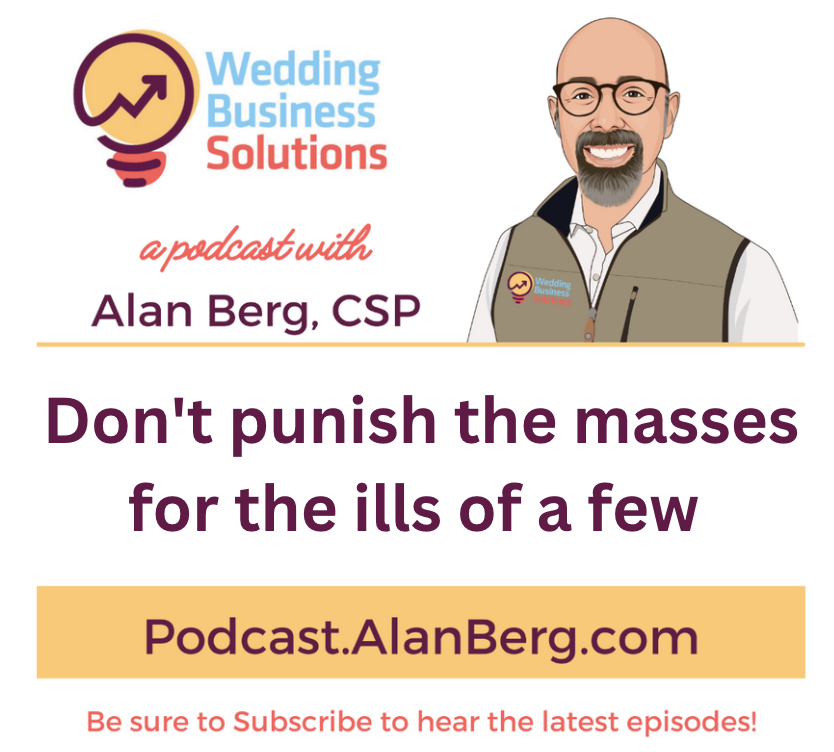
 Don’t punish the masses for the ills of a few
I’ve used this phrase before on the podcast “Don’t punish the masses for the ills of a few”. Just recently I saw another wedding/event pro coming up with what felt like punitive rules, so I decided it was time to devote an episode to this. How many things are you telling your couples and customers they can’t do? Is your “no” list bigger than your “yes” list?
Listen to this new 7-minute episode for more a little introspection and ideas on how you can be more “yes” focused, while still having the rules and policies you really need.
If you have any questions about anything in this, or any of my podcasts, or have a suggestion for a topic or guest, please reach out directly to me at [email protected] or visit my website Podcast.AlanBerg.com
Please be sure to subscribe to this podcast and leave a review (thanks, it really does make a difference). If you want to get notifications of new episodes and upcoming workshops and webinars, you can sign up at www.ConnectWithAlanBerg.com
Don’t punish the masses for the ills of a few
Don’t punish the masses for the ills of a few. Listen to this episode, see where I’m going with this. Hi, it’s Alan Berg. Welcome to another episode of the Wedding Business Solutions Podcast. This is a phrase that I’ve used probably quite a few times here on the podcast, and I definitely use in my speaking and in my personal life.
And what it comes from is I see rules and things created by different businesses because of something. You know, bad that happened, something that, that, that did not go well. So they create a rule around it or they create a policy around it and maybe it goes into your terms and conditions and things like that.
And the challenge with it is, is you end up looking at things from the negative light. Like we don’t want this to happen again. And I agree with you, you definitely don’t want a lot of things that happen to happen again if they did not go well. But the problem with it is we end up punishing everybody because somebody did something wrong or somebody didn’t listen or maybe because we actually created the situation that made that thing go south and now we’re trying to fix it.
But we’re fixing it the wrong way. I’ll give you a, for instance, I see very often people will say, well, the couple or the client didn’t do this and it was in the terms and conditions. And I’m like, well, really, I, do you read the terms and conditions? And even if you did, and the event is a year from now, do you remember the terms and conditions?
I just had an, an episode, Sarah Fox or 500 words where she talks about re. Great. Cutting your contract down to 500 words in real, just plain English. This is what I’m going to do. This is what you’re going to do. This is what you’re going to pay and when, and here you go. And then the, it’s more than 500 words because you’re going to have the details of those things.
But the overarching thing with the terms, it can be just cut down to that. I actually just paid Sarah to do, redo my agreement so that it’s simpler. And mine wasn’t bad to begin with, but the formatting and stuff needed it. She did a wonderful job and did that for me. So. Are we trying to create rules to stop every possible bad thing that could happen, even though they rarely ever do?
And then the things that happen more often, can we come up with a better way of doing this? For instance, if you’re a venue and you don’t allow outside alcohol, which is You know, unless you’re a venue that does allow outside alcohol, most of them don’t, especially if you’re selling alcohol, you’re not going to allow anybody to bring outside alcohol.
And people do that, right? The question is, how do we avoid that? And it’s by better communication, but at the right time. So a year before the wedding and you tell them that that’s fine, but remember, The guests aren’t there in the conversation, the the bridal party is not there in the conversation. So if your bridal party decides that before the wedding, they’re going to bring in some, you know, bottles of alcohol and have a little party beforehand, nobody told them that they can’t.
Now, common sense would say you shouldn’t do that, but that’s another story we’re not talking about common sense. But if that’s the thing, then you have to let the couple know, listen, your bridal party can’t do this. Your guests can’t do this. And you need to communicate that to the, to. to them. You need to do this as you lead up to the wedding, getting close to it, not a year before, and then complain that they didn’t read line 42, section B, item 3 of the contract, because that’s just asking them to do something that you wouldn’t do, right?
So, punishing the masses for the ills of a few is. Coming up with rules, policies, things to try to avoid every bad thing that could happen instead of making it clearer about what are the, you know, what is the terms of this agreement? And if there are things that you want to avoid, the question is, is this a once in a lifetime kind of a thing?
All right. Has this happened to you once in 10 years? And now all of a sudden, it’s a policy. And do we really want to punish the next one because of that? Cause we know that. And the answer should always be yes. If you’re a customer, that’s what you want to hear. Your customers want to hear that as well.
And when you say you can’t do this, you can’t do this, you can’t do this, you can’t do this, you become the no company. And when you become the no company, they want to do business with somebody else. So simply look at your terms and conditions. Look at the way your agreement is written. Look at what you’re telling them.
And is it written in a positive way, which is here’s all the great things, here’s the things you can do. And by the way, these are a few things that you can’t do, right? And then can you Limit those things and cut those things down that they can’t do to the things that happen often that you would want to avoid as opposed to the very rare things that, you know, we just can’t, we can’t be avoiding every possible bad thing that could happen other than just Doing the best we can to do a great job every time.
So think about those things. Go and read your agreement and say, Hey, if I was the customer and I’m reading this, first of all, do I understand it? Otherwise listen to that episode I did with Sarah Fox on, on contracts. Do I understand it? Is it very clear? Would it be clear to somebody who doesn’t understand our, our industry, our, our category, our lingo, things like that.
And then does it feel punitive? Like we’re punishing people like, no, no, no, no, no, no, no, no, no, no, no. And I think we’ve all seen that. As, as customers, when we see people having things like that, it’s like, whoa, you know, what, you know, what bad things have happened to you. I would never do something like that.
And most reasonable people wouldn’t. Are we punishing the masses and making ourselves look worse in the same time because we’re looking like the no company. We’re looking like the, the, the looking to punish people for things as opposed to looking to have a great time and then letting them know clearly, like as you get closer to when you’re going to perform the service, these are a few things to keep in mind.
Could you have the top five, seven, 10 things that they need to know now? A year after they signed an agreement with you, six months after they signed an agreement with you, could you go back to them and say, okay, here’s a reminder, here are some of these top things you need to keep in mind. This is when you can get into the venue.
This is when, right, all these things, these are the things you’re going to do. And by the way, here’s a few things to keep in mind. You know, no outside alcohol by you, by your bridal party, by your guests. Please notify them of that. They will be confiscated at that time. We do have security there. This is why insurance, whatever.
And sometimes just explaining the why of it. Not just the what will make people accept it more, right? The, the what, you can’t do this, but they don’t understand why because they would never imagine doing that. Now, if there’s a good reason, maybe we could do that. But if it’s because it happened once in the last five years and we want to put it into the agreement, it’s probably a bad reason for it being in there.
Now you’re punishing the masses for the ills of just a few. Go back and take a look at your stuff. I hope you don’t find anything there, but if you do, you can make it better. Thanks for listening.
I’m Alan Berg. Thanks for listening. If you have any questions about this or if you’d like to suggest other topics for “The Wedding Business Solutions Podcast” please let me know. My email is [email protected]. Look forward to seeing you on the next episode. Thanks.
Listen to this and all episodes on Apple Podcast, YouTube or your favorite app/site:
- Apple Podcast:
- YouTube: www.WeddingBusinessSolutionsPodcast.tv
- Spotify: https://spoti.fi/3sGsuB8
- Stitcher:
- Google Podcast:
- iHeart Radio: https://ihr.fm/31C9Mic
- Pandora:
©2024 Wedding Business Solutions LLC & AlanBerg.com